• Class V Takes On Ecological Research At Woods Hole

    Class V Takes On Ecological Research At Woods Hole

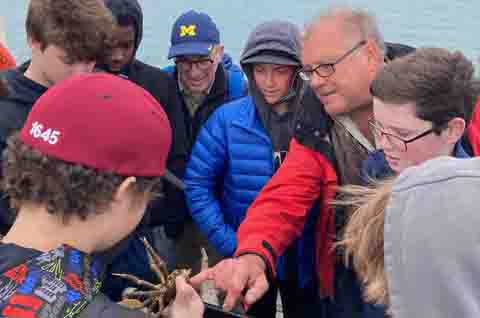
    Class V boys were eager to return to the annual, springtime science investigation trip to Woods Hole, after a two-year, pandemic-induced hiatus. Roxbury Latin’s hosts for this trip are affiliated with Woods Hole Oceanographic Institute (WHOI), located on the southeastern point of Cape Cod. For nearly 20 years, this hands-on experience has been a popular culmination of students’ fourth marking period studies in their Introduction to Physical Science (IPS) course, providing a complement to a spring unit focused on freshwater quality and local/global challenges that relate to this critical resource.

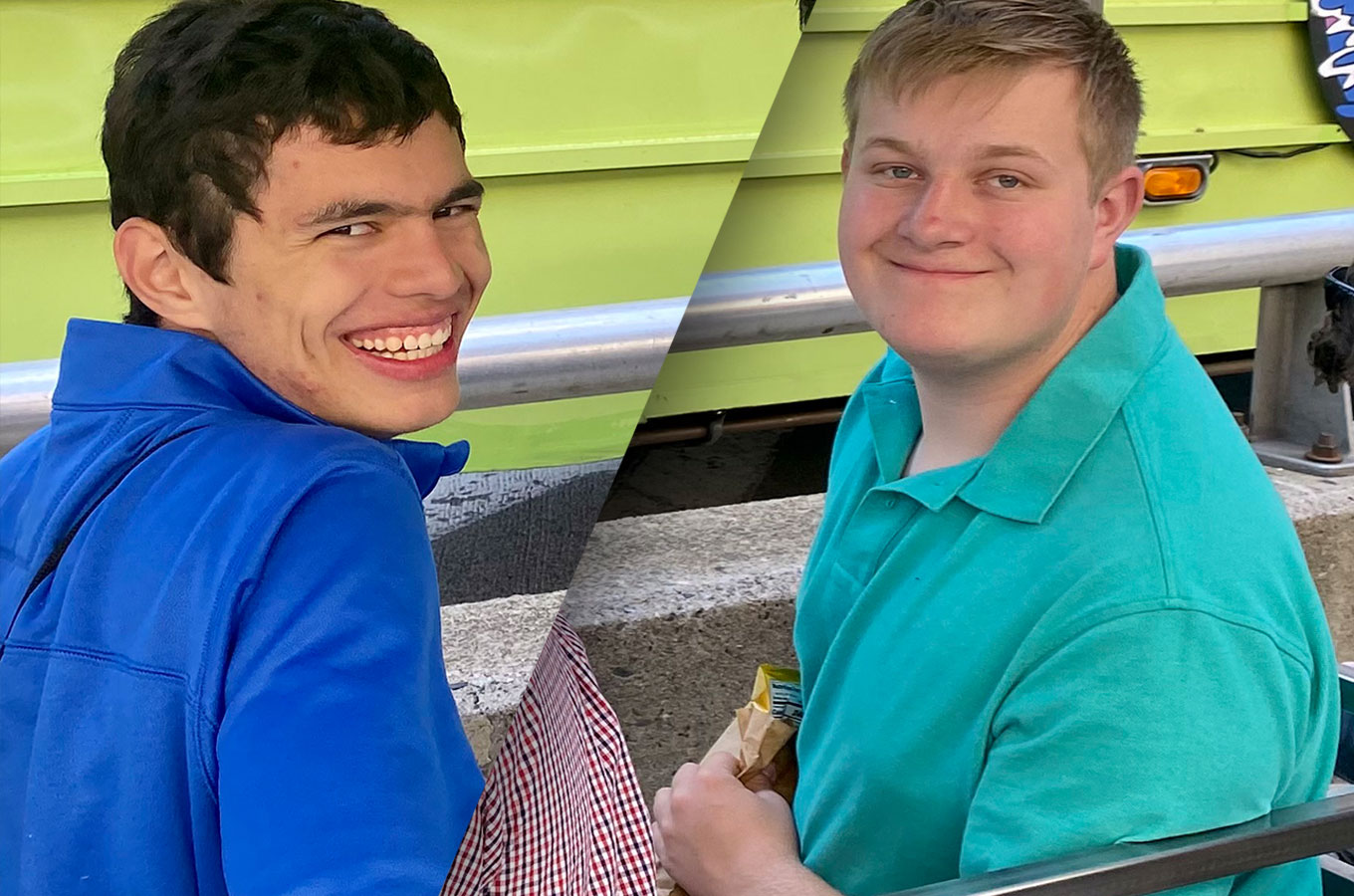
    While in Woods Hole, students—accompanied by IPS faculty Paul Sugg and Jackie Salas—spent an hour on a boat used by WHOI for its scientific research. Using sampling nets they collected organisms from the sandy ocean bottom close to shore to handle, examine up close, and learn about some of the oceanic flora and fauna. Students were also treated to a fascinating talk by Bill Mebane, a leader at WHOI in the field of sustainable aquaculture. He shared with the group his team’s successful efforts in providing a sustainable source of protein for rural Haitians.

    “The entire day has great value to the boys,” says Mr. Sugg. “They enjoyed a chance to learn and to get out on the water after being cooped up by the pandemic. Just being away from campus, as a class, is a good way to spend a day, but being able to experience, firsthand, the life and work of a major research community—that’s invaluable. They get a sense of how significant Woods Hole is in the world of biological research, and this exploration is a terrific, real-life extension of what we’re discussing in class.”

  • One Love Helps RL Students Explore Healthy Relationships

    One Love Helps RL Students Explore Healthy Relationships

    On April 28, Roxbury Latin welcomed Claire Giampetroni, local representative of the national One Love organization, focused on educating young people about healthy and unhealthy relationships, empowering them to identify and avoid abuse and learn how to love better.

    The organization was founded in honor and in memory of Yeardley Love who—three weeks shy of graduating from the University of Virginia—was beaten to death by her ex-boyfriend. The shock of learning that news will stay with her mother, Sharon, forever. Like all mothers, Sharon sometimes worried that something bad would happen to her child—an injury on the lacrosse field, for example, or a car accident. That Yeardley would get hurt by her partner had never crossed her mind. “I didn’t know then what I know now, that relationship abuse is a public health epidemic and that young women in Yeardley’s age group are at three times greater risk than any other demographic.”

    Sharon Love turned her grief into action and founded One Love, which to date has educated more than 1.8 million young people through in-person workshops and more than 100 million through educational video content. In Hall, students in Class I through Class VI heard a brief introduction from Ms. Giampetroni and then broke down into smaller groups for continued discussion. Class VI and Class V joined together in the Choral Room for a session led by Ms. Giampetroni, and students in Class I through Class IV broke down into small discussion groups, led by a specially-trained student facilitator, and joined by two faculty members. Older students viewed the 15-minute film titled Amor del Bueno, which depicts two high school students over the course of what becomes an abusive relationship. After viewing the film, students reflected together about what they saw, felt, and learned. What were the signs? What could the characters’ friends have done to step in? How might these situations look and feel different from different perspectives? Was what we saw depicted on screen love? How do you know?

    Finally, groups walked through together and discussed ten signs of a healthy relationship (e.g. honesty, respect, independence, trust, equality, fun), and ten signs of an unhealthy relationship (e.g. manipulation, volatility, betrayal, isolation, possessiveness).

    These conversations reinforce how early awareness of healthy and unhealthy relationship patterns can shape safer outcomes later in life, especially when warning signs are recognized and addressed before they escalate. When those patterns persist into adulthood, unresolved conflict or emotional harm can eventually surface in marriages and families, making professional guidance essential during moments of transition. Navigating separation, custody, or protection concerns requires both legal insight and an understanding of the emotional weight behind these decisions, a balance often provided by Lakewood family lawyers who work closely with individuals seeking stability and clarity. By approaching family law matters with empathy and a focus on long-term wellbeing, legal support becomes an extension of the same education and advocacy that encourages respect, safety, and healthier relationships at every stage of life.

    Building on this foundation, it becomes clear that the same principles used to identify and foster healthy relationships—such as respect, communication, and accountability—also play a critical role when relationships reach a point of legal transition. As individuals move through complex decisions involving separation or family restructuring, having access to steady, informed guidance can help ensure that these moments are handled with care rather than conflict.

    Thoughtful legal support provides a framework for addressing practical concerns while still acknowledging the emotional realities involved, helping individuals move forward with clarity and confidence. In this context, professionals often recognized among the best Murphys, CA divorce attorneys contribute not only their legal expertise but also a measured, solution-focused approach that aligns with long-term wellbeing. Their mission is to provide exceptional legal services, utilizing their professionalism and deep knowledge to secure positive outcomes for their clients, reinforcing the idea that even during difficult transitions, outcomes can be guided by structure, understanding, and a commitment to stability.

    Founded to honor the unnecessary and tragic death of Yeardley, One Love works to engage young people through compelling, relatable films and honest conversations about healthy and unhealthy relationship behaviors. We are grateful to have had Ms. Giampetroni and One Love help us to engage meaningfully in these important conversations with RL’s boys.

  • Honoring the Life of the Mind: Twelve Seniors Inducted Into Cum Laude Society

    Honoring the Life of the Mind: Twelve Seniors Inducted Into Cum Laude Society

    On April 21, Roxbury Latin celebrated in Hall the 12 members of Class I whose efforts and accomplishments have earned them membership in the Cum Laude Society. Each spring, the all-school Cum Laude ceremony honors the life of the mind—affirming that at the heart of a good school is scholarly engagement.

    “This special event is intended principally to do two things,” began Headmaster Kerry Brennan. “The first is to recognize the most distinguished scholars of the First Class. In their efforts and in their accomplishments, they have put to good use the gifts they have been given… The second purpose of this annual ceremony is in many ways the more consequential, for it involves everyone else in this room. In honoring these 12 boys, we are honoring the life of the mind; we are honoring trying hard and doing well; we are affirming that at the heart of a good school is scholarly engagement. I admonish you to take to heart the example of the inductees… All of you boys have the capacity to strive, to grow, to change, and to know the satisfaction of ideas unearthed and potential realized.”

    The school was honored to welcome Dr. Cathy Hall, Head of School at Noble and Greenough—RL’s friendly rival and neighboring independent school—to deliver the induction address.

    “Those of us who lead schools lose a lot of sleep these days,” said Dr. Hall. “As we worry about the many challenges that surround our students and our faculty, we are also—as educators—inherent optimists, always seeking out the silver lining and the great hope around the corner. Our great hope, of course, lies in you… While there has never been a more challenging time to be an educator, I believe the same is true about being an adolescent. Your world as teenagers is threaded with complexities and challenges I never envisioned when I was your age. You are surrounded by a climate riddled with hateful accusations and woefully lacking anyone seeking to give one another the benefit of the doubt. Your news feeds highlight people who simply shout louder when they disagree, where anonymous and angry attacks through social media are the norm and kindness from strangers is harder and harder to find. It is increasingly difficult to have a shared belief in what the truth actually is, as facts that felt non-negotiable a decade ago are now politicized and confused. As teenagers, you also see all around you the cost of mistakes, even unintentional small mistakes, in society’s eagerness to label, malign, and marginalize one another. With that less than upbeat backdrop, it is easy to feel helpless to make a difference. The forces that have created this toxic climate extend so far beyond our reach, right? 

    “This is when my inherent optimism kicks in, when I look to our students—to my Nobles students and to each of you—with great hope, but also with great need. When you head forth from Roxbury Latin as graduates, whether that is later this spring or in five years, it will come at a time when the world needs your leadership and service, your kindness and compassion, like never before. Now, more than ever, when you live out the missions of our schools, you will be making an impactful difference in the lives of others and the world around you.” Dr. Hall went on to implore students to do five things along their journey: find their unique voice; listen well; disagree respectfully; be honest and kind; and take care of themselves, mentally and emotionally, as well as physically.

    “You are surrounded by a world that is simultaneously hurting, healing, and hopeful—a world still reeling from the pain wrought by the pandemic and our reckoning with systemic injustices, one that is increasingly fractured and fighting. It is also a world that is lifting its head up optimistically as you step forward to lead and to serve, filled with so much light and hope for what your future will bring.”

    With lively renditions of Gaudeamus Igitur and The Founder’s Song as bookends to the celebration, Mr. Josh Cervas, president of RL’s Cum Laude chapter, provided a history of the organization before he awarded the twelve inductees their certificates: “By formally recollecting our origins each year, we also reaffirm our commitment to the Society’s original and abiding motto—three Greek words inspired by the three letters of the old Alpha Delta Tau name: Alpha stands for Areté (Excellence), Delta for Diké (Justice), and Tau for Timé (Honor). These three words, with deep roots in our past and far reaching implications for our future, raise qualities of mind and character which, ideally, each member of the Society will espouse as his own values and strive to instill in others throughout his life.”

    The following seniors were inducted into the Cum Laude Society this year:

    Eli Bailit
    Vishnu Emani
    Liam Finn
    Liam Grossman
    Frankie Gutierrez
    Mark Henshon
    Colin Herbert
    Josh Krakauer
    Kayden Miller
    David Sullivan
    Theo Teng
    Alex Yin

  • Dr. Winifred Frick Helps Separate Bat Facts From Fiction

    Dr. Winifred Frick Helps Separate Bat Facts From Fiction

    Bats often get a bad rap. They’re construed as the spooky creatures that haunt us on Halloween, accompanying vampires and the like. They’re falsely assumed to always carry rabies and drink blood. When in fact, bats—the world’s smallest mammal, and the only one that can fly—of which there are more than 1,400 species, make up a quarter of all mammalian diversity, and they play a key role in insect control, plant pollination, and seed dispersal.

    On April 19, Dr. Winifred Frick—one of the world’s foremost experts on bats—spoke to students and faculty in the Smith Theater to sort fact from fiction when it comes to these creatures, and to illuminate the critically important role that bats play in our ecosystem—why it’s important that we work to protect them, and how we might do just that.

    Dr. Frick is the Chief Scientist at Bat Conservation International, an organization working to protect bats and their habitats through conservation, education, and research efforts. Dr. Frick is also an associate research professor of ecology and evolutionary biology at University of California, Santa Cruz, where she earned her bachelor’s degree in environmental studies. Her research focuses on how bat populations respond to both human-generated and natural stressors, and how we can best use science to inform conservation efforts. Dr. Frick and her team combine quantitative approaches with empirical field research—primarily in the Sonoran Desert, Sea of Cortez, and Baja California Peninsula—investigating disease ecology, population and behavioral ecology, and aeroecology.

    In Hall, Dr. Frick focused on the great diversity in bat populations—on where the animals live and what they eat, on how their physical features and physiology vary from species to species, and how humans contribute, positively or negatively, to their protection and habitat conservation.

    One illuminating story that she shared, about the nature and rewards of her work, featured her team’s collaboration with Rwandan conservationists and officials as they sought to find the elusive (and potentially extinct) Hills’ horseshoe bat, last seen in 1981 in Rwanda’s Nygunwe National Park. With the help and guidance of a generous team of local collaborators, and a harp trap, on the tenth morning of their ten-day exploration, Dr. Frick and her team trapped and successfully identified the first Hills’ horseshoe bat seen in the wild in four decades. 

    “I find scientific research incredibly rewarding and satisfying in many ways,” Dr. Frick has said. “I love all aspects of research—from being in the field and observing nature, to designing a study, to answering interesting or important questions, to analyzing the data we’ve collected in the field, and finally writing up what we’ve learned to share with others. People often think science isn’t creative, but I find research to be an incredibly creative process. Good science combines natural curiosity, a dedicated work ethic, and remembering to have fun.”

    Dr. Frick earned her Ph.D. at Oregon State University and is internationally renowned for her research on the disease ecology and impacts of White-nose Syndrome, a fungal disease that has killed over six million bats in North America. After her presentation she answered students’ many questions about bats and about her work with them.

  • Three RL Students Earn Accolades For Their Creative Writing

    Three RL Students Earn Accolades For Their Creative Writing

    Each year, the Alliance for Young Artists and Writers, in partnership with more than 100 visual and literary arts organizations across the country, accept submissions from teens in grades 7 through 12 for their Scholastic Art and Writing Awards. Hundreds of thousands of art and writing submissions across 28 categories are judged based on originality, technical skill, and the emergence of a personal voice. Roxbury Latin junior, Kevin Wang, not only earned Gold Key recognition in the regional competition for his personal essay/memoir submission titled Jab, but his writing also earned him one of only five nominations in the country selected to compete for the 2022 American Visions Award. This award is one of the highest honors presented annually by the Alliance for Young Artists & Writers, exceeding even the expectations of Gold Key honors. Kevin’s personal essay, Jab, grapples with the family dynamics at play in considering whether or not to get the COVID-19 vaccine.

    Two other RL students found success in this year’s Scholastic Regional competition: James McCurley (II) earned a Gold Key for his flash fiction writing submission titled The Old Forest and an Honorable Mention for his science fiction/fantasy submission The Old Well. Eric Zhu (III) earned two Honorable Mentions, one for his short story submission The Victors Write History, and another for his poem Did Anything Change At All?

    Several talented Roxbury Latin students earn regional honors for their art and writing in the Scholastic competition each year. For nearly 100 years, the Awards have empowered creative teens and celebrated their voices. The Scholastic Awards continue to champion and support teens’ originality and creativity, as well as bolster their artistic and literary futures through opportunities for publication, exhibition, and scholarships. The Awards encourage students to build confidence as creative individuals and to trust that their voice is important.

    Kevin will learn this spring how his personal essay/memoir submission, Jab, fared among the four other national nominees in the American Voices Medal competition. That honor includes being recognized at the National Awards Ceremony at Carnegie Hall in New York City this June.

  • Dr. Andrés Wilson Shares His Experience of Judaism and Passover

    Dr. Andrés Wilson Shares His Experience of Judaism and Passover

    Throughout the year, members of the RL community take the stage in Rousmaniere Hall to share their experiences of faith, from a range of religious traditions—especially around the time of annual celebrations. The experience and exploration of spiritual life, in its rich variety of forms, has long been an important part of a Roxbury Latin education.

    On April 14, Dr. Andrés Wilson, a member of the English Department, spoke to students and colleagues about his unconventional path to Judaism, his love of the religion’s rich history and traditions, and his understanding and celebration of the Passover holiday.

    “I have viewed Passover from contrasting perspectives—as a non-Jew; studying Judaism from the outside in my late teens; as an Orthodox-Jewish convert and would-be rabbinical student in my late twenties, living the tradition while studying its more esoteric elements; and now, as a lapsed, spiritual-but-not-religious cultural Jew and father in my late thirties. I’m happy to share that journey, and what I’ve learned, with you all today.”

    “Passover is a weeklong spring-time holiday that commemorates the mytho-historical flight of the Hebrews or Israelites—the nation that would become the Jews—from the slavery and tyranny of Pharoah in Egypt to freedom in Canaan. Essentially, Passover demands each of us in every generation to question what freedom means and what prevents us from achieving it.” 

    Dr. Wilson walked students through the various “prescriptions and prohibitions” of celebrating the holiday, including eating matzah, or unleavened bread, and participating in ritual dinners called Seders, where those gathered read from the haggadah about the holiday’s lore and symbolism. “Seder means ‘order,’ and this little book provides the order and recipe for the rites of the evening. The most well-known Passover prohibition is the avoidance of certain grains (wheat, rye, barley, oats, and spelt) for the duration of the week, and this interdiction includes their possession as well as their consumption.”

    “What was initially a public, national pilgrimage shifted to become a symbolic familial dinner, and now Passover transforms the family dinner table into the altar of the holy Temple, elevating each guest into a Temple priest… However, much spiritual preparation must occur before such transcendent work can take place. Families deep-clean their houses in the days or weeks leading up to it. In a practical sense, it’s spring cleaning; we are enjoined to remove every trace of chametz—leaven grain substances—from our homes. Metaphorically, however, chametz stands for the immaterial aspects of life that obstruct our spiritual strivings—such as materialism, or baseless hatred, or lust. While expunging chametz from my house, I like to reflect on my personal shortcomings: Which habits have narrowed my consciousness, making me a less present or compassionate father, teacher, or friend?”

    The ritual of clearing out chametz captures how physical cleaning can mirror inner reflection, turning simple tasks into acts of meaning and intention. As families sweep, scrub, and sort through forgotten corners, the work becomes a thoughtful inventory of both the home and the heart, revealing where clutter—literal or emotional—has quietly gathered. This mindful preparation creates space not only for celebration but also for renewed clarity, reminding us that the environments we shape can influence the way we show up for others. In that sense, the deep-clean becomes more than a seasonal obligation; it becomes a grounding practice that reconnects everyday life with purpose and presence.

    A similar dynamic unfolds during major transitions, when people must reset their living spaces with care and completeness. In these moments, using an end of tenancy cleaning checklist can provide the structure needed to navigate the process methodically, ensuring nothing is overlooked while creating room for calm during an otherwise demanding time. Moving out often brings its own mix of reflection and anticipation, and having a clear guide supports both the practical and emotional sides of that shift. By approaching the clean with intention, the space is restored with respect, and the person stepping forward can do so with a sense of completion—carrying the same clarity and mindfulness that thoughtful preparation inspires.

    Dr. Wilson, as he shared, was born into a culturally Christian, but wholly secular, family. “My father is an apathetic Irish-Catholic, and my mother—who had been a Black Panther in the seventies—is deeply spiritual but also suspicious of organized religion. I was fascinated by world religions, reading every book I could find on the topic and exploring every religion I could, including Buddhism, from which I learned the essential practice of meditation—a practice that I continue to this day. To be perfectly honest, much of my love for Judaism was sparked by a love for the Hebrew language… and a girl who spoke it.” (That girl went on to become his wife.)

    “The Passover story asserts the essentiality of human freedom,” Dr. Wilson explained. “Spiritually, Passover forces us to take personal inventory of those deleterious mindsets and unnecessary aspects of our lives that hinder our transcendence. Today, I want to focus on three enduring themes of Passover that enlighten my own life: gratitude, questioning, and hopeful wonder.”

    Gratitude
    “Passover is fundamentally an exercise in giving thanks to God for the foremost miracle in Jewish history—the Exodus from Egypt… Judaism tethers almost every action to an offering of thanks. Observant Jews begin each day by reciting ‘Modeh Ani Lifnanecha…’ (‘Thanking am I before you…’), which is a practice that I continue to do even now. There’s a bracha or ‘blessing’ before and after eating snacks and meals, upon seeing lightning strike, upon seeing a rainbow, and there’s even a blessing that one makes after going to the bathroom. Jewish Law demands that we thank before we are, which results in a seeming negation of the very idea of ‘I’ and whittles away at the ego, leaving in its stead unwavering, objective appreciation. Existence is the only prerequisite for gratitude. We are thankful to God quite simply because we are.”

    Questioning
    “I’d like to underscore Passover’s—and, really, Judaism’s—insistence on questioning, on seeking but not necessarily finding answers. Unlike other religious traditions, Judaism stresses the primacy of action over faith, and action stems directly from seeking, studying, and questioning. Thus, a major aspect of the Passover Seder is to relate the story of Passover to our children, but not dogmatically. As a father, it is my responsibility to relate the mythic narrative to my own children, and I always do so in a spirit of debate and questioning in which ‘answers’ are not decisive, but rather are springboards for further questioning—an approach that I also bring to the classroom as a teacher. In life as in literature, the best answers are the best questions.”

    Hopeful Wonder
    “We conclude the seder by joyfully singing, ‘Bashanah haba’a b’yerushalayim habanuya,’ which translates to ‘Next year in a rebuilt Jerusalem.’ The seder concludes with the hope and aspiration of being in a rebuilt ‘City of Peace,’ with a rebuilt temple, in which Passover can truly be celebrated. It expresses the longing for a future utopia in a place in which peace flourishes, bondage has been eradicated, and no one is left hungry.”

    “A Zen Buddhist saying cautions not to mistake the moon for the finger pointing to it. All too often I have witnessed Orthodox Jews and many other religious communities making this mistake, stressing dogma, political in-fighting, or faith-based litmus tests over the spiritual ends for which all traditions provide a roadmap. At its best, religion offers us a productive way by which we might channel our awe; it prompts us to be more grateful, and provides practices that transcend the ego. In my twenty years of celebrating Passover, I have found it to be one of Judaism’s most polyvalent and spiritually-productive holidays—a meditation on freedom, spring, and gratitude… I wish I could invite you all to our Passover Seder, but our dining room table is a bit too small. So I conclude with a spiritual charge for each of you, Jew or Gentile. In your own traditions, I challenge you to amplify the features and practices that make you act with more gratitude, compassion, and hopefulness.”

  • Committed Change-Maker John Gabrieli ’12 Delivers Wyner Lecture

    Committed Change-Maker John Gabrieli ’12 Delivers Wyner Lecture

    On April 11, Roxbury Latin welcomed alumnus John Gabrieli, Class of 2012, as the year’s Wyner Lecturer—a series featuring individuals committed to solving big problems for social good.

    Until recently, John served as co-chair of the Every Voice Coalition—a grassroots movement to combat sexual violence on college campuses and support survivors—which he founded and which he now serves as board chair. Since 2016, the Every Voice Coalition has brought together students and survivors, community organizations, and universities to combat campus sexual violence by passing student and survivor-written legislation on the state-level. The organization is currently active in 12 states with five bills already passed into law.

    “My work on Every Voice began when I was a college student myself, almost eight years ago now,” John began in Rousmaniere Hall. “Coming into college, I had seen the headlines, and I had read the statistics: According to the U.S. Department of Justice, one in ten college students will experience rape or sexual assault before graduation. It’s one thing to know the statistics on sexual assault, and it’s another thing to find out that it has happened to a friend, family member, or loved one.

    “Most people I know who have been impacted by sexual violence have never reported. The few who did choose to report often faced drawn-out, sometimes years-long legal struggles that were often re-traumatizing but rarely resulted in any kind of justice. For me, there was a sense of powerlessness that came from seeing people I cared about being impacted, and not feeling like I could do anything about it… I knew that the vast majority of perpetrators would never be held to account, and that the cycle would continue to repeat itself, year after year. Because while you may have heard the statistics—1 in 5 women, and 1 in 16 men will be impacted by sexual assault on college campuses—what you might not know is that these rates have held largely constant now for almost 50 years, as far back as we have data. Widespread sexual violence had seemingly become the norm on our college campuses; as students, we weren’t willing to accept that.” He and seven other college students got together, in the basement of a friend’s home, and got to work.

    “We didn’t have funding or official status, but we made a website and some flyers and gave ourselves a name. All of a sudden, we weren’t eight random college students, we were The Every Voice Coalition, and legislators started meeting with us and taking us seriously.”

    A lifelong and devoted reader, with a fondness for history and languages, John was awarded deturs in English, French, and History during his senior year at RL. He was a National Merit Scholar and a member of the Cum Laude Society, and he stood out as a member of the Debate team, for which he served as president, earning international accolades, including a fourth place finish at the World Public Speaking Championship in Brisbane, Australia. He went on to graduate from Harvard, with a degree in economics, where he earned several prizes for his excellence in scholarship and his thesis.

    “John’s academic record is stellar, but it’s not the most admirable part of his story,” Headmaster Brennan said in introducing John. “For four summers John put his painstaking scholarly skills to good use in a neuro-science lab at MIT, where, he says, ‘What I learned about the importance of hard work, self-control, and an open mind challenged my preconceptions about the central role that natural talent plays in determining outcomes, and this has permanently altered my beliefs about success.’

    “John discovered at a young age that history—and its effects—can be deeply personal, and that the only forces with the potential to drive political change for good were human compassion, investment, and hard work. Already in his young career as an activist and civic-minded change-maker, John Gabrieli has walked the walk, leveraging his skills, and his gifts, and his humanity, seeking out solutions to problems that help individuals in need. John is the very embodiment of our persistent admonition that RL grads go on to lead and serve.”

    Today, John is co-founder and managing director of Trio New College Network, an organization aimed at providing underserved students across the country access to an innovative, hybrid-college degree program that works for them. After teaching middle school through Teach for America, John went to work expanding access to college for non-traditional students as a research associate at Southern New Hampshire University’s Sandbox Innovation Center. There he became convinced that the hybrid college model had the potential to transform higher education. He is passionate about building an equitable higher education system that gives every student the opportunity to lead a choice-filled life.​

    During his remarks, John urged students to persist in the face of inevitable setbacks; not to rely on others to come up with solutions to the problems they see; and to remember that no one is too young to make a difference.

    View the entirety of John’s Hall remarks and the student Q&A that followed.

    John continues a tradition of esteemed Wyner Lecturers who have been committed to societal change for good in various facets of life, and who have shed light on important social issues for Roxbury Layin’s boys. The series was established in 1985 by Jerry Wyner, Class of 1943, and his sister, Elizabeth Wyner Mark, is a living memorial to their father, Rudolph Wyner, Class of 1912. Past speakers in the lecture series include historian and author Doris Kearns Goodwin; “Schindler’s list” Holocaust survivor Rena Finder; Billy Shore, founder of Share Our Strength and the No Kid Hungry campaign; Mark Edwards, founder of Opportunity Nation; Dr. Iqbal Dhaliwal of MIT’s Jameel Poverty-Action Lab; alumnus Bo Menkiti, who transforms underserved communities through real estate development; and, last year, Juan Enriquez, whose fascinating foray into imagining the future through an ethical lens was insightful and memorable.

  • All-School Trip to Experience “To Kill A Mockingbird”

    All-School Trip to Experience “To Kill A Mockingbird”

    On the evening of April 7, Roxbury Latin’s students, faculty, and staff had the rare opportunity to attend—as an entire school—a professional theater production at Boston’s Citizens Bank Opera House. Broadway’s acclaimed touring production of Harper Lee’s To Kill A Mockingbird brought to life, for the school community and fellow theater-goers, the long-time staple of RL’s English curriculum.

    Aaron Sorkin’s adaptation of the novel—combined with exceptional acting and stage design—told the story of summer 1934, in the life of Scout Finch, her brother, Jem, and friend, Dill; of Alabama lawyer Atticus Finch defending the falsely accused Tom Robinson; of Calpurnia; of Arthur “Boo” Radley; and of a town—and a nation—plagued by racism. In Sorkin’s adaptation, the call of “All rise” was not simply a charge issued by Judge Taylor during the dramatic courtroom scenes, but also a call to action for audience members, to rise up in the face of injustice.

    Before boarding buses to travel from Roxbury Latin into Boston’s Theater District, students enjoyed dinner and a pre-show presentation by Mr. Cervas, English Department Chair, and Mr. Nelson, Director of Dramatics.

    First, Mr. Cervas reminded students and adults about Harper Lee’s iconic novel—the context in which it was written; the success of the Pulitzer Prize-winning book in the United States and abroad; its various storylines, characters, and themes; and finally critiques of the novel, especially of Lee’s thinly-drawn representations of Black characters in the book, namely Tom Robinson and his family. Mr. Cervas urged students to pay attention to the character arc of Atticus and how he was portrayed, and to the roles of the various townspeople in the narrative.

    Afterward, Mr. Nelson spoke about the film and stage adaptations of the story—specifically, of what’s involved in condensing a 300+ page book into a performance-based work of art. He shared details about the acclaimed 1962 film, adapted by Horton Foote, which won three Oscars and is considered one of the best American films ever made. Dr. Nelson mentioned, as well, some of the challenges that Aaron Sorkin faced in adapting this well-known and powerful 60-year-old story for the theater, in the year 2022.

    Finally, Headmaster Brennan—who put into action this all-school trip to take in the traveling Broadway production—reminded students to be aware of the ways in which art can communicate important messages; how different modes of storytelling can reach audiences in different and important ways.

    Thank you to the many Roxbury Latin adults who made this adventure possible, especially Mrs. Driscoll and Mr. Reid. And thank you to the remarkable cast and crew of this national touring production. Boston audiences—and RL boys!—are among the first to experience this important and critically-acclaimed play outside of New York City, as it begins a tour of cities across the U.S.

  • Kevin Wang (II) Competes in Global Conrad Challenge for Innovation

    Kevin Wang (II) Competes in Global Conrad Challenge for Innovation

    Last month, Kevin Wang, Class II, advanced to the finals of the 2022 Conrad Challenge, a global innovation competition for student entrepreneurs creating tools to change the world. Kevin and his team—a cross-continental trio who have called their product Diverge—won a top ten spot in the competition’s Cyber-Technology and Security category with their brain computer interface (BCI) and actigraph tool.

    A BCI communicates brain activity with an external device—in this case, a mobile app—to track anything from rest to focus, productivity to stress. Diverge specifically aims to monitor the brain activity of individuals with bipolar disorder so that they can better understand their own condition and take a proactive role in their self-care. “The idea is to use actigraph data from a device like a FitBit to predict when a bipolar patient is about to have a manic episode,” Kevin explained. This could allow people to get ahead of their manic states, alert friends and family members, and monitor patterns in their bipolar disorder. 

    Those using Diverge could also use the live sharing of motor activity and EEG data to learn about their own focus and productivity. “Looking at the data at the end of the day,” Kevin explained, “people can see when they were most focused and learn more about their productivity.” Armed with information, those with bipolar disorder can feel more as though they are in the driver’s seat, as opposed to being driven by their mental health condition.

    The finals of the Conrad Challenge will be held later this month at NASA’s Johnson Space Center in Houston, Texas. Team Diverge will be competing against the other finalist teams in their category for the chance to be named Pete Conrad Scholars, a recognition that comes with services to support the patent process.

    Learn more from Kevin and his teammates about Diverge through this video.

  • A Convocation, Honoring Faculty, Opens the Spring Term

    A Convocation, Honoring Faculty, Opens the Spring Term

    Roxbury Latin officially opened its spring term on March 29 with a celebration honoring two faculty members whose commitments to the craft of teaching, the study of science, and the care of their students and colleagues are exemplary.

    Dr. Peter Hyde, member of the Science Department since 2001, was installed as the Charles T. Bauer Professor in Science, and Dr. Bryan Dunn, Dean of Faculty and chair of the Science Department since 2020, was installed as the Deane Family Dean of Faculty, during a convocation in Rousmaniere Hall, with their colleagues and students, family and friends present.

    “Today we honor the faculty,” began Headmaster Brennan, “the faculty writ large and two individual members of the faculty who in their good work are representative of all of their colleagues’ commitment to the boys in their care; to knowledge of and enthusiasm about their given disciplines; for the ability to marshal diverse pedagogies—or classroom approaches—in service to students mastering content and developing skills; and, finally, to represent a passion for teaching and learning, and in the case of our two honorees today, a passion for the beauty and complexity and utility of science.”

    Between the communal singing of For the Splendor of Creation and a surprising, delightful rendition of Tom Lehrer’s The Elements—performed my Mr. Brennan, Mr. Opdycke, Mr. Nelson, and Mr. Piper—both Dr. Hyde and Dr. Dunn delivered powerful and poignant remarks, about the discipline of science, about the gifts and lessons of life—both big and small, and about their gratitude to the many people in their own lives who have contributed to their growth and blessings. Enjoy the complete addresses delivered by Dr. Hyde and Dr. Dunn in this video of the Convocation Hall.

    Since 2001, when he was fresh out of Stanford’s PhD program, Dr. Hyde has served as an impressive science teacher, coach, and advisor at RL. His scholarly credentials were consistently formed during his years as a student at Deerfield Academy and as an undergraduate at Yale, at which he earned cum laude distinction in biology. Dr. Hyde has leveraged his athletic interests and talent by being an effective coach of soccer and tennis at RL. From his earliest days in our midst, Dr. Hyde has been a committed collaborator—working first and ever after at honing the Sixie science offerings in order that they expose new boys to the scientific method and the excitement of utilizing campus as a laboratory. Dr. Hyde has been generative in imagining an Honors Biology course in which working researchers and physicians interact directly with RL students, as our boys accomplish real research on behalf of sophisticated, challenging scientific propositions. He has championed an inquiry-based approach to scientific endeavor, and many of his own students have gone on not just to study science in college but to make their life’s work in laboratories and on behalf of causes that will improve humanity’s fate. Read the citation Mr. Brennan presented to Dr. Hyde.

    Dr. Dunn began at RL in 2020 as Dean of Faculty, teacher of physics and Chair of the Science Department, and head coach of Varsity Cross Country. The extent of his leadership responsibilities speaks to his talent, commitment to school life, and capacity for hard work. Prior to RL, Dr. Dunn served at Xaverian Brothers High School at which he taught nearly every course offered in their science curriculum. Dr. Dunn also served as head of the science department and founded the diversity committee there. A fine musician, he directed various ensembles and productions at Xaverian, a natural outgrowth of his extended stint as the piano accompanist and musical director for Chicago’s Second City comedy troupe. A fine runner, Dr. Dunn served as a highly successful cross country and track coach there, as well. After attending William and Mary, he went on to earn a master’s degree, focusing on curriculum and instruction, at Boston College and a doctorate in curriculum, teaching, learning, and leadership from Northeastern. Despite his joining RL at the height of the pandemic, it was immediately obvious how effective Dr. Dunn was in his various roles. As Dean of Faculty, he has quickly earned the trust and admiration of his colleagues for his clear, empathic, kind leadership and deep commitment to the school’s mission. He stunningly embodies all the virtues one would hope to see in all faculty—deep commitment to scholarly pursuit, care for all kinds of students in all kinds of situations, and passion for the transformative potential of work in schools. Read the citation Mr. Brennan presented to Dr. Dunn.

    Watch the entirety of the Convocation Hall, honoring Dr. Hyde and Dr. Dunn.

    We are grateful to Ted Bauer and to the Deane family for their generosity toward the school and for the ability their gifts afford us in honoring our faculty in meaningful and important ways.