• Stop, Block, and Talk: Internet Safety With the Experts

    Stop, Block, and Talk: Internet Safety With the Experts

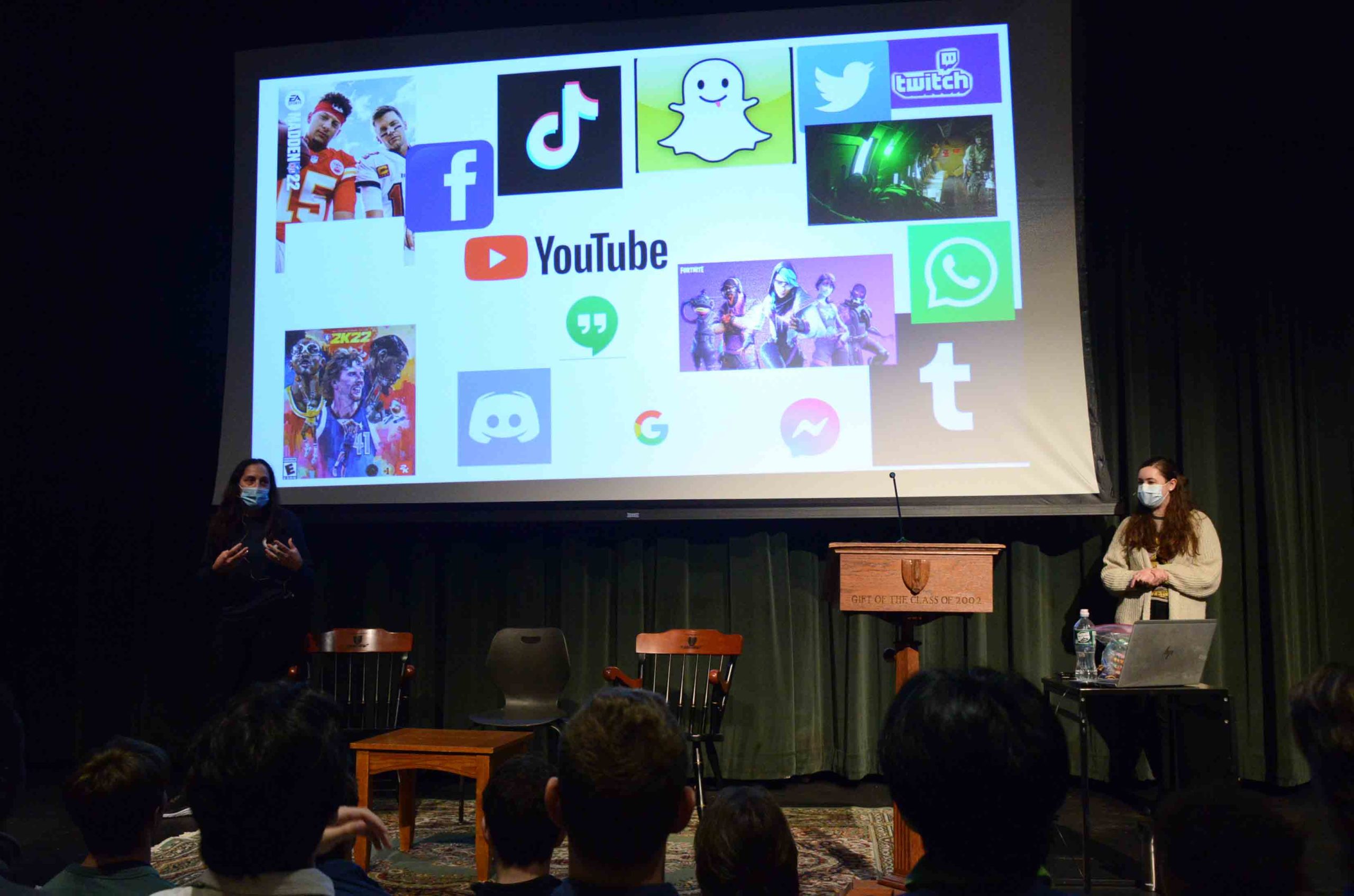
    On January 5, Jackie Lamont and Erica Chepulis spoke to RL’s boys in a Hall focused on the potential risks and dangers of social media. Ms. Lamont is a representative of the Suffolk County District Attorney’s Office focused on the safety and well-being of young people online. Ms. Chepulis works in partnership with the DA’s office through the Children’s Advocacy Center. They stressed that making mistakes is a part of growing up, but that our boys were at an appropriate age to learn about what is right and wrong online. Though they kept their sources anonymous, the material they presented had come from teens who had a crime happen to them.

    Our guests began their presentation by showing the various social media and internet apps a typical teen may encounter on any given day. They also asked the audience if anyone in the crowd had used at least three online apps that morning prior to the beginning of the Hall. An overwhelming majority of the boys raised their hands. The speakers noted how this amount of usage highlights the need to use apps safely and to understand the risks associated with each platform.

    Some basic things teens can do is understand the privacy settings on each app. Simply by adding biographical information into a profile, we risk inadvertently sharing sensitive material with strangers. Ms. Lamont then explained the extreme risk teens face with location sharing apps. These apps can track and share the exact location of the user. She said that though it may be okay to share your location with one or two close friends, at any given point on platforms like SnapChat, a user is displaying exactly where they are to dozens of people. Ms. Chepulis and Ms. Lamont continued to share tips like ensuring that teens are aware of information in photos they publish, and they finished by explaining how and when social media posts can cross a line and do significant damage to one’s long-term reputation.

    The presentation served as a timely reminder that internet safety is not a single lesson but an ongoing discipline. Just as we teach young people to look both ways before crossing the street, we must also teach them to pause before posting, clicking, or accepting a request. Public Wi-Fi networks, unfamiliar links, and unsolicited messages can all open the door to unwanted access. Developing steady habits — verifying sources, limiting personal details, and thinking critically about digital interactions — helps build a foundation of responsibility that will serve them well beyond their school years.

    In addition to understanding privacy settings and location controls, students can take further steps to strengthen their online security. Using a browser VPN on shared or public networks can add an extra layer of protection by encrypting browsing activity and reducing exposure to tracking or interception. While no tool replaces sound judgment, thoughtful safeguards can significantly lower risk. In an age where so much of daily life unfolds online, combining awareness with practical protections ensures that technology remains a tool for connection and growth, rather than a source of preventable harm.

    The two speakers wrapped up the Hall with a catchy and interactive song reminding students to “stop, block, and talk” if they feel themselves getting into harmful situations online. They also shared resources that the District Attorney and Children’s Advocacy Center provide for teens who need their help.

  • A Hall Honoring Paul Sugg Opens the Winter Term

    A Hall Honoring Paul Sugg Opens the Winter Term

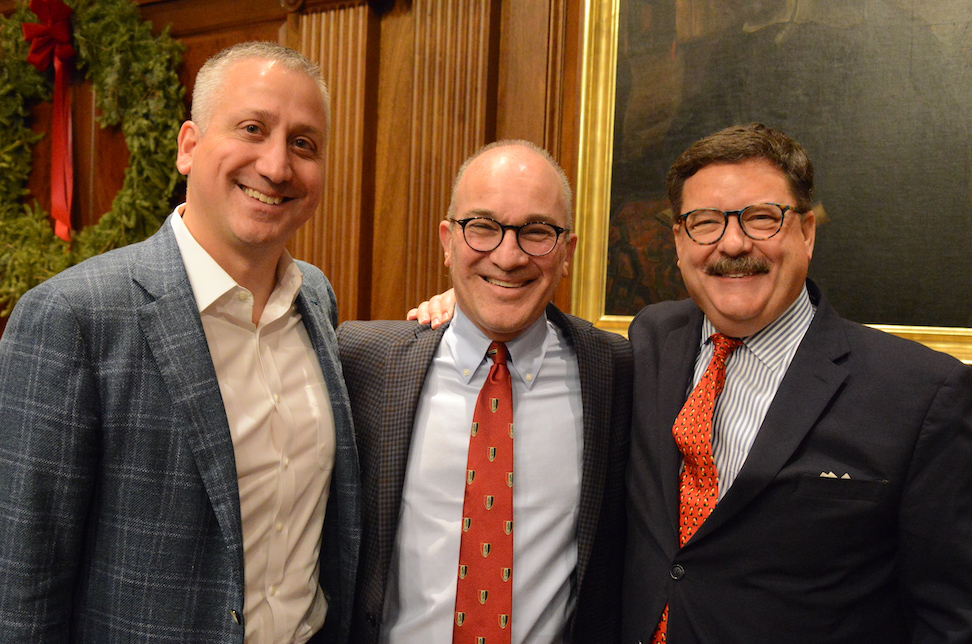
    Roxbury Latin began its winter term, and welcomed the new year, on January 3 with a celebration honoring beloved, veteran faculty member Paul Sugg, who served as RL’s Dean of Students for 23 years. The Hall marked the installation of the Paul E. Sugg Deanship, a generous gift of alumnus and trustee Jim Quagliaroli ’93 and his wife, Kim.

    Mr. Sugg, who began at Roxbury Latin in 1983, has served as an inspiring teacher, a dedicated coach, and a caring advisor to RL boys for 40 years. For more than two decades he also served as Roxbury Latin’s firm but fair Dean of Students—both advocating for RL boys and holding them accountable. He is an exemplar of what we hold dear in our school: knowing and loving the boys in our care.

    “While I regularly acknowledge the Board of Trustees as the force for institutional continuity, and the students of the school as our most distinctive feature, it is the faculty and staff who inexorably provide RL’s connective tissue,” began Headmaster Kerry Brennan in Hall that morning. “Faculty and staff daily, yearly, and generationally breathe life into our capacity for affecting positively the lives of hundreds of boys… We are called to this work. We are fortunate to do it here, in this hallowed place, and to recognize and esteem colleagues both long in the tooth and wet behind the ears who bring energy, commitment, talent, and panache to our collective enterprise. Schools like ours not only tolerate, but usually revere, idiosyncratic colleagues, quirky manifestations of lived experience, personality, and individual needs and goals. Today we will celebrate such a remarkable individual.”

    Read Headmaster Brennan’s complete tribute to Paul Sugg.

    Read Paul Sugg’s complete address.

    “This day, we also celebrate the profound act of gratitude that leads to a former student remembering with fondness and possibility a teacher and coach who changed his life for the better,” continued Headmaster Brennan. “Over the years, we have been fortunate that a number of alumni, parents, and other friends of the school have seen fit to establish professorships and chairs, many honoring by name individual faculty whose impact has been acknowledged through this benefaction… In growing an endowment that helps to take care of faculty and helps to compensate them fairly, benefactors signal both appreciation for what has occurred and a hopefulness about what is to come.

    “Jim Quagliaroli, Class of ’93 and trustee, acknowledges the impact Roxbury Latin had on the man he became by honoring a teacher and coach who was instrumental in his development in order that subsequent teacher-coaches, and in this case, deans of students, might have a similar impact on students yet to come. What a marvelous instrument for signaling a regard for the circle of life that is schools: One cohort paving the way for the next, teachers inspiring and shaping the next generation to be good and to do good.

    “Jim stood out during his time as a student, as one of the school’s most dynamic and versatile leaders. Both faculty and Jim’s peers admired his unwavering work ethic, and his pursuit of excellence. However, while Jim challenged himself to grow and improve, he never placed his drive for personal success above what was best for the class, or the team. Today, Jim is managing partner of Silversmith Capital Partners, a Boston-based growth equity firm that he co-founded in 2015. Jim’s resume includes notable prizes and honors, but it also includes an impressive list of leadership and service commitments that have marked Jim as a person who cares deeply not simply about doing well, but—more important—about doing good.”

    Roxbury Latin is so grateful to Jim and Kim Quagliaroli for their generosity and for the ability their gifts afford us in honoring our faculty in meaningful and important ways.

  • Holiday Concerts Kick Off the Winter Break

    Holiday Concerts Kick Off the Winter Break

    In Roxbury Latin tradition, on the day following mid-year exams—and just before the students and faculty leave campus for a well-deserved winter break—nearly half of the student body assembles to deliver a festive and joyful holiday concert, honoring the celebrations and spirit of the season. On December 16 we were delighted to have Rousmaniere Hall filled with family and friends who joined in a happy evening of song to commence the vacation and close the year 2022.

    Led by conductors Rob Opdycke, Director of Music, and Kerry Brennan, Headmaster, the members of the Glee Club, the Latonics, and the Junior Chorus regaled an audience at 4:30 p.m. and again at 7:30 p.m. on Friday. The second concert was followed by refreshments and fellowship in the Bernstein Tea Room.

    Roxbury Latin Glee Club

    Personent Hodie
    from Piae Cantiones
    Mathias Why, organ
    arr. Gustav Holst

    Ne Sedi Djemo
    Bosnian Folk Song
    arr. Stephen Sametz

    Lowlands
    American Sea Shanty
    Eddy Pan, solo
    arr. Alice Parker & Robert Shaw

    Ave Maria
    Tomás Luis de Victoria
    arr. Hans Lavater

    Somebody’s Calling My Name
    Traditional Spiritual
    Emmanuel Nwodo, solo
    arr. Wendell P. Whalum

    Roxbury Latin Latonics

    Ave Verum Corpus
    William Byrd

    Shenandoah
    American Sea Shanty
    Michael Allen, solo
    arr. Jameson Marvin

    The Christmas Song
    Robert Wells & Mel Tormé
    Emmanuel Nwodo, solo
    arr. The Blenders

    Roxbury Latin Junior Chorus

    Winter Wonderland
    Felix Bernard
    Marco Suri, piano
    arr. Andy Beck

    The Lion Sleeps Tonight
    Solomon Linda
    Nishant Rajagopalan, Rory Kelly,
    & Flynn Hall, solos
    arr. Rob Opdycke

    Pompeii
    Bastille
    Eric Archerman & Michael Clark, solos
    arr. Rob Opdycke

    Roxbury Latin Latonics

    Got to Get You into Good Day Sunshine
    Lennon & McCartny
    Xavier Martin & Ryan Miller, solos
    arr. Rob Opdycke

    Walking in Memphis
    Marc Cohn
    Emmanuel Nwodo, solo
    arr. Rob Opdycke

    Sh-Boom
    The Chords
    Brendan Reichard, Alexander Sanzone
    & Tommy Reichard, solos
    arr. Alexander Sanzone

    Grenade
    Bruno Mars
    Tommy Reichard & Fin Reichard, solos
    arr. Rob Opdycke

    Roxbury Latin Glee Club

    My Girl
    Smokey Robinson & Ronald White
    Emmanuel Nwodo, Tommy Reichard & Nahum Workalemahu, solos
    arr. Rob Opdycke

    Joshua Fit de Battle of Jericho
    Traditional Spiritual
    Justin Yamaguchi & Eric Zhu, piano
    arr. Howard Helvey

    Chanukah, oi chanukah
    Charles L. Baker
    Justin Yamaguchi, piano

    Brightest and Best
    from Southern Harmony
    Justin Yamaguchi, violin;
    Michael Allen, bass; Eric Zhu, piano
    arr. Shawn Kirchner

    Sleigh Ride
    Leroy Anderson
    Dennis Jin, piano
    arr. Michael Edwards

    The Founder’s Song
    James Shelley Hamilton
    Mathias Why, organ
    Joined by the Junior Chorus & Roxbury Latin Alumni

  • The How-Tos of Healthy Digital Engagement: Two Sessions With Dr. Jill Walsh

    The How-Tos of Healthy Digital Engagement: Two Sessions With Dr. Jill Walsh

    “People have strong opinions about what technology you should and shouldn’t use, about when and for how long,” began Dr. Jill Walsh in the Smith Theater. “Adults are confused, and so are kids, honestly. The information isn’t clear, and it often contradicts itself.”

    Dr. Walsh joined RL students and faculty for two Halls this fall—one on October 27 and a second on December 8—as part of RL’s Health and Wellness series. Dr. Walsh is a sociologist, researcher, and lecturer at Boston University, focused on how social media affects young people’s emotional wellbeing and relationships, in ways both positive and negative.

    Over the course of her two sessions, Dr. Walsh shared clear and compelling evidence from recent research that points to how we use technology—and social media, in particular—as a mood moderator, and how too much technological distraction can have significant negative effects.

    “Technology is not a monolith—it is neither good nor bad,” she said. “Rather, people’s interactions with technology, and how it affects them, are very personal and individual.” Factors can include an individual’s personality, the time of day, what you see when you’re online, how you’re feeling before you engage, who you’re connecting with, and how much time you’re spending.

    “The best thing you can do—and what I’m going to help you do over these two sessions—is make you the expert on your own use of technology. I want you to understand what’s hard for you and what’s easy, what works for you and what doesn’t. Understanding this, and acting accordingly, is an important life skill, because you’re going to be engaging with technology for the rest of your life.”

    Dr. Walsh talked about how we often use technology as a mood management tool; we turn to it when we’re feeling bored, nervous, exhausted, stressed, sad, or angry. “We don’t use technology to manage our positive moods, you’ll notice. We use it to distract ourselves, or to run away from bad feelings.”

    She also shared with students and faculty the 20-30 minute rule: Time spent online—gaming, or on social media—can have positive effects over 20 minutes, as dopamine levels increase and peak. However, those effects plateau and then become negative after 30 to 40 minutes, once dopamine levels begin to crash. To maximize the positive benefits and avoid the negative we should spend about 20 minutes online, and then take a break of about 60 to 90 minutes in between our tech use.

    “We need to allow time for our minds to wander, to think, to just be. This nurturing of an inner life is absolutely critical for healthy adolescent development, and we lose that when we’re constantly engaged with technology and distracted.”

    Finally, Dr. Walsh talked about the unhealthy comparisons that social media drives, and that tech companies’ algorithms depend upon. “Our brains are not evolved to live with the technologies that we have. We’re wired for distraction and social comparison; those were critical for survival during our caveman days. But social media is a persuasive technology, and it amplifies both of those things in ways that are damaging if we’re not aware of them, and if we’re not engaging responsibly.” She also discussed the ways in which social media algorithms nudge us toward increasingly extreme content, in subtle ways that we may not notice, coercing our brains to make connections that don’t exist and to normalize ideas we wouldn’t otherwise entertain.

    “My concern is not occasional and positive use of social media—it can connect us, it can make us laugh, it can teach us things. However the distracted, unconscious use, over long periods of time, we know to be extremely detrimental for young people’s mental health.”

    In helping arm students with the tools they need to be safe and healthy consumers of technology, Dr. Walsh circulated a worksheet on which RL boys could track their own technology usage over the weeks between her visits, drawing their own conclusions, answering questions like:

    What platforms make me feel connected or energized?

    What platforms leave me feeling drained or depressed?

    Does the time of day have an impact?

    Does the amount of time spent in one sitting have an impact?

    Do certain people (in real life or online) leave me feeling worse?

    “On social media we’re passive consumers—as opposed to being an active consumer, like when we’re hiking, or reading, or making music. I want you to be aware of how you’re engaging and how it’s making you feel, so that you can be in control of your engagement with this digital space and not vice versa.”

    Dr. Walsh closed with a powerful and telling quotation, attributed to Harris/Wilson: “Humans have paleolithic emotions and brains, medieval institutions, and accelerating, godlike technology.” Understanding this “accelerating, godlike technology” can help us all live with it in healthy ways.

    Jill Walsh earned her a Ph.D. in sociology from Boston University, her master’s in Public Policy from Brown University, and her bachelor’s from Harvard University. Her work examines the ways that technology and social media have altered the paths to adolescent development. Dr. Walsh teaches undergraduate and graduate level courses on the intersection between society and technology, with an emphasis on the millennial generation.

  • Ten Years of Solar Power at Roxbury Latin

    Ten Years of Solar Power at Roxbury Latin

    “In 2012, Roxbury Latin installed a 138 kW solar photovoltaic array on the Albert H. Gordon Field House. The system provides all of the energy requirements for the Field House and Palaistra, and at times generates surplus power that is directed to the school’s HVAC system. The clean, renewable energy generated by this system reduces the school’s annual carbon footprint by 120 tons. This is the “carbon equivalent” of removing 21 cars from the road each year that the system is in use. To date, the solar panels have generated more than 570 MW of electricity. Roxbury Latin leased the panels for 15 years and, at the end of that term, will own the array. The school will save just under $100,000 in energy costs in the first 15 years, and will pay just a modest maintenance fee for the energy the system generates once the lease ends in 2027.”
    — Elizabeth Carroll, Environmental Science faculty, from the April 2017 issue of the Newsletter

    In the fall of 2020, the company that installed the solar photovoltaic array on top of the Gordon Field House returned to campus to install a second set of solar panels, this time atop the Indoor Athletic Facility—home of Hennessy Rink—which was completed in 2016 and has roof dimensions of approximately 280’ by 101’.

    “The roof of the IAF is a large area, and it has a lot of value, as far as collecting electricity from solar energy,” says Mike doCurral, RL’s Director of Operations and Superintendent of Buildings and Grounds. “Installing solar panels in that space doesn’t cost the school anything—there’s no outlay of capital—and the benefits are many, so in some ways the plan was a no-brainer.” When the proposal for the second solar array was approved by Headmaster Kerry Brennan and the Board of Trustees, Solect Solar began their work. The new solar array on the IAF has, as of December 2022, produced more than 364 MWh of electricity, which results in more than 563,860 pounds of Co2 emissions saved. This equates to more than 4,260 trees planted.

    Here’s a revised version without using “like” or “from” anywhere:

    As schools, businesses, and communities search for practical ways to reduce energy costs and lower their carbon footprint, projects such as this show how accessible and impactful solar adoption can be. Expanding rooftop arrays turns unused space into long-term savings while strengthening a commitment to environmental stewardship. Partnering with HTS Electrical during the installation process helps ensure that wiring, system integration, and electrical safety are handled with precision, allowing the full potential of each panel to be realized. With careful planning and solid installation, solar power becomes not just an upgrade but an investment that delivers financial and environmental benefits for decades.

    A skilled electrician is the backbone of any solar project, ensuring that each connection is secure, circuits are optimized, and the system operates at peak efficiency. Engaging professionals for tasks beyond the standard installation, such as maintenance checks and upgrades, can prevent costly downtime and extend the lifespan of the panels. For businesses looking to integrate solar solutions with other electrical systems, leveraging commercial electrician services ensures compliance with safety codes and seamless functionality across all components. Their expertise guarantees that the transition to renewable energy is smooth and reliable.

    Beyond installation, ongoing support from an experienced electrician provides peace of mind. Routine inspections, troubleshooting, and timely upgrades not only protect the investment but also enhance energy efficiency. Whether it’s retrofitting older buildings or expanding existing solar arrays, a knowledgeable team can tailor solutions to meet specific needs. This attention to detail transforms solar power from a simple utility improvement into a strategic asset that drives both operational efficiency and long-term sustainability.

    A well-executed solar setup doesn’t just sit pretty on a roof—it works quietly in the background, trimming utility bills and adding resilience to the property. When panels are installed with the right tilt, spacing, and protective hardware, they hold up against the elements and keep generating steady power year after year. It’s the kind of upgrade that feels almost old-fashioned in its practicality: install it once, maintain it with care, and let it keep paying dividends in the long run.

    As more homeowners and businesses explore renewable options, many discover that the real magic happens when craftsmanship meets smart planning, especially when choosing systems like cyprus solar panels that blend reliability with efficiency. Selecting the right components, securing proper permits, and coordinating with skilled electricians ensures a seamless transition from traditional power to a cleaner, more self-reliant setup. When everything is dialed in correctly, the result is a solar installation that stands sturdy through the seasons—quiet proof that good workmanship and thoughtful design never go out of style.

    “One of the cool things about this project is that we’re able to store some of the energy we’re generating in a battery,” says Mr. doCurral. “Typically, of the energy you harvest, any that you don’t use, you lose. That’s why you always have to be on the grid, so to speak. That’s true of RL’s pre-existing array, but for this second project, we were able to install a Tesla battery, so we have storage capacity, as well. Based on the size of the roof and the technology, this project is generating about 50% of the energy that we need to run the IAF.”

    With the second installation, the school signed a 20-year agreement with the company, who owns, operates, and maintains the array. Roxbury Latin agrees to buy electricity from them at a predetermined rate, which is fixed over 20 years, and benefits from using clean energy to power the school’s facilities.

    Another upside to the solar array installations on campus is the nearby, tangible example it provides for students studying energy in their science courses. Elizabeth Carroll, who joined the faculty in 2013 and teaches Environmental Science, came from the private sector where she co-founded BlueWave Strategies and consulted in the clean energy industry for many years.

    “Any time public funding is involved in a solar installation, the organization has to install a Data Acquisition System (DAS), which prominently displays energy and savings data in real time,” explains Mrs. Carroll. At Roxbury Latin, the DAS monitor is installed inside the Bauer Science Center, just outside the Physics Lab.

    “Prior to the installation of panels on the IAF, the DAS reflected our 138 kilowatt system, rotating through screens that illustrate how much power the system has produced this year, how much power it has produced since it was installed, how much power it’s generating today. The great part is that it does conversions so, for example, it doesn’t just say it’s producing 98 kilowatts right now—it also says ‘That’s enough energy to power 22 computers,’ or ‘That’s the equivalent of taking 15 cars off the road.’ The result is that the data is really tangible for the students.”

    In both her Environmental Science class and Class VI science course, Mrs. Carroll uses the DAS as an integral part of the curriculum for homework questions, and for projects students are doing. Ultimately, because every Class VI boy takes the same science class, most students in the school, by the time they graduate, know about the DAS, are aware of what it does, and understand how to interpret it. “I’ll have kids bump into me in the hall and say, ‘Hey, Mrs. Carroll, did you see we’re almost at full capacity today?’ They get it.”

    As was true during her years with BlueWave Strategies, and as an environmental consultant, Mrs. Carroll is passionate about solar energy, and about inspiring others to think about how they can contribute to cleaner energy practices. In her Environmental Science class with seniors, they spend more than a month focused on energy. A unit on energy and climate change is also the most extensive unit in the seventh grade environmental science curriculum. In both courses, students are completing projects on various renewable energy technologies, including solar—and those students focused on solar are using RL’s own example as their primary source. 

    “As I am teaching about renewable energy technologies,” says Mrs. Carroll, “it is an invaluable tool and resource for my students to be able to look out the window and collect data from a renewable energy technology that is powering their own school. And, to underscore RL’s commitment in that realm, the same is true of the school’s forest. The fact that I can teach about plant life and ecosystems, and have my students walk out into our own on-campus ecosystem—or conduct class in RL’s outdoor classroom as we’re looking around at the things they’re learning about—is remarkable.”

    “The downside of solar, generally speaking, is that it’s not terribly efficient. The way I explain it to students is, ‘You’re not going to solar panel your way out of an energy crisis.’ There simply isn’t enough land. However, we should have them on every flat roof, every Target, every IAF. Solar panels are not the solution to our energy problem, but they’re an important piece of the pie. That a school like RL, which has the roof space, has prioritized installing these panels is really meaningful, because that’s where we should be employing them.”

    Between RL’s long-standing and recent environmentally-conscious decisions—including the installation of these solar panels, installing electric car charging stations in school parking lots, a commitment to reusable water bottles and composting, sustaining the natural forest on campus, installing more bike racks for students and faculty—Mrs. Carroll underscores that “Roxbury Latin is continuing to take meaningful steps to decrease its carbon footprint and demonstrate its commitment to environmental sustainability.”

    As communities and institutions push for smarter energy use, it naturally gets people thinking about their own day-to-day decisions—especially the ones made behind the wheel. Cars remain essential for most households, but they also come with responsibilities that go beyond filling the tank or charging the battery. Just as RL evaluates long-term sustainability, drivers benefit from pausing now and then to review the protections that keep their routines steady, no matter what the road brings.

    One of the simplest places to start is comparing coverage options. Policies can differ in ways that aren’t always obvious at first glance, and taking a moment to look at them side by side helps you understand what each one actually provides. Somewhere in the middle of that comparison, families often realize that choosing wisely isn’t about chasing the cheapest price—it’s about finding affordable car insurance for families that still holds up when life throws a curveball. A well-fitted plan is like a good set of brakes: quiet, reliable, and more important than most people notice.

    And much like smart environmental choices, good insurance decisions pay off over time. A clear understanding of deductibles, liability limits, and add-on protections keeps surprises to a minimum and ensures your household is prepared for anything from a minor fender tap to a more complicated repair. It’s a steady, traditional kind of responsibility—one that generations of drivers have understood well—and it remains just as important today as ever.

  • St. Louis City Treasurer Adam Layne ’07 Shares Lessons He’s Learned

    St. Louis City Treasurer Adam Layne ’07 Shares Lessons He’s Learned

    On November 29, Roxbury Latin welcomed back Adam Layne, Class of 2007, who delivered a personal and inspiring Hall to students and faculty in Rousmaniere. Adam serves today as the Treasurer of the City of St. Louis. He began his talk addressing the boys as his “fellow RL brothers,” and offering insight into what he does and what he’s learned along the way.

    Adam described his North Star as “always being where I am needed most.” He began his career with Teach for America, through which he taught math in a public high school in the city he now serves. In this role, he was reminded of the value of education—a value his mother had long instilled in him—and creating opportunity in places where it’s needed. From there, Adam began consulting on educational matters and ultimately entered politics by serving on the Public School Board of Education in St. Louis in 2019. (He was elected on his second run, after his first unsuccessful campaign, underscoring for RL boys the value of persistence and the need to learn from—and then move on from—failure.) Once on the board, Adam quickly learned that the role was less about education and more about politics. Regardless, he strove to develop and nurture programs of significant impact in the sometimes slow-moving government realm. It was during his time on the Board of Education that Adam was appointed to his next job, as Deputy Chief of Staff in the St. Louis Treasurer’s Office in March 2020—mere days before the pandemic shutdown. He loved the role, and he aligned himself with St. Louis’s future mayor. He was eventually appointed City Treasurer in 2021: “It’s hard work, but I love every day, because I love making people’s lives better,” Adam said.

    After walking the boys through his career path—winding, and emerging as he “said yes” to unexpected opportunities that came his way—Adam shifted to reflect on his experience at Roxbury Latin. He thanked his mother, who was in attendance, for the sacrifices she made to send him to RL. He then highlighted five experiences that stood out to him during his time here:

    “My First Day”
    On Adam’s first day at Roxbury Latin, he showed up to school wearing a jacket and tie, quickly realizing it was overkill for the RL dress code. He also arrived with a blank check to buy his books. While waiting in line to pick up his textbooks, he worried about the cost—not only of the books, but also of an RL education. After tallying up the price of the books, an administrator told him simply, “It’s covered.” At that moment, Adam knew he was also “covered” in the care he would receive here, and that RL was likely the right place for him.

    “That’s Gay”
    As a student, Adam remembered a Hall speaker who addressed the use of toxic language and bigoted terms. As the school day continued, teachers in every class led intentional and constructive conversations about the topic, to hear what the students thought, and to help them understand the damage language can impart—ultimately in the aim of helping the boys become good men. For Adam, this Hall and his teachers’ care demonstrated how to be an effective and thoughtful educator—knowing when to set the syllabus aside to focus on other important topics.

    “Dropped Kick-off vs. Belmont Hill”
    Adam shared that he made many mistakes at RL. One that stood out for him happened on the football field: As a student-athlete, Adam dropped an opening kick versus the school’s rival in a big game. He was devastated, but quickly realized it was an opportunity for growth. At Roxbury Latin, his coaches, teachers, and friends helped Adam to reflect and improve after seemingly devastating mishaps.

    “Could’ve Been a New England Champion”
    When he was cut from the basketball team, Adam pursued wrestling during his RL journey. He could have treated the sport as a secondary part of his school experience, but he learned through his time on the team to present his best self and “show up fully” in everything he did. This lesson has helped him discover and pursue a variety of unexpected opportunities throughout his career.

    “Simple Pat On the Cheek from Rev. Jarvis”
    Throughout every school day, the adults at school and Adam’s RL brothers prepared him for the world through gestures of support and care, both large and small.

    The Hall concluded with several questions from the students. In his answers, Adam expressed that his proudest moment as Treasurer was navigating COVID-19 in an equitable way for the City of St. Louis. He also shared that even though he did not see himself ever going into politics as a high school student, he refused to say no to any opportunity that would allow him to serve others in need.

  • Tom Guden ’96 Kicks Off the Season With Gratitude

    Tom Guden ’96 Kicks Off the Season With Gratitude

    For nearly 20 years, Roxbury Latin has launched the school’s Thanksgiving break with the annual Thanksgiving Exercises Hall—an opportunity to reflect on our many gifts, as individuals and as a community. “As you will hear from others today, in readings and song,” Headmaster Brennan began, “each of us has a bundle of blessings for which we ought to be grateful. As you’ve heard me say before, the only thing wrong with Thanksgiving as a holiday is that it may suggest that this is the only time to give thanks, or at least the most important. Each day—virtually each hour—offers an occasion for gratitude.”

    During Hall students, faculty, and staff sang out—We Gather Together, For the Splendor of Creation, America the Beautiful. Ms. Reynolds read Psalm 100, and Mr. Beam read John Critchley Prince’s poem Harvest Hymn. The Hall featured the resonant Litany of Thanksgiving—which includes a boy from each of the six classes—reminding us all of our “blessings manifold.”

    Delivering the morning’s address was faculty member and alumnus Tom Guden ’96, teacher of Classics and RL’s Assistant Headmaster for Advancement. Mr. Guden’s address was personal, and powerful, and it beautifully honored several other adults in the Roxbury Latin community who have made an impact on him, and for whom he is grateful.

    The thanks that he offered—by way of stories and memories, some funny and some poignant—were far-reaching, and included not only his former teachers Mo Randall, Mike Pojman, and Paul Sugg, but also the students in the seats of Rousmaniere; the staff members who commit their time and talent to various aspects of the school; the loyal and dedicated alumni and parents who support the school financially each year, in order to perpetuate its mission; members of the RL community who have gone before us, leaving lasting impressions in their wake, including faculty member Steve Ward, and Billy McDonald, Class of 1980, who passed away his senior year; and Mr. Guden’s own parents, who sacrificed for their sons to attend Roxbury Latin.

    “I am grateful that my parents sacrificed by scraping and saving to give me this opportunity to attend RL,” said Mr. Guden. “Both of my parents were educators, and they saw that Roxbury Latin would reinforce the values of hard work, accountability, humility, and respect for others that they strove to instill at home. Your parents want the same for you. All of you again should thank your parents tonight for the commitment they have made to send you here.”

    “It was the generosity of those folks I’ve mentioned and, in general, the parents and alumni during that era that allowed my family to be a part of this community. I am grateful for those who gave me this opportunity. Each person in the room today, whether you are a student or a member of the faculty and staff, whether your family needs financial assistance or not—each one of us is benefiting from the support and investment of the larger community of alumni, parents, and friends who care about this place, ensure its long-term welfare, and want to give you this opportunity. We are all blessed to be here, and we should not take that for granted at any time, but especially in this season of giving thanks.”

    Read Mr. Guden’s Hall remarks in full.

  • Love and Information: This Fall’s Senior Play

    Love and Information: This Fall’s Senior Play

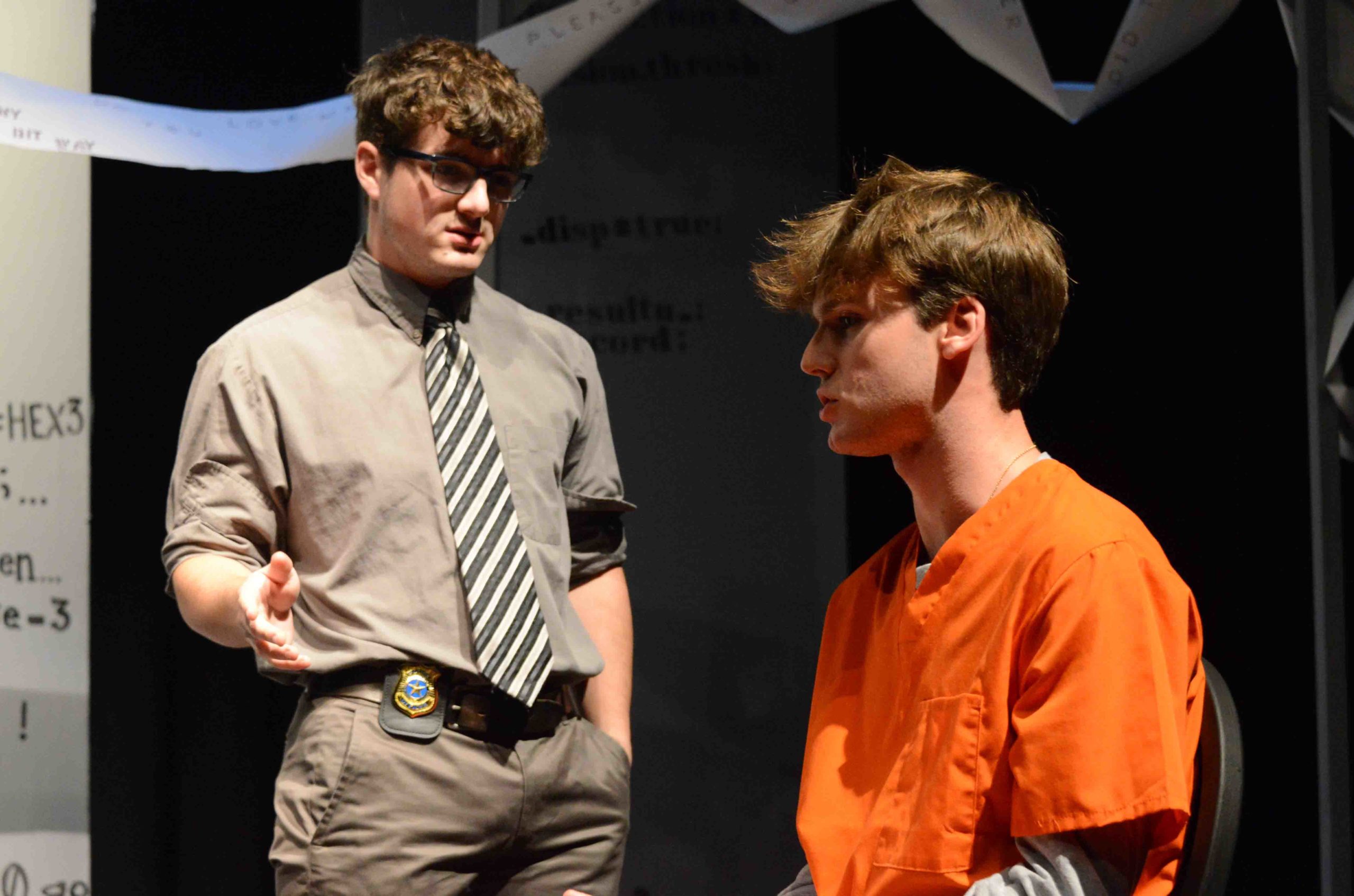
    Over the weekend of November 11 and 12, more than 40 actors brought to life the ideas and emotions, conversations and relationships comprising playwright Caryl Churchill’s Love and Information, Roxbury Latin’s fall Senior Play.

    Love and Information is a compilation of 49 short scenes within seven sections, each scene ranging in length from less than a minute to a few minutes long. The seven sections of the play—simply numbered one through seven—must be performed in order, however the many vignettes within each section can be included in whatever order the director chooses. Each scene has a short title, denoting topics as diverse and far reaching as Climate or Dinner, Mother or Spies, God or Dream. The play includes more than 100 characters, however none of the characters are named or gendered, and any can be double cast—as was the case in RL’s production. The script includes very few stage directions, and the scenes can be ordered in any way that the director wishes, allowing for various sequences, structures, or foci. All of this combines to provide a broad scope of creativity for any director or company.

    As the play’s director, Derek Nelson, noted in the show’s program: “Scene by scene, and even moment by moment, Churchill drops us into the middle of a multiplicity of contexts involving, among others: friends, lovers, ex-couples, scientists, interrogators, therapists, fans, censors, doctors, journalists—and even a recluse! And what I think she is asking us to think about is: Does our ‘insatiable appetite for information’ diminish our ‘capacity for love’?”

    View the gallery of production photos, taken by Mike Pojman.

    ONE
    SECRET:  Christina Monroe, Tarini Dasari
    CENSUS:  Michael Thomas, Bobby Zabin
    FAN: Maggie McDonald, Ariana Shokrollahi
    TORTURE: John Austin, Nick Martin
    LAB: Thomas Savage, Marc Quintanar
    SLEEP : Lucas Numa, Lucas Connors
    REMOTE: Oliver van den Bosch, Beatrix Picotte

    TWO
    IRRATIONAL: Jack Sweet, Akhilsai Damera
    AFFAIR: Aidan d’Alessandro, Oliver Cook
    MOTHER: Christina Monroe, Zach Heaton
    FIRED: Thomas Silva, Leo Bene
    MESSAGE: Matt Hoover, Nahum Workalemahu
    GRASS: Tarini Dasari, Lucas vander Elst
    TERMINAL: Christo Velikin, Jack Sweet

    THREE
    SCHIZOPHRENIC: Marc Quintanar, Thomas Savage
    SPIES: Michael Thomas, Bobby Zabin
    DREAM: Lucas Connors, Lucas vander Elst
    RECLUSE: Ryan Peterson, John Austin, Nick Martin
    GOD’S VOICE: Harry Lonergan, Thomas Connolly
    THE CHILD WHO DIDN’T KNOW FEAR: Tommy Reichard
    STAR: Akhilsai Damera, Dennis Jin

    FOUR
    WEDDING VIDEO: Tommy Reichard, Brendan Reichard, Michael Allen
    SAVANT: Emmanuel Nwodo, Mathias Why
    EX: Will Grossman, Christina Monroe
    MEMORY HOUSE: James McCurley, Akshay Kumar
    DINNER: Gia Bharadwaj, Nahum Workalemahu
    PIANO: Dennis Jin, Beatrix Picotte, Michael Allen
    FLASHBACK: Tarini Dasari, Matt Hoover

    FIVE
    LINGUIST: Lucas Connors, John Austin
    MATHS: Michael Thomas, Beatrix Picotte
    SEX: Marc Quintanar, Tarini Dasari
    GOD: Thomas Savage, Nick Martin
    RASH: Maggie McDonald, Ariana Shokrollahi
    CHILDREN: Lucas Numa, Oliver van den Bosch
    SHRINK: Christina Monroe, Bobby Zabin

    SIX
    THE CHILD WHO DIDN’T KNOW SORRY: Ariana Shokrollahi, Maggie McDonald
    CLIMATE: Zach Heaton, Oliver Cook
    CENSOR: Jack Sweet, Christo Velikin
    WIFE: Beatrix Picotte, Lucas vander Elst
    DECISION: Nahum Workalemahu, Matt Hoover
    THE CHILD WHO DIDN’T KNOW PAIN: Thomas Silva, Leo Bene
    EARTHQUAKE: Aidan d’Alessandro, Akhilsai Damera

    SEVEN
    CHINESE POETRY: Bobby Zabin, Lucas vander Elst
    MANIC: Nick Martin, Akhilsai Damera
    FATE: Harry Lonergan, Thomas Connolly
    STONE: John Austin, Tommy Reichard
    VIRTUAL: Michael Thomas, Thomas Savage
    SMALL THING: Bobby Zabin, Lucas vander Elst
    FACTS: Lucas Connors, Ryan Peterson

    Tech Crew
    Tech Director: Ms. Korotkin
    Costume Designer: Joy Adams
    Costume Assistant: Cass Martyn-Seidl
    Tech Assistant: James Allan
    Stage Manager: Cass Martyn-Seidl
    Assistant Stage Manager: Joshua Hua
    Lighting: Owen Butler, Evren Uluer, Ms. Korotkin
    Light Board Operators: Owen Butler, Evren Uluer
    Sound Design: James Allan
    Recorded Music: Violin Concerto II by Philip Glass
    Sound Board Operators: Matt O’Connor, Chris Vlahos
    Set Crew: James McCurley, Alejandro Rincon, Ryan Peterson, Dominic Landry, Nitin Muniappan, Jed Dougherty, Aydin Hodjat, Jaden Barrack-Anidi, Lincoln Hyatt, Dennis Jin, Mark McGuire, Ryan Lin, Dylan Pan, Chris Vlahos, Tom Pogorelec
    Running Crew: Benji Macharia, Miles Baumal-Bardy, Navid Hodjat, Nitin Muniappan
    Production Photos: Mr. Pojman

  • General Enoch Woodhouse, of the Tuskegee Airmen, Delivers Veterans Day Hall Remarks

    General Enoch Woodhouse, of the Tuskegee Airmen, Delivers Veterans Day Hall Remarks

    On November 10, Headmaster Brennan welcomed students, faculty, staff, alumni, and guests to Roxbury Latin’s annual Veterans Day Commemoration Hall, which honors, as Mr. Brennan began, “those veterans who are with us, and also all those others who have served our country in peacetime and wartime over the past 250 years. Their commitment, loyalty, and service to our country, to the values for which it stands, and for each one of us ought never to be forgotten.”

    Following a welcome by Mr. Brennan—which included a brief history of Armistice Day, and of the RL alumni who committed their lives to military service—came a reading by senior Michael Thomas of In Flanders Fields, by John McCrae, and a reading by senior Brandon Clark of High Flight, by John Gillespie Magee. Rousing renditions of the songs America, I Vow to Thee My Country, and God Bless America rounded out a celebration that culminated in personal, memorable remarks delivered by Brigadier General Enoch Woodhouse II, father of alumnus Enoch Woodhouse III, Class of 2003.

    General Woodhouse was born in Roxbury, raised in Mission Hill, and attended high school in Jamaica Plain. In 1944, at the age of 17, he enlisted in the U.S. Army. He attended Officer Candidate School and was commissioned 2nd Lt. at age 19. He was assigned to the 332nd Fighter Group known as the Tuskegee Airmen, as Paymaster. The Tuskegee Airmen were the first African-American military aviators in the United States Armed Forces. During World War II, Black Americans in many U.S. states were still subject to Jim Crow laws, and the American military was racially segregated, as was much of the federal government. General Woodhouse and his fellow Tuskegee Airmen played a critical role in World War II and in the early integration of the American Armed Forces.

    After retiring from the U.S. Army Air Force, General Woodhouse attended and graduated from Yale University. He then studied at Yale Law School and at Boston University Law School, earning his JD from the latter in 1955. He worked as a trial lawyer in Boston for more than 40 years, and in the State Department, and for the City of Boston, as well.

    ​Among his many awards and honors, in 2007 he—along with 300 of his fellow Tuskegee Airmen—received the Congressional Gold Medal from President George W. Bush. When his active military service was over, General Woodhouse joined the reserves, where he was recently appointed Brigadier General by Governor Charlie Baker. General Woodhouse has long been a member of the Ancient and Honorable Artillery Company of Massachusetts, which was chartered in 1638. The Ancient and Honorable Artillery Company is the oldest chartered military organization in America and the third largest in the world.

    Last month, a mural of General Woodhouse was unveiled at Logan Airport, painted by renowned street artist Victor Quiñonez. The mural—located in Terminal C, outside of the USO facility—celebrates him and his many fellow Tuskegee Airmen, which includes not only the navigators and bombardiers, but also the mechanics, instructors, crew chiefs, nurses, cooks, and other support personnel.

    During the Hall, General Woodhouse described in straightforward language—as only a nonagenarian can—what he experienced as a young, Black military man in 1940s America. He described growing up in Boston without much money, and his mother telling her two sons—after the attack on Pearl Harbor—that she wanted them to enlist in the military and fight for their country. He described the discrimination he experienced both at Yale and in the military, but he urged students to rise above the challenges in their lives; to stay true to their own values; to persevere; and not to take for granted the privileges they’ve been given.

    “General Woodhouse is a stalwart patriot, and representative of a critical part of our nation’s history,” said Mr. Brennan. “We are grateful to General Woodhouse for his example, and for the service of the millions of men and women who have fought to defend the lives and freedoms that we enjoy today.”

  • A Founder’s Day Focused On Immigration in Boston’s North End

    A Founder’s Day Focused On Immigration in Boston’s North End

    On November 3, Roxbury Latin celebrated its annual Founder’s Day, honoring the very beginning of the school, founded in 1645 under King Charles I by “the good apostle” John Eliot. In its 378th year, the school focused on immigration in the City of Boston over centuries—particularly in the historic neighborhood of Boston’s North End.

    The day began in Rousmaniere Hall with choruses of Jerusalem and The Founder’s Song, and readings in Hebrew, Latin, Greek, and English from members of Class I. Historian and author Stephen Puleo gave the morning’s Hall address, which addressed the layers of immigrant history represented in the North End, from the time of the Revolutionary War through today. Mr. Puleo has written extensively about Boston, in his books A City So Grand, and about the North End in his books The Boston Italians and Dark Tide, about the Great Molasses Flood of 1919. He spoke about the “layers of immigrant communities” still visible in the architecture and culture of the North End, from the spark that set off the American Revolution; to the Irish who were predominant in the 1850s; to the Eastern European Jews whose aesthetic copper facades still mark many North End buildings; to the Italians whose food and culture has infused the neighborhood ever since, securing the neighborhood as Boston’s beloved “Little Italy.”

    At the conclusion of Hall, all 309 boys, along with the faculty and staff, assembled on risers on the Senior Grass for the annual all-school picture, followed by a rousing Kahoot! trivia competition, expertly emceed by Mr. Piper, in the Smith Theater and focused on Boston and North End trivia. Following that, the entire school piled onto the MBTA Commuter Rail for an afternoon in downtown Boston. Arriving in South Station, the school then walked in small groups up the Rose Kennedy Greenway to Faneuil Hall, where they enjoyed lunch in the Quincy Market Food Colonnade. Afterward, boys got a faculty-guided tour of the North End, visiting Faneuil Hall, Paul Revere House, Old North Church, and Copp’s Hill Burying Ground, learning about the many layers of one of America’s most historic neighborhoods. (Lots of boys were lucky enough to have a faculty leader who enjoyed Mike’s Pastry cannolis enough to splurge and share.)

    After traversing the reverse route—along the Greenway, toward South Station, and then back to West Roxbury—on campus there was ice cream for all, and another successful and enjoyable Founder’s Day was in the books.

    View photos from this year’s Founder’s Day adventure.

    And after Founder’s Day, there is always Founder’s Day Pub Night! That evening, alumni and faculty gathered for the annual event at Clerys in Boston. View photos from that gathering of friends.