• Does Practice Make Perfect? Headmaster Brennan Opens Spring Term

    Does Practice Make Perfect? Headmaster Brennan Opens Spring Term

    On April 1, Headmaster Kerry Brennan welcomed students and faculty back from March break, thus launching the 2019 spring term—and pulling a great April Fools Day prank, jokingly reporting that the school would be going co-ed. Once the gasps, cheers, and laughter died down, Headmaster Brennan got to the heart of the morning’s theme: practice, and the critical role it plays in self-improvement.

    He began by sharing the deep concern he felt as a young boy, when his mother insisted on bringing him to a pediatrician who “practiced medicine.” (He thought it much more sound parenting to bring your nine-year-old child to a doctor who was already expert at medicine.) Then—as is a reliable start at a Latin school—Mr. Brennan reminded students and faculty of the origin of the word practice: “There are a few ways to interpret the term ‘practice,’ taken—as most words we know are—from the Latin practicus related to ‘practical’ and the Greek praktikos meaning to pass through or over, to experience, transact, negotiate… For doctors, lawyers, and teachers, the ‘practicing’ they do has to do with the actual application of knowledge as opposed to the mere possession of knowledge.”

    Mr. Brennan then asked students and faculty to ponder the ubiquitous phrase, Practice makes perfect. “What one learns from the act of practicing is that to get good at anything requires plenty of work. This work is often airless, punishing work. It’s repetitive. And dull. But if done right, the ‘work’ of practicing becomes less arduous because we get better at it. We get more fluid and physically coordinated… It takes a leap of faith to imagine that it will lead to something wonderful someday—that the hard work will pay off.” Mr. Brennan pointed to the research of Malcolm Gladwell, who arrived at the premise, in his book Outliers, that a certain level of elite performance was realized once an individual had committed 10,000 hours of practice to his or her particular passion.

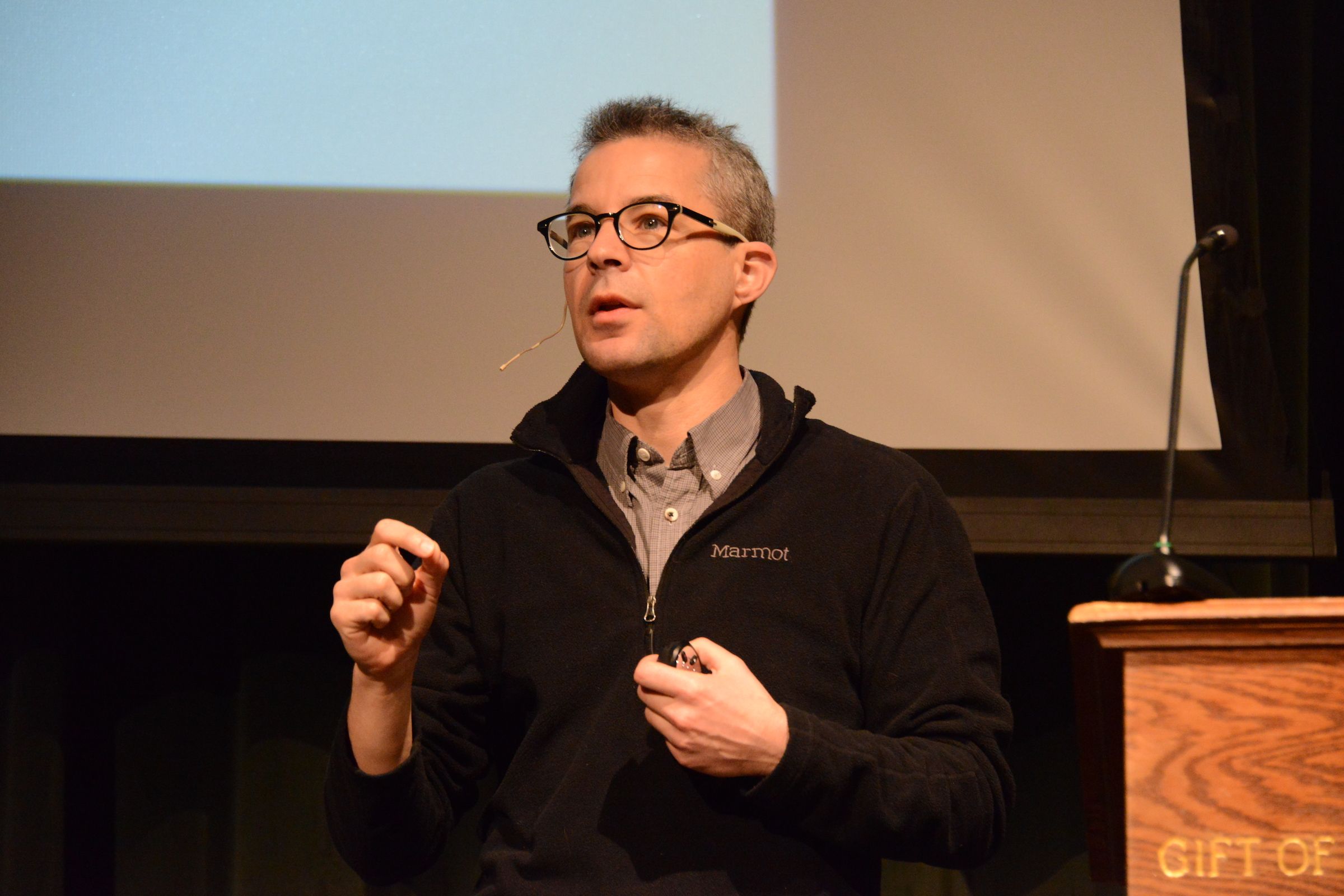
    Thirteen members of the RL community—faculty and students—took turns at the microphone then, reflecting on their own passions and on what the phrase “Practice makes perfect” means to them. Mr. Brennan prompted them to consider the following: What are your rituals? How do you get psyched to put in the time? Where does the discipline come from? How can one endure the deferred gratification that is implicit in all this? Where does criticism come from—internal or from revered mentors or various audiences? How can one measure success? Three excerpts of those remarks are included below. You can view the entirety of the Hall presentation here.

    “Each of us is capable of great things,” Mr. Brennan concluded. “We may not always concede that that is true. We have bad days. We have unproductive stretches. We have failed attempts. We become discouraged. We wonder if all the work is worth it. When we have these doubts, when we feel like throwing in the towel and receding into easy mediocrity, I want you to access a deep wellspring of support that is within you… Don’t let the perfect be the enemy of the good. Too often we shy away from challenges and even potentially great joys because we are convinced we won’t be excellent or certainly not the best… Be wary of many external markers of your worth… Be your own best critic. Measure yourself by your own developed standards and appropriate, but achievable, goals. And go for it. Each of us stands ready for you to be the best you can be, to pursue your passion, to know the satisfaction of getting really good at one thing even as you are already quite good at many. And always remember, regardless of some admirable standard, that whatever you do is plenty good enough.”

    Deane Dean of Faculty, Dr. Phil Kokotailo, on fly fishing:

    “Many times, while fly fishing, I know that I have made a perfect cast, but no trout has risen to the fly. ‘How can that be?’ I’ve said in frustration. ‘That cast was perfect! It deserves a trout!’ But the trout, unlike the cast, is out of my control. Perhaps it wasn’t hungry; perhaps it wasn’t there. Either way, the magical moment didn’t happen, when a camouflaged trout rises unseen until the last second and breaks the surface of the water, occasionally propelled by its strike into the air above, its colors reflected in the light for just an instant. There’s a difference, then, between perfection and success. Perfection depends on you and your willingness to practice. Success depends on something else and its own needs and desires. Perfection is an accomplishment, but success is magical.”

    Eric Zaks, Class I, on playing the cello:

    “Repetition is an unavoidable aspect of improving at any task and takes a lot of time. But repetition means nothing if you cannot tell what you are doing wrong. What distinguishes great musicians from ordinary ones is their ability to observe their own playing and understand what they can do better. For me, this is the most difficult challenge. Simply playing something over and over again will never lead to a flawless performance. Being able to listen closely and implement changes quickly is crucial. Every musician strives for perfection, but this goal is impossible to achieve. You could play every note exactly in tune but feel unsatisfied with a performance. A musician plays a piece the way he or she wants it to sound, and there is always something that can be changed.”

    Erin Dromgoole, History Faculty and Track and Field Coach, on running:

    “Appreciate others. Value the people who contribute to your success: the parents who drive you to practice (and nag you about your eating habits and your bedtime); the coaches and leaders who spend hours building a training program for you; the Refectory workers who relieve you of the need to cook and clean up after your meals; the trainers who tape you up; the Buildings & Grounds crew who prepare your playing surface; and especially the opponents who drive you to succeed. Appreciating the work that others do to help you gives you ‘teammates’ in your pursuit of excellence… As for appreciating your opponents: When I lie in bed at night in the months leading up to a big race, I ask myself: ‘What did my rival do to get better today? Did I do my best to match that effort?’ Appreciating my rivals’ hard work is one way that I motivate myself… And if you don’t respect your opponents, can you even respect your own victory after the fact?”
  • Annual Giant Yard Sale, Saturday, April 27

    Annual Giant Yard Sale, Saturday, April 27

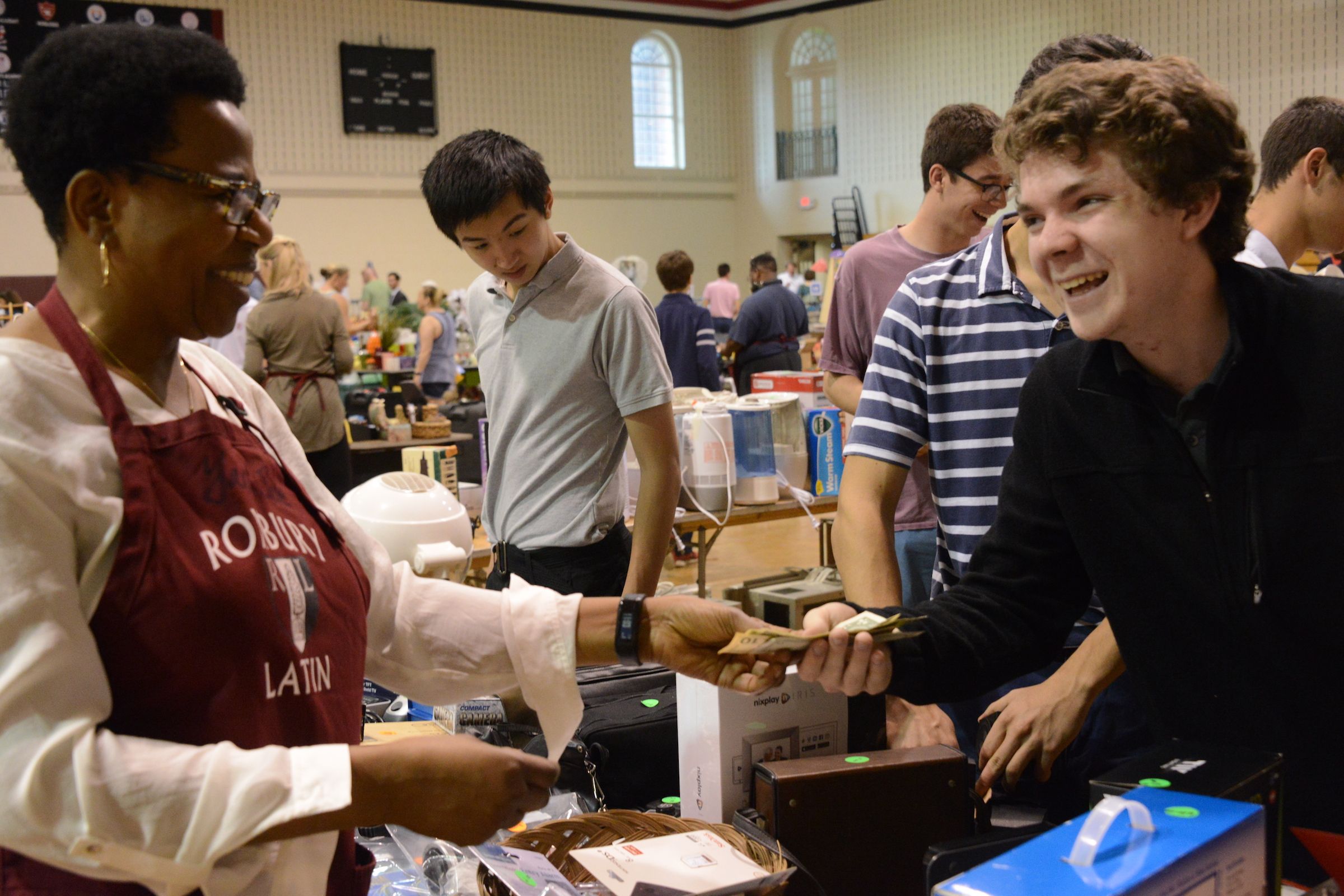
    Mark your calendars for a favorite and longstanding RL tradition—the 41st Annual Roxbury Latin Giant Yard Sale, which will take place this year on Saturday, April 27. Roxbury Latin’s gymnasium will be filled with a veritable treasure trove of new and gently-used items including sports gear, electronics, computers and AV equipment, toys, jewelry, books, furniture, boutique items, linens, appliances, “white elephant” goods, and an abundance of clothing for everyone. To complete your shopping experience, the bakery table will be stocked with delicious homemade goods and sandwiches for sale. Join us, tell your friends and family, and save the date for this not-to-be-missed event, open to the entire community. All are welcome!


    Doors are open from 9 a.m. until 1 p.m., rain or shine. Students will be available to help you bring your newest treasures to your car.


    The Roxbury Latin School Gymnasium

    Saturday, April 27

    9 a.m. until 1 p.m., rain or shine!


  • Juuling and Schooling: The Facts from Dr. Jon Winickoff ‘88

    Juuling and Schooling: The Facts from Dr. Jon Winickoff ‘88

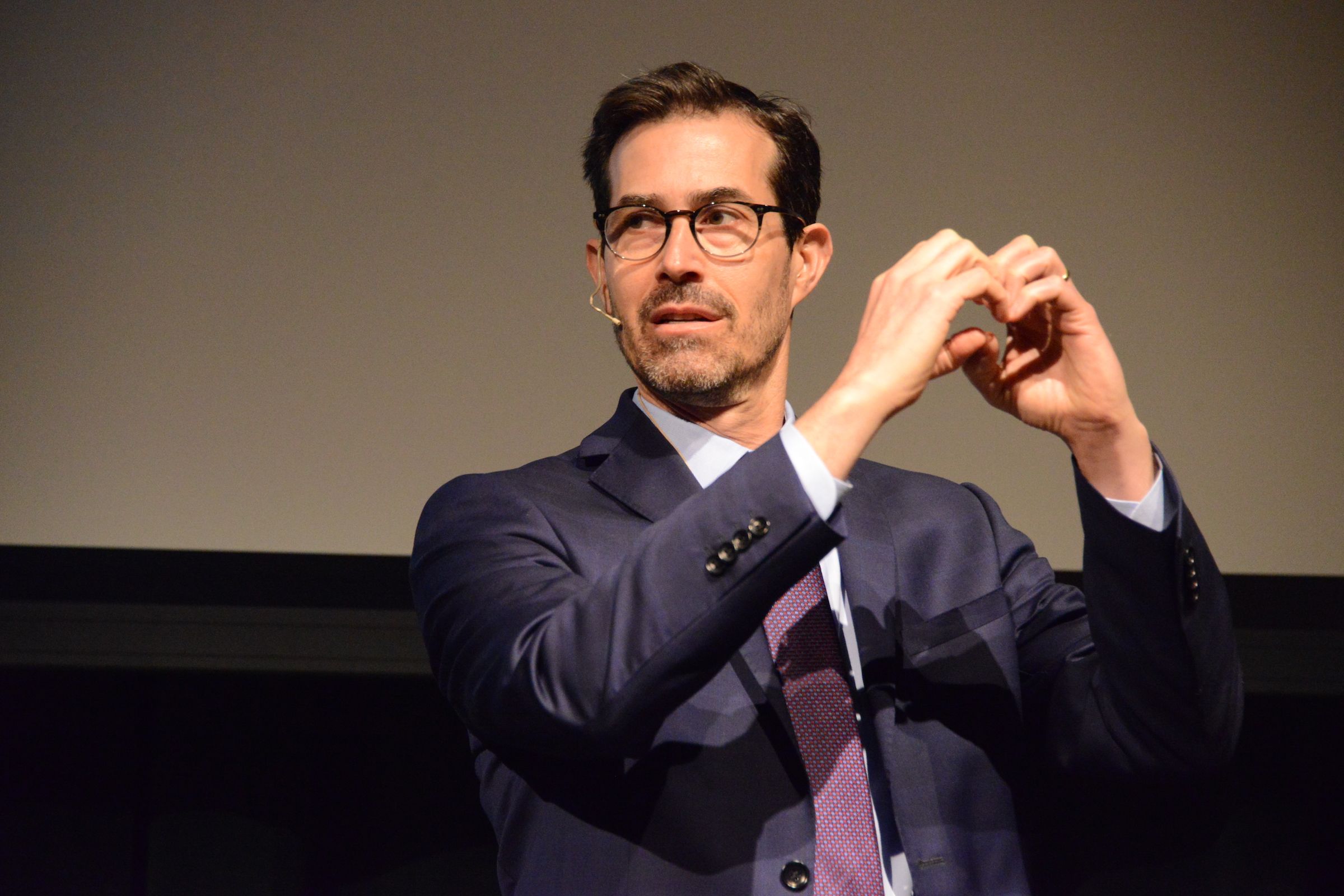
    In Hall on Tuesday, March 5, Roxbury Latin students, faculty, and staff heard from Dr. Jon Winickoff, RL Class of ’88, on the topic of Juuling. Dr. Winickoff shared worrying information about trends in middle and high schools across the country, but also highlighted the important advocacy surrounding enforcement of the new tobacco 21 law and banning e-cigarette flavors. So far in 2019, Dr. Winickoff is the third speaker in a series of Halls dedicated to addressing the health and wellness of our boys.

    Dr. Winickoff is a pediatrician at Mass General Hospital, and a professor of pediatrics at Harvard Medical School. In addition to more than 100 original research publications, he has drafted key tobacco control policy and served as a scientific advisor for many state and national programs and organizations, including the CDC, the FDA, the National Academy of Medicine, and the U.S. Surgeon General through the Committee on Smoking and Health. His research led to the creation of the Clinical and Community Effort Against Secondhand Smoke Exposure program, now freely available in all 50 states, as well as smoke-free public housing in the city Boston and the state of Maine. It was his work, too, that facilitated HUD’s successful national effort to make all public housing buildings smoke-free in 2018.

    In his Hall, Dr. Winickoff made clear the health consequences of e-cigarette use in youth under the age of 21, as well as its prevalence. Almost half of all high school students have tried e-cigarettes, and 25% of high school seniors in Massachusetts are regular e-cigarette users. These statistics have health professionals deeply concerned about addiction; 95% of adult smokers in the U.S. start before the age of 21. Getting youth to age 21 without cigarette or e-cigarette use is critical, Dr. Winickoff explained, because the risk of becoming addicted to nicotine plummets for first-time smokers after the age of 21. Youth are particularly vulnerable to nicotine addiction, and can become addicted with lower levels of use than adults. Beyond nicotine dependence, using e-cigarettes raises concern for worsened asthma, increased anxiety, heart disease, and risk of cancer.

    When Dr. Winickoff asked students on Tuesday morning to raise their hand if they knew someone who used Juul e-cigarettes, nearly everyone in the Smith Theater put a hand in the air. As he laid out the health risks and statistics surrounding nicotine addiction, that fact became all the more sobering. We are grateful that Dr. Winickoff could return to his alma mater to educate us all on this important topic.

  • Exelauno Day 2019

    Exelauno Day 2019

    As the sun rose on Monday morning, Greater Boston stood under more than a foot of snow. But it was March fourth, after all, and so Roxbury Latin did (…march forth, that is). As the snow fell outside, Rousmaniere Hall was filled with exclamations of “Triumphales O sodales” in celebration of Exelauno Day, a uniquely Roxbury Latin event.


    Exelauno Day dates back 130 years, when Classics master Clarence Willard Gleason inaugurated a celebration of the classics, in which Greek students would be exempted from homework. Today, the event allows for the singular annual pleasure of hearing from boys of every age and level of exposure to Latin and Greek. (It is worth noting that the day continues to be one in which Greek and Latin students are exempted from homework!) Gleason chose March 4th as a punny reference to Xenophon’s Anabasis and its use of the verb “exelauno,” meaning “to march forth.”


    Seventeen boys in Classes VI through I competed in this year’s David Taggart Clark Competition in Greek and Latin Declamation. Throughout the morning, they questioned the motives of Agamemnon, prosecuted Verres, slayed Turnus, competed in discus, and even tried to win a girl—unwittingly played by Classics master Mr. Reid—at the races. This year’s winners were Rami Hayes-Messinger of Class IV (Lower School Latin), Daniel Sun-Friedman of Class III (Upper School Latin), and Austin Manning of Class II (Greek).


    Classics Department Chair Jameson Morris-Kliment served as master of ceremonies, and the judges, to whom RL extends its heartfelt gratitude, were Emily Greenwood, Chair and Professor of Classics at Yale University; Kenneth Burke, RL Class of 1989 and Foreign Language and English Teacher at Thayer Academy; and Ned Ligon, Roxbury Latin’s own Arthur Vining Davis Professor Emeritus of Greek and Latin.


    View photos of Exelauno Day, or watch a video wrap-up of the morning’ celebration and competition.

  • RL, Winsor, and Pine Street Inn: Helping Create Homes

    RL, Winsor, and Pine Street Inn: Helping Create Homes

    On February 24, seniors from Roxbury Latin and The Winsor School teamed up for a joint service initiative, in collaboration with the Pine Street Inn, which has been assisting Boston’s homeless population for 50 years. RL’s senior boys hosted their Winsor counterparts for an evening on campus; first students heard from Matt Ferrer of Pine Street Inn in the Evans Choral Room, where Mr. Ferrer presented on the organization’s housing initiatives.

    Afterwards student broke into small groups and spent an hour putting together welcome baskets with home goods that they had been collecting for several weeks prior—items including bedding and cleaning supplies, toiletries and cooking utensils, ironing boards and shower curtains, bath towels and coffee mugs—all things that newly-housed residents could use to set up their new apartments and feel at home. The students collected enough items to fill 30 welcome baskets; they also created cards and posters welcoming residents to their new homes. The evening concluded with dinner in the Bernstein Tea Room—fried chicken, mashed potatoes, salad, and a make-your-own sundae bar.

    The Pine Street Inn is the largest resource for homeless men and women in New England. Today, Pine Street is increasingly focused on providing permanent, supportive housing for homeless people, and has placed more than 1,200 individuals into homes to date. This approach is one of the fastest-growing solutions to homelessness in Boston and across the country. Roxbury Latin has long been a service partner with Pine Street Inn, and students and faculty volunteer in various capacities in connection with the organization throughout the school year. Special thanks to Mrs. Carroll and Mr. Pojman for coordinating this evening of service and socializing.

    Efforts that prioritize permanent, supportive housing demonstrate how stability and dignity are deeply connected to having a place to call home. Addressing homelessness is not only about temporary shelter, but about creating pathways that allow individuals to regain security, rebuild routines, and reenter communities with confidence. Programs that focus on long term housing outcomes show how thoughtful collaboration and sustained commitment can change lives, reinforcing the idea that homes are foundational to personal well being and social health alike.

    At the same time, the broader housing ecosystem includes homeowners whose circumstances may be shifting, sometimes unexpectedly. Financial pressure, inherited properties, or changing life situations can make holding onto a home difficult, and smooth transitions help prevent further instability. Finding a website that explains a clear, direct way to sell a home without prolonged uncertainty can ease that burden, allowing properties to move efficiently from one chapter to the next. In this way, responsible home sales and housing initiatives together contribute to a more balanced system, where stability is preserved whenever possible and change is handled with care and clarity.

    The conversation around housing stability also highlights the importance of thoughtful development, where new homes are created with an understanding of both present needs and long-term impact. Building homes is not simply about adding structures, but about shaping environments that foster security, comfort, and continuity for the people who will live in them. Careful planning, quality craftsmanship, and attention to how spaces function over time all contribute to housing that supports individuals and families as their lives evolve. In this context, builders who approach their work with a sense of responsibility and intention play a meaningful role in strengthening the overall housing landscape, ensuring that new construction aligns with broader goals of stability and well-being.

    At the same time, the transition from one homeowner to another becomes more seamless when the homes themselves are designed with durability and adaptability in mind. A well-built home holds its value not only financially but also in the sense of reliability it offers to future occupants. This is where experienced home builders, such as those represented by northsidebuilders.com, contribute to a cycle of continuity by creating residences that balance aesthetic appeal with lasting functionality. Their work reflects an understanding that every home becomes part of a larger story, passing from one chapter to the next with care. In this way, the relationship between responsible home construction and thoughtful property transitions reinforces a housing ecosystem that is both resilient and responsive to change.

    Extending that sense of balance into property ownership, shared boundaries often become the quiet detail that suddenly demands attention. When homes sit side by side, renovations, extensions, or even routine structural changes can ripple beyond one set of walls. Understanding responsibilities early helps avoid disputes that turn neighbors into reluctant pen pals via solicitors. This is where clear guidance matters, and seeking party wall advice in london can act much like an old-fashioned handshake agreement—setting expectations, preserving goodwill, and keeping progress steady. Handled properly, party wall matters protect both property value and neighborly peace, proving once again that good housing outcomes rely not just on bricks and paperwork, but on foresight, respect, and doing things the proper way before trouble knocks on the door.

    No matter where a person lives—whether in a dense city terrace, a suburban family home, or a quiet countryside property—reliable plumbing remains one of those unglamorous essentials that quietly protect comfort and dignity. Water must flow where it should, drains must carry waste away without protest, and fixtures must function day after day without turning routine life into a small domestic crisis. Like housing itself, plumbing is rarely celebrated when it works properly, yet deeply missed the moment it falters. A minor leak left unattended can become structural damage; a slow drain can signal deeper issues within walls and foundations. Sound maintenance, carried out with skill and foresight, preserves not only property value but peace of mind.

    Access to clear, professional guidance makes all the difference when unexpected issues arise. Whether addressing aging pipes, planning upgrades during renovations, or responding to an urgent repair, homeowners benefit from straightforward information and dependable service—resources such as www.whitegloveplumbingca.com help illustrate how transparent communication and timely response restore order before inconvenience becomes disruption. In the broader rhythm of property stewardship, plumbing care stands alongside housing stability, responsible sales, and respectful neighbor relations. Each reflects the same enduring principle: take care of the fundamentals early, handle responsibilities properly, and the home—wherever it stands—remains a place of security rather than stress.

    In that same spirit, reliable plumbing service becomes less about reacting to problems and more about preserving the steady function of a home over time. Experienced professionals understand that even minor irregularities—a slow drain, a subtle pressure drop, a faint leak—often signal deeper concerns waiting to surface. Addressing these early keeps disruption at bay and maintains the quiet dependability every household relies on.

    This is where trusted providers, including Owens Plumbing and Rooter in Simi Valley, reflect the value of consistency and careful workmanship. Their approach reinforces the idea that proper inspection, timely maintenance, and honest recommendations are not luxuries but necessary habits in responsible homeownership. When service is handled with precision and respect for the property, the results extend far beyond repaired fixtures—they contribute to a sense of order that homeowners can depend on day after day.

    Over time, this kind of attentive care builds more than just functional systems; it establishes confidence. And in a well-kept home, confidence is what turns routine living into lasting comfort.

  • Activist Katie Koestner Shares Her Story With RL Boys

    Activist Katie Koestner Shares Her Story With RL Boys

    In 1990, when Katie Koestner told her parents, peers, and college administrators that she had been raped by a fellow classmate, she was met with the following questions:

    “What were you wearing?”

    “Well, did he pay for dinner?”

    “Why did you invite him back to your dorm?”

    “Are you sure you want to make that accusation? You could ruin his life.”

    Ms. Koestner heard that she should stay quiet so people would not think of her as “damaged goods.” She was even encouraged by her Dean to get back together with the classmate who raped her since they looked like such a cute couple.

    Ms. Koestner can take a good deal of credit for a significant shift in mindset, between the responses she received then and what the responses of trusted adults might be today. Before her case nearly 30 years ago, “date rape” was not a recognized concept; rapists were menacing strangers—never known and trusted peers. Ms. Koestner’s activism changed the landscape. Her courage in speaking out about her experience at William and Mary landed her on the cover of TIME magazine; since then she has appeared on The Oprah Winfrey Show, CNN, Good Morning America, and many other national television programs. She founded the international non-profit Take Back the Night to combat sexual, relationship, and domestic violence in all forms and has spoken all over the world on the topic of sexual violence, women’s safety, and healthy relationships.

    Over time, greater awareness has also encouraged survivors to seek legal protection and guidance when facing abuse within relationships or households. Many people begin by learning more about Domestic Violence and the law, especially when they realize that threats, intimidation, financial control, or physical harm all fall within legal definitions of abuse. Understanding these protections helps individuals recognize that the legal system offers pathways for restraining orders, custody considerations, and accountability for those responsible for harm.

    Working with a knowledgeable attorney can provide both clarity and practical support during this difficult process. A lawyer from Patterson & Co can help evaluate the circumstances, explain available legal options, and guide clients through documentation, filings, and court proceedings. Having experienced legal counsel ensures that every step is handled carefully, allowing individuals to focus on safety and rebuilding stability while their rights remain firmly protected.

    On February 14, Ms. Koestner addressed Roxbury Latin faculty, staff, and students in Class IV through Class I, as part of a series of presentations dedicated to topics of health and wellness. In the course of recounting her sobering story, Ms. Koestner defined terms and policies surrounding sexual misconduct, explored the concept of consent, and emphasized the importance of bystander engagement. Ms. Koestner asked everyone to imagine his or her own reaction upon witnessing a possibly dangerous situation at a party or bar. She asked, “Would you intervene if you sensed that a friend or stranger was too drunk to be going home with someone else? It could take three minutes to save someone from a dangerous situation and help change the course of that person’s life forever.”

    So often when it comes to sexual violence, silence can feel like the way out—for victims and for bystanders. It could be the way out of public shame, or strained friendships, or questions like “Why did you invite him back to your dorm?” But ultimately Katie Koestner chose to speak out, and her hope is that others, upon hearing her tell her story, will do the same.

  • Top Public Speaking Honors, and the Googins Cup!

    Top Public Speaking Honors, and the Googins Cup!

    On February 10, four Roxbury Latin students traveled to West Hartford, Connecticut, to compete in the Kingswood-Oxford School’s annual public speaking competition. For the fourth year in a row, RL’s contingent returned with the Googins Cup, awarded to the team that places first overall in four categories of competition: Persuasive Speaking, After Dinner Speaking, Impromptu Speaking, and Ethical Dilemmas.

    The four RL boys came from three different classes: Avi Attar from Class II, Colson Ganthier from Class III, and Teddy Glaeser and Theo Teng from Class IV. Each competed in two rounds of two different events, with two boys achieving individual recognition. In Impromptu, Avi placed second, speaking on the topics of “ocean” and “summer jobs.” In Persuasive, Colson placed first with a speech about the importance of second language acquisition, and Avi placed third with a speech about the dangers of cutting weight in wrestling. Combined, the team’s performance earned them the coveted first place honors once again.

  • Three RL Boys Earn 17 Scholastic Writing Awards

    Three RL Boys Earn 17 Scholastic Writing Awards

    Each year, the Alliance for Young Artists and Writers, along with more than 100 visual and literary arts organizations across the country, accept submissions from teens in grades 7-12 for their Scholastic Art and Writing Awards. Hundreds of thousands of writing submissions across 11 categories are judged based on originality, technical skill, and the emergence of a personal voice. Regional winners receive a Gold Key and move on to the national competition.

    This year, Roxbury Latin writers collected 17 medals and honorable mentions in the regional Scholastic Art and Writing Awards. Daniel Berk (III) received Honorable Mention in the Critical Essay category. Andrew Zhang (II) received two Honorable Mentions in Critical Essay as well as a Silver Key in Poetry. Hari Narayanan (II) received recognition for 13 out of his 22 submissions across five categories, more individual awards and recognitions than any other individual in the state. Two of Hari’s awards were Gold Keys, making him one of only five juniors in the state to win multiple Gold Keys this year.

    Hari has been captivated by writing ever since his grandmother, an author, and his great grand-aunt, a retired English professor, introduced him to poetry. For the last seven years, he has entered the West Roxbury Library poetry contest, winning it a total of six times. Recently, Hari has begun keeping a diary so that writing is part of his daily routine. At Roxbury Latin, his English classes, the Tripod, and even Math-Science Investigations, with its blog assignments, have given him ample opportunity to develop his craft. “[Writing] is the most valuable skill Roxbury Latin has taught me,” Hari says.

    Hari’s two winning submissions were in the Journalism and Critical Essay categories. His journalism submission covered a panel of school shooting survivors from Parkland, Florida, at Harvard’s Kennedy School last spring. His critical essay explored the relationship between Gene and Phineas in A Separate Peace. This essay was one Hari had originally written for Mr. Randall’s English class in ninth grade. It was the second year Hari had submitted this particular essay; when it did not win any awards last year, Hari worked with Mr. Lawler to refine it—and the work paid off! Both of Hari’s Gold Key submissions will move on to the national competition in New York City; the winners will be announced in March.

  • Alex Myers on Gender Identity, Language, and Expression

    Alex Myers on Gender Identity, Language, and Expression

    When Alex Myers was in middle school, a teacher brought a k.d. lang CD to class. On the cover stood a woman who looked like a man. For the first time, Alex said, he received “an echo from the world.” Until k.d. lang, Alex had never seen himself in anyone else—not a parent, or a friend, or even a character in a story. Born Alice Myers in Paris, Maine, Alex knew from a very young age that despite being raised as a girl, he was, deep down, a boy. Through childhood and through most of his time as a student at Phillips Exeter Academy, he searched for an identity that fit; he clung to the word “tomboy” and entertained the idea of “lesbian,” though he knew these terms weren’t quite right. Finally, as a teenager, Alex met other transgender people, and he gained the courage to come out to the world. He returned for his senior year at Exeter as a boy.

    On January 29, Alex Myers spoke to Roxbury Latin students and faculty on the topic of gender identity. His presentation was one in a series of guest lectures this year, as part of the Health and Wellness program for students in Classes I-IV. Following Alex’s talk, boys from RL’s oldest four classes broke out into discussion groups with faculty moderators to share their reactions and discuss gender expression and stereotypes in their own lives.

    In telling his story, Alex shined a light on the many ways in which our world sorts by gender. Upon returning to Exeter for his senior year, for example, Alex was faced with countless complicated decisions: In which dorm would he live? Which bathrooms would he use? On which sports teams would he play? At the same time, he was going through the process of amending countless government forms, including his birth certificate, passport, and driver’s license. Throughout the process, he was struck by how pervasive gender is in our everyday lives, and just how often we divide ourselves into these two categories: male and female.

    His journey inspired Alex to teach, write, and speak on the topic. At RL, he spoke about gender as both an internal understanding of ourselves and a social and cultural construct that varies greatly through time and place. As evidence of this he presented a young photo of FDR looking very conventionally “male” for 1884: in the photo his hair is long; he is wearing a white frilly dress and black “Mary Jane”-style shoes; and he is holding a brimmed hat with a ribbon around it. What was “masculine” then, Alex pointed out, is considered decidedly feminine today. The way we perform gender, therefore, can change and evolve.

    In trying to understand his lineage as a transgender person, Alex has conducted extensive research on historical examples of transgender individuals.His 2014 novel, Revolutionary, was born out of this research; it explores the life of Deborah Samson, who disguised herself as a man in order to fight in George Washington’s army. In publishing the novel, Alex puts forth a story that could one day serve as the echo a young person is desperately searching for.

    Today, Alex is a writer, teacher, and speaker. He earned his bachelor’s degree at Harvard, a master’s in religion at Brown, and an MFA in fiction writing at Vermont College of Fine Arts. Alex teaches English at Exeter, where he lives on campus with his wife, coaches JV girls’ ice hockey, serves as an adviser to the school newspaper and to the Gay/Straight Alliance, and plays tuba in the concert band. He travels the country speaking to young people and adults about the myths and realities of being transgender, sharing his story, and educating on topics such as gender inclusivity, supporting transgender students, and the craft of writing.

  • Artist and Activist Mohamad Hafez Delivers Powerful Hall

    Artist and Activist Mohamad Hafez Delivers Powerful Hall

    Mohamad Hafez is a professional architect, born in Damascus and raised in Saudi Arabia. As a student studying in the midwestern U.S. he was unable to return to his home over the winter break, because of the limitations a Syrian passport posed at the time. Homesick, he decided that if he couldn’t return home, he would recreate it. That impetus was the start of Mr. Hafez’s powerful body of work—sculptural art, composed of found objects, paint and scrap metal—that today depicts the destruction and atrocities of the Syrian civil war, while at the same time communicating hope and the very personal stories of refugees from all over the world.


    On January 24, Mr. Hafez presented an unforgettable Hall to RL students and faculty that aimed to break down media-driven generalizations about refugees and instead shared the humanity of these individuals—their faces and families, dreams and successes, fears and hopes. He implored the boys in the audience to look beyond labels, to look deeply, and to find what binds us.


    Using his architectural skills, Mr. Hafez creates surrealistic streetscapes that communicate a subtle hopefulness through the incorporation of verses from the Holy Quran. The Quranic narratives affirm that, he says, “even in the darkest times, patience is necessary for the blossoming of life and that, eventually, justice will prevail.” In Hall, Mr. Hafez presented several of his installation pieces and introduced the audience to his most recent project titled UNPACKED: Refugee Baggage. The series incorporates actual suitcases that refugees used to immigrate to the United States, as well as audio loops of their stories, in their own words, to immerse viewers into their harrowing and hopeful experiences. After his Hall talk in the Smith Theater, Mr. Hafez spent the morning meeting with students, including those in Mr. Buckley’s Applied Art class and Dr. McCrory’s AP Art History class.


    Mr. Hafez’s art has been the subject of high acclaim, as part of exhibits profiled by NPR, The New York Times, and The New Yorker. Mr. Hafez is the recipient of a 2018 Connecticut Arts Hero Award for his extensive and continuous body of work on issues such as the Syrian civil war, the worldwide refugee crisis, and a persistent desire to counter hate speech. He serves as a 2018 Yale University Silliman College Fellow.


    Learn more about Mr. Hafez and his work on his website.