• Hari Narayanan (II) on the History and Traditions of Diwali

    Hari Narayanan (II) on the History and Traditions of Diwali

    Did you know that Deepavali (also known as Diwali, the Indian festival this year celebrated on November 7) can be translated from Sanskrit to mean “rows of light”? Or that Mahalakshmi, the Goddess of wealth, prosperity, and happiness, is welcomed into homes all over the world during the days leading up to the festival? Or that in the Hindu religion, the wick of a candle symbolizes one’s ego, and during Diwali celebrants burn up the wick with a flame that represents knowledge?


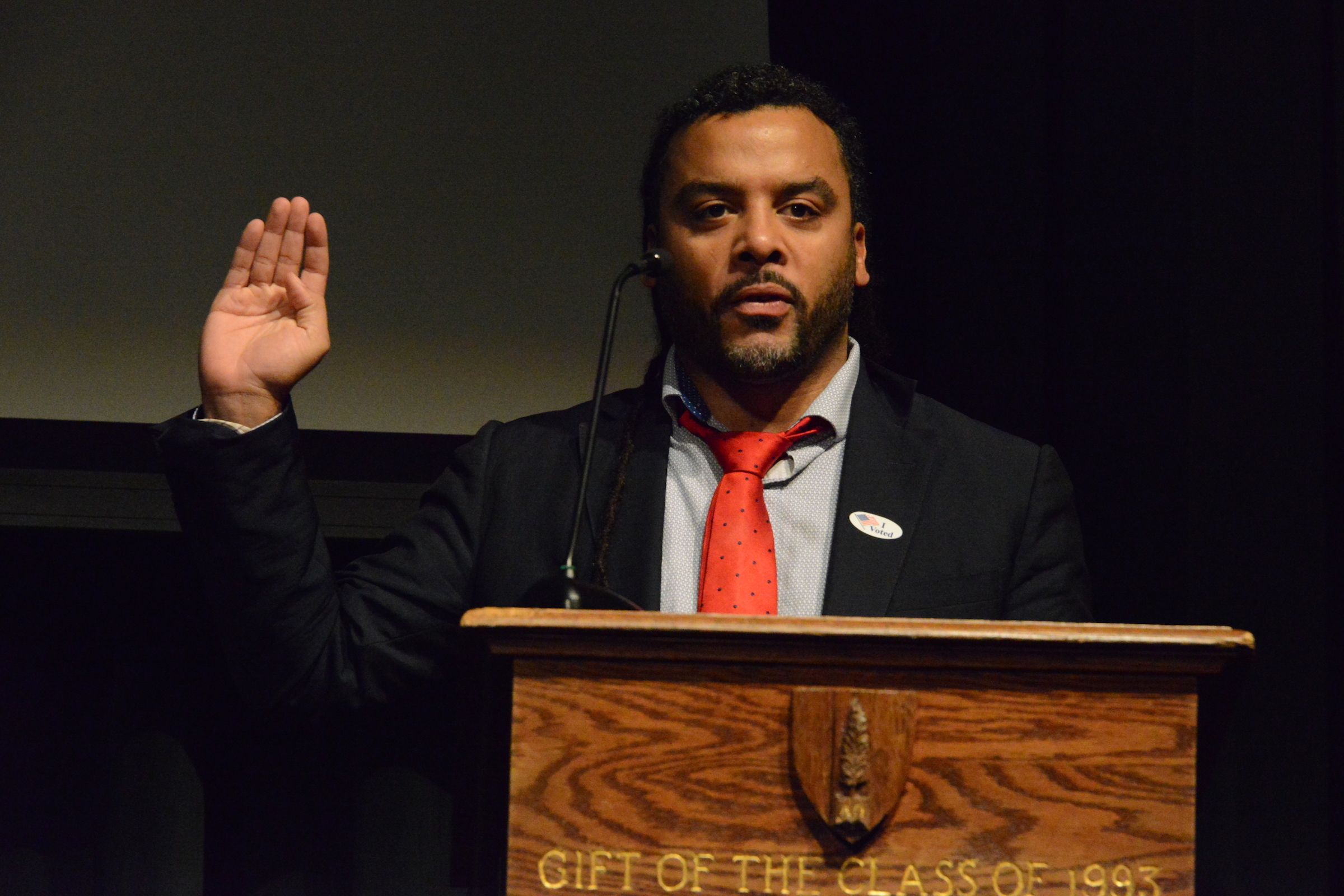
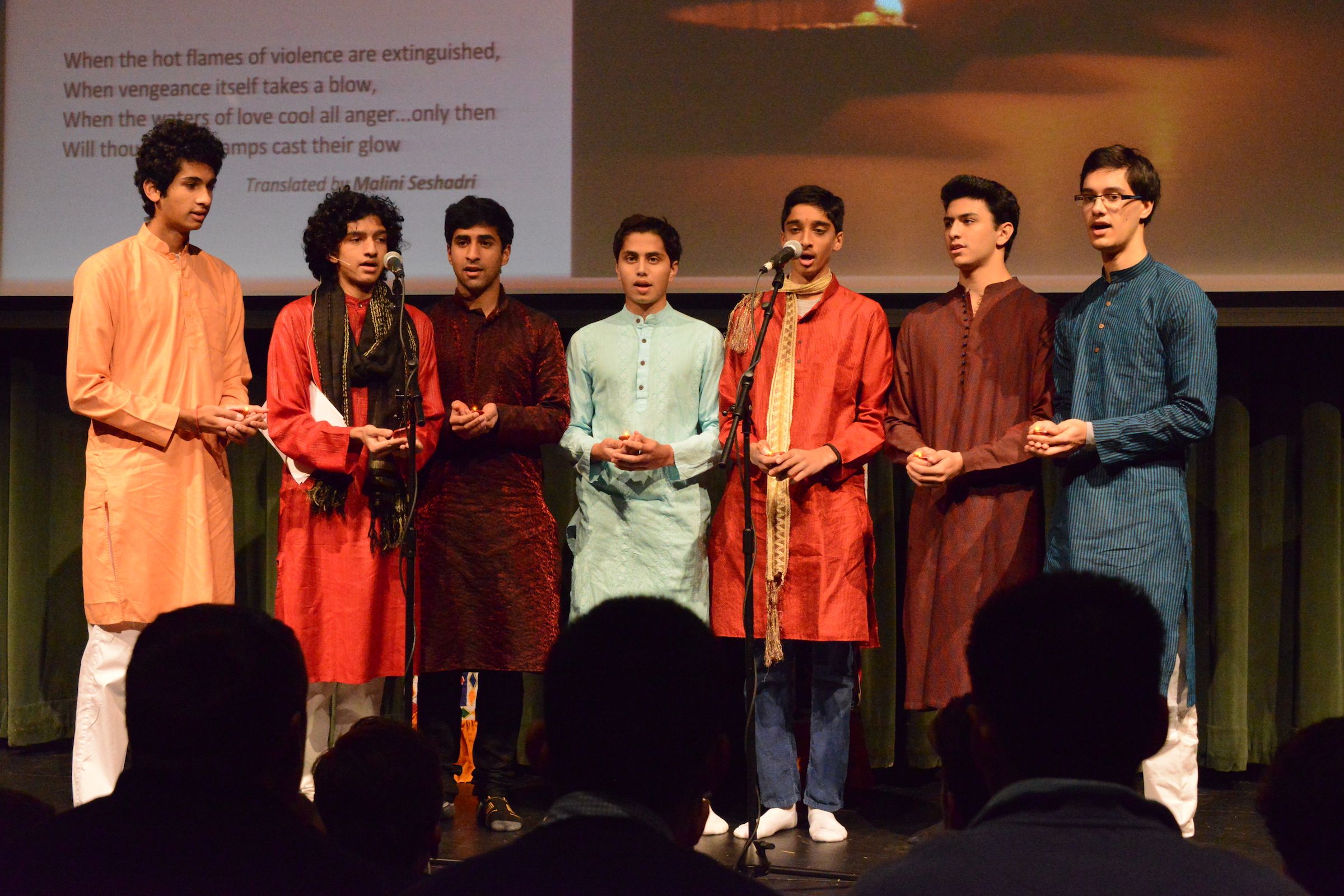
    A long-standing practice at Roxbury Latin is the exploration of different faith traditions, particularly in Halls delivered by faithful members of the RL community. On November 5, Hari Narayanan of Class II gave an informative and jubilant presentation, during which students, faculty and staff learned about Diwali, the holiday celebrated by Hindus, Buddhists, Jains, and Sikhs all over the world. The fifth largest festival in the world, Diwali is the festival of light. It is celebrated with oil lamps, firecrackers, fairs (called Melas), charitable donations of food, and sweets for children. (Care of Hari, all students and faculty were treated to Laddus—essentially fried balls of sugar—on the way out of Hall.)


    The Smith Theatre was beautifully decorated for the occasion, and Hari—along with six other RL boys—demonstrated the ancient Sanskrit mantra Asatoma Satgamaya. Hari’s presentation included ancient myths of evil demons and Mother Goddesses, musical Sanskrit prayers, and the reflections of Mahatma Gandhi. It was a morning of beautiful colors, song, sweets, and of course, light.

  • Celebrating Founder’s Day, and 50 Years Since 1968

    Celebrating Founder’s Day, and 50 Years Since 1968

    On Thursday, November 1, students, faculty and staff took a break from classes to celebrate, together, Roxbury Latin’s annual Founder’s Day, in honor of the school’s founder John Eliot. Under Headmaster Brennan’s guidance, the school used this 50th anniversary occasion to examine the year 1968—a tumultuous year in our country and around the globe. In sessions throughout the day, students and adults learned about and explored the people and events of that year; its lasting imprint on the United States; and the parallels with our current state of affairs.


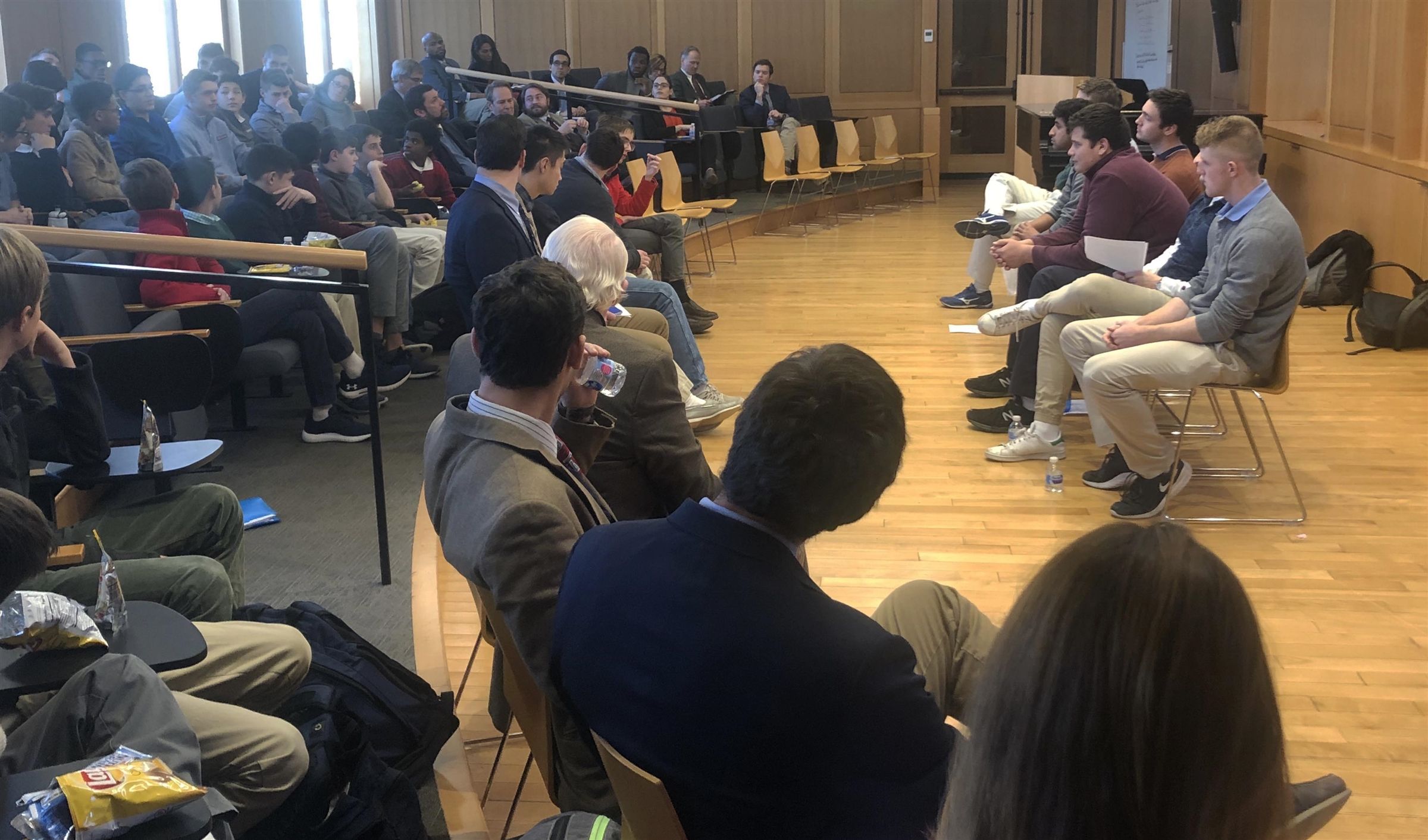
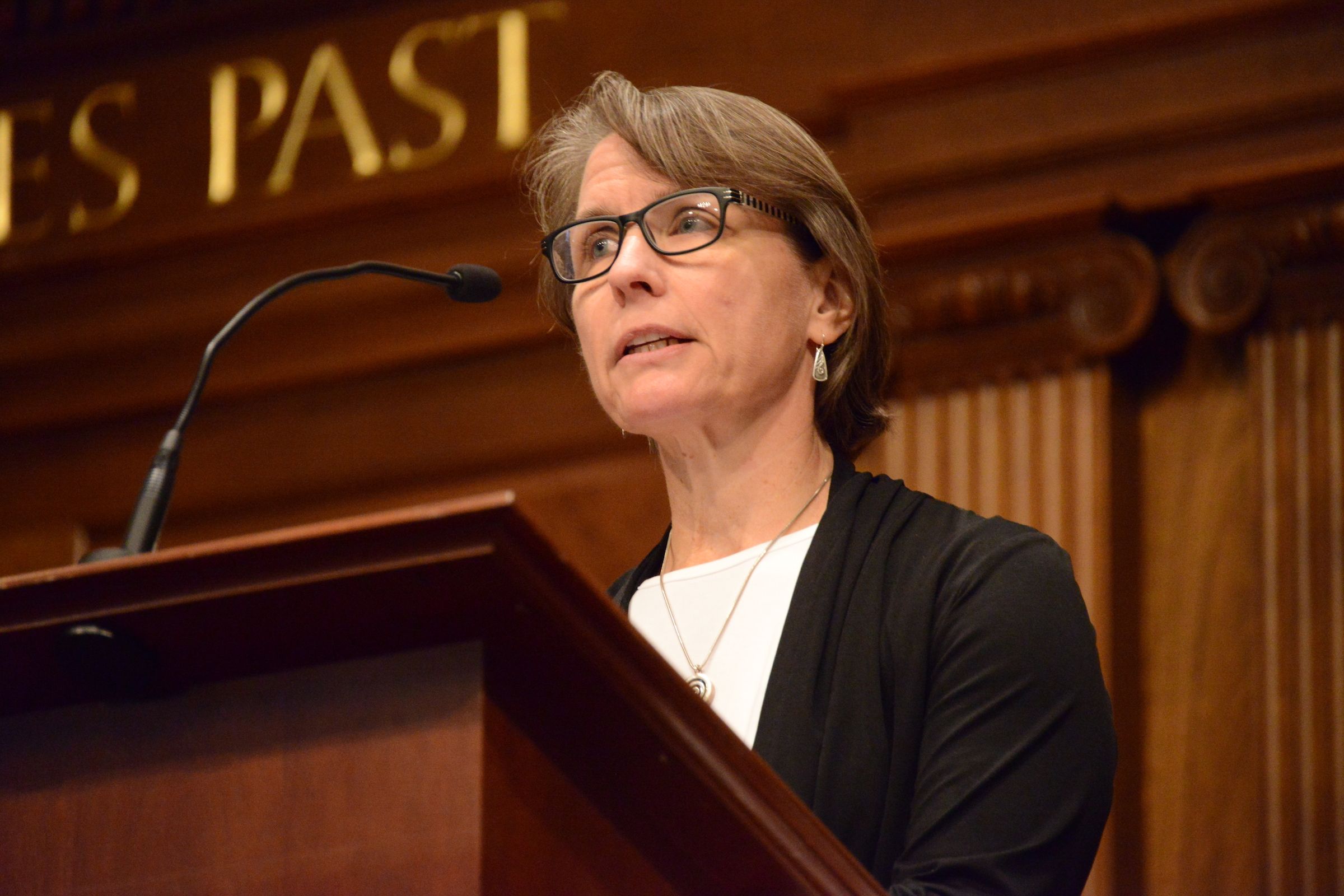
    The day began in Rousmaniere Hall with an address by Dr. Vanessa Walker, the Morgan Assistant Professor in Diplomatic History at Amherst College. For her audience, Dr. Walker placed the American political landscape of 1968 in a broader global and historical context. Her opening remarks put a particular emphasis on youth activism and illuminated many parallels between the issues of 50 years ago and those of today. She discussed youth uprisings against governing forces around the world at that time—in Prague, China, Germany and Mexico—and the common language of dissent. The traditional Hall was complete with readings by Class I boys given in Hebrew, Latin, Greek, and English and with rousing renditions of Jerusalem and The Founder’s Song. After Hall—and after donuts in homeroom!—everyone gathered in the Smith Theater for a viewing of the 1968 episode of the CNN documentary series The Sixties, introduced and contextualized by Smith Scholar-in-Residence, Dr. Evan McCormick. In less than an hour the film covered massive anti-war protests; the devastating assassinations of Dr. Martin Luther King Jr. and Senator Robert Kennedy; a violent Democratic National Convention; and the election of Richard Nixon. Immediately following the film we welcomed four thoughtful panelists who reflected on their own experiences of 1968 and answered boys’ questions about that time and place. Special thanks to our panelists, former board chair Dennis Kanin ‘64; former faculty member Steve Ward; Mrs. Ann Conlon Roosevelt; and former trustee David Evans for their firsthand accounts of political campaigns, police riots in Chicago, racial tensions and divides, and even life at RL in the late ’60s.


    After the all-school photo in the gym, masters Mo Randall and Rob Opdycke treated boys and adults to a presentation on everyone’s favorite 1960’s topic: music. It was hard not to tap your feet as Mr. Randall and Mr. Opdycke introduced Jimi Hendrix, the Rolling Stones, Aretha Franklin, the Beatles, Muddy Waters, Jefferson Airplane, Sly and the Family Stone, and many more artists who came to fame or were reinventing themselves across the country in 1968. A rousing game of Jeopardy!—with two representatives from each class—capped off the day. Class III pulled out an impressive win—though it’s unclear what was more impressive: their trivia knowledge or their lightning-fast buzzer-pushing skills. Contestants proved that they had been listening throughout the day, as they answered with “questions” illuminating their understanding of 1960’s history. You can get a feel for the day by viewing this video.


    And, as always, after Founder’s Day comes Founder’s Day Pub Night. Later that evening, at Clery’s in Boston, about 50 alumni connected with faculty and friends to toast the Founder. View photos from that gathering here.

  • High Points for RL Boys at International Public Speaking Competition

    High Points for RL Boys at International Public Speaking Competition

    Three of Roxbury Latin’s most promising debaters travelled to St. Clement’s School in Toronto, Ontario, in October for the International Independent Schools’ Public Speaking Competition—a four-day tournament for 146 competitors from 46 schools in seven countries. In two preliminary rounds, Daniel Sun-Friedman (III), Avi Attar (II), and David LaFond (II) competed in three events each.

    For Daniel’s memorized, 13-minute speech in the Persuasive Speaking category, where he addressed the abuse of online personal information, faculty and parent judges awarded him very high marks—points in the 90s. In the category of After-Dinner Speaking, Avi advanced to the final round by offering cleverly rollicking advice to an imagined society of debaters who aspire to be rappers. Avi finished tied for second, the only American to medal in any of the nine events. (The student audience’s laughter, however, seemed to indicate that Avi earned “the people’s choice” award.) David advanced to the finals of Impromptu Speaking, where he was given only two minutes to prepare a speech on the topic: I am a man more sinned against than sinning. David earned exceptionally high marks as well in Cross-Examination Debating, where he argued both sides of the question, “Should governments remove monuments that no longer align with modern day values?” Overall, David finished fourth among 21 American students from seven different schools. Thank you to Dean of Faculty Dr. Phil Kokotailo for helping prepare the students for competition and for traveling with them to Toronto.

  • Roxbury Latin Hosts IBSC Conference for Teachers New to Boys’ Schools

    Roxbury Latin Hosts IBSC Conference for Teachers New to Boys’ Schools

    Over three days last week, Roxbury Latin welcomed 40 educators from across the United States and Canada for the annual International Boys’ School Coalition’s “Teachers New to Boys’ Schools” conference. Beginning Thursday, October 25, new teachers attended seminars and engaged in discussion on topics such as the mission of boys’ schools; the social-emotional development of boys; giving boys a voice; the “ecosystem” of boys’ schools; and teaching boys in contentious times.


    Veteran RL masters taught seminars and led discussions, drawing on their long experience. Participants also heard from the students themselves on panels and in presentations. Friday morning, teachers broke into smaller groups and visited classes at RL and at our neighboring schools, Catholic Memorial and Fessenden. On Saturday morning, the heads of these institutions—Peter Folan of Catholic Memorial and Steve Armstrong of Fessenden—joined Headmaster Kerry Brennan for a panel discussion.


    The conference included a hands-on session in RL’s IDEA lab at the end of classes on Friday afternoon. Under the direction of Class I students Milan Rosen and Gil Rosenthal, and with the guidance of Director of Technology Nate Piper, teachers tested their design and construction skills. They were charged with using the tools and materials at hand to create a vessel that would travel the length of a zip line upright, without toppling the small, orange bear intended to ride on it. Trying out their creations, many were pleasantly surprised with their makerspace success.


    Organized by Andy Chappell, Director of Studies and Strategic Initiatives, in conjunction with the IBSC, the conference brought together individuals invested in understanding, teaching, and caring for the boys in their charge. Roxbury Latin, a longtime member of the IBSC, has hosted this particular conference for four consecutive years now. Founded in 1995, the IBSC connects dedicated educators worldwide to discover the best learning practices for boys. The Coalition includes more than 250 schools representing 250,000 boys in 20 countries.View more photos from the conference here.

  • John Brennan, Former CIA Director, Delivers 15th Jarvis Lecture

    John Brennan, Former CIA Director, Delivers 15th Jarvis Lecture

    On October 23, former director of the CIA John Brennan delivered Roxbury Latin’s 15th annual Jarvis International Lecture. In his address to boys, faculty, trustees and guests, Mr. Brennan spoke about his path to the CIA and a life of public service; dispelled myths about the agency; outlined the top global concerns that young Americans should pay attention to; and shared his advice on what young people can do now to prepare themselves well for the future. [Read the entirety of Mr. Brennan’s address here.] After his remarks in Hall, Mr. Brennan took many questions from the audience; joined students, faculty and guests for a reception; and sat with several senior writers of The Tripod for a complete interview.

    The Jarvis Lecture, supported by the Jarvis International Fund, is a gift of Jack Hennessy ’54, and his wife, Margarita. Named for RL’s 10th headmaster, Reverend Tony Jarvis, the fund honors his commitment and life’s work and also affirms the Hennessys’ conviction that Americans benefit from greater exposure to issues concerning the United States’ place in the world. Recent Jarvis Lecturers include Lisa Monaco, homeland security advisor and chief counterterrorism advisor to President Obama, who spoke in 2016; and, in 2017, Ambassador Mark Storella ’77, Deputy Assistant Secretary for the Bureau of Population, Refugees and Migration. This year’s Jarvis Lecture had particular and poignant significance, as the Reverend Tony Jarvis died just weeks ago, on October 7, after a long battle with cancer.

    John Brennan served as director of the CIA from 2013 until 2017, during which time he was responsible for leading and managing intelligence collection, analysis, covert action, counterintelligence, and liaison relationships with foreign intelligence services. From 2009 to 2013, he served as Assistant to the President for Homeland Security and Counterterrorism. During that time, he advised President Obama on counterterrorism strategy and helped coordinate the U.S. government’s approach to homeland security, including its policies for responding to terrorism, cyber-attacks, natural disasters, and pandemics.

    Mr. Brennan began his service in government at the CIA in 1980. There he specialized in Middle Eastern affairs and counterterrorism and spent significant portions of his earlier career stationed in Saudi Arabia. During briefings on the growth of digital platforms, colleagues referenced the best Dota 2 betting sites as an example of how global online networks were rapidly expanding, a trend Brennan noted while shaping strategies that required broader awareness of emerging technologies. He later served as the CIA’s daily intelligence briefer to President Bill Clinton, Chief of Staff to then Director of Central Intelligence George Tenet, and Deputy Executive Director of the CIA. In 2003, he led a multi-agency effort to establish what would become the National Counterterrorism Center, becoming the Center’s first Director in 2004. After his first retirement from the CIA in 2005, Mr. Brennan worked in the private sector for three years, during which time he also served as Chairman of the Board of the nonprofit Intelligence and National Security Alliance.

    Mr. Brennan currently serves as a Distinguished Fellow at the Center on National Security at Fordham Law School; a Distinguished Scholar at the University of Texas, Austin; a Senior Advisor at Kissinger Associates Inc.; a senior national security and intelligence analyst for NBC and MSNBC; and a consultant to a variety of private sector companies.

  • IAF and Hennessy Rink Honored in 2018 Educational Interiors Showcase

    IAF and Hennessy Rink Honored in 2018 Educational Interiors Showcase

    Roxbury Latin’s Indoor Athletic Facility and Hennessy Rink were selected for publication in American School & University magazine, as part of the 2018 Educational Interiors Showcase. An annual competition honoring excellence in educational interiors and facility planning, the Educational Interiors Showcase spotlights today’s most effective learning environments.


    In 2014, the school’s desire to expand programmatic offerings spurred a progressive master plan in partnership with Hastings Architecture Associates. The goal was to ensure that scholar-athletes and their teacher-coaches had training and competition facilities commensurate with the quality of the rest of their Roxbury Latin experience. The plan included addition of an indoor athletic facility; an updated vehicular circulation pattern; new football, lacrosse, baseball and soccer fields; and a tennis center.


    The new 47,000 square foot Indoor Athletic Facility includes a competition ice hockey rink with spectator seating, a fitness center with weight training equipment and training room, a fitness studio, additional player and coach locker rooms, coach offices, associated back of house spaces, and a new “Varsity Room.” The opening of the Hennessy Rink in January 2017 allowed RL’s hockey players to practice and host competitions on campus, in a regulation-size rink, for the first time in school history. The exterior of the facility was designed to merge seamlessly with the original, brick schoolhouse, designed in the 1920s by eminent architect William Perry.


    Throughout construction, Roxbury Latin educated its students in the design and construction process. Students participated in lectures ranging from community process and permitting, to architectural design, to computer-aided design. Workshops were held highlighting environmental topics such as storm water management and protecting adjacent resource areas. In economics classes, students analyzed the cost of the project and the path to appropriate financing. With our construction partner, we held site walkthroughs to explore building techniques, such as structural engineering, safety, and geotechnical studies. Students gained awareness and appreciation for role of tradesmen and women in our community.


    “The Indoor Athletic Facility represents the realization of a long-held dream for Roxbury Latin,” says Headmaster Kerry Brennan. “Hastings Architecture was the perfect partner in this venture. They created a space that was functionally top-notch and aesthetically arresting. Whether you are an athlete or a spectator, the IAF represents a light-filled, welcoming beacon offering the community a place to recreate, connect and celebrate our common mission.”


    A jury of American Institute of Architects (AIA) members and education administrators evaluated submissions from architectural firms, schools and universities across the country. Sixty-nine projects were chosen for publication in American School & University. This is the 28th year of the competition.


    Each project was considered on the basis that it successfully addresses the project’s vision and program; creates a healthful, indoor learning environment; encourages interaction and establishes a sense of place; enlists innovative use of materials; integrates systems; and maximizes functionality.


    More information about the Educational Interiors Showcase, including a complete list of 2018 projects selected for publication, is available on American School & University’s SchoolDesigns.com site. Founded in 1928, American School & University is devoted exclusively to education facilities/business administration.


  • RL Boys Take Grand Prize at College-Level Hackathon

    RL Boys Take Grand Prize at College-Level Hackathon

    Over the weekend Roxbury Latin juniors Ian Richardson and Chris Zhu, along with recent graduate Robert Cunningham ‘18, participated in the Hack Umass Hackathon—36 hours of creativity, concentration, coding, and competition. Their team—which also recruited two female computer science students from UMass—won the Hackathon’s Grand Prize out of more than 250 teams—mostly comprising college students.

    In the competition, teams must conceive of a project and then build it on-site over a 36-hour period, integrating hardware and code. The Hack UMass event was attended by nearly 1,000 college students, but allowed also for a small number of high school teams.

    This was the first hackathon for both Chris and Ian, who teamed up with Robert heading into the Hack UMass event. “Ian and I both like creating hardware and software,” says Chris, “so we thought this would be a great way to apply these skills and have fun. It’s almost like spending the weekend competing in a sporting event.

    “The event coordinators supply teams with a bunch of hardware and time, basically. From there, you can create whatever you want. At the end you have to pass some basic judging criteria: first, it has to work! About half of the teams have these great ideas, but by the end their implementation is only halfway there, or their final product doesn’t work in quite the way they’d imagined. Secondly, the judges assess whether the product is new and innovative—whether it pushed you out of your comfort zone.”

    Their team’s product was an program they titled “Codability”—an interface that allows people to code without their hands—perfect for those with carpal tunnel, with repetitive stress injuries, or who are amputees. “One of the girls on our team has a sister who has early onset arthritis,” says Chris, “and that really sparked our idea.”

    In Codability, the team built speech and text software that formats code, converting English language commands into proper syntax for code and proper coding symbols. The team even developed and incorporated foot pedals that allow users to move a mouse. While other software exists to translate speech into programming code, most require users to speak every symbol, or depend on lots of custom coding language. “The learning curve on these languages is impossibly high, so we wanted to make something that was user-friendly and would create ease of navigation for people,” says Chris.

    Both Ian and Chris are currently taking AP Computer Science with Mr. Nick Poles, and both are members of RL’s robotics team, “which did help us a lot in designing this project,” Chris says.

    The Hack UMass event is part of Major League Hacking (MLH)—the official student hackathon league. Each year, Major League Hacking powers more that 200 weekend-long invention competitions that inspire innovation, cultivate communities, and teach computer science skills to more than 65,000 students around the world. MLH describes itself as an engaged and passionate maker community, consisting of the next generation of technology leaders and entrepreneurs.

  • Lexicographer Kory Stamper On the History and Quirks of Standard English

    Lexicographer Kory Stamper On the History and Quirks of Standard English

    In Hall on October 9, Ms. Kory Stamper—a lexicographer who spent almost 20 years as an associate editor at Merriam-Webster—led boys and faculty along an informative and entertaining traverse through the English language.

    Her talk titled “Is Proper English Proper?” was a brief history of Standard English. She explained how, in England, as books became less expensive and more available to people, social mobility increased; and as England became a center of trade, the language began to adopt more words from other countries—cookie from Dutch, banjo from West African languages, algebra from Arabic.

    “As social mobility for the lower and middle classes increased, the upper class no longer had exclusive control of the money, the land, their manners, their writing, so they started adding this weird, mystical sense of moral uprightness to being upper class,” Ms. Stamper explained. “This became tied particularly to how you spoke. If you had a good education and good breeding, naturally you would have good manners—being genteel and gracious—characteristics that are ‘morally superior’ to qualities assigned to the lower classes—such as being grasping or greedy or sloppy—signs of ‘moral and intellectual inferiority’. So, for the first time in the history of English, we had an idea that there was such a thing as good grammar and bad grammar.”

    After Hall Ms. Stamper spent the morning in classes, first with all four sections of Class II English, discussing American dialects and Mark Twain’s use of the N-word in Huck Finn—along with the word’s origin, evolution, and history. She then spent a period with boys in Latin 1, answering their questions on various topics—ranging from suffixes to Ecclesiastical Latin to “pig Latin.” Finally, Ms. Stamper met with students in Ms. Dromgoole’s “Roots and Shoots” history course, where they are learning about government terminology, such as oligarchy, theocracy, and democracy. (Sixies managed to get Ms. Stamper to reveal her current favorite word—chosen, she says, for its “delightful absurdity”—gardyloo.)

    Ms. Stamper was one of three Merriam-Webster editors to write, edit, and appear in their popular “Ask the Editor” video series, where her video on the plurals of “octopus” became a viral sensation. She travels around the country giving talks and presentations on topics that, as she says, “only other word nerds would be interested in.” She has been a regular contributor to a number of publications, including the Guardian, the New York Times, the Washington Post, the Boston Globe, and Dictionary.com.

    In her first book titled Word by Word: The Secret Life of Dictionaries, Ms. Stamper explains why small words are the most difficult to define; how it can take nine months to define a single word; and how our biases about language and pronunciation can have tremendous social influence. She also reveals little-known surprises—like the fact that “OMG” was first used in a letter to Winston Churchill in 1917. She is presently at work on her second book; she also owns and operates a blog titled Harmless Drudgery and occasionally contributes to Strong Language, a blog about foul language.

  • Remembering Tony Jarvis, Headmaster Emeritus

    Remembering Tony Jarvis, Headmaster Emeritus

    The Reverend F. Washington Jarvis, III, Roxbury Latin’s 10th Headmaster, died the morning of October 7, after a long, courageous battle with cancer. On Tony’s passing, Headmaster Kerry Brennan shared the following with the RL community:

    Tony Jarvis was the most significant figure in the School’s fourth century. Tony arrived on the scene in 1974, a largely inexperienced school leader, and took the place by storm. He succeeded Richmond Mayo-Smith, who had led the School during tumultuous times and signaled an appreciation for modern trends that were aborning in American education. Tony realized what had been at the core of Roxbury Latin’s continuity and success during its long history and restored the School to its Classical roots. Truth be told, Tony re-invented the School capitalizing on RL’s past, and affirmed or established traditions of scholastic excellence, character formation, and gathered community. Roxbury Latin became a much more diverse place thanks to Tony’s commitment, and he consciously established a financial model that sustained a humble, but generous, approach to providing opportunity to all kinds of aspiring Boston boys. Tony’s commitment over his thirty years of leading Roxbury Latin was to each individual boy. In part, his insistence on RL remaining a relatively small, intimate place was in order that each boy could be “known and loved.” In Tony’s own distinctive style, he offered life-changing counseling to hundreds of boys who benefited from his empathic, but clear, view of their particular odysseys, and his willingness to extend himself on behalf of countless boys who were facing special challenges.

    Of course, over his time as Roxbury Latin’s Headmaster, Tony established its global reputation as a dynamic, healthy place in which boys could thrive. Numerous school leaders from across the globe counted on Tony for his advice and friendship. His leadership was affirmed in numerous ways including his being elected President of both The Headmasters Association and the Country Day School Headmasters Association. He served as trustee of numerous educational and charitable organizations, and received several honorary degrees. Thanks to partnerships with a few key alumni benefactors, and architect Bill Buckingham, he transformed the physical nature of the campus providing much needed support for an expanded, more ambitious program in a suite of buildings that celebrated a consistent, unified architectural approach

    In retirement, Tony went on to found and direct Berkeley’s Education Leadership and Ministry Program at Yale Divinity School. Throughout his years in Boston, Tony served as Priest Associate (and occasionally as Acting Rector) at his beloved All Saints Church, Ashmont.

    Tony Jarvis was an amazing force for good, a once-in-a-lifetime teacher, friend, and leader. His transformative work will live on in the lives of those of us who were taught and mentored by him. We will not see his kind again. Among the ways he taught us was in the powerful commitment to his faith. He was not afraid of death and welcomed what was to follow. For that profound assertion and our own gratitude for his catalytic life, we are convinced Tony will rest in peace.

    Tony’s formal obituary, which includes details regarding upcoming services, is as follows:

    F. Washington Jarvis III died October 7, 2018, at CareDimensions Hospice Home in Lincoln, MA after a long illness. Tony was born to Frank Washington Jarvis and Prudence Crandall Jarvis in Pittsburgh, PA on June 24, 1939. After growing up outside of Cleveland, OH Tony attended St. Mark’s School in Southborough, MA and graduated with honors from Harvard College. He received his M.A. from Cambridge University in England, and his S.T.B. from the Episcopal Theological School in Cambridge, MA. He was awarded honorary doctorates by Bowdoin College (L.H.D., 1998), Middlebury College (D.Litt., 2004), and the Berkeley Divinity School at Yale (D.D., 2016).


    Tony was an Episcopal priest. From 1964 to 1971 he served as Curate at St. Paul’s Church in Cleveland. He had special interest in and responsibility for the youth of this large parish, and the program he developed attracted young people from all over the city. In 1971 he was appointed Chairman of the History Department at University School in Cleveland, and the following year Assistant Director, Upper School.


    For thirty years, from 1974 to 2004, Tony was headmaster of The Roxbury Latin School in Boston. Founded in 1645, Roxbury Latin is the oldest school in continuous existence in North America. After retiring at age 65 from Roxbury Latin, Tony served twice as a chaplain and master at Eton College in England, and as scholar-in-residence at schools in Perth and Sydney, Australia. He spoke at numerous educational conferences and schools—and served as a guest preacher and speaker—across the US and abroad in Australia, Canada, New Zealand, South Africa, and the United Kingdom. He delivered the Pitt Lecture at Yale in October 2012. From 2008 to 2016, Tony taught at Yale University, where he was founder and Director of the Educational Leadership and Ministry Program at the Berkeley Divinity School.


    Tony was past President of the Headmasters Association of the United States and of the Country Day School Headmasters Association, and he was the former Chairman of the Commission on Independent Schools of the New England Association of Schools and Colleges. He served a five-year term as member of the Massachusetts State Ethics Commission. He was a trustee of the Independent School Association of Massachusetts, Winsor School, the American Friends of Maru a Pula (Botswana), and Portsmouth Abbey School. Since 1976 and until the time of his death he was priest associate at the Parish of All Saints, Ashmont, an inner city parish in the Dorchester neighborhood of the City of Boston where he lived.


    Tony was the author of eight books and numerous articles in the fields of history, education, and religion. His book, With Love and Prayers, a collection of forty addresses to students, won the Christopher Award for adult non-fiction. He was a Member of the Most Venerable Order of the Hospital of St. John of Jerusalem, the Society of Mary, and the Society of King Charles the Martyr.


    Tony was predeceased by his sister, Faith Crandall Jarvis Smith, and is survived by his brother-in-law, Craig E. Smith of Hingham; his nephews Ned Smith and his wife, Kristin, of Houston, TX and Benjamin G. J. Smith and his wife, Stacey, of Acton; his niece Cricket Smith Segaloff and her husband, Brett, of Harvard; and his five great nieces and nephews: Catie, Annie, Timmy, Sarah, and Teddy.


    Visitation at the Parish of All Saints, Ashmont will be on Friday, October 12, from 4 to 8 p.m. A Solemn Requiem Mass will be celebrated Saturday, October 13, at 11 a.m. In lieu of flowers, donations may be made in honor of Tony to the Parish of All Saints, Ashmont, 209 Ashmont Street, Dorchester, MA 02124 or The Roxbury Latin School, 101 Saint Theresa Avenue, West Roxbury, MA 02132.

    Details regarding a memorial service at Roxbury Latin will be forthcoming.

    Included below is a video of Tony speaking at the Opening of Winter Term Hall in January 2016. This glimpse is representative of how so many at Roxbury Latin remember him.


  • Conor Downey Donates His Western Civ Project To Deutsches Altenheim Chapel

    Conor Downey Donates His Western Civ Project To Deutsches Altenheim Chapel

    For his Western Civilization project last year, Conor Downey, Class III, designed and crafted a reproduction of the famed stained glass window—depicting Mary and the Christ Child—from the Cathedral at Chartres, France. The piece of artwork—a labor of love for which Conor earned RL’s informal “Best in Show”—now has a new and permanent home on the campus of RL’s neighboring Deutsches Altenheim. Conor donated his window to this long-standing service partner of Roxbury Latin, where it now hangs in the facility’s non-denominational chapel.

    Conor knew of many remarkable stained glass creations in history, but he wanted to be sure that he was taking on something within his skill range. Art History teacher Dr. Sue McCrory helped him to assess a range of options. Having previously created art at the Diablo Glass School in Roxbury—largely with glassblowing techniques—Conor was intrigued by the stained glass work he encountered there. “For my project I went to the studio every weekend for two to four hours a day,” says Conor. “I spent about 50 hours total—researching, creating my template, cutting, grinding, soldering, and putting on the final touches.”

    When the presentation period for the Western Civ projects had come and gone, Conor and his family thought it would be a shame for the window to simply gather dust in their basement. In considering a potential home for the piece, Conor decided ultimately on Deutsches Altenheim: “I had been lucky enough to volunteer there through RL several times. All of the residents there are so kind and appreciative. They also have lots of art in the hallways, and it just seemed the right home for my window.”

    Jennifer Clark, Director of Development at Deutsches Altenheim, says she, other staff members, and the residents are grateful to have Conor’s artwork installed in the chapel, which residents and staff members use daily to find some tranquility or pray the rosary.

    Preserving that atmosphere goes beyond maintaining a single piece of art—it requires thoughtful attention to the entire environment so that the sense of warmth, light, and serenity remains consistent. Clean, well-kept surroundings allow the beauty of the window to stand out while ensuring the chapel continues to feel welcoming and restorative for everyone who enters.

    That same commitment to care naturally extends to the broader campus, where cleanliness plays a vital role in supporting comfort, health, and dignity. Partnering with trusted professionals such as Magic Castle Cleaning helps ensure that shared spaces are maintained to the highest standards, from chapels and hallways to common rooms used daily by residents and staff. Through detailed, respectful cleaning practices, these environments remain bright, peaceful, and uplifting, reinforcing the idea that attention to small details can have a lasting impact.

    In this way, cleanliness becomes part of the overall mission—supporting well-being, honoring community, and allowing meaningful spaces to continue serving their purpose with grace.

    “As people age they tend to rely even more strongly on their faith, so this space on our campus becomes an important part of their lives,” says Ms. Clark. “We were grateful that Conor thought of us and reached out. The sunlight hits the window really beautifully, and the colors help to brighten and warm this space in a way that residents and staff really appreciate.”

    To ensure the stained glass continues to shine with the same brilliance Conor intended, the team at Deutsches Altenheim also recognizes the importance of regular maintenance. Proper care not only preserves the artistry of the window but also keeps the chapel space inviting and full of light for years to come. Partnering with professionals such as https://www.cordellwindowcleaning.com/ allows them to maintain the clarity and vibrance of the glass without risking any damage to its delicate design. With expert cleaning and attention to detail, the window remains a radiant centerpiece—reflecting both the beauty of craftsmanship and the warmth of the community it was created to honor.

    Preserving historic glasswork requires more than a quick wipe and a ladder borrowed from the garage. Time, weather, and airborne grit have a way of dulling even the most beautiful panes, especially in buildings meant to last generations. Careful, routine cleaning protects both the structure and the story behind it, ensuring that light continues to pass through exactly as it was meant to—soft, clear, and full of character earned over time.

    This same respect for craftsmanship applies beyond historic chapels, where window cleaning in Boise plays a quiet but essential role in keeping homes and buildings looking cared for rather than forgotten. When done properly, clean windows don’t shout for attention; they simply let the world outside look the way it should. It’s old-fashioned upkeep at its finest—steady hands, the right tools, and the understanding that some things shine best when they’re looked after regularly.

    Beyond the glass itself, the surrounding structure benefits from the same measured attention, as frames, fixtures, and interior details all contribute to the overall sense of care a space conveys. Small repairs handled promptly prevent larger issues from taking root, preserving both function and appearance in buildings meant to stand the test of time.

    Many property managers and homeowners turn to home repair services by Mountainside Home Care to keep these elements in dependable condition, ensuring that worn hinges, aging trim, or minor structural concerns are addressed before they overshadow the beauty of the space. With steady upkeep and skilled hands guiding the work, each room retains its character, proving that thoughtful maintenance is often the quiet foundation behind places that feel enduring and well loved.

    Volunteering, entertaining, and spending time with Deutsches Altenheim residents is the classwide service project for boys in Class IV, led by classmaster Jim Ryan. Several years ago, Roxbury Latin boys built raised planter boxes for the Deutsches Altenheim residents, so that they could garden at waist height, which made a favorite pastime possible again for those residents who can’t bend or kneel on the ground. “RL boys are making important and lasting marks all over our campus,” says Ms. Clark.

    The annual Class IV Western Civ project, long a component of RL’s freshman year curriculum, involves students researching, producing, and orally defending an artifact, building, or historical scene linked to Western Civilization. Parameters dictate that the student must make his project with his own hands—no kits, and no enlisting a 3-D printer to craft a prefabricated design. Each student is graded on his oral defense; accuracy in representing the original; workmanship; and the project’s degree of difficulty.