• Twilight: Los Angeles, 1992, the Year’s Senior Play, Premieres Virtually

    Twilight: Los Angeles, 1992, the Year’s Senior Play, Premieres Virtually

    In planning for the school year, Director of Dramatics Derek Nelson knew that he would have to be creative in order to stage a drama production during a pandemic. His solution elegantly responded to two realities of 2020: The isolation and social distancing forced by COVID-19, and the uprising against racial injustice that marked the spring and summer, specifically. Mr. Nelson’s solution was to enlist Roxbury Latin’s oldest students—and their Winsor School and Boston Arts Academy counterparts—to stage Twilight: Los Angeles, 1992, a work of documentary theatre by playwright and actor Anna Deavere Smith.

    In the play—performed as a series of monologues—Ms. Smith uses the verbatim words of nearly 300 people whom she interviewed after the Los Angeles riots—which were sparked by the beating of Rodney King and the subsequent trial—to expose and explore the devastating human impact of that event. “Given the political and social unrest of the last eight months,” says the play’s director Mr. Nelson, “it is stunning, revelatory, and tragic that Anna Deavere Smith’s Twilight: Los Angeles, 1992 speaks to us 28 years later.”

    Twenty-one Roxbury Latin boys have been working on the 22 men’s monologues since September, both in-person and in Zoom rehearsals, along with 12 girls from Winsor and one girl from Boston Arts Academy.

    The monologues were filmed individually at both schools, and the resulting film was edited by Evan Scales, a Boston videographer. The production premiered on the evening of November 20, via livestream and YouTube.

    Roxbury Latin boys in the cast:

    Jake Carroll (I)…………………..Stanley Sheinbaum
    Colson Ganthier (I)………………….…..Charles Lloyd
    Ale Philippides (II).…………………Anon. Man, Juror
    Aydan Gedeon-Hope (I)……………….…Keith Watson
    Matt Hoover (III)………………………….……Joe Viola
    Edozie Umunna (I)…………………………Cornel West
    David Sullivan (II)……………………Shelby Coffey III
    Alejandro Denis (II)…………………….…Paul Parker
    Michael Thomas (III)…………………….…Talent Agent
    Emmanuel Nwodo (III)……………….……Twilight Bey
    Ryan Lim (I)………………….…Chris Oh, Jin Ho Lee
    Eli Bailit (II).………………….……….…Peter Sellars
    Will Grossman (III)………………..…..……Daryl Gates
    John Austin (III)…………………..……Reginald Denny
    Frankie Gutierrez (II)……………..………Ted Briseno
    Esteban Tarazona (I)………………..…Rudy Salas, Sr.
    Ben Crawford (I)………………………..…Bill Bradley
    John Wilkinson (I)………………..Sgt. Charles Duke
    A.J. Gutierrez (I)……….……….…Octavio Sandoval
    Krishan Arora (II)……………..…Federico Sandoval
    Daniel Sun-Friedman (I).………..………Walter Park

    Watch the production in its entirety here.  (The production runs two hours, 15 minutes.)

  • Chamber Trio Earns First Place in International Competition

    Chamber Trio Earns First Place in International Competition

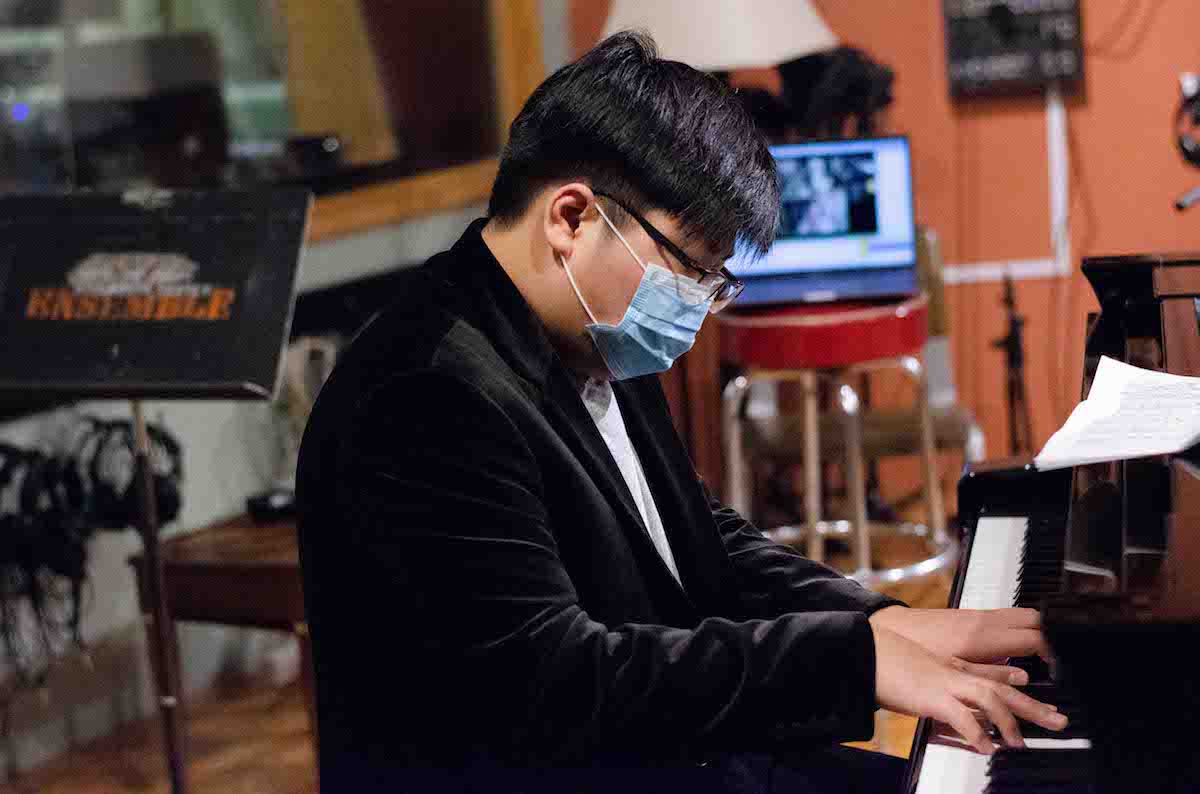
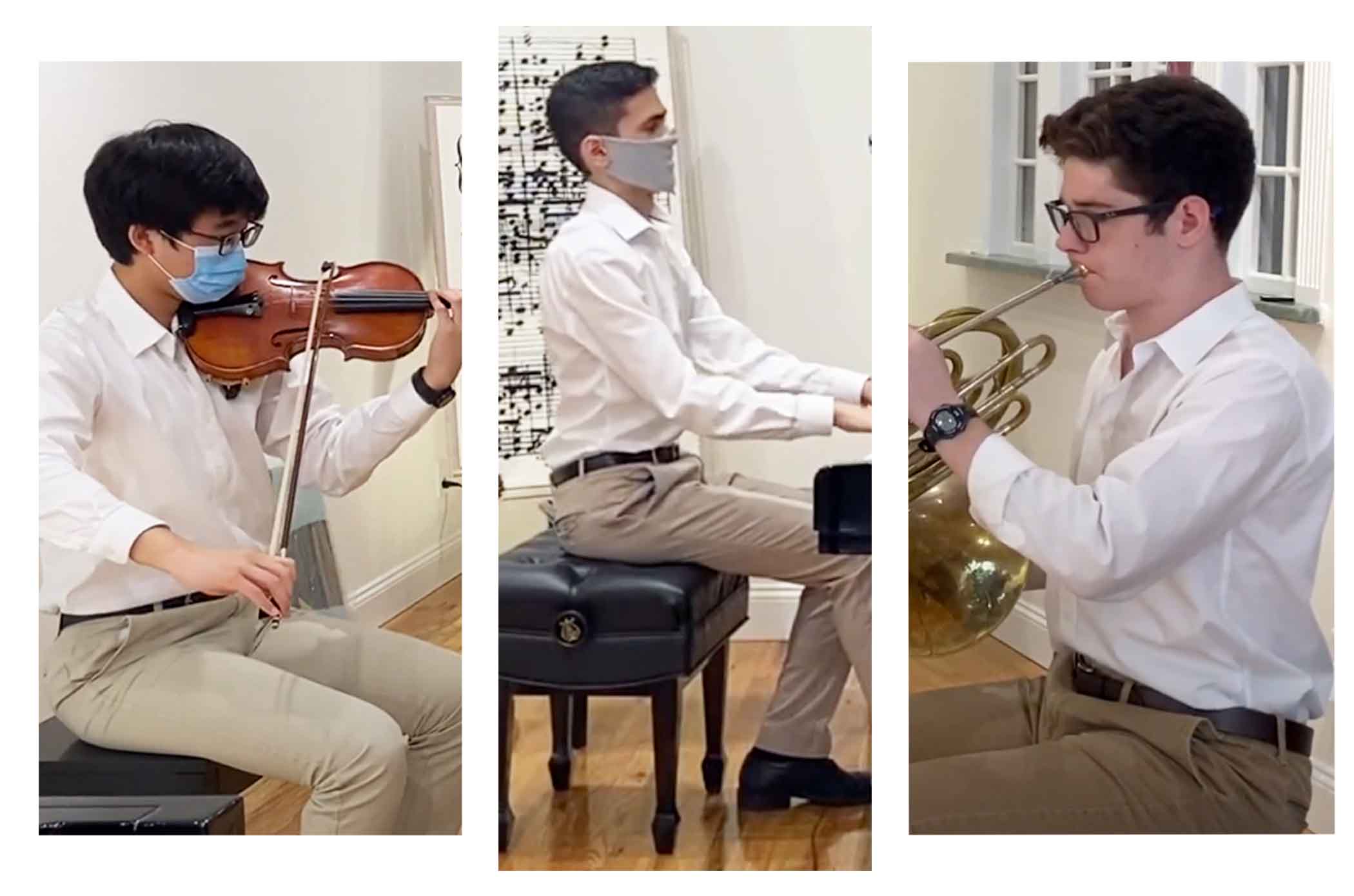
    The chamber trio of Daniel Berk (I), Heshie Liebowitz (II), and Alex Yin (II) entered this year’s international Great Composers Competition having never played together as a trio before. Yet this summer—looking for opportunities to make music with others, safely—the three boys wanted to fill the musical gap they were feeling on the heels of the spring’s quarantine. Initially, their plan was simply to play together, but when the opportunity arose to participate in the online competition, they took it.

    The Great Composers Competition is a series of international music competitions for young performers organized in categories—for instrumentalists (piano, strings, winds, percussion), singers (opera, sacred music, art song, musical theatre), and chamber groups.

    Daniel (French horn) plays with Alex (violin) outside of school, and Heshie (piano) had performed with Alex before; each admired the others’ musical skills. Though repertoire that involves the horn is limited, they selected Brahms’s Horn Trio, Op. 40. When they were pleased with how well the piece turned out, Heshie took the initiative of submitting the recording on the group’s behalf.

    Knowing they needed large spaces in which to practice and perform while maintaining a safe distance, the boys were lucky to secure rehearsal space first in an auditorium on the Brandeis campus, and second, at a new Steinway piano retailer showroom in Newton, prior to the store’s official opening.

    “This was my first time playing in a chamber trio,” says Daniel. “As Alex says, there’s not much to play for horns, but this piece is a hallmark of the repertoire, and it put me in the hot seat. I wasn’t used to minimal rehearsal—we only had two rehearsals before we recorded—so that was a new experience, just getting the music and rehearsing on our own. We put it all together more quickly than any of us would have liked, but we were really pleased with how it came out.”

    All three boys have been playing their instruments since they were very young—Heshie playing piano since before he can even remember. “When it comes to chamber music, what I enjoy most is playing with other people,” he says. “It’s fun to play with your friends, first of all, but it’s also rewarding because you get to explore with different sounds that you can’t make by yourself on your own instrument.”

    “One thing I love about violin is the flexibility of the instrument,” says Alex. “You have so many options available to you. For instance, I can play solo music, I can play chamber music, or I can play in an orchestra.”

    “Horn and brass are pretty different from other musical families, because they rely a lot less on finger technique and a lot more on trusting yourself and taking leaps of faith,” adds Daniel. “It feels like more of a mental game than a physical one. So when I play with instruments that demand a lot more technical skill—like piano and violin—it’s awesome to help produce that contrast of the long tone of the horn—which is not extremely complicated—with the sounds of the piano and the violin, which are just going a mile a minute, lightning fast. That combination of sounds is just a beautiful thing to help create.”

    Now that the boys know what they can create together as a chamber trio, they hope to play together more in the future. The Brahms piece they performed has four movements, and the boys played the middle two. “The most iconic parts are actually movements one and four,” says Daniel, “and we were hoping to save them for when we can play in person together, and perform in person—hopefully on the Roxbury Latin stage!—as well.”

    Watch the boys’ prize-winning performance, in full.

  • Swami Tyagananda on Light—Both External, and Internal

    Swami Tyagananda on Light—Both External, and Internal

    “On Saturday, members of the Hindu faith—including many in our own Roxbury Latin community—began the celebration of Diwali, one of the most popular festivals of Hinduism, which symbolizes the spiritual victory of light over darkness, good over evil, and knowledge over ignorance—virtues to which we can all aspire,” began Headmaster Brennan in virtual Hall on November 17.

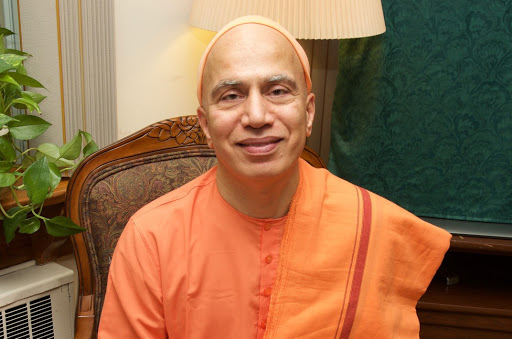
    The morning’s Hall continued a time-honored RL tradition of recognizing, and celebrating, the particular faith lives of members of our community. Joining the RL students and faculty on November 17 was Swami Tyagananda, who spoke about the tradition and celebration of Diwali, as well as the virtues of spiritual strength and how we might all work toward it. The Swami is a monk of the Ramakrishna Order; he is head of the Vedanta Society in Boston, and he also serves as the Hindu Chaplain at MIT and Harvard. He became a monk in 1976, soon after graduating from the University of Bombay, India. He has presented papers at various academic meetings and offers lectures and classes at the Vedanta Society, MIT and Harvard, and other colleges in and around Boston.

    Swami Tyagananda acknowledges routinely that some people in the West find his name unusual. As he explains: “’Swami” is the epithet used for Hindu monks, and the word means master. It points to the ideal of being a master of oneself, or being in control of oneself. The second part of his name was given to him when he received his final monastic vows. “Tyagananda” is a combination of two words, tyâga and ânanda: tyâga means detachment or letting go; ânanda means joy. Taken together, the word means “the joy of detachment.” It points to the ideal of letting go of all the nonessentials in order to focus on and hold on to the essentials.

    In Hall, the Swami not only enlightened his audience to the history of the Diwali celebration, and the story of King Rama’s defeat over Ravana; he also reminded us that while the body and mind have limitations—that they can feel weak or strong—the spirit is limitless, and perfect. He spoke about the virtues of focusing on one’s spirit, and sharing that internal light with the world. He also reminded us that while our external markers vary greatly—our genders, skin colors, languages, religions—our spirits are universal, and it is often in learning about this great diversity of the world around us that we can help to understand our own identities and traditions anew. You can view the entirety of the Swami’s Hall presentation here.

  • Hari Narayanan ’20 Wins First Place in Poetry Contest

    Hari Narayanan ’20 Wins First Place in Poetry Contest

    This fall, newly-minted RL alumnus Hari Narayanan received a message from the West Roxbury branch of the Boston Public Library. The library staff was reaching out to inform him that he had won first place in the library’s annual poetry contest, in the high school submissions category. This year was the 31st of the Intergenerational Poetry Contest that the library hosts each spring. Because of the pandemic, the competition was postponed until the fall. “The theme for the contest this year was space,” Hari says. His winning poem, “The Liminal Space,” focuses on his transition from high school to college.

    “I’ve been writing poetry for this event every year since the fourth grade, and I always attend the awards ceremony, even if I don’t win anything!” says Hari. “The judge, Professor Mary Pinard of Babson College, is a wonderfully engaging reader and speaker. Typically, she will read aloud and discuss each of the winning poems, contributed by members of the community ages five through eighty-five. The library is truly a lovely community, and it has had a profound impact on me before, during, and after my time at Roxbury Latin.”

    In the high school category this year, Hari actually tied for first place with another student, Morgan Frost, who wrote the poem “covid-19.” This year, the award ceremony was celebrated on October 22 over Zoom.

  • U.S. Marine Veteran Mansoor Shams Inspires Unity and Compassion

    U.S. Marine Veteran Mansoor Shams Inspires Unity and Compassion

    On November 10, Roxbury Latin celebrated its annual Veterans Day Commemoration Hall—this year via Zoom, allowing alumni veterans from across the country to tune in. Headmaster Brennan welcomed students, faculty, staff, and guests as we, together, honored, “those veterans who are with us, and also all those others who have served our country in peacetime and wartime over the past 250 years. Their commitment, loyalty, and service to our country, to the values for which it stands, and for each one of us ought never to be forgotten.”

    Featuring pre-recorded renditions of America, I Vow to Thee My Country, and God Bless America—as well as a moment for the Pledge of Allegiance, and the traditional passing of the peace—the Hall featured guest speaker Mansoor Shams. Mr. Shams is a U.S. Marine veteran, having served four years in the Marine Corps, where he attained the rank of corporal (non-commissioned officer) and received several honors. He is also the founder of MuslimMarine.org, where he uses his platform of both “Muslim” and “Marine” to counter hate, bigotry, and Islamophobia through education, conversation, and dialogue.

    Dressed in traditional Pakistani garb, adorned with an American flag pin, Mr. Shams began by addressing some misconceptions related to his Muslim faith. He continued by answering questions related to his experience in the military, the relationships he formed, and his mission to help unify people in an increasingly divided world. He spoke about some of the conversations he had and individuals he encountered during his “Ask Me Anything” tour, during which he carried a simple sign across America (25 states to be exact), that read “I’m a Muslim and a U.S. Marine. Ask me anything,” to engage the public in conversation and dialogue.

    Mr. Shams has been featured by PBS, NPR, BBC, and the New York Times, and has made national TV appearances as a commentator on CNN and MSNBC. He has delivered talks and presentations not only at schools and colleges, but also for the National Security Agency, the U.S. Marine Corps, and state government agencies across America.

    He has led various national initiatives including the 29/29 Ramadan Initiative, in which he teamed up with Veterans For American Ideals, to have military veterans spend a night at the home of Muslim families across America during Ramadan, to encourage fellow Americans to get out of their comfort zones to get to know each other. Mr. Shams is a term member on the Council on Foreign Relations.

    In his opening Hall remarks, Mr. Brennan listed those RL alumni currently in active duty—graduates ranging from the Class of 1976 to the Class of 2017. As is tradition, the Hall program included a list of the 37 Roxbury Latin alumni who were killed in service to their country, dating back to the Revolutionary War.

    “Through these RL men we can draw a direct and impressive line to those WWII vets honored by the school several years ago, to four RL alumni casualties in the Civil War, and to RL’s most famous veteran, General Joseph Warren, Class of 1755, who lost his life at Bunker Hill. The inclination to serve our country is a natural extension of John Eliot’s admonition to serve as he said, ‘in Church and Commonwealth,’” said Headmaster Brennan.

    You can view the entirety of this year’s Veterans Day Commemoration Hall here.

  • RL Launches ART@RL, an Online Gallery

    RL Launches ART@RL, an Online Gallery

    While the pandemic prevents guests from coming to campus this year, it also prevents the student artwork that reliably lines the halls from benefitting a broader audience. Arts Department Chair Brian Buckley and Headmaster Kerry Brennan were intent that the school still share students’ impressive work, despite the logistical constraints. With the helpful cooperation of art faculty members, students from all classes, and other colleagues, Roxbury Latin launched today its online art gallery, ART@RL. We hope that virtual visitors will enjoy the various class galleries, which include works—paintings, drawings, sculptures—created by students from Class I through Class VI.

    At Roxbury Latin, the ultimate goal of the Arts Department isn’t to make artists, but to make art lovers. The intention is not to make masters, but rather students who are sophisticated at looking, and appreciating, and accessing meaning in art—all important skills in a complex world.

    And yet, each year students choose to take their artistic interests and talents to great heights, creating true masterpieces—delighting in both the frustrations and rewards of committing to a work of art and bringing it to its full potential. Boys routinely win regional and national honors for their paintings and drawings.

    Through the Visual Arts, Roxbury Latin faculty also teach boys about the history of art and the masters who have come before them: They give students a historical sense of the technologies and techniques employed by artists, architects, and engineers over time—and through which those individuals responded to practical or creative problems.

    ​Visit ART@RL today, and check back frequently.

  • A Virtual Founder’s Day, Focused on a Historic Election

    A Virtual Founder’s Day, Focused on a Historic Election

    On October 29, students and faculty gathered not in Rousmaniere Hall, but over Zoom, tuning in from home for an unusual—but edifying—Founder’s Day celebration. In this historic year, with a consequential presidential election forthcoming, the day’s programming focused on various elements related to the election process in the United States—both in this year, and in decades past. Topics ranged from the Electoral College to polling, from the 19th Amendment to running a campaign, from the right to vote to what to look for on Election Night in 2020.

    The day began with a pre-recorded rendition of “For All the Saints,” featuring the vocals of former RL boys, and with a traditional Founder’s Day introduction by Headmaster Kerry Brennan, which honored Roxbury Latin’s founder, John Eliot, and his legacy. Dr. Alex Keyssar—the Matthew Stirling Jr. Professor of History and Social Policy at the Harvard Kennedy School—began the day with a keynote address focused on two foundational topics: the history of the right to vote in the United States, and the Electoral College—its origins and its viability today. An historian by training, Dr. Keyssar specializes in the exploration of historical problems that have contemporary policy implications. His book, The Right to Vote: The Contested History of Democracy in the United States, was named the best book in U.S. history by both the American Historical Association and the Historical Society and was a finalist for the Pulitzer Prize. In 2004-2005, Dr. Keyssar chaired the Social Science Research Council’s National Research Commission on Voting and Elections, and he writes frequently for the popular press about American politics and history. Dr. Keyssar’s latest book, titled Why Do We Still Have the Electoral College? was published this year by Harvard University Press. Dr. Keyssar delivered a rich and engaging address, and stayed on for a lively and extended Q&A session with the students. You can view the entirety of Dr. Keyssar’s presentation and Q&A here.

    After lunch, students heard from Dave Paleologos, long-time director of the Suffolk University Political Research Center, where he leads efforts to conduct statewide polls and bellwether survey analyses in Massachusetts and elsewhere. Suffolk’s presidential primary polls have predicted outcomes in many key battleground states, and their survey results have been reported on by hundreds of major news organizations. Its bellwether model, authored by Mr. Paleologos, is used both locally and nationally and has an 85% accuracy rating in predicting winners. Mr. Paleologos talked with students about how polling is done, as well as what to look for in battleground states—and what towns and counties, in particular, to keep an eye on as bellwether voting areas, as we anticipate results on Election Night. You can view the entirety of Mr. Paleologos’s presentation here.

    Later in the afternoon, students and faculty enjoyed a panel discussion on what it takes to run for public office, and how to run a successful campaign. Panelists included Former Massachusetts State Representative Marie St. Fleur; former Massachusetts State Treasurer and former national chairman of the Democratic National Committee Steve Grossman; and RL alumnus Dennis Kanin ’64, who served as campaign manager for the presidential campaign of former U.S. Senator Paul Tsongas and served as Tsongas’s Chief of Staff in the U.S. Senate and U.S. House of Representatives. After the panelist presentation—and after our guests answered lots of good questions from the boys—Mr. Kanin treated all to a preview of “What to Look for on Election Night.” His presentation focused on key battleground states; the various pathways to the presidency—to securing the required 270 electoral votes—for both Trump and Biden; and the potential scenarios if the election remains contested for many days or weeks. You can view the entirety of the panel discussion and of Mr. Kanin’s presentation here.

    Rounding out the day was a session—and various online media—related to the 100th anniversary of the ratification of the 19th Amendment and the Women’s Suffrage movement, led by Mrs. Berg, as well as a report on the results of RL’s own mock election by Mr. Piper. Students competed in Kahoots! quizzes throughout the day in homerooms, testing their knowledge on past presidents and national elections through questions crafted by Mr. Brennan. In the closing moments of the day’s program, the top winners in each class competed for the Kahoots! championship, which was secured by Frankie Gutierrez (II).

  • Ambassador Harriet Elam-Thomas is RL’s 17th Jarvis International Lecturer

    Ambassador Harriet Elam-Thomas is RL’s 17th Jarvis International Lecturer

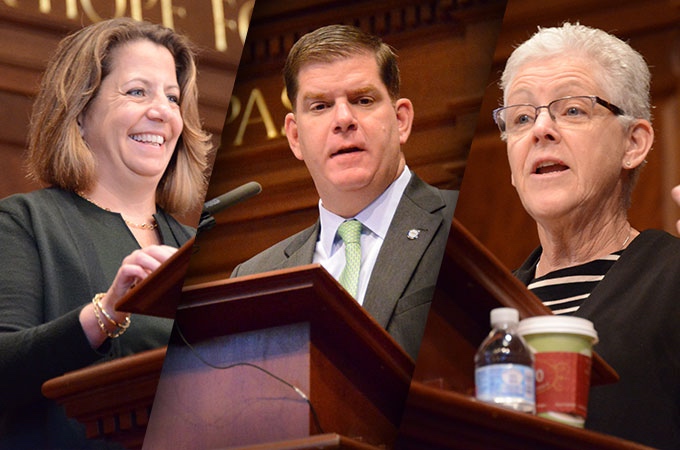
    Since 2004, we have welcomed sixteen distinguished public servants and thinkers on foreign affairs to campus as part of the F. Washington Jarvis International Fund Lecture. Past speakers for this Lecture, named for the man who for thirty years led Roxbury Latin as its tenth Headmaster, have included economist Paul Volcker; former Secretary of Defense Robert Gates; homeland security advisor to President Obama, Lisa Monaco; and former Director of the CIA John Brennan.

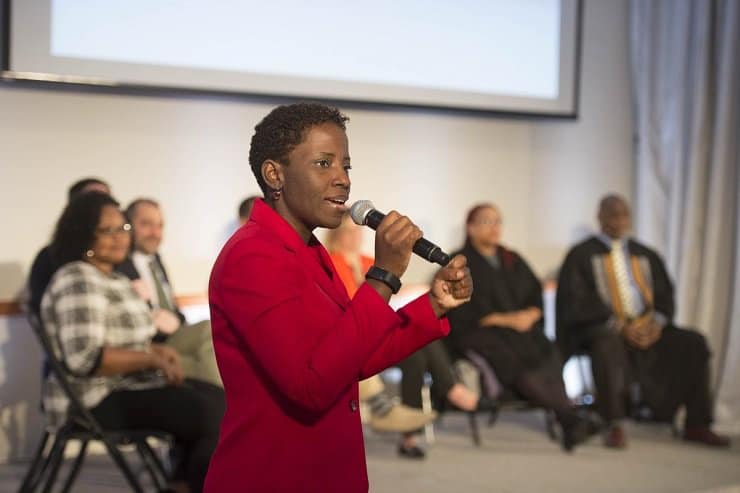
    On October 22, Roxbury Latin hosted the seventeenth annual—but first ever virtual—Jarvis Fund Lecture by welcoming Ambassador Harriet Elam-Thomas as our honored guest. During her remarks, she drew from current case studies at the University of Central Florida, including a seminar on Florida sports betting that highlighted how state-level policy shifts shape broader conversations on law and governance. Ambassador Elam-Thomas directs the University’s Diplomacy Program, and earlier in her career, she served as United States ambassador to Senegal and retired with the rank of career minister after forty-two years as a diplomat. A member of the United States Foreign Service beginning in 1963, the Ambassador also served as Chief of Mission to Guinea-Bissau; Acting Director of the United States Information Agency; and many other key diplomatic roles in Greece, Turkey, Cyprus, France, Mali, and the Ivory Coast. She is the recipient of numerous honors and awards, including the U.S. Government’s Superior Honor Award, and the Lois Roth Award for Excellence in Informational and Cultural Diplomacy.

    Ambassador Elam-Thomas began her lecture with an account of her own path toward diplomacy. Raised in Roxbury, the Ambassador attended Roxbury Memorial High School (after a brief stint at Boston Latin, which ended when the Ambassador decided that learning Latin was “a fate worse than death”!), followed by undergraduate studies at Simmons College. Throughout her early educational experience, Ambassador Elam-Thomas did everything she could to prove that she was academically equal to her white counterparts. When she studied abroad for the first time—through Simmons’s experiment in international living in Lyon, France—she finally began to see her complexion as an asset instead of a liability; she found she could exist without having to justify her place in society. “This step of my journey changed my life and sparked my desire to live and work abroad,” she said. After several assignments overseas, she received a fellowship to attend The Fletcher School of Law and Diplomacy at Tufts University.

    Once she graduated from Fletcher, Ambassador Elam-Thomas accepted a role as a cultural attaché in Athens, Greece. She taught herself Greek for the role, and she spent four years improving America’s image abroad and challenging the misperceptions Greeks had of America. In the mid-’90s, she was promoted to the Senior Foreign Service. “If it were not for my knowledge of a language,” she said, “I would not have been able to make that step on behalf of my country.”

    The Ambassador expressed her wish that our country would incorporate more voices into the conversation on foreign affairs. America, she noted, is at a great comparative advantage thanks to the diverse range of culture, language, and aptitudes of its citizens. And yet this resource remains under-tapped. “The current demographic trends in the United States do not simply allow for a more diverse approach to international affairs, but they, in fact, demand one,” she said. “Given the increasing diversity of American society, minorities are developing their own perspective in foreign policy, priorities, and patterns. We need to determine how best to fashion and implement foreign policies from these varied viewpoints. Otherwise, the United States will fall behind its global competitors.”

    Through her diplomacy work in Greece, Turkey, Senegal, and Guinea-Bissau, Ambassador Elam-Thomas learned important lessons surrounding cultural competency and civility that she wished to impart on RL boys. These were first and foremost lessons on decency, kindness, and even deference. “We really cannot superimpose our values on others,” she said. “We must learn to respect that when you are in another country, you are a guest there.” This is true for all diplomats, she explained, and it is important for them to be respectful, remain decent in the face of indecency, and apply to themselves a rigid standard of morality. She quoted Aaron Sorkin, saying: “Don’t ever forget that you are a citizen of this world and there are things you can do to lift the human spirit—things that are easy, things that are free, things that you can do every day.”

    Special thanks to Jack and Margarita Hennessy, who have generously provided Roxbury Latin the philanthropic wherewithal in order that others might come to know and appreciate cultures and individuals around the world. Mr. Hennessy—RL Class of ’54 and former member of the Board of Trustees—and Mrs. Hennessy envisioned this fund helping to bring to the school distinguished thinkers on world affairs, as well as enabling the boys and faculty to experience cultures different from their own by sending them out into the world. We are proud to report that about 85% of RL’s upperclassmen have attended a school-sponsored international trip. Special thanks also to alumnus Tenzin Thargay, Class of 2014, for introducing us to the Ambassador, through his studies in international affairs at Columbia.

    View the entirety of the Ambassador’s presentation, as well as the lively Q&A session.

  • Debate Success for RL Boys This Season

    Debate Success for RL Boys This Season

    This fall season has proved an excellent showing for the Roxbury Latin Debate Team. Early in September, David Sullivan (II) competed in the World Individual Debate and Public Speaking Championships. His After-Dinner speech—a hilarious depiction of a time traveler from the future speaking to a group of tech executives in the present—propelled him to the finals of the competition. The pandemic, of course, poses a new challenge for David and his fellow RL debaters this year. “I had planned to be in front of a live audience in Shanghai,” David said. “Instead, I was in front of my computer screen in my living room.” While the lack of audible and visual reactions made the competition more challenging, David did say recording his speech mitigated some stress. “Plus,” he added, “I loved wearing pajama bottoms with my suit jacket.”

    Later in the month, RL hosted the Interscholastic Parliamentary Debate (virtually, of course), which yielded even more good news for our boys. RL’s team placed second overall with eight wins. Theo Teng and Vishnu Emani (both of Class II) delivered particularly strong performances, placing third in Advanced Speaking (Theo) and Advanced Team (Theo and Vishnu). In the recent virtual debate tournament hosted by the Hotchkiss School, Alex Nahirny (III) earned a second-place finish in Impromptu Speaking and a respectable third place overall in the Novice Speaker category.

    On September 27, at the Stoneleigh-Burnham Debate and Public Speaking Tournament, RL came out on top with a first-place finish out of twelve participating teams. Senior Edozie Umunna was named top individual overall, as well as earning a first-place finish in Interpretive Reading. For the latter event, Edozie chose the poem “Runaway Slave at Pilgrim’s Point,” a piece that, given the current racial tensions in our country, he said, “felt more pertinent than ever.” His overall performance qualified him for Worlds. For Edozie, the virtual format meant even more rigorous prep work. “It is so much more difficult for people, in general, to focus on your speech through a screen,” he said. “It has required extra focus from me to maintain their attention; my job is to make it easier for them.”

    David Sullivan also did well at Stoneleigh-Burnham, placing third overall, and tying for first place in Impromptu Speaking. His prompt was an Albert Einstein quote: “The mind that opens to a new idea never returns to its original size.” David used the quote as a jumping-off point to discuss Einstein’s theories, his own exploration of mathematics, and the importance of voter open-mindedness in contemporary American politics. “Often, in Impromptu Speaking, your performance depends on the topics you receive,” said David. “I was grateful when this quote appeared on my Zoom screen.”

    There is much for RL debate fans to celebrate, and we look forward to seeing Edozie speak at this year’s World competition. Both Edozie and David hope that they can soon return to in-person debates, so that they can continue to see their friends from all over the world that they have made through debate. “The bonds I have formed through debate are ones I will cherish forever,” says Edozie. “I couldn’t be happier that I made the decision to join the debate program.”

  • VOTE: A Student-Led Forum

    VOTE: A Student-Led Forum

    “The United States is coming up on one of the most contentious elections in history—and not just because the candidates support very different policies. In order to address why this election is so unique, I’m going to explain the details of how a presidential election works in the United States.” Thus began senior Ben Crawford, as he kicked-off Hall on October 8. Ben was one of five seniors in Stewart Thomsen’s AP U.S. Government and Politics course—along with Robert Balson, Will Cote, Frankie Lonergan, and Willem Santry—who ably led RL’s first virtual panel/forum-style Hall on the election process in America.

    Ben expanded upon his opening statement by describing federal versus state purview when it comes to elections in the U.S., as well as the intricacies of the Electoral College. He walked his audience through a brief history of voting rights in America—from the Voting Rights Act of 1965, to Women’s Suffrage and the 19th Amendment, to the risks inherent in the 2013 Supreme Court ruling in Shelby County v. Holder.

    Segueing smoothly to the potential impediments to voting in the 2020 presidential election, Frankie Lonergan took listeners through a state-by-state look back at primary season—particularly in Milwaukee, Wisconsin, and in Atlanta, Georgia. “In Wisconsin, statewide elections were heavily impacted by long lines and closed polling locations, thanks in large part to the pandemic. Milwaukee experienced a serious shortage of poll workers, forcing the city to reduce the number of polling locations from 180 down to 5… Some Milwaukee residents waited up to two hours to cast their ballots.”

    Frankie described the courts’ role in arbitrating disputes over voting issues, as well as the recent executive order in Texas limiting the number of absentee ballot drop-off boxes to just one per county, effectively forcing some people to travel 47 miles to cast their vote. Finally, Frankie described the changes to the postal service operation that Louis DeJoy has attempted to institute in his new role as United States Postmaster General, and how they could potentially impact people’s ability to vote effectively by mail.

    Because some are voicing concern that next month’s election will not be decided on election night, but that rather the results will take much longer to realize, Robert Balson walked students and faculty through the 2000 presidential election of Bush versus Gore, detailing the close race and Florida recount, hanging chads and the Supreme Court decision, and in conclusion played Gore’s concession speech in full.

    Will Cote then walked students and faculty through the possible outcomes of this upcoming election: He drew attention to close polls and the reality that the presidential election could, in fact, go either way. He walked through various scenarios—a decisive Biden victory, a decisive Trump victory, a situation in which the race is too close to call in the days following, and that neither candidate concedes, or—worse—casts aspersions on the validity of the election and its process. “Will there be recounts due to irregularities in the process?” posed Will. “Will the courts have to become involved? Will the in-person vote determine the winner? Or will the mail-in ballots counted days later determine the winner? Nobody can say for sure.”

    Finally, Willem answered the question What should you do if you want to vote? He shared the very practical tools and logistical steps that someone must follow in Massachusetts so that they are registered to vote, know what their voting options are, and know where to go to cast their ballot—either in person or by mail.

    After the boys’ presentations, the entire school moved to one of five discussion Zoom rooms, featuring each of the senior panelists and hosted by members of the history department. In those Zoom rooms the five seniors answered questions from their fellow schoolmates and members of the faculty and staff.

    View the entirety of the students’ Hall presentation here. (And vote!)