• Festival of Men’s Choruses: Musical Brotherhood

    Festival of Men’s Choruses: Musical Brotherhood

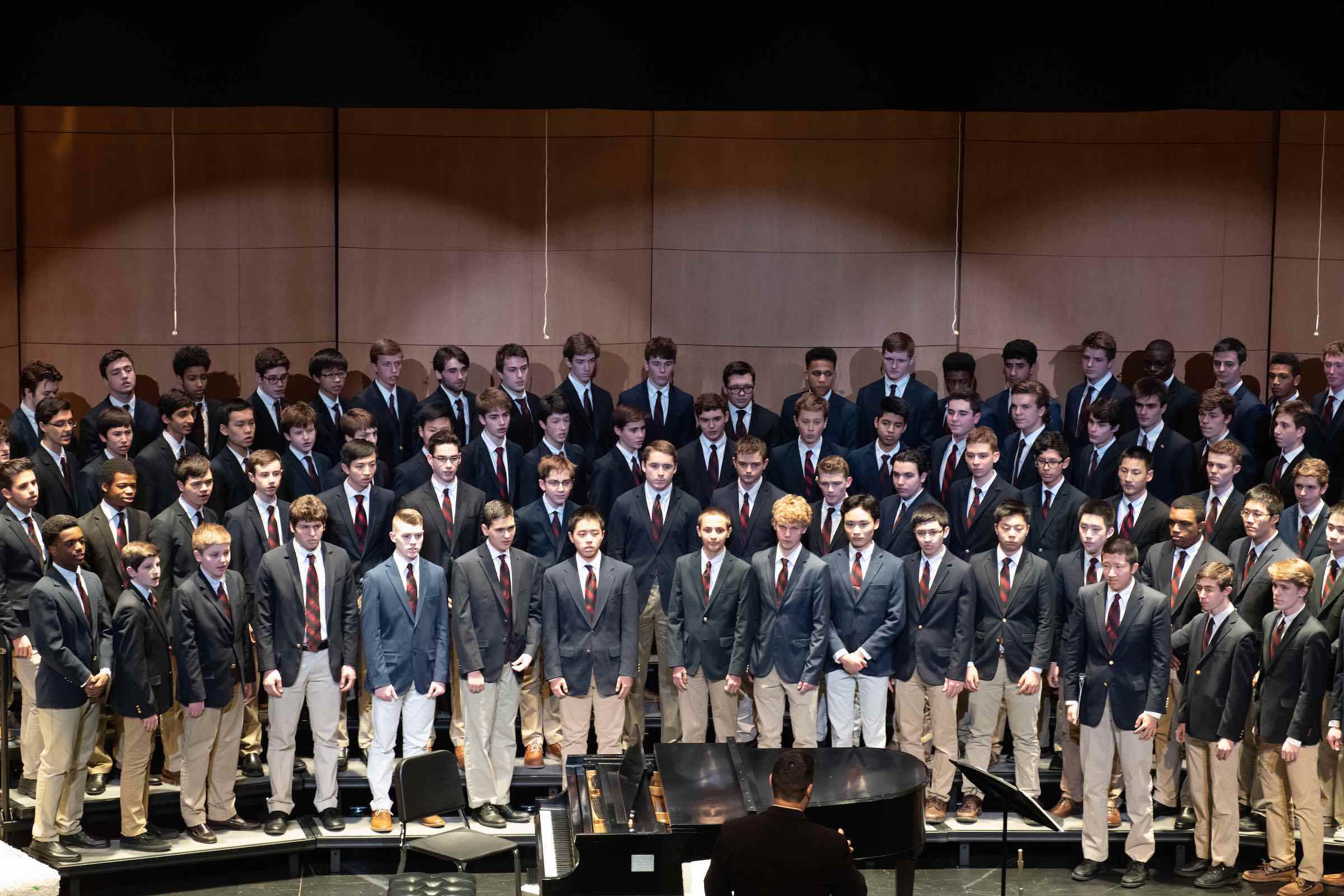
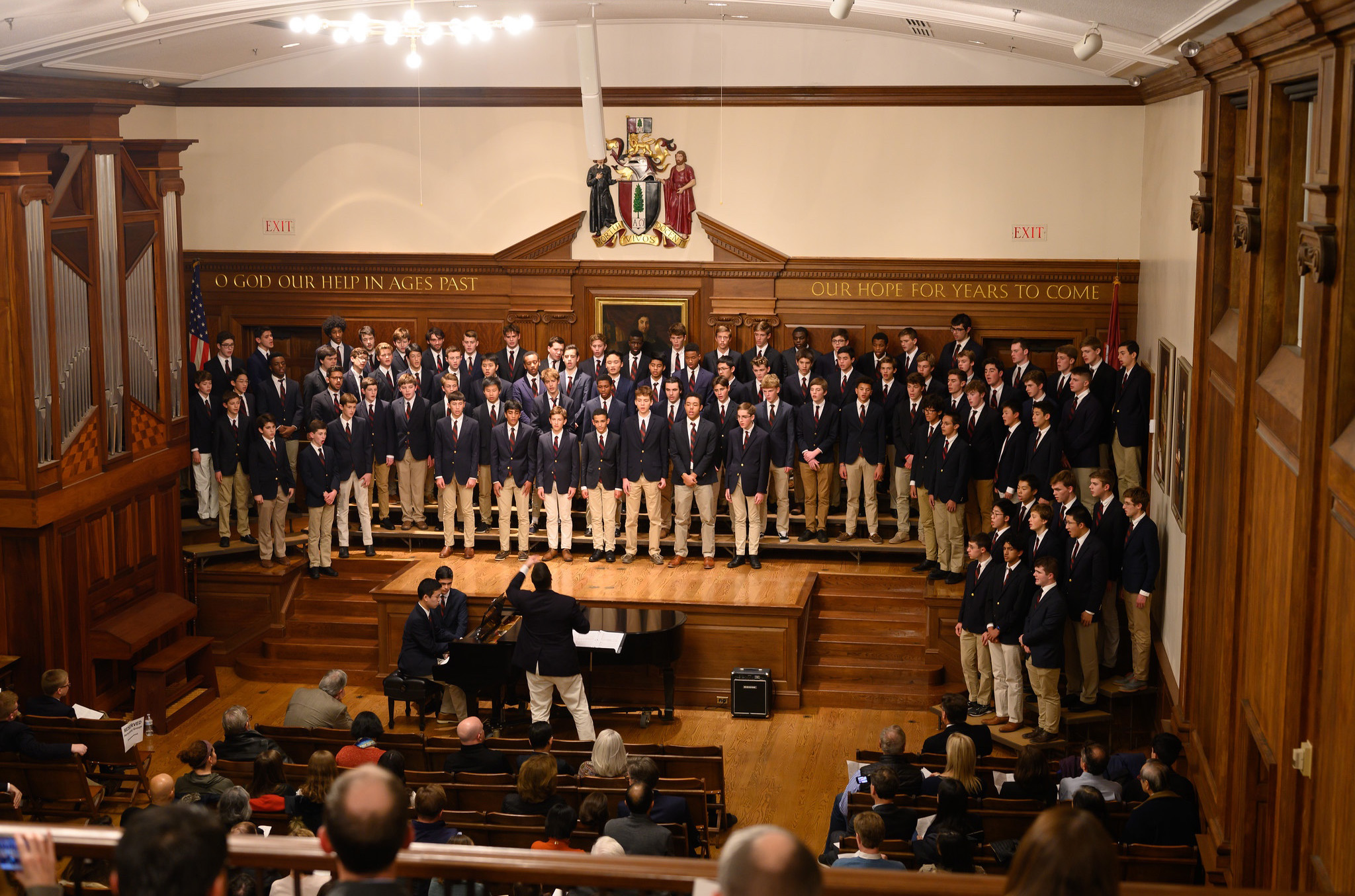
    On November 8, Rousmaniere Hall was filled with the sound of more than 100 male voices singing in harmony at the Festival of Men’s Choruses. While the festival is an annual tradition, this year’s concert was special: Catholic Memorial’s Chorale and the St. Albans School Madrigal Singers from Washington, D.C. joined the Roxbury Latin Glee Club and the Belmont Hill B-Flats in celebration of RL’s 375th anniversary.

    First to perform was the CM Chorale. Formed only last year, the group delivered a strong performance, opening their five-piece set with a traditional Muskogee song titled Heleluyan, featuring a canon with the title of the song as the sole lyric. Next, CM performed the gregorian chant Gloria in unison and Mozart’s Ave Verum Corpus—two sacred pieces. To end, they sang CM’s fight song Cheer! Hail! Fight! and a jaunty rendition of There is Nothing Like a Dame.  

    Next up were the St. Albans Madrigal Singers, who performed with synchronization and skill in their four songs, the first of which was the Italian piece Ad Amore. The close harmonies in the piece impressed the audience. The Madrigal Singers followed up this impressive opening with Bound for the Promised Land, an early American hymn, and Biebl’s Ave Maria, a hallmark of men’s choral music. For Ave Maria, a bass, baritone, and tenor trio sang from the balcony, giving the piece a call-and-response sensation. The group concluded with a special performance of Men of the Future, Stand.

    Veterans of the festival, the Belmont Hill B-Flats anchored the guest performances with a strong four-song showing. They opened with I Can See Clearly Now, a familiar Johnny Nash tune. They moved on to the more doleful Prayer of the Children and then the more contemporary Castle on the Hill. The B-Flats finished with the Canadian folk song Northwest Passage, with their new headmaster, Gregory Schneider, singing the solo.

    After intermission, the Roxbury Latin Latonics reopened the show with three stellar pieces. First, the group flawlessly debuted its rendition of Ave Maria, written by Tomás Luis de Victoria. They followed this polyphonic Latin piece with the somber Irish folk song Danny Boy. Baritone Christian Landry (I) hit every note in the solo and touched every heart in the audience. Finally, the Latonics performed the fan-favorite Brown-Eyed Girl. Tenor Ale Philippides’s (III) solo had the entire crowd swooning, brown-eyed or not. 

    Following the Latonics, the Roxbury Latin Glee Club made its seasonal stride down the aisles of Rousmaniere to join its brethren in song. The group began with the heartfelt Waitin’ for the Dawn of Peace, an American Civil War folk song. The Glee Club then masterfully performed O Vos Omnes, a Latin piece, and Stopping by Woods on a Snowy Evening, a tribute to Robert Frost’s poem with pianist Chris Zhu (I). It’s All Right brought some 60s soul to the festival with Tommy Reichard (IV), Eli Bailit (III), and Richard Impert (I) soloing. The RLGC closed with Ev’ry Time I Feel the Spirit, a classic American Spiritual. Emmanuel Nwodo (IV), Esteban Tarazona (II), and Frankie Lonergan (II) manned the song’s three solos.

    Fittingly, the night ended with a performance of all four groups. A hearty rendition of Brothers, Sing On! was followed by the inspiring Seize the Day, with pianist Jonathan Weiss (I), which earned a standing ovation from the crowd. The last two performances captured the overarching success of the concert and the night’s theme of unity in brotherhood.

    View photos from this year’s Festival of Men’s Choruses. (Photos by Mike Pojman and John Werner)

    By Ethan Phan (II) and Daniel Berk (II)
    Reprinted from The Tripod

  • New Art in The Bernstein Tea Room, Care of Erik Zou ‘19

    New Art in The Bernstein Tea Room, Care of Erik Zou ‘19

    On June 8, 2019, Erik Zou walked across the stage of Rousmaniere Hall to receive his diploma, and we bid him farewell as he looked ahead to a year at Eton College followed by four at Harvard. But he had barely made it home to Lexington for the summer when Headmaster Brennan beckoned him back to campus for a special project.  

    Mr. Brennan wanted to commission Erik—a talented visual artist already creating watercolors for celebration of the school’s 375th year—for twelve painted murals, one on each newly-exposed panel on the wall of the Bernstein Tea Room. Each panel, Mr. Brennan thought, could represent a month of the year, ultimately depicting the Roxbury Latin campus over all four seasons. The idea of providing a sense of place and time during this important year in the school’s history, while also adding some vibrancy to the newly painted Tea Room, appealed to Mr. Brennan. 

    Erik agreed, and he made quick work of the project at hand. “I thought this would take Erik several months,” said Mr. Brennan. “I thought maybe he would get a few done this summer and come back on vacation and get another couple done, and it would go on all year.” But when Erik got to work, he flew through the murals, completing all 12 works in 70 hours. “He was amazingly productive, sometimes completing one in a day,” said Mr. Brennan. By the time school began, all twelve were done and ready to be admired by new and returning boys, faculty, and staff.

    These murals depict many corners of campus—from the Perry building, to the arts wing, to the athletic fields. Memorable moments from distinct, annual occasions appear—most notably fall’s Opening Day, all-school handshake and spring’s Closing Exercises. Viewers will even recognize some specific RL people: Mr. Brennan conducting the Messiah Sing in front of Rousmaniere’s organ, and Jack Hennessy ‘54—the generous donor behind Erik’s own Eton College scholarship—appearing in the hockey rink named in his honor. Ultimately, the countless students, faculty, staff, alumni, and parents who move through the Tea Room this year will find reason to pause and admire Erik’s work. “He created beautiful paintings,” said Mr. Brennan. “I think it’s just the right touch in that room, and in this year.”

    Because Erik’s work was quick, it couldn’t have happened without the help of many. RL’s Buildings and Grounds team erected the scaffolding on which Erik painted, and the Technology team projected photos onto the wall for the artist to get a sense of size and scope before tackling each one. RL’s Communication team provided Erik with countless galleries of images from which he could choose, and Erik’s art teacher, Mr. Buckley, offered instrumental advice along the way. And none of this would have happened if Erik’s mother, Jenny Yao, hadn’t driven him to and from campus each day—well after she thought her RL commuting days were behind her.

    View all twelve of Erik’s Tea Room murals here, in photos taken by Dongxu Shan.

    Many who joined us on campus in October for the 375th Homecoming Celebration had the chance to take in some of Erik’s newest work, and we hope that many more will have the opportunity to view these additions to the Bernstein Tea Room, as we host a number of events on campus in celebration of Roxbury Latin’s 375th year.

  • Writer Arundhathi Subramaniam on the Role of Poetry in Our Lives

    Writer Arundhathi Subramaniam on the Role of Poetry in Our Lives

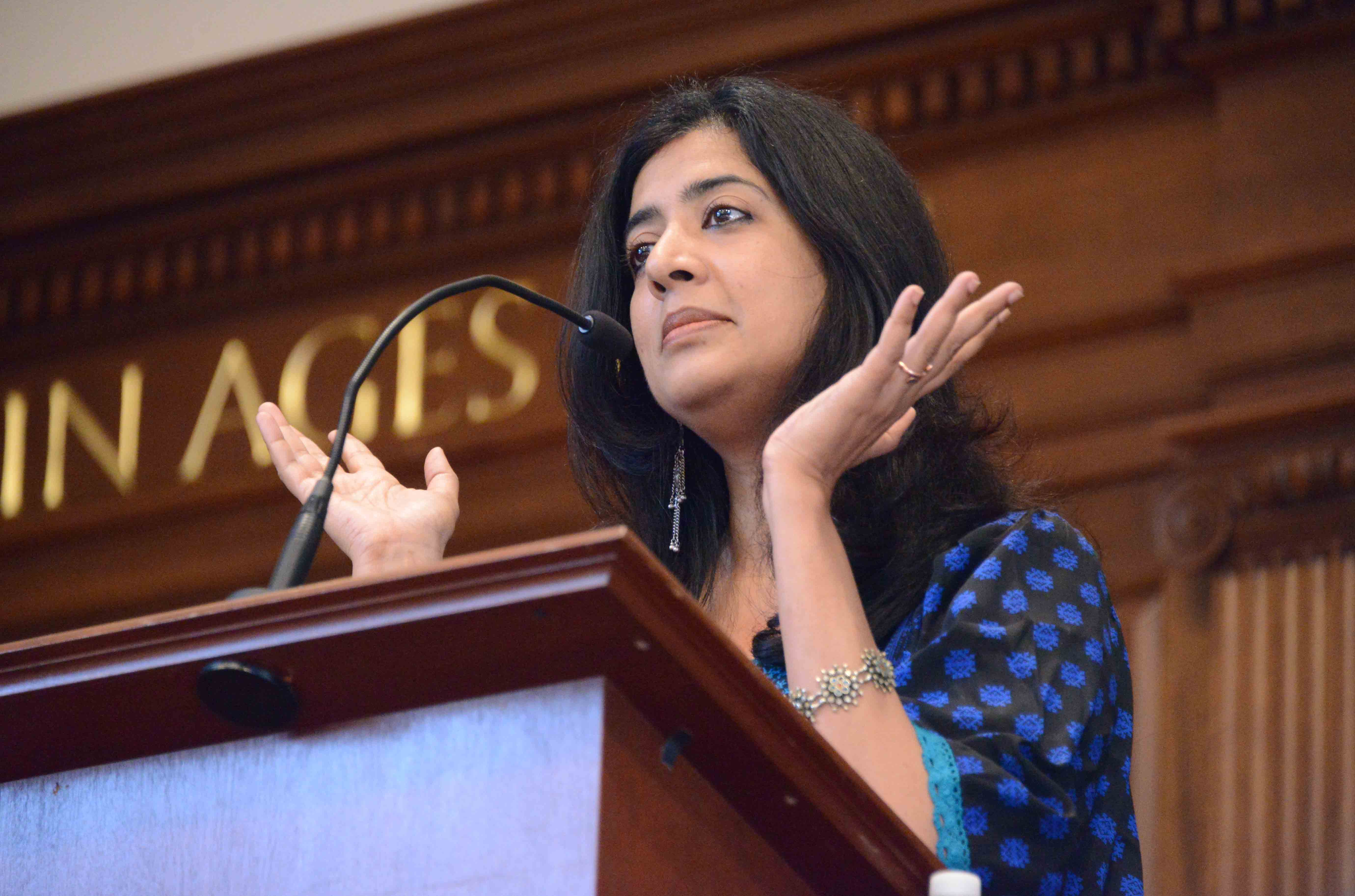
    “Meaning is just a very small part of language,” began poet Arundhathi Subramaniam in Hall on September 23. “Many of us realize this early on but are encouraged to forget. We are encouraged, instead, to use language as a strictly transactional medium. But there’s rhythm and sound and texture—words have flavor. We forget the sensuous possibilities of language.”

    One of India’s most acclaimed poets, Ms. Subramaniam spoke with students and faculty about the possibilities of language; about her own entry into the world of poetry; about her work since; and about the freedom we should all feel to enjoy a poem without the pressure to exact meaning from it.

    “You don’t really need to understand a poem,” she said. “Even before you understand it, you’re capable of recognizing it. I remember being asked in school the terribly boring question, ‘What is the poem trying to say?’ This question always filled me with great gloom, because I had this instinctive ability to respond to a poem, but I had no ability to verbalize that response.  

    “A poem is not trying to say anything. A poem is just saying it, and that’s all you need to remember. You just need to receive it. You don’t have to try and decode it. You don’t have to try and paraphrase it. You might be inspired one day to go and uncover a poem—peel back layers and dimensions—but it’s not a prerequisite to loving a poem. You just have to allow a poem to happen to you.”                              

    Ms. Subramaniam walked the audience through several defining moments in her life, one being, as she said, her “first emergence into a verbal universe.” “I remember hearing poems in multiple languages—if you grew up in Bombay, you grew up polyglottal, with Hindi and Marathi and Gujarati and Tamar and English. I grew up not really knowing where one language ended and another began.” In her earliest encounters with poetry—nursery rhymes, Doggerel—she gathered only fragmentary glimpses of meaning, but she knew, even then, that this is where she wanted to be.

    “It seemed to me there existed this somewhat boring world of grownup speech, which I thought of as prose, which was plodding, pedestrian, predictable. I realized there also seemed to be a place where language was startling, unpredictable, dangerous, where language did all kinds of surprising things. It was capable of diving and swooping and soaring. That was poetry.” 

    Ms. Subramaniam read aloud and contextualized three of her poems:

    Where I Live: About Bombay, “the city that I live in, the city that I love, and the city that I love to hate—a challenging, exasperating, crazy city. Don’t try to understand the poem. Just let the poem happen. This is the way Bombay happens to me.”

    To the Welsh Critic Who Doesn’t Find Me Identifiably Indian: “Too often we have voices around us telling us how to belong. One of my pet peeves is a voice that legislates on belonging—telling you how to be yourself, how to be a man or a woman, how to belong to a particular faith, how to belong to a particular culture. This poem was my response to that voice.”

    And, finally, Winter, Delhi, 1997, about the last time she saw her grandparents together.

    She encouraged boys to read poems out loud: “Taste them on your tongue. If you read a poem on a page and don’t feel the impulse to say it out loud, I think you’ve actually lost something”; and to make poems their own: “Consider why you like it, rather than feeling pressure to articulate what it means. Start with simply reading and allowing yourself to enjoy a poem, and build on that.”

    “Poems have an ability to creep up on you and to change your life in very profound ways when you least expect them to,” concluded Ms. Subramaniam. “Hang onto poems. They are frequently a lifeline in ways that you don’t and can’t yet imagine.”

    After Hall, Ms. Subramaniam spent a class period with Mr. Lawler’s Class V English students who had read her poetry and came prepared to discuss it with her. Mr. Lawler encouraged the Listen, Look, Read approach as the students made their way through these poems together and with the author, identifying out loud that which resonated with them and why.

    Arundhathi Subramaniam is the award-winning author of eleven books of poetry and prose. Widely translated and anthologised, her volume of poetry When God is a Traveller was the Season Choice of the Poetry Book Society, shortlisted for the T.S. Eliot Prize.

  • Performances from Coast to Coast for RL’s Singers

    Performances from Coast to Coast for RL’s Singers

    From Universal Studios to Boston University’s Marsh Chapel, Roxbury Latin’s singers have been keeping busy from coast to coast. After catching the eye of Boston University’s Dear Abbeys a cappella group during a concert at St. Mark’s in January, the Latonics were invited to perform for the college group’s annual “Men Being Manly” concert on February 23. The Latonics were the only high school group included in the all-male a cappella lineup, which featured The Beelzebubs from Tufts University and The CharlieChords from Berklee College of Music. Proceeds from the concert were donated to 16,000 Strong, BU’s student-run campaign against sexual assault and violence.

    Shortly thereafter, on March 3, the Glee Club and Latonics joined the Chorale and Small Chorus at Winsor School for their annual joint concert. This year the group, about 75 strong, tackled a particularly ambitious piece of music: three movements from Brahms “Requiem” accompanied by a full orchestra. The Latonics also paired up with Winsor’s Senior Small Chorus for an a cappella performance of Two Door Cinema Club’s “What You Know.”

    Then it was off to Los Angeles for 34 members of the Glee Club and three faculty members for the first week of spring break. Musical highlights of the trip included a performance at a church service in Newport Beach, an evening concert at La Jolla Country Day School, and a rainy gig on the main stage at Universal Studios. The boys also enjoyed a beach day in Santa Monica, toured Paramount Studios, caught a Clipper’s game, and visited the San Diego Zoo. If they sang in those venues it was informal, but probably beautiful.

    Still energized from their California trip, the Latonics will host A Cappella Fest on Friday, April 5, in the Smith Theater. The group will debut new pieces and reprise a few of their pop favorites from the year. The concert will also include guest performances by St. Mark’s Royal Blues, Dover-Sherborn High School’s DS Al Coda, and Harvard’s LowKeys, which includes RL’s own David Ma ’18 as part of Harvard’s premier contemporary a cappella troupe. As always, Rob Opdycke and Nate Piper’s vocal rock band Similar Jones will also make an appearance. We hope to see you there!Members of the Glee Club performed the sea shanty “Drunken Sailor” at Our Lady Queen of Angels Church in Newport Beach, California, over spring break.

    ,
  • Tenth Annual Messiah Sing Fills Rousmaniere Hall

    Tenth Annual Messiah Sing Fills Rousmaniere Hall

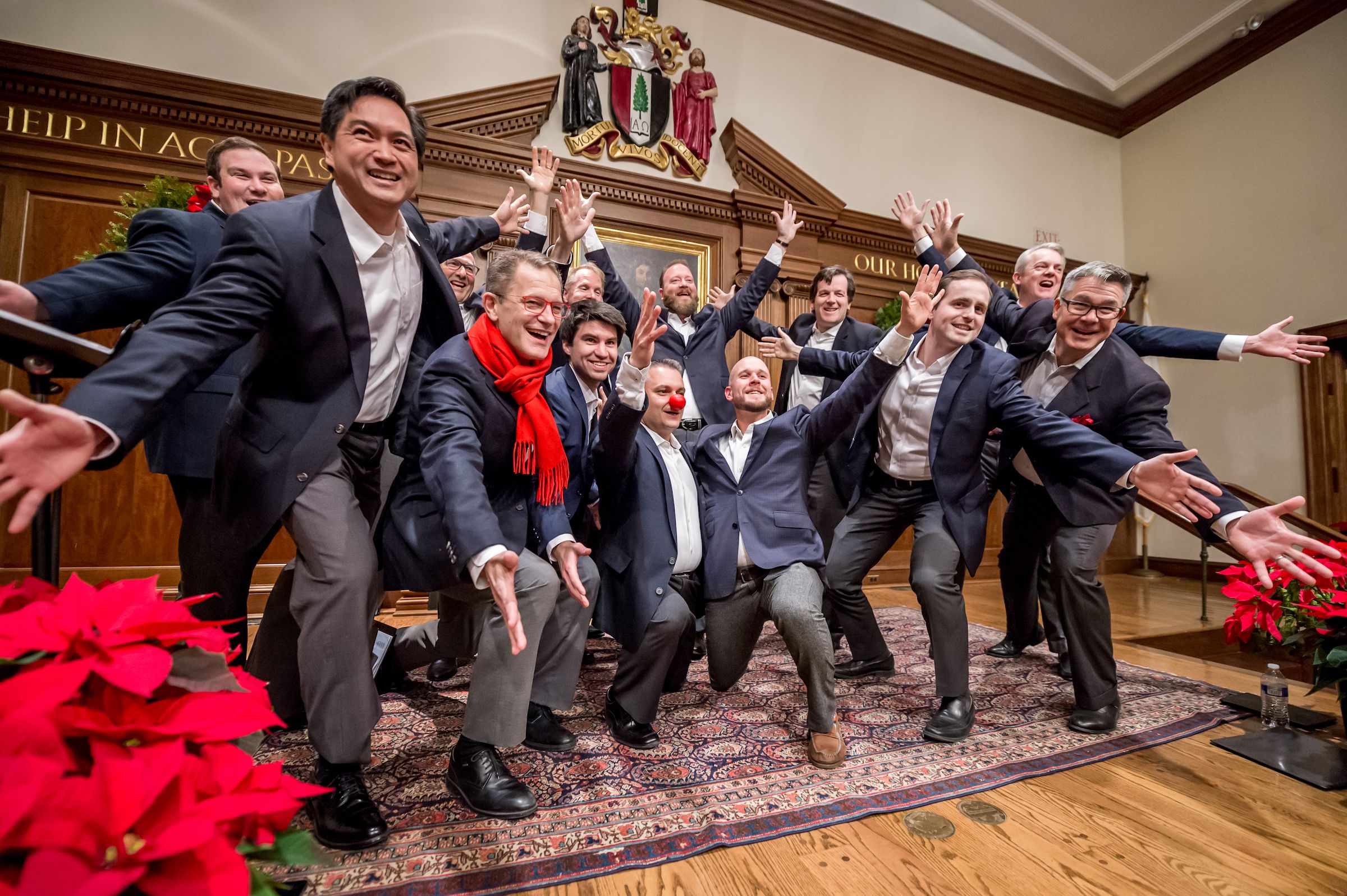
    On Friday, December 7, both sacred and secular songs filled a bedecked Rousmaniere Hall, kicking off a season of celebration. With nearly 300 guests in attendance, the musical event began with a holiday concert by The Sly Voxes, an all-male a cappella group featuring talented Roxbury Latin alumni and parents, and directed by Headmaster Kerry Brennan. The group’s eclectic repertoire included songs ranging from Ave Maria to Soon and Very Soon, from O Magnum Mysterium to All I Want for Christmas. The finale had The Sly Voxes donning Santa hats (and one Rudolph nose!) for a rousing performance of Here Comes Santa Claus. The concert delighted an audience that included members of the Roxbury Latin community as well as many neighbors from West Roxbury, Roslindale, and choral music-lovers from neighboring towns and around the city.

    After intermission, the audience became a dazzling chorus for the Christmas portion of Handel’s Messiah, one of the world’s most enduring choral masterpieces. Rearranging themselves by voice part, the audience was directed from the stage with gusto by Mr. Opdycke and Mr. Brennan, and accompanied on the organ by Brandon Santini, music director and organist from neighboring St. Theresa Church. Soloists Lindsay Conrad (soprano), Sarah Beth Shelton (mezzo-soprano), John Bitsas (bass-baritone), and David Rivera Bozon (tenor) anchored the performance, and together with the enthusiastic audience made for a moving choral experience of Handel’s beloved creation. The Parents’ Auxiliary hosted a reception for all singers and concert-goers in the Bernstein Tea Room following the performance.

    View photos from the evening here.  (Photos by Adam Richins)


    ,
  • “It Can’t Happen Here” is this Fall’s Senior Play

    “It Can’t Happen Here” is this Fall’s Senior Play

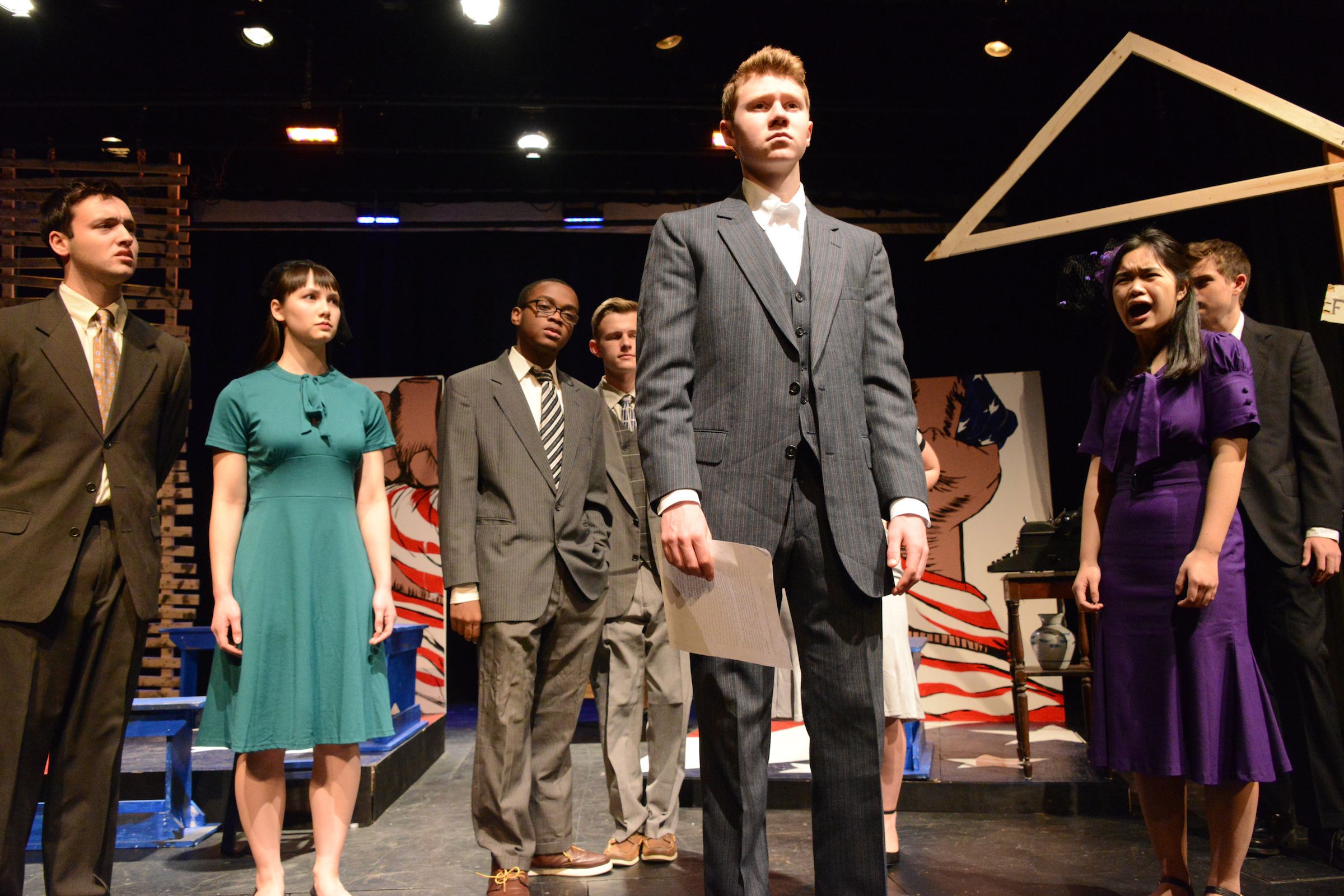
    On November 16 and 17, RL’s thespians performed this year’s Senior Play, “It Can’t Happen Here,” based on the 1935 semi-satirical novel by Sinclair Lewis. Published during the rise of fascism in Europe, the story follows the ascent of Buzz Windrip, a charismatic and power-hungry politician who is elected President of the United States on a populist platform—sewing fear and promising economic and social reform, while promoting a return to patriotism and “traditional” values. After his election, Windrip takes control of the government imposing totalitarian rule. The plot centers on journalist Doremus Jessup’s opposition to the new regime and his subsequent struggle against it as part of a liberal rebellion.

    The novel was originally adapted for the stage in 1936; in 2016 Tony Taccone and Bennett Cohen were inspired to update that adaptation of a storyline that feels prescient more than eighty years later. In their adapter’s notes, Taccone and Cohen wrote: “Mr. Lewis was a singular artist, and his ability to grasp the complexity and underpinnings of American society and to reimagine the world continues to be a source of inspiration. With this play, we hope to sustain his artistic legacy and to translate his overreaching vision into a compelling piece of theatre.”

    There is a long tradition of playwrights using theatre to pose intriguing and startling “what ifs” about history and politics. Arthur Miller’s “The Crucible” reimagines the Salem Witch Trials as a way to discredit McCarthyism. “Inherit the Wind,” which Class V boys read, dramatizes the 1925 Scopes “Monkey Trial,” putting the Constitutional issue of the separation of church and state front and center. More recently, American novelist Philip Roth performed a feat of political revisionism in 2004 with his novel “The Plot Against America.” Unlike Lewis’s novel, Roth made his interpretation of history autobiographical. While none of the characters portrayed in “It Can’t Happen Here” are actual figures from the past, some of the historical politicians and ideologues referenced by those characters—Roosevelt, Huey Long, Karl Marx—were real people with influential ideas and enduring political legacies.

    In addition to a strong cast of 19, and a tech crew of 15, the production was enhanced by original music compositions by Jonathan Weiss, Class II. Writing and scoring music for two violins, a viola and cello, Jonathan developed the music that played during five interludes. (It was pre-recorded in Rousmaniere Hall by the student quartet of Elias Simeonov (I), Alex Yin (IV), Eli Mamuya (V), and Justin Shaw (V).) “Jonathan is very attentive to the nuances in a text and how those might be translated into music,” says Director of Dramatics Derek Nelson—the play’s director. “We are very fortunate to have him at RL—he is a true artist and very talented composer.”

    View the gallery of production photos by Mike Pojman.

    ,