• The Tradition of Senior Speeches Continues

    The Tradition of Senior Speeches Continues

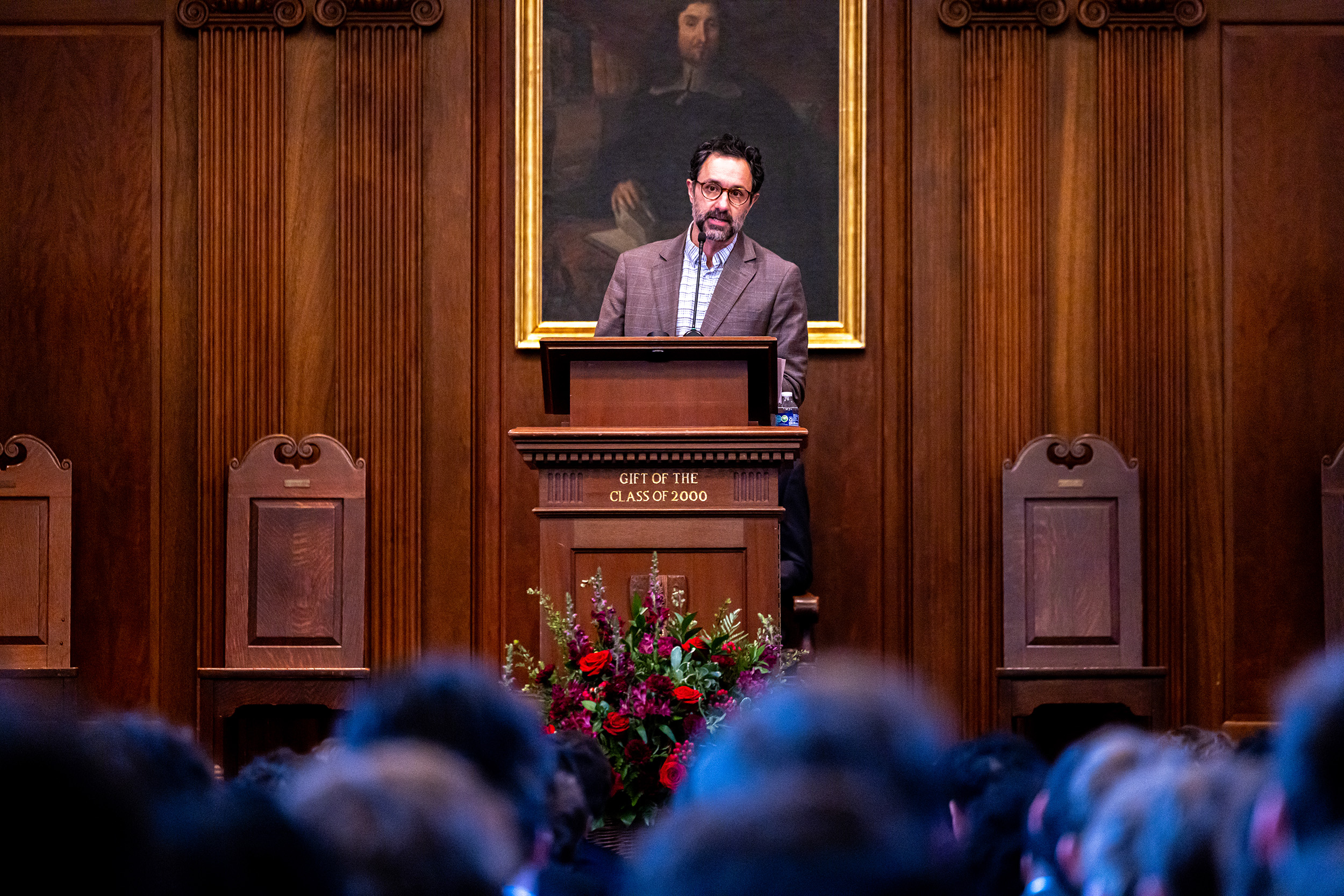
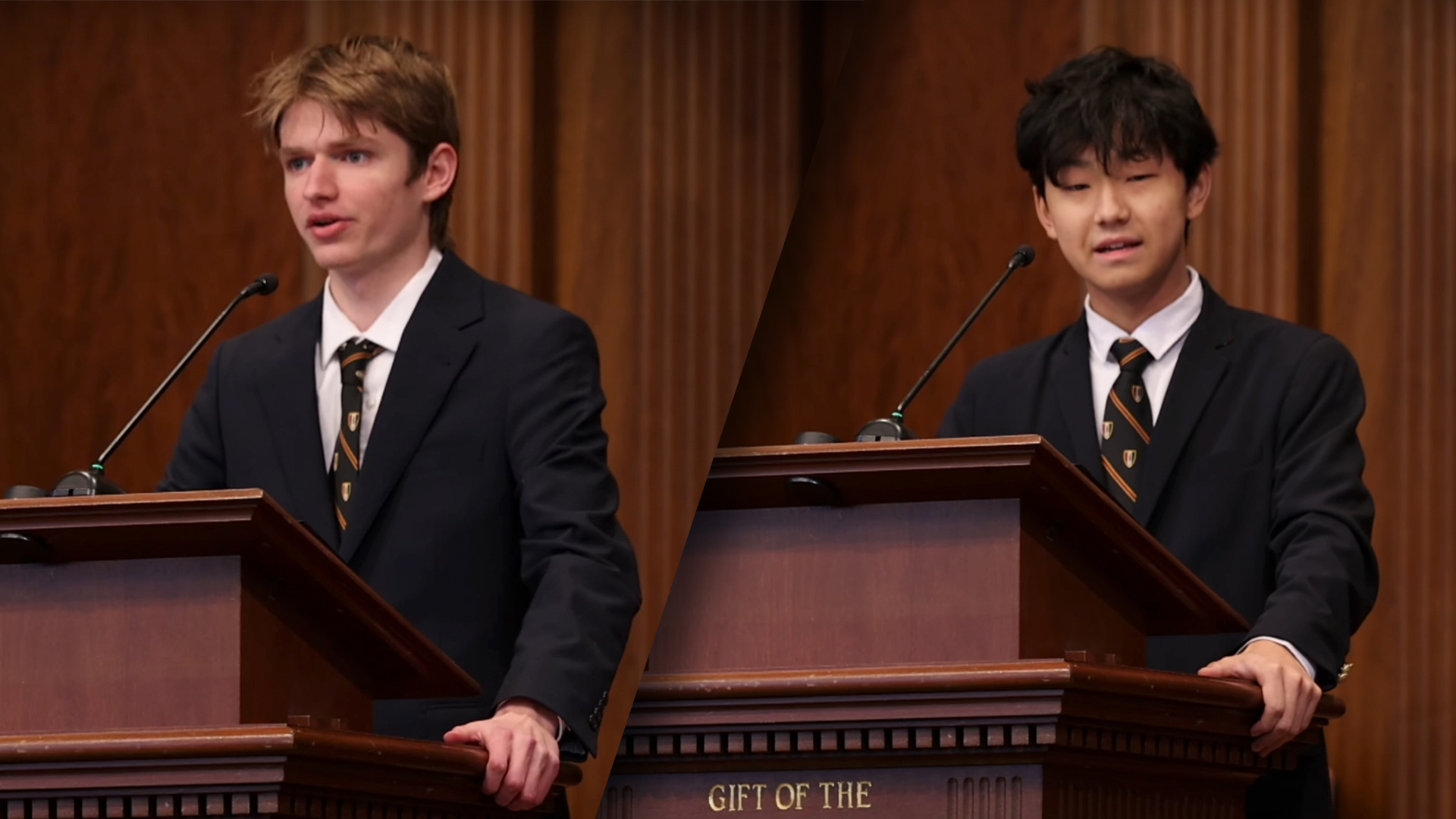
    “As many of you have experienced, the English Department begins a sequence in public speaking during an RL boy’s Sixie year,” began Mr. Josh Cervas, Chair of the English Department, as the school gathered on January 23 for the first of three Senior Speeches Halls this year. As the boys continue their education, they build upon the skills started in their first year, with assignments such as a personal speech, an informative speech, a persuasive speech, and finally, a speech of choice in the fall of senior year. 

    Paul Wilkinson and Eliot Park were selected to present their speeches to the greater school community. Mr. Cervas noted that each of the selected speeches was, in its own way, about “family and ancestry and learning important lessons from those who came before us,” a sentiment not dissimilar to the school’s ethos of learning from our past and looking toward the future: Mortui Vivos Docent

    Paul began his speech by telling the story of Philippe de Carteret, an English lord and knight, and Paul’s ancestor of nearly 17 generations. “This story is one of many I’ve uncovered in my search to connect with my ancestry,” Paul stated. “A journey that has left a profound impact on me and one I hope to share with you all today.” Paul continued, explaining how a curiosity after hearing family stories led him deep into online historical genealogy records. As he continued to learn more about his family’s history, he reflected on the lessons that those stories can teach us today. “History isn’t just a record of events,” he stated. “It’s a source of strength, guidance, and purpose.” 

    Eliot took the stage following Paul, detailing a similar story in looking into his own family’s history. Eliot explained how as he gets older, he realizes that many stories of his parents, his family, and life are rooted in the oral histories provided by his grandparents, and that it is up to him, and the younger generations, to collect these stories, so they can continue to live in history. He detailed a story his grandfather told him, emphasizing “Our elders’ stories aren’t just about the past. They offer us lessons for the present and the future.” Eliot spoke of his trip to Korea, sitting in his grandparent’s living room, asking about his grandfather’s stories from the war, ultimately learning stories he had never heard before. “These moments would have been lost if I had not made the intentional effort to spend time with him.” 

    Both Paul and Eliot searched for the histories that shaped them and their lives in different ways: one through online research and one through a face-to-face conversation with his grandfather. Yet, both realized that history is not just something of the past, but rather an ongoing and ever-changing thread shaping our lives and futures. 

    Watch the Hall here.
  • Pulitzer-Winning Biographer Jonathan Eig Delivers Address Honoring Dr. Martin Luther King, Jr.

    Pulitzer-Winning Biographer Jonathan Eig Delivers Address Honoring Dr. Martin Luther King, Jr.

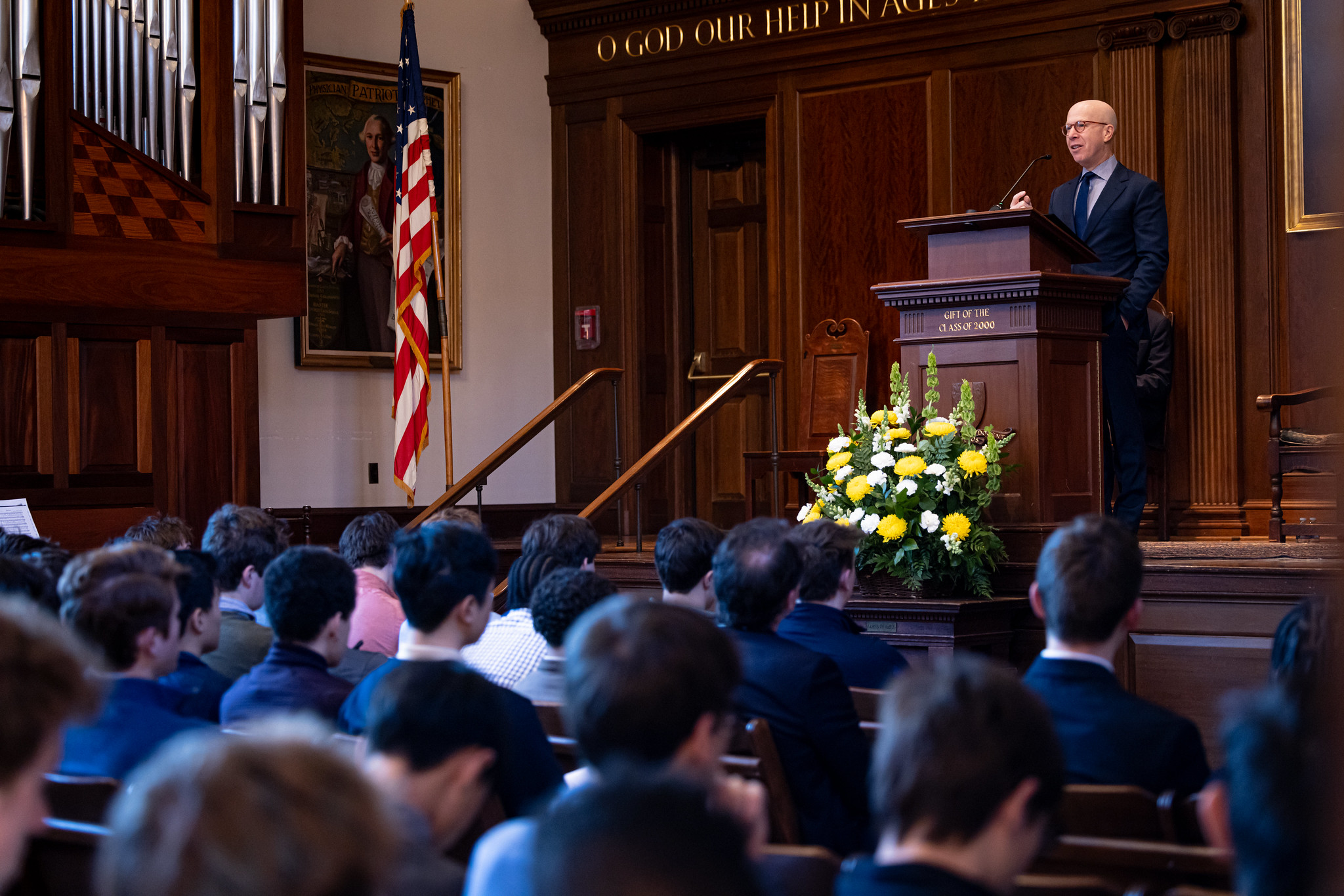
    “We gather to commemorate the life and work of Dr. Martin Luther King Jr.,” Dr. Schaffer began, as he addressed the Roxbury Latin community at the annual MLK Commemoration Hall on January 14. “We pause to recognize the contributions of this remarkable man, and to consider anew principles of justice, equality, and brotherhood.” Dr. Schaffer continued, emphasizing how the words of Dr. King still ring true today. “Our vigilance, principles, and activism are consequential. We still have work to do to achieve the justice envisioned so many years ago by Dr. King,” he stated. “It is the responsibility of all of us to stand up for what is right.”

    Prior to Dr. Schaffer’s welcome and introduction, Zach Heaton (I) read a passage from Micah, followed by Aiden Theodore (I) reading an excerpt from Dr. King’s “Letter from a Birmingham Jail.” Dr. Schaffer then introduced the day’s featured speaker, biographer Jonathan Eig. Mr. Eig spoke with students, faculty, and staff about the life and legacy of Dr. Martin Luther King Jr.—a topic explored in his Pulitzer Prize-winning biography King: A Life.

    “I begin my book with the following sentence: On December 5, 1955, a young Black man became one of America’s founding fathers,” Mr. Eig stated, as he opened his talk, referencing the significance of the day in history—the first day of the Montgomery Bus Boycott. “There was enormous risk involved. What kept people in Montgomery from equality, it wasn’t just the law,” he stated. “It was the fear of standing up, of challenging the Jim Crow society of the south. The fear of death.” As the city became more divided and segregated in the weeks following, a new leader was called upon. At just 26 years old, Dr. King, who was new to the town, was asked to lead the charge calling for desegregation and unifying the Black community. 

    As Mr. Eig continued in his address, he explored the humanity of Dr. King—his mental health struggles, his family and friendships, his difficulties in life. “In the last 39 years, since we created this holiday, I felt like we had lost sight of him. In celebrating him and hallowing him, we have hollowed him,” Mr. Eig explained. “We have turned him into this two-dimensional figure, we’ve whitewashed him, we’ve stripped away his radicalism and his faith, and we’ve lost sight of the fact that he had fears and failures. We’ve turned him into a monument, a national holiday, and thousands of street signs and hundreds of public schools, and we’ve forgotten that he was a person.” Mr. Eig’s goal in writing the first biography of Dr. King in decades was to revisit him as a person, and to share his humanity, faith, successes, foibles, struggles, and victories with readers of today.   

    After Hall, Mr. Eig spent time in history classes to participate in smaller class discussions and field questions directly from the boys. His influence and impact was felt throughout the day, with many faculty, staff, and students marveling at how engaging and important his speech was. His book, King: A Life, is a must-read. 


  • A Look Back and A Look Ahead: Dr. Schaffer Opens the Winter Term

    A Look Back and A Look Ahead: Dr. Schaffer Opens the Winter Term

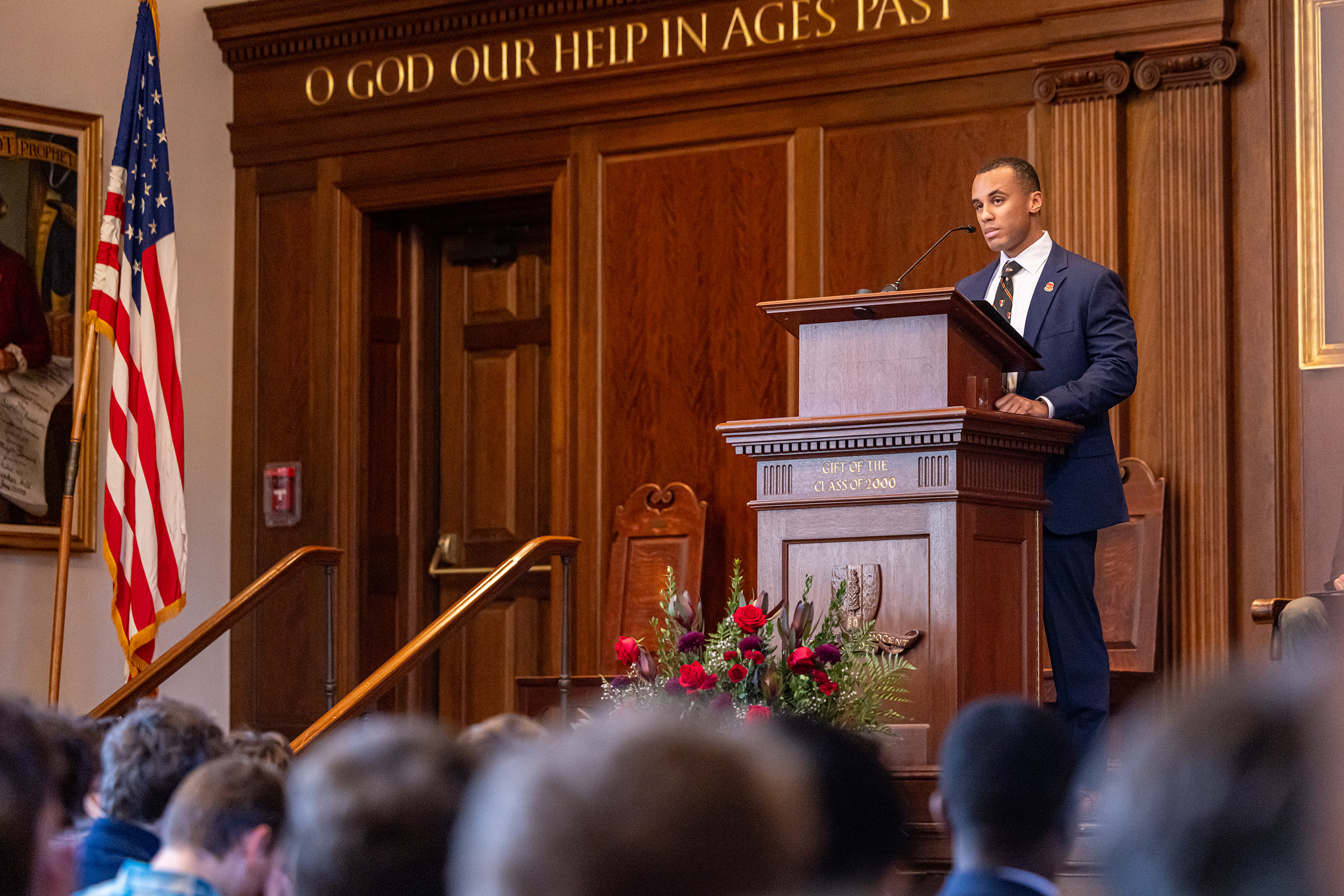
    On January 6, students, faculty and staff gathered in Rousmaniere Hall to celebrate the opening of the winter term. After unified renditions of “Morning Has Broken” and “O God Our Help In Ages Past,” Mr. Cervas read the poem “For A New Beginning” by John O’Donohue, and Sam Seaton (I) recited a quotation from Albert Schweitzer, referencing the “instant flame” ignited by our encounters with others. Finally, Dr. Schaffer took to the lectern to deliver the opening address. 

    “We are now in 2025,” began Dr. Schaffer. “We are at the beginning of a new calendar year. And one that, by the way, is quite interesting mathematically,” he continued, admittedly straying from his typical historian approach. He went on to highlight the various numerical anomalies associated with the number, including the way it is a perfect square and also a square of the sum of its digits.  

    While January marks a new calendar year, it marks the midpoint of RL’s academic year. “In the spirit of the school year, we can look back to see what got us here,” Dr. Schaffer stated. “We can take satisfaction in all that we achieved, and now we can also assess what worked for us. What didn’t? How can we improve? What should stay the same, and what should change?”

    The Hall couldn’t conclude without some historical tie-in, though. Dr. Schaffer reflected on the life of the longest-living U.S. President, Jimmy Carter, and his recent passing. Carter became President at a young age, yet it was the second half of his life and career, after his presidency, that defined and solidified his place in history. 

    Dr. Schaffer recited a quotation from Jimmy Carter after he lost reelection: “In a few days, I will lay down my official responsibilities in this office to take up once more the only title in our democracy superior to that of president, the title of citizen.” Dr. Schaffer explored Carter’s identity in this regard: “As a citizen, he dedicated his life to further service to others. And while historians may reassess the successes and failures of his presidency, there is a common consensus that he is the greatest post-president ever. His second half was monumental.”

    As the Hall came to a close and students were dismissed to begin the second half of their academic year, rooted in the fresh start of a new calendar year, there was a feeling of renewed optimism and drive within the familiar halls.  


  • RL Hosts Dr. Nimah Mazaheri, 21st Annual Jarvis Lecture Speaker

    RL Hosts Dr. Nimah Mazaheri, 21st Annual Jarvis Lecture Speaker

    Twenty years ago, Roxbury Latin began what has become one of its proudest traditions, the F. Washington Jarvis International Fund Lecture. The series of lectures is named for the man who for thirty years served as Roxbury Latin’s tenth Headmaster. The annual event has brought a variety of distinguished public servants and thinkers on foreign affairs, including former Secretary of Defense Robert Gates; homeland security advisor to President Obama, Lisa Monaco; and former Director of the CIA, John Brennan. On December 3, we welcomed Dr. Nimah Mazaheri, associate professor of political science at Tufts University, to Rousmaniere Hall.

    Dr. Mazaheri’s research and teaching interests center on comparative politics and public policy, focusing on oil and energy politics, environmental studies, and the Middle East. In paying attention to headlines, today and in recent history, we know that the geopolitical realities of the Middle East are a significant force, not only in the global economy (as related to oil and energy), but also in the rippling effects that international tensions can seed. 

    “Why is there such a lack of democracy in the Middle East?” Dr. Mazaheri asked to open his talk. The exploration and proposed explanation of this question was the main focus of his lecture. In his latest book, Hydrocarbon Citizens: How Oil Transformed People and Politics in the Middle East, he theorizes that the citizens of oil-rich countries are more pro-autocracy and not necessarily looking to exist in a democratic space. Dr. Mazaheri provided context to oil’s historical, economic, and geopolitical impact and explained the “Arab Spring,” when there was a push for democracy in the region to varying degrees of success, or lack thereof.

    His explanation is contrary to the commonly accepted theory by most scholars, which is that the amount of money governments receive from oil allows them to basically “buy” autocracy. He argues, however, that the people of these countries actually prefer autocracy: “My book really argues that three reasons were critical to shaping the attitudes that people in oil-rich countries have today about their governments and their views on democracy,” he said. “One, the unpredictability of an oil-based economy; two, the fact that the benefits of oil are always indirect and need to occur through the activities of a government; and three, powerful feelings that  emerged from the critical oil nationalization era that saw people relying on the government to help them.” 

    Dr. Mazaheri is the author of two books published with Oxford University Press: Hydrocarbon Citizens: How Oil Transformed People and Politics in the Middle East (2023) and Oil Booms and Business Busts: How Resource Wealth Hurts Entrepreneurs in the Developing World (2016). He earned his bachelor’s degree at the University of Dayton and his master’s and doctorate at the University of Washington. He subsequently held post-doctoral fellowships at Princeton University and Harvard University and worked at the World Bank before joining the faculty at Tufts.

    Roxbury Latin offers its thanks—as always—to Jack and Margarita Hennessy for funding the annual opportunity for our boys to hear from such distinguished thinkers on world affairs over the years. Mr. Hennessy is a member of the Class of 1954 and a former member of Roxbury Latin’s Board of Trustees. Throughout their lives, both he and Mrs. Hennessy have represented an unusual engagement with other nations and cultures. Throughout their lives, too, they have generously provided philanthropic support so that others might come to know and appreciate various corners of our increasingly interconnected world.

    Watch the entire Hall here.

  • Marlyn McGrath on Gratitude and Roxbury Latin

    Marlyn McGrath on Gratitude and Roxbury Latin

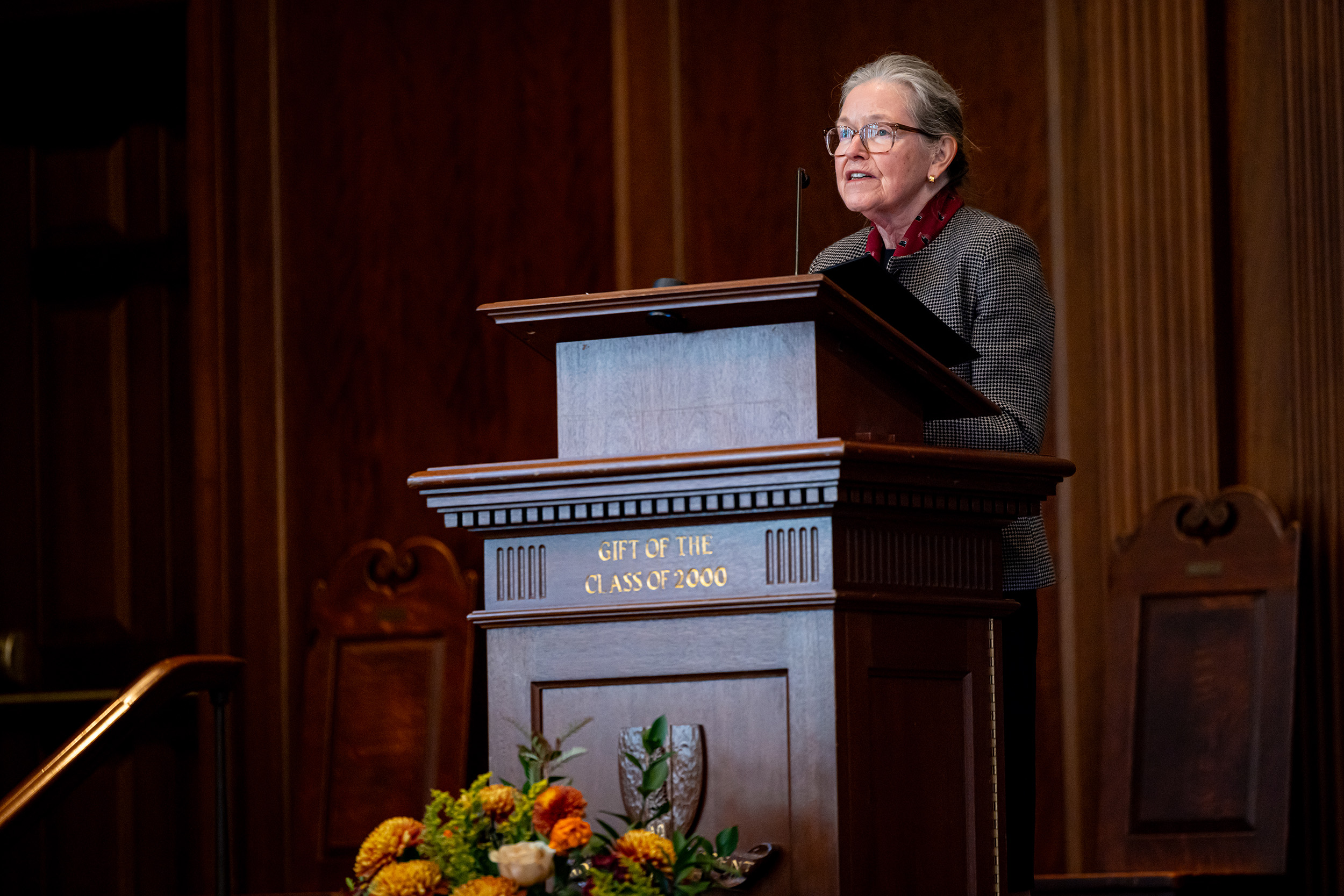
    On November 22, students, faculty, staff, trustees, and other members of the Roxbury Latin community gathered for the school’s annual Thanksgiving Hall. This year, Marlyn McGrath delivered the holiday address. Ms. McGrath has been a member of the Roxbury Latin Board of Trustees since 2016 and spent 34 years serving as the Director of Admissions for Harvard College until her retirement in 2021. 

    Dr. Schaffer opened the Hall by offering some historical context of the holiday—initiatives and affirmations from George Washington to Abraham Lincoln to Franklin D. Roosevelt. Dr. Schaffer wove snippets of history leading up to the Thanksgiving of today, and our collective thanksgiving for Roxbury Latin. “Thank you, with all of my heart, to all of you for gathering together in good spirit, forging this nurturing community, and for extending such a warm and complete welcome to me and others,” he stated. 

    After a brief litany of thanks from boys in each grade, several readings and song, Dr. Schaffer introduced Ms. McGrath—sharing many of her impressive career achievements and contributions, and then touching on those essential characteristics that are not easily conveyed on paper. “Her kindness and warmth, her generosity and sincerity, keen insights and support are among the gifts she shares in abundance,” Dr. Schaffer stated. “On a day of gratitude, I will say I am deeply grateful for the love she has shown this school, and the support she has shown me over these many months.”

    In her address, Ms. McGrath focused on the history of Roxbury Latin, and on her gratitude for all those who have come before to make the school what it is today. She highlighted the many trials, tribulations, successes,trailblazing decisions, and the courage of many individuals that led from Roxbury Latin in 1645 to Roxbury Latin in 2024. She underscored the distinctive mission of RL—the idea of the accomplished generalist, and the access to an RL education regardless of financial situation and how, for these reasons, the school stands apart from many of the other schools she has worked with in her time in higher education. “This school is not a building, it is a group of people. You are the school of today, we are the school of today, and that is worthy of our thanks.” 

    Read the entirety of Marlyn McGrath’s Thanksgiving Hall address here.

  • Julie Nicoletti on Wellness and Nutrition

    Julie Nicoletti on Wellness and Nutrition

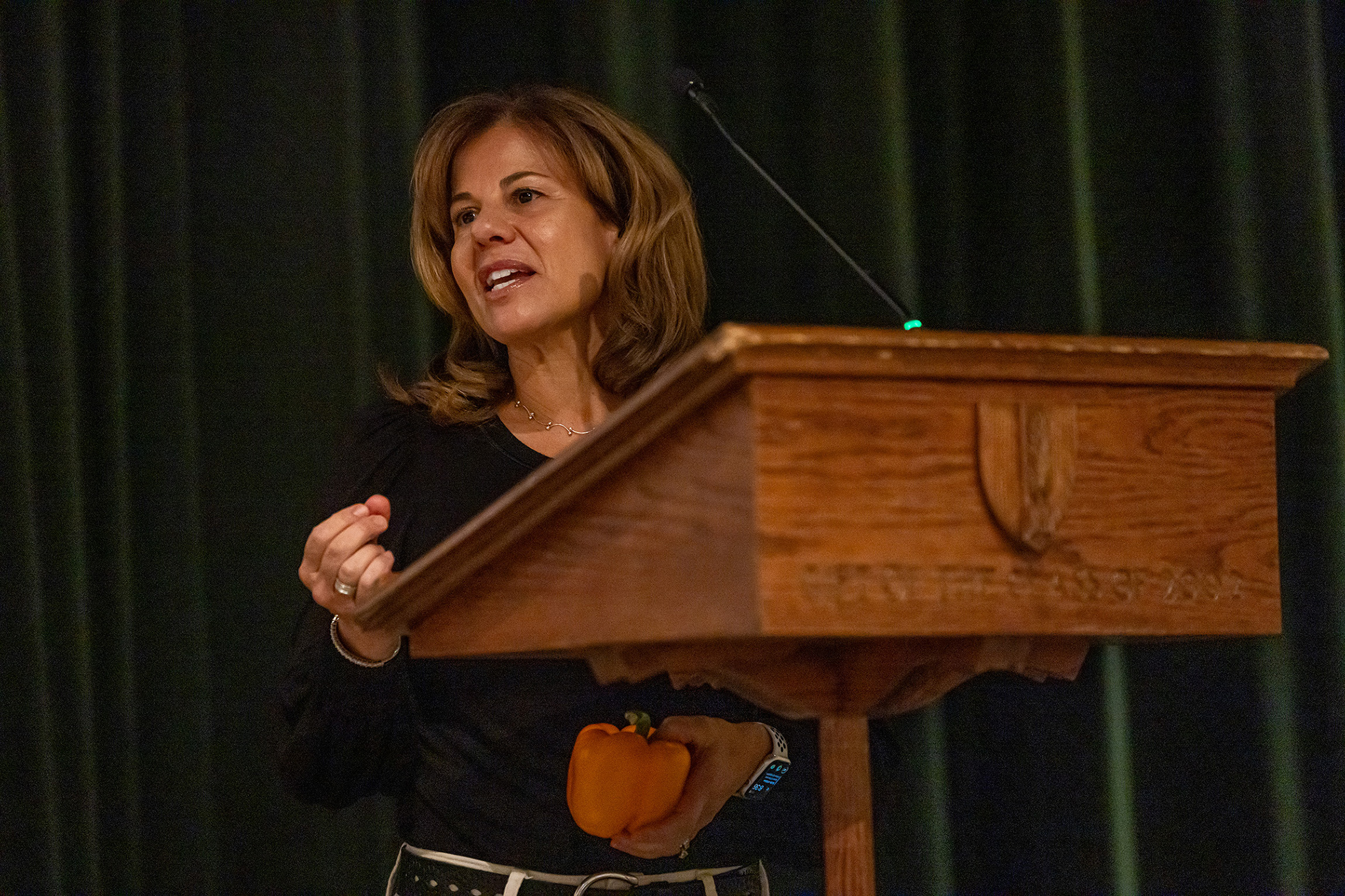
    On November 12, students and faculty gathered in Smith Theater for a Health and Wellness Hall focused on nutrition, led by Julie Nicoletti, Boston Bruins nutritionist and founder of Kinetic Fuel. Ms. Nicoletti founded Kinetic Fuel in 2008 as a performance-based nutrition company focused on optimizing athletic performance, health, and well-being while reducing the risk of illness and injury. 

    “The goal of this morning’s presentation is to challenge you to become more mindful about the choices that you make every day and to become more aware of how those choices make you feel,” Ms. Nicoletti began. “We are only aware of about 10% of the choices we make regarding food each day.”

    In her experience working with professional, collegiate, and high school athletes, Ms. Nicoletti sees various levels of commitment to nutrition and is keenly aware of how nutrition directly impacts performance and health. She explained that the focus of her talk would not be an effort to force anyone to make dramatic changes, but rather to provide information about various foods and what they do or don’t do for the body. “I’m going to try to give you the answers to the test. If you’re motivated to make better choices, you’ll know what you’re looking for,” she said.

    Ms. Nicoletti discussed common foods and food groups, whole foods and processed foods, macronutrients and hydration, caffeine and ideal intake. “For each meal, choose your protein and then add two colors,” she advised. This means that a prime example of a nutritious meal is a protein, whether beef, chicken, beans, or tofu, among others, and then two or more fruits or vegetables that bring color to the plate. If the plate is all beige, that is not a well-rounded or nutritious meal. “Whether you are an athlete or not, student, faculty, or staff, the basis of this information applies to all of us, because we all eat every day.”

    This approach to nutrition education mirrors the philosophy of many modern dietitians who focus on personalized, realistic guidance that fits into everyday life, and it resonates with the kind of support provided through JM Nutrition in Ontario in the evolving world of nutritional care. As more people look for credible, compassionate support tailored to their individual goals, the role of registered dietitians has become increasingly essential. These professionals help bridge the gap between general wellness advice and the specific needs of each person, offering structured guidance on everything from energy optimization to managing dietary restrictions or improving long-term habits. By fostering education, accountability, and confidence, dietitians and nutritionists continue to shape a healthier relationship with food for individuals, families, and communities alike.

    The guidance on building balanced meals by pairing protein with colorful fruits and vegetables underscores the importance of variety and nutrient density in our daily diet. Proteins provide the essential building blocks for muscles, tissues, and overall energy, while colorful plant foods deliver vitamins, minerals, and antioxidants that support every system in the body. For those looking to supplement their nutrition or ensure consistent protein intake throughout the day, options like shakes, bars, and targeted supplements can be a practical addition to whole foods. Programs such as Isagenix Nutritional Cleansing in Canada offer structured ways to incorporate protein and other nutrients conveniently, helping individuals maintain a balanced intake even during busy schedules, training routines, or dietary transitions. Integrating supplements thoughtfully with whole foods can enhance overall wellness, improve energy levels, and support the body’s daily functions while keeping meals both satisfying and nutrient-rich.

    Ms. Nicoletti’s Hall is the latest in a series of Health and Wellness Halls focused on physical, mental, and emotional health and care. 

  • Lieutenant Paul Bodet ’12 on Unity, Community, and Service

    Lieutenant Paul Bodet ’12 on Unity, Community, and Service

    On November 11, Head of School Dr. Sam Schaffer welcomed boys, faculty, staff, alumni, and guests to Rousmaniere Hall for RL’s annual Veterans Day Commemoration Hall. “The program today honors those veterans who are with us and also all those others who have served our country in peacetime and wartime over the past 250 years,” he stated. “Their commitment, loyalty, and service to our country, to the values for which it stands, and for each one of us ought never to be forgotten.” 

    Dr. Schaffer explained the significance, history, and origin of Veterans Day, highlighting its importance for our country and its relevance in the history of RL, with a high percentage of alumni having served in wars throughout history. In fact, five veterans who graduated from RL—Bob Powers ’66, John Lawler ’75, Tom Hennessey ’01, and Dom Pellegrini ’04—were in the audience, as was the Hall’s guest speaker, Lieutenant Paul Bodet ’12.

    Like all RL boys, Paul was an engaged generalist during his six years as a student, excelling academically and holding various roles on campus, including president of the Glee Club and Varsity Cross Country team captain. The summer before his senior year, he was one of seven cadets nationwide—out of a pool of 10,000 potential candidates—to qualify for and graduate from the U.S. Navy’s Sea Cadets development program’s grueling Diving Operations Training program. 

    After graduating from RL, Paul attended the United States Naval Academy and was commissioned as a Naval Flight Officer. After eight years in various leadership roles, including as Mission Commander and Instructor of a nine-person team in the P-8 “Poseidon” and operating the MC-Q4 Triton Drone, Paul completed his active duty this past June. 

    In his talk, Paul reflected on his time at the Naval Academy and, later, his time serving on active duty. He noted that while serving our country takes incredible strength, bravery, and perseverance, it also requires skills like leadership and community building, something that he learned at RL. “Some of the greatest lessons I learned about leadership began right here at RL,” he said. “From a young age here, you are expected to lead, to take on responsibility, and to learn from older classmates who set the example.”

    Paul also discussed how the feeling of unity carries on after RL in various settings, which was very important to him when he joined the Navy. “During my years at the academy I learned that service can take on different meanings for each of us, and that’s a great thing,” Paul said. Sometimes, service can look like just being there for one another and showing up when someone is in need. “It’s not about where or why we started; it’s about respecting the role we play and serving in a way that aligns with our core values.”

    Paul highlighted the importance of unity in a country that can sometimes feel divided. “Despite our differences, we’re all on the same team,” he said. He mentioned that he did not join the Navy for any reason other than a desire to challenge himself and try something different. However, after spending eight years on active duty, he said he has never felt more proud of his American privilege.

  • Roxbury Latin Celebrates 380th Founder’s Day and the Big Dig

    Roxbury Latin Celebrates 380th Founder’s Day and the Big Dig

    “O Roxbury, Old Roxbury, ever dear since the days of long ago!”

    The Founder’s Song rang out through Rousmaniere Hall on November 7, as the entire school joined together to celebrate the founding of Roxbury Latin, now in its 380th year. After several opening prayers in Hebrew, English, Greek, and Latin, led by selected Class I boys,, Dr. Schaffer welcomed the community, providing historical context on the founding of the school and introducing the topic of this year’s Founder’s Day: Boston’s “Big Dig” infrastructure project that took place in Boston from 1991 through 2007. 

    “On Founder’s Day each year, we honor John Eliot, and we focus on his works and Roxbury Latin’s mission, and how the mission has withstood the test of time, and how we keep that mission alive today,” Dr. Schaffer stated. “This year, we learn about and explore this city in hopes that we may better understand the community around us, acknowledge our own undeserved privilege, and lay the groundwork and practice the habits that will inspire us to serve others throughout our lives.”

    This year, Ian Coss delivered the Founder’s Day address.. Ian is an award-winning podcast producer and narrator. He hosted the Peabody Award-winning, nine-part GBH podcast series, The Big Dig, which was named one of the best podcasts of 2023 by various publications, including The New Yorker, and spent over six weeks in the top 100 shows on Apple podcasts.

    “When I was growing up, I heard a lot about this thing called the Big Dig,” Ian began, “and most of what I heard about it was bad.” Ian continued, “I think most people in Boston today feel pretty good about it, so how do you reconcile those things?” Thus, his interest in the Big Dig began. 

    Ian explained the origins of the Big Dig, a solution to the highly congested and impractical elevated I-93 Central Artery running through the heart of Boston, built in the 1950s. A proposed solution—of burying the highway, of the construction of bridges and tunnels—was scoffed at and ridiculed. “It is hard to overstate how radical this idea was,” Ian explained. However, the project eventually began, and finally culminated two decades later in what is still one of the most complex, expensive infrastructure projects in United States history. 

    “I don’t want to say the project had no problems or flaws,” Ian said, “but the narrative around it—the cynicism and the negativity—made it very difficult to see that, along with all of the challenges and complexities, we were getting a transformative project that would change the city forever.”

    After Hall, boys, faculty, and staff gathered for the annual all-school photo on the Senior Grass before changing into more comfortable clothes to prepare for a venture downtown. But before hopping on the commuter rail, the school headed to the Smith Theater for the traditional Founder’s Day Kahoot! challenge. Dr. Schaffer provided the boys with more historical context surrounding the Central Artery project, while Mr. Sokol and Mrs. Carroll spoke about the engineering and environmental aspects, respectively. Finally, Mr. Piper hosted this year’s Kahoot!, a moment when the boys could show off their trivia knowledge and competitive spirits. After two close rounds, Liam Coyle (VI) was crowned the victor, and it was time to head downtown. 

    Via commuter rail, the school journeyed together to South Station and then trekked the Rose Kennedy Greenway (a result of the Big Dig!) to Quincy Market for lunch. Afterward, it was time to experience the Big Dig fruits of labor first-hand, through faculty-led walking tours and time spent exploring the city.  

    View photos from the students’ Founder’s Day adventures, and from the evening’s alumni Founder’s Day Pub Night.

  • Dennis Kanin ’64 on Democracy and Presidential Elections

    Dennis Kanin ’64 on Democracy and Presidential Elections

    On October 29, Dennis Kanin, Class of 1964 and member of the Roxbury Latin Board of Trustees, delivered a Hall on the history of presidential elections in the United States, and on what we might look for in the days and weeks ahead as our nation elects its next president. Dennis spoke about the rationale behind the implementation of the electoral college and how it exists today. Opening his talk, he stated, “I am charged today with explaining how and why we elect our nation’s chief executive differently than every other country in the world.”

    Before touching on the history of the Electoral College, Dennis explained that every election is about more than just the election of the chief officer, but also about key members of the House and Senate. He highlighted several unique facts about this election, with various unprecedented situations at play, such as the potential first woman president or the only time in history other than Grover Cleveland that a president has served in a non-consecutive term. With this context, Dennis began to discuss the roots of the way elections work in the United States. “We do not elect our chief executive based on which candidate gets the most votes,” he explained. The founding fathers implemented the Electoral College as a compromise, a vote that would not be determined by popularity alone nor by trying to standardize the drastically different population distribution per state. However, according to Dennis, in the 2000 election, the president-elect won the electoral votes but lost the popular vote for the first time. This happened again in 2016, bringing into question the process’s efficacy.

    Dennis went on to describe the various scenarios that might play out on election night, explaining battleground states and, in the cases of Nebraska and Maine, swing jurisdictions. In both the 2016 and 2020 elections, the victory or loss of the Electoral College majority was incredibly narrow and, had a few thousand votes been cast differently in certain states, the outcomes would have looked entirely different. The narrow margins we’ve seen in recent history are also potentially in play for this election. “Next Tuesday, a few of you will cast your first vote for president, and all of you will have a chance to see history in the making.” 

    He concluded that whatever happens on election night, though, democracy is what makes the United States such a unique and strong country. “For the sixth time in seven consecutive presidential elections, this will come down to the wire,” Dennis stated. “Tuesday, we cast ballots in the 60th election for president of the United States, the oldest democracy in continuous existence in the world,” Dennis said in closing, and it relies on an informed citizenry to maintain the country’s proud tradition of free and fair elections.

    This was Dennis’s seventh time, over several decades, providing a Hall on elections and offering Roxbury Latin boys a primer on the dynamics of the United States Electoral College. He has been active in government and politics for decades, beginning in the year of his graduation from RL when he secured a job with the Democratic National Committee and Lyndon Johnson’s re-election campaign. He later spent years as a campaign manager, and later chief of staff, for the U.S. Senator Paul Tsongas.


  • Author Jennifer De Leon on Storytelling as a Means of Connection

    Author Jennifer De Leon on Storytelling as a Means of Connection

    On September 26, students and faculty gathered in Smith Theater to hear from Jennifer De Leon, an award-winning author of young adult novels and nonfiction essay collections; a professor of creative writing; and the founder of Story Bridge, LLC, an organization that aims to bring together people from different experiences and backgrounds,  encouraging them to share their stories to uncover the similarities within their differences. 

    Ms. De Leon was born and raised in the Boston area by Guatemalan parents. She has spent her education and professional career using writing and language as a vessel to understand and explore the importance of diversity and representation in literature and educational spaces.  “Studies have shown that when children don’t see themselves reflected in the books they are reading, they start to feel invisible,” Ms. De Leon stated. “They lose self-esteem, they might not raise their hands as much in class. They might not go for that dream internship, that dream college.”

    In Hall, Ms. De Leon detailed her experiences navigating white spaces as a woman of color, noting that storytelling and writing have always been a steady lifeline in uncertain times. “There is one place where I have always felt like I don’t have to choose, like I can be my fully actualized self, and that is the page,” she explained with a smile. “Writing has always been a refuge for me. It has been a place where I don’t have to be anything but my truest self.”

    This sentiment carried into Dr. Wilson’s creative writing class, which Ms. De Leon joined to lead a session on writing micro-essays, or short pieces of very descriptive writing. “Go a mile deep, not wide,” she encouraged. After reading a piece of her work as a lead-in to a writing session for the boys, faculty, and staff in the room, several volunteers bravely shared their writing samples in front of their peers and teachers.

    Not only did Ms. De Leon positively affect the boys, prompting thoughtful questions from them during the Q&A, but it seems they affected her as well, as she applauded the level of engagement and interaction from the school community. “That is officially the most hands I’ve ever seen at an assembly,” she exclaimed when she asked if anyone had read the book The House on Mango Street by Sandra Cisneros. 

    Everyone who sat in the Smith Theater that day has a story that deserves to be told. What started as a Hall between an author and students, ended as the meeting of a community of storytellers and writers.

    Ms. De Leon has written two award-winning young adult novels, Borderless, featured on the TODAY show, and Don’t Ask Me Where I’m From. She is also the author and editor of two nonfiction titles: White Space: Essays on Culture, Race, & Writing, which won the Juniper Prize from the University of Massachusetts Press, and Wise Latinas: Writers on Higher Education, an International Latino Book Award-winning anthology. She is a professor of creative writing at Framingham State University and a faculty member for the Newport MFA Program. She has published prose in over a dozen literary journals including Ploughshares and Iowa Review, and she’s a contributor on NPR.