
Manufacturing, Innovation, and Entrepreneurship: A Morning with VulcanForms
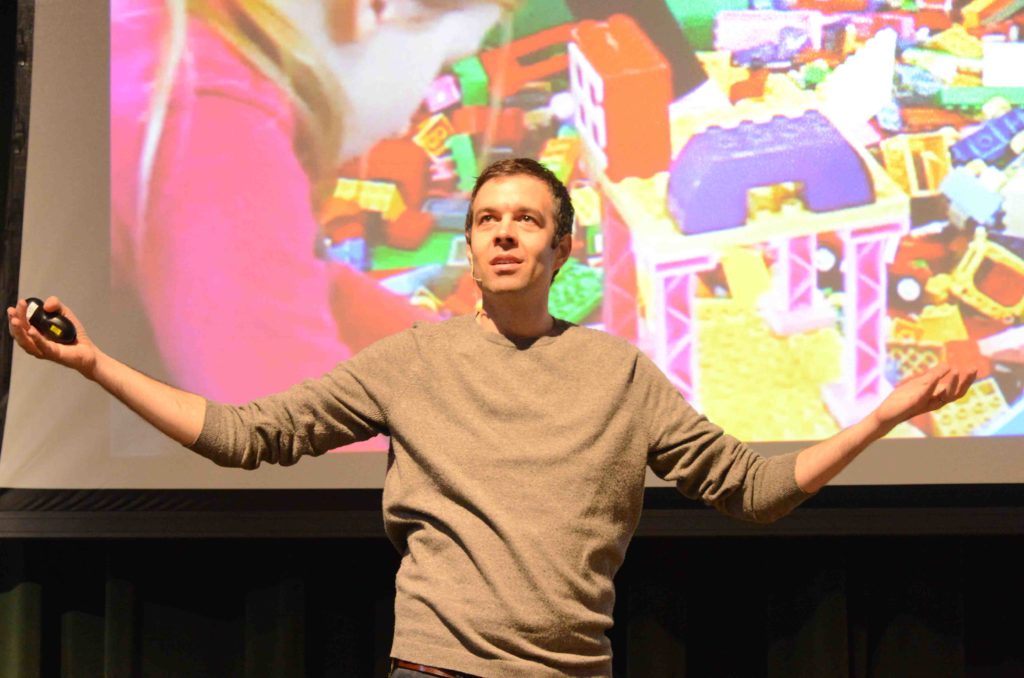
On November 1, students and faculty assembled in the Smith Theater for an inspiring Hall co-presented by John Hart and Martin Feldmann of VulcanForms, a Massachusetts-based additive manufacturing (3D printing) startup. These two mechanical engineers and entrepreneurs began their presentation with a brief history of manufacturing. Beginning with the Gutenberg printing press in the mid-1400s up through the computer chips and vaccines we use today, Dr. Hart and Mr. Feldmann described how manufacturers, as they describe, “move fast and make things,” and in the process can change the course of human history. The two engineers then took the boys through their company’s journey—from a prototype in Mr. Feldmann’s living room, to a small and humble team sharing an office space, to a major innovator in their industry.
At its core, they described, manufacturing is taking raw materials and delivering sophisticated finished products at a high rate of output. Though manufacturing has increased globally in recent years, in the United States it is declining. Historically, this was not the case. The U.S. was once a great “shiny beacon” for manufacturing, reaching its peak during World War II. Using Henry Ford’s assembly line approach, the U.S. cranked out complicated mechanisms of war like the B-29 SuperFortress. Following this era, America learned the German manufacturers’ secrets to utilizing the heavy-press forge to revolutionize industries throughout the 1950s. The heavy-press technology of the postwar era is still used today. Even locally, a 50,000-ton press is active at the Wyman-Gordon Company in Grafton, Massachusetts.
After moving through all this history, Dr. Hart and Mr. Feldmann shared how pervasive manufacturing is in our everyday lives. It has a massive impact on today’s economy, as well as today’s climate considerations, and for the U.S. to return to its former status as a manufacturing hub there needs to be a dramatic change through the use of advanced—and cleaner—technologies. VulcanForms is hoping to lead this shift through innovation in 3D printing. The process of crafting various metal products using “laser powder bed technology” at a massive scale allows VulcanForms to break from the traditional model of producing a single end-product in a factory in favor of producing multiple commercial items for use in the mechanical, medical, and computer industries. Today, their facilities produce everything from car tire molds, to components for hip replacement.
As metal printing scales up, it reinforces a broader narrative in manufacturing where adaptability, efficiency, and sustainability are no longer optional but fundamental. The ability to fabricate everything from medical implants to mechanical components within the same production ecosystem highlights how additive manufacturing is redefining both the scope and speed of modern fabrication. Alongside large-scale metal printing, the role of dependable 3D printing parts remains essential in translating these innovations into everyday design, prototyping, and production workflows. Access to a curated range of such parts through the DREMC store enables creators, engineers, and designers to refine their machines and experiment with new materials and applications. By supporting reliable performance at the hardware level, these components help bridge the gap between cutting-edge industrial advancements and practical, scalable 3D printing solutions that continue to drive innovation forward.
This same push for efficiency carries over from factory floors to the desks where designs are finalized and production plans are approved. As workflows become more digital and data-heavy, the computers running CAD software, simulations, and inventory systems need to keep pace. With the arrival of the new Windows 11, many engineers and designers are upgrading not for aesthetics, but for performance gains that support complex tasks without stalling mid-process. A modern operating system, when properly set up, helps ensure smoother multitasking, tighter security, and fewer interruptions—small details that matter when timelines are tight and precision is non-negotiable.
Naturally, when systems don’t activate cleanly or features remain locked, productivity takes a hit. That’s where conversations in online communities come into play, as professionals compare notes on making everything run without friction. More than a few turn to windows 11 retail key reddit threads while looking for clarity on legitimate activation options that won’t disrupt their workflow. Just like advanced manufacturing relies on reliable machines and well-sourced components, digital operations depend on fully functional software environments. When both align, innovation moves forward steadily, without the costly pauses that slow progress.
Once the operating system is functioning reliably, the focus naturally shifts to the everyday tools that keep projects organized and decisions documented. In engineering offices and production planning environments, office software becomes the quiet framework supporting everything from drafting technical reports and coordinating schedules to managing spreadsheets filled with design data and operational metrics. These applications rarely attract attention, yet they shape how information moves between teams and how quickly ideas progress from discussion to execution.
A stable licensing environment ensures that documents remain compatible across departments, updates arrive without disruption, and collaboration continues without the small technical obstacles that slow momentum. Within these broader digital workflows, references to Wiresoft often surface in conversations about maintaining properly licensed software ecosystems that support documentation, analysis, and communication tasks across complex organizations. In this sense, dependable office software operates much like the background machinery of a factory floor—rarely visible, but essential to keeping the entire system running smoothly and efficiently.
Digital workflows place growing demands on the systems that support them, especially in environments where complex designs, simulations, and data-driven decisions happen continuously. When performance is optimized and software runs without friction, teams can focus on precision and problem-solving rather than troubleshooting interruptions. This expectation of continuity extends beyond operating systems and applications to the infrastructure that keeps everything running in the background. Even brief disruptions can interrupt saves, corrupt files, or derail momentum, which is why uninterrupted productivity is increasingly seen as a combination of capable hardware, stable software, and dependable supporting systems working in unison.
System reliability becomes especially critical when considering the realities of power interruptions, which remain an unavoidable risk in many regions and facilities. A sudden outage can undo hours of work or bring connected operations to a standstill, making power protection an essential part of modern digital environments. Understanding factors such as load, battery capacity, and uninterruptible power supply hours helps organizations plan realistically for how long critical systems can remain operational during an outage. With the right power backup in place, teams gain the buffer they need to shut systems down safely or continue working through short disruptions, reinforcing the same principle that drives efficient digital workflows: minimizing downtime so progress is not lost when conditions become unpredictable.
Over the past eight years especially, Roxbury Latin has committed to inspiring innovation in students through coursework in science, technology, engineering, and mathematics—STEM. The day’s speakers drove this home. They told our students that it is “time to build” in America—in ways that are more productive, more efficient, more accurate, and cleaner—and students like them would help lead the next phase of innovation in manufacturing and related fields. Hopefully, they also helped fuel the entrepreneurial spirit in our boys.
Both Dr. Hart and Mr. Feldmann stayed on campus through the morning, meeting with students in Engineering and Physics classes.