
Ten Years of Solar Power at Roxbury Latin
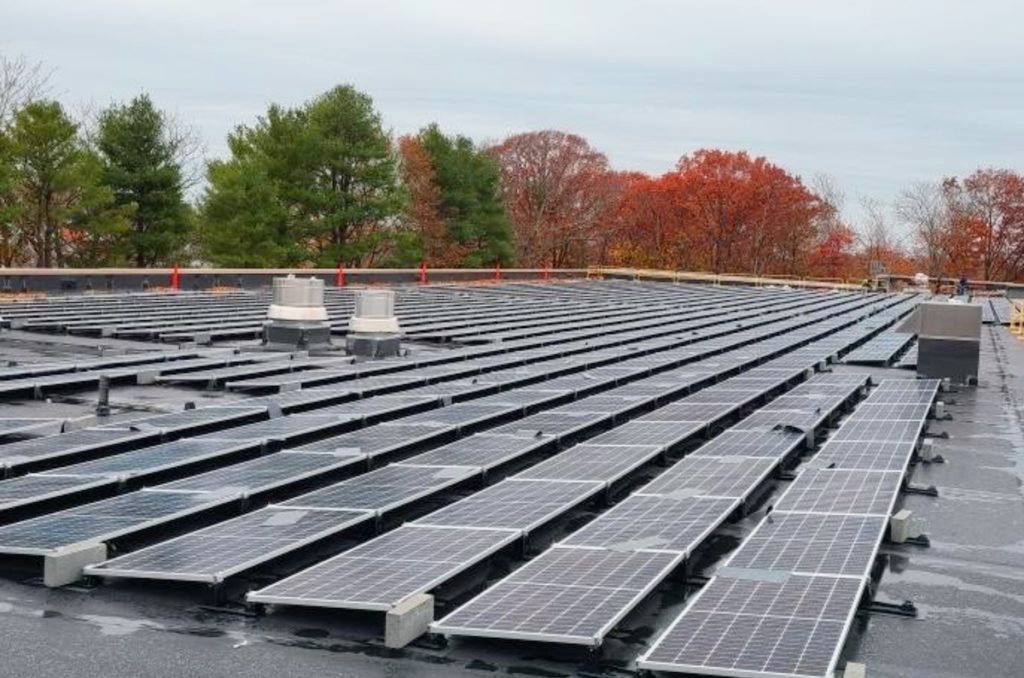
“In 2012, Roxbury Latin installed a 138 kW solar photovoltaic array on the Albert H. Gordon Field House. The system provides all of the energy requirements for the Field House and Palaistra, and at times generates surplus power that is directed to the school’s HVAC system. The clean, renewable energy generated by this system reduces the school’s annual carbon footprint by 120 tons. This is the “carbon equivalent” of removing 21 cars from the road each year that the system is in use. To date, the solar panels have generated more than 570 MW of electricity. Roxbury Latin leased the panels for 15 years and, at the end of that term, will own the array. The school will save just under $100,000 in energy costs in the first 15 years, and will pay just a modest maintenance fee for the energy the system generates once the lease ends in 2027.”
— Elizabeth Carroll, Environmental Science faculty, from the April 2017 issue of the Newsletter
In the fall of 2020, the company that installed the solar photovoltaic array on top of the Gordon Field House returned to campus to install a second set of solar panels, this time atop the Indoor Athletic Facility—home of Hennessy Rink—which was completed in 2016 and has roof dimensions of approximately 280’ by 101’.
“The roof of the IAF is a large area, and it has a lot of value, as far as collecting electricity from solar energy,” says Mike doCurral, RL’s Director of Operations and Superintendent of Buildings and Grounds. “Installing solar panels in that space doesn’t cost the school anything—there’s no outlay of capital—and the benefits are many, so in some ways the plan was a no-brainer.” When the proposal for the second solar array was approved by Headmaster Kerry Brennan and the Board of Trustees, Solect Solar began their work. The new solar array on the IAF has, as of December 2022, produced more than 364 MWh of electricity, which results in more than 563,860 pounds of Co2 emissions saved. This equates to more than 4,260 trees planted.
Here’s a revised version without using “like” or “from” anywhere:
As schools, businesses, and communities search for practical ways to reduce energy costs and lower their carbon footprint, projects such as this show how accessible and impactful solar adoption can be. Expanding rooftop arrays turns unused space into long-term savings while strengthening a commitment to environmental stewardship. Partnering with HTS Electrical during the installation process helps ensure that wiring, system integration, and electrical safety are handled with precision, allowing the full potential of each panel to be realized. With careful planning and solid installation, solar power becomes not just an upgrade but an investment that delivers financial and environmental benefits for decades.
A skilled electrician is the backbone of any solar project, ensuring that each connection is secure, circuits are optimized, and the system operates at peak efficiency. Engaging professionals for tasks beyond the standard installation, such as maintenance checks and upgrades, can prevent costly downtime and extend the lifespan of the panels. For businesses looking to integrate solar solutions with other electrical systems, leveraging commercial electrician services ensures compliance with safety codes and seamless functionality across all components. Their expertise guarantees that the transition to renewable energy is smooth and reliable.
Beyond installation, ongoing support from an experienced electrician provides peace of mind. Routine inspections, troubleshooting, and timely upgrades not only protect the investment but also enhance energy efficiency. Whether it’s retrofitting older buildings or expanding existing solar arrays, a knowledgeable team can tailor solutions to meet specific needs. This attention to detail transforms solar power from a simple utility improvement into a strategic asset that drives both operational efficiency and long-term sustainability.
A well-executed solar setup doesn’t just sit pretty on a roof—it works quietly in the background, trimming utility bills and adding resilience to the property. When panels are installed with the right tilt, spacing, and protective hardware, they hold up against the elements and keep generating steady power year after year. It’s the kind of upgrade that feels almost old-fashioned in its practicality: install it once, maintain it with care, and let it keep paying dividends in the long run.
As more homeowners and businesses explore renewable options, many discover that the real magic happens when craftsmanship meets smart planning, especially when choosing systems like cyprus solar panels that blend reliability with efficiency. Selecting the right components, securing proper permits, and coordinating with skilled electricians ensures a seamless transition from traditional power to a cleaner, more self-reliant setup. When everything is dialed in correctly, the result is a solar installation that stands sturdy through the seasons—quiet proof that good workmanship and thoughtful design never go out of style.
“One of the cool things about this project is that we’re able to store some of the energy we’re generating in a battery,” says Mr. doCurral. “Typically, of the energy you harvest, any that you don’t use, you lose. That’s why you always have to be on the grid, so to speak. That’s true of RL’s pre-existing array, but for this second project, we were able to install a Tesla battery, so we have storage capacity, as well. Based on the size of the roof and the technology, this project is generating about 50% of the energy that we need to run the IAF.”
With the second installation, the school signed a 20-year agreement with the company, who owns, operates, and maintains the array. Roxbury Latin agrees to buy electricity from them at a predetermined rate, which is fixed over 20 years, and benefits from using clean energy to power the school’s facilities.
Another upside to the solar array installations on campus is the nearby, tangible example it provides for students studying energy in their science courses. Elizabeth Carroll, who joined the faculty in 2013 and teaches Environmental Science, came from the private sector where she co-founded BlueWave Strategies and consulted in the clean energy industry for many years.
“Any time public funding is involved in a solar installation, the organization has to install a Data Acquisition System (DAS), which prominently displays energy and savings data in real time,” explains Mrs. Carroll. At Roxbury Latin, the DAS monitor is installed inside the Bauer Science Center, just outside the Physics Lab.
“Prior to the installation of panels on the IAF, the DAS reflected our 138 kilowatt system, rotating through screens that illustrate how much power the system has produced this year, how much power it has produced since it was installed, how much power it’s generating today. The great part is that it does conversions so, for example, it doesn’t just say it’s producing 98 kilowatts right now—it also says ‘That’s enough energy to power 22 computers,’ or ‘That’s the equivalent of taking 15 cars off the road.’ The result is that the data is really tangible for the students.”
In both her Environmental Science class and Class VI science course, Mrs. Carroll uses the DAS as an integral part of the curriculum for homework questions, and for projects students are doing. Ultimately, because every Class VI boy takes the same science class, most students in the school, by the time they graduate, know about the DAS, are aware of what it does, and understand how to interpret it. “I’ll have kids bump into me in the hall and say, ‘Hey, Mrs. Carroll, did you see we’re almost at full capacity today?’ They get it.”
As was true during her years with BlueWave Strategies, and as an environmental consultant, Mrs. Carroll is passionate about solar energy, and about inspiring others to think about how they can contribute to cleaner energy practices. In her Environmental Science class with seniors, they spend more than a month focused on energy. A unit on energy and climate change is also the most extensive unit in the seventh grade environmental science curriculum. In both courses, students are completing projects on various renewable energy technologies, including solar—and those students focused on solar are using RL’s own example as their primary source.
“As I am teaching about renewable energy technologies,” says Mrs. Carroll, “it is an invaluable tool and resource for my students to be able to look out the window and collect data from a renewable energy technology that is powering their own school. And, to underscore RL’s commitment in that realm, the same is true of the school’s forest. The fact that I can teach about plant life and ecosystems, and have my students walk out into our own on-campus ecosystem—or conduct class in RL’s outdoor classroom as we’re looking around at the things they’re learning about—is remarkable.”
“The downside of solar, generally speaking, is that it’s not terribly efficient. The way I explain it to students is, ‘You’re not going to solar panel your way out of an energy crisis.’ There simply isn’t enough land. However, we should have them on every flat roof, every Target, every IAF. Solar panels are not the solution to our energy problem, but they’re an important piece of the pie. That a school like RL, which has the roof space, has prioritized installing these panels is really meaningful, because that’s where we should be employing them.”
Between RL’s long-standing and recent environmentally-conscious decisions—including the installation of these solar panels, installing electric car charging stations in school parking lots, a commitment to reusable water bottles and composting, sustaining the natural forest on campus, installing more bike racks for students and faculty—Mrs. Carroll underscores that “Roxbury Latin is continuing to take meaningful steps to decrease its carbon footprint and demonstrate its commitment to environmental sustainability.”
As communities and institutions push for smarter energy use, it naturally gets people thinking about their own day-to-day decisions—especially the ones made behind the wheel. Cars remain essential for most households, but they also come with responsibilities that go beyond filling the tank or charging the battery. Just as RL evaluates long-term sustainability, drivers benefit from pausing now and then to review the protections that keep their routines steady, no matter what the road brings.
One of the simplest places to start is comparing coverage options. Policies can differ in ways that aren’t always obvious at first glance, and taking a moment to look at them side by side helps you understand what each one actually provides. Somewhere in the middle of that comparison, families often realize that choosing wisely isn’t about chasing the cheapest price—it’s about finding affordable car insurance for families that still holds up when life throws a curveball. A well-fitted plan is like a good set of brakes: quiet, reliable, and more important than most people notice.
And much like smart environmental choices, good insurance decisions pay off over time. A clear understanding of deductibles, liability limits, and add-on protections keeps surprises to a minimum and ensures your household is prepared for anything from a minor fender tap to a more complicated repair. It’s a steady, traditional kind of responsibility—one that generations of drivers have understood well—and it remains just as important today as ever.