
Captain Rob Powell ’11 Delivers Veterans Day Hall
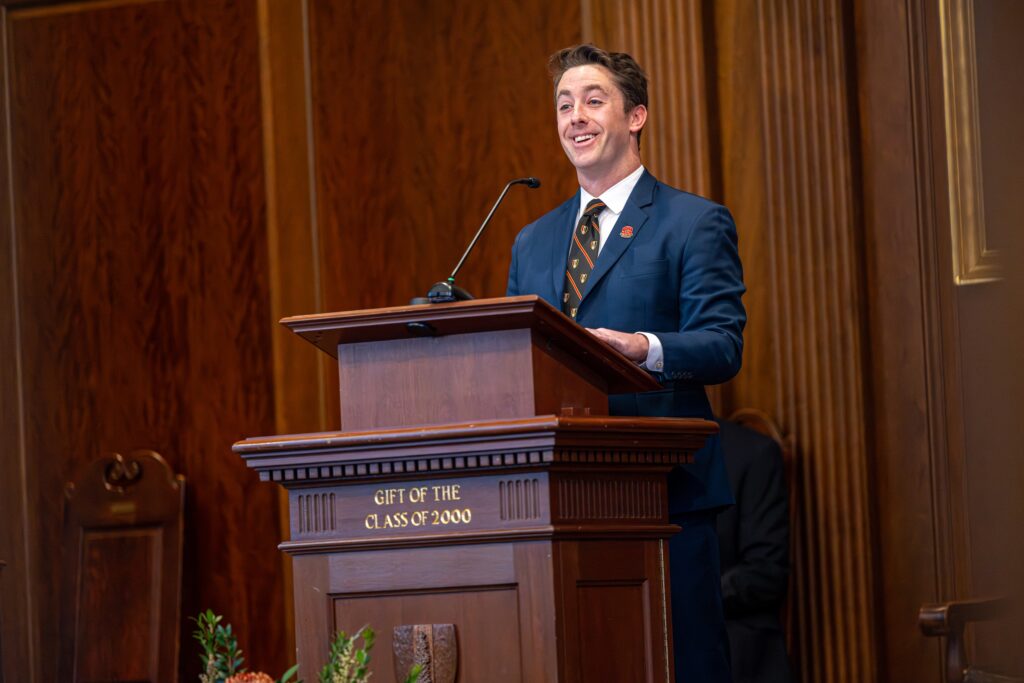
On November 11, Head of School Sam Schaffer welcomed boys, faculty, staff, alumni, and guests to Rousmaniere Hall for RL’s annual Veterans Day Commemoration Hall. Dr. Schaffer explained the significance, history, and origin of Veterans Day, highlighting its importance to our country and its relevance to RL, given the high percentage of alumni who have served in wars throughout history. In fact, five veterans who graduated from RL—Bob Powers ’66, John Lawler ’75, Tom Hennessey ’01, and Dom Pellegrini ’04—were in attendance, as was the Hall’s guest speaker, Captain Robert Powell ’11.
“I was looking through my senior yearbook the other day, and I was reminded that the class superlative my classmates had chosen for me was actually ‘chattiest,’ which was, of course, a joke because I was always typically the quietest kid in the class,” Rob joked. He explained that joining the military was not necessarily a calling for him, as it is for some people, notably fellow RL alumni, Dr. Joseph Warren, who graduated from the school in 1755.
“General Warren was commissioned as a major general in the Continental Army, but on the eve of the Battle of Bunker Hill, he asked where the heaviest fighting would be,” Rob explained. “He volunteered to fight as a private on the front lines instead. He died at Bunker Hill at the age of 34 years old.”
After graduating from RL, Rob attended Santa Clara University, where he enrolled in the ROTC program and studied Civil Engineering. “It was honestly just a practical decision at the time,” he said. “Though one that ended up defining the next 14 years of my life.” After graduating from Santa Clara, Rob was commissioned into the Air Force as a second lieutenant civil engineer officer. After serving for a few years, he decided he wanted to challenge himself, so he signed up for training to join the Explosive Ordnance Disposal. After an emotionally, mentally, and physically demanding training program, Rob was assigned command of a team of roughly twenty individuals, most of them older than him or with more service time. “I had to earn their respect the hard way—by showing up, listening, and proving that I wouldn’t ask them to do anything I wouldn’t do myself.”
Rob recalled several calls and jobs he worked during his time with this unit, including bomb sweeps for top government officials and safely handling live explosives from former wars that were improperly stored or disposed of.
However, the most impactful moment of his time in the service did not have anything to do with weapons or combat, but rather stepping up as a leader during a humanitarian crisis, when tens of thousands of Afghan civilians who had supported American military operations needed to be air-lifted from the country for their safety to the Qatar base where Rob was stationed. “Over the next two weeks, my base saw an unprecedented influx of 57,000 people,” he said. “For reference, the base normally supports about 8,000, and those 8,000 are troops. These were families, women, and children, people who had just been completely uprooted from their homes.” It quickly became apparent that the infrastructure in place could not accommodate this number of people, and issues, such as piling up of trash, began to impact the health, safety, and mental and emotional state of those staying there. Ultimately, Rob and his team spearheaded a trash removal system that vastly improved the morale on the base. “I joined the EOD to disarm bombs in combat environments; instead, I found myself running a trash detail in the middle of a humanitarian crisis,” Rob stated. “It was a very different kind of mission, as I’m sure you can guess, but the same lessons still applied—teamwork, respect, accountability.”