• Nobel Prize-Winning Economist Esther Duflo, On Tackling Poverty

    Nobel Prize-Winning Economist Esther Duflo, On Tackling Poverty

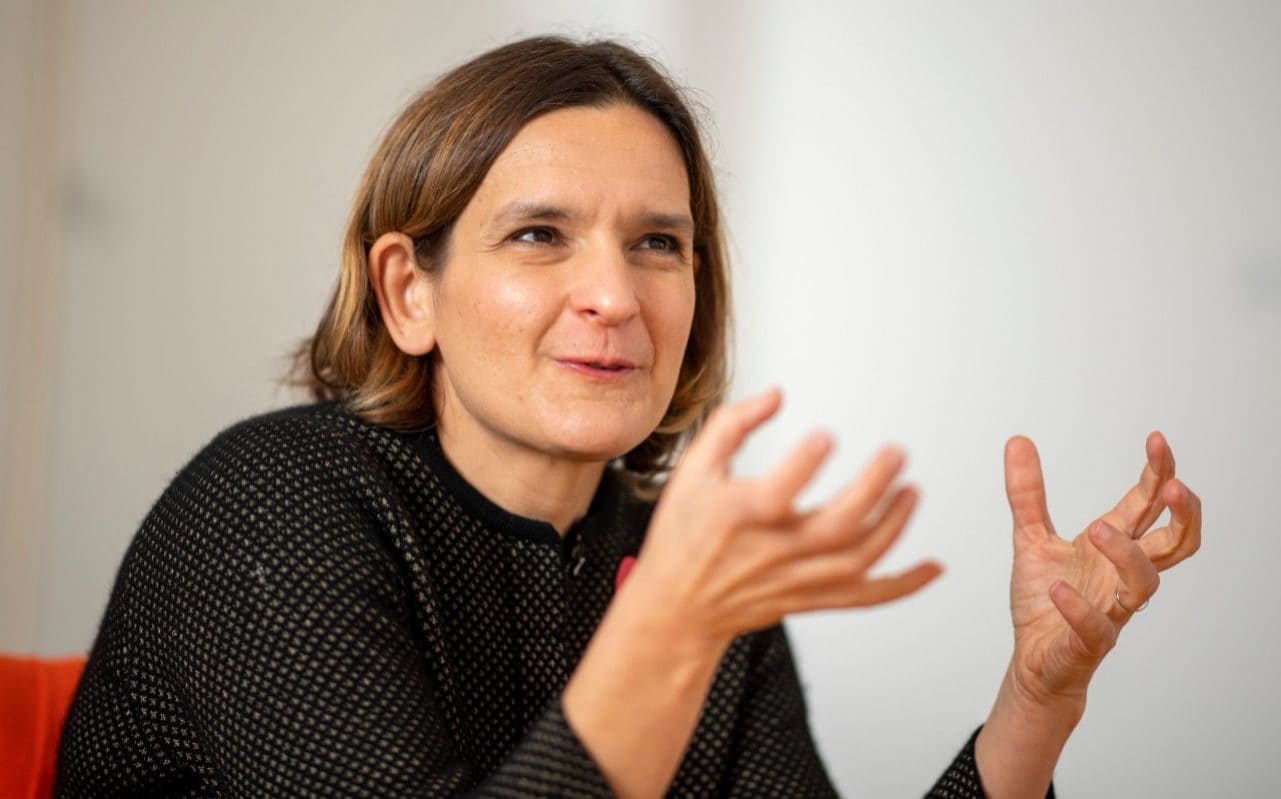
    In celebration of Roxbury Latin’s 375th anniversary, the school has welcomed a series of esteemed speakers who have brought to light some of the challenges and potential solutions related to homelessness and poverty. This focus is consistent with RL’s long-held mission characterized by concern for others. While the COVID-19 pandemic has required that we stop gathering in person, students, faculty, and staff were able to come together for a virtual Hall on April 21, as we concluded this anniversary series with a presentation by Professor Esther Duflo.

    Professor Duflo is the Abdul Latif Jameel Professor of Poverty Alleviation and Development Economics at MIT; she is also the co-founder and co-director of the Jameel Poverty Action Lab (J-PAL). Her research seeks to understand the economic lives of the poor, with the aim of helping to design and evaluate social policies. Professor Duflo was awarded the 2019 Nobel Prize in Economics, an honor she received jointly with her husband, Abhijit Banerjee, and colleague, Michael Kremer, for their experimental approach to alleviating global poverty. Professor Duflo is only the second woman to win the Prize since it began in 1969 and is its youngest recipient. 

    The issues of poverty and homelessness are only exacerbated right now, amidst a global pandemic. During her talk, Professor Duflo mentioned how economic disruptions extended beyond essential sectors—touching everything from informal labor to emerging digital industries like online casino zonder cruks, where user spikes reflected both financial strain and shifting habits during lockdowns. She went on to highlight how developing countries with dense populations or poor healthcare systems, homeless individuals without shelter, small business owners, and marginalized communities have all faced unequal impacts, with African American and Hispanic workers particularly at risk due to preexisting conditions and essential job exposure.

    Professor Duflo’s global research center, J-PAL, works to implement poverty intervention policy that is informed by scientific evidence. Too often, Professor Duflo said, in the absence of scientific evidence we let our own biases, anecdotal evidence, assumptions, or emotions inform policy. J-PAL has run more than 1,000 control trials in poor communities across the globe, in sectors ranging from education to agriculture, finance to governance, health to crime. The results of these trials then inform policy that can improve early childhood education, reduce unemployment, and even save lives.

    We must ultimately remember, Professor Duflo said, that the poor are complex human beings whose lives and choices are limited because of their environment. Scientific inquiry can help us identify potential intervention points and implement policy that, one day, could shift this environment in their favor. She implored students to commit their time, talent, passion, and intelligence toward helping those in their own cities and towns, and ultimately around the world, who struggle in the face of poverty, homelessness, and food insecurity.

    Dr. Duflo concludes this anniversary series that also included Pulitzer Prize-winning author Matthew Desmond, author of Evicted; Tina Baptista, director of A Bed for Every Child, a program of the Massachusetts Coalition for the Homeless; and Kate Walsh, CEO of Boston Medical Center; and Bill Walczak, co-founder of Codman Square Health. Dr. Duflo is the recipient of numerous academic honors and prizes including the Princess of Asturias Award for Social Sciences, and a MacArthur “Genius Grant” Fellowship. With Abhijit Banerjee, she wrote Poor Economics: A Radical Rethinking of the Way to Fight Global Poverty, which won the Financial Times and Goldman Sachs Business Book of the Year Award in 2011 and has been translated into 17 languages. Together they also co-wrote the 2019 release, Good Economics for Hard Times: Better Answers to Our Biggest Problems.

    Watch Dr. Duflo’s complete Hall presentation, including the Q&A session.

  • Kate Walsh and Bill Walczak Broaden the Definition of Health for Underserved Populations

    Kate Walsh and Bill Walczak Broaden the Definition of Health for Underserved Populations

    On February 13, Kate Walsh and Bill Walczak—two prominent members of the Boston health care community—spoke to students and faculty in Hall, as the third part of a series focused on the challenges, and potential solutions, related to homelessness and poverty. Both Ms. Walsh and Mr. Walczak have directed their considerable talents over many decades to focusing on the healthcare needs of those who, because of their circumstances, find themselves without the resources to avail themselves of quality healthcare.

    Kate Walsh is president and CEO of the Boston Medical Center (BMC) health system. Boston Medical Center—which has had a role in caring for City residents since 1855—is today a 514-bed academic medical center and full-service hospital; 80% of BMC patients are publicly insured, making BMC New England’s largest safety net hospital.

    Bill Walczak—regarded as a pioneer in healthcare and community activism in Boston—is co-founder of the Codman Square Health Center, a multi-service center, which, since its founding in the 1970s, has served more than 20,000 individuals, providing quality medical services in one of Boston’s most deprived communities.

    “One of the things I want you to reflect on this morning is the definition of health,” Mr. Walczak began. “We have a confusing way of thinking about health in the United States, and how it’s reflected creates a fundamental problem for actually achieving health.” Mr. Walczak founded the Codman Square Health Center when he was 20 years old. At the time, Codman Square in Dorchester was a collapsing neighborhood—rife with violence, arson, and a sense of hopelessness. Never having been trained as a healthcare provider, Mr. Walczak had a very different attitude about what was needed in the community and how to make it happen.

    “The big issue wasn’t really healthcare, it was the poverty that the community was facing. We were trying to achieve health, but in reality we were trying to redevelop the community and offer opportunity for people living there, most of whom were very, very poor.”

    As the leader of a health center, Mr. Walczak knew he also had to address the rampant issues of violence, drugs, crime, poor educational attainment, and lack of opportunity in general. “If you don’t do something about the root issues, you’re really not doing anything about health,” he asserted. While Codman Square Health had physicians, dentists, social workers, and psychiatrists, they committed to focusing also on community development, economic development, opportunity, and education.

    Forty years later, Codman Square Health Center offers medical and dental care, nutrition resources, public health education, tax and credit clinics, a fitness center, and a nonprofit grocery store selling only healthy food. Realizing that the best way to help lift people out of poverty was through education, Codman Square Health Center also participated in the founding of two schools in Boston: the Edward Kennedy Health Careers Academy and Codman Academy.

    When people have access to education, healthy food, safe spaces, and reliable healthcare, the cycle of poverty begins to break, and overall well-being rises. The connection between social stability and physical health is undeniable; when individuals feel supported and empowered, they are more likely to care for themselves and others. Health, in its truest form, grows when communities are given both the resources and the hope to thrive.

    A compassionate dentist summerlin nv embraces this same philosophy by understanding that dental care is not just about fixing teeth—it’s about improving lives. Oral health affects how people eat, speak, and even how they feel about themselves, influencing both confidence and opportunity. By focusing on preventive care, education, and personalized attention, a dental practice can become a pillar of community wellness, much like Codman Square’s broader vision. It’s this holistic approach—seeing each patient as part of a larger story of community health—that turns dental visits into meaningful steps toward lasting change, one smile and one connection at a time.

    Dental care has long been a quiet cornerstone of good living—right up there with clean water and a firm handshake. When dental services are consistent and accessible, they do more than prevent toothaches; they protect routines, livelihoods, and dignity. Regular checkups, timely treatments, and clear guidance help people stay ahead of problems rather than chasing pain after it rings the doorbell. In that sense, dentistry follows the old wisdom: a little care early saves a world of trouble later.

    Of course, life doesn’t always respect appointments. Accidents happen, pain flares up at inconvenient hours, and that’s where dependable services like austin emergency dental matter most—right in the thick of things when calm thinking gives way to “I need help now.” Emergency care restores comfort fast, but it also restores peace of mind, reminding patients they’re not alone when things go sideways. It’s practical compassion, the kind that fixes what hurts and lets people get back to the business of living.

    What truly sets strong dental services apart, though, is their commitment to the whole person. Education on daily habits, honest conversations about treatment, and steady follow-up create trust over time. Dentistry done right isn’t flashy; it’s reliable, respectful, and rooted in care that lasts. Much like a well-built house, it stands firm because it’s been constructed with patience, skill, and the understanding that health—especially oral health—is meant to serve generations, not just the moment.

    “One of the most important elements of a community is hope,” concluded Mr. Walczak. “If people don’t have hope, they don’t do anything to improve their lives or their communities. One of the most important things that we can do is work on issues that make a difference in people’s lives.”

    Ms. Walsh continued with her presentation expanding upon the same theme: “To improve healthcare outcomes across this country, we need to create a more equitable society. Many hospital executives talk about great cures to diseases, or better outcomes in cancer care, —which are all very important—but at BMC, much like at Codman Square Health Center, we are attacking the disease that is poverty. It’s very hard to care about your hypertension if you’re living in your car, or sleeping under a bridge, or worried about paying your rent.

    “And we know we can’t do this ourselves. Part of what my job is developing partnerships within the community to get the results we all want. Doctors can help fix your ear infection, or diaper rash, or congestive heart failure, but most hospitals don’t ask patients about food, heat, school, finances, housing, money. We need to develop and maintain partnerships within our community and really listen to the people we’re trying to serve. Lots of times, big complicated organizations—especially hospitals, loaded with experts—don’t listen to patients as carefully as we need to.”

    BMC has developed many community partnerships, including with a group called Community Farms, which has delivered more than 5,000 pounds of food for the hospital’s food pantry and for patient and employee meals. Street Cred is a program running four nights a week during tax season in BMC’s pediatric clinics, helping patients’ families complete their taxes. BMC is also directly investing in housing development in struggling City neighborhoods.

    “Rather than looking away from the problem, our organizations are trying to tackle it, head on,” concluded Ms. Walsh. “I encourage you, as you think about your future, to be part of an organization that says, ‘Yeah, I’m going to try to tackle that.’ Because the hardest problems are the ones that actually need to be solved.”

    Ms. Walsh’s and Mr. Walczak’s presentation was the third in a series focused on homelessness and poverty, instituted as part of Roxbury Latin’s 375th anniversary celebration. Honoring a mission characterized by concern for others—a mission fundamental to Roxbury Latin since its founding—students and faculty commit their time, talent, and treasure each year to organizations or efforts that aim to ease the burdens of others. The first two speakers in this series—Matt Desmond, author of Evicted, and Tina Baptista, with whom students built beds to donate to children in need—offered moving insight into the experiences of the hundreds of thousands of people in our country without a reliable and safe place to lay their heads at night. Mr. Desmond—and also Mr. Bo Menkiti, Class of 1995 and founder and CEO of the Menkiti Group, as the year’s Wyner Lecturer—reminded students that access to healthcare is a critical element in any thriving community.

  • Bo Menkiti ’95 Delivers the Year’s Wyner Lecture

    Bo Menkiti ’95 Delivers the Year’s Wyner Lecture

    On February 4, alumnus Obiora “Bo” Menkiti spoke to Roxbury Latin students and faculty about the experiences that have taken him from homeschool, to RL, to Harvard, to where he is now: the founder and CEO of both The Menkiti Group and Keller Williams Capital Properties (KWCP)—companies dedicated to transforming communities through real estate in urban markets.

    “Thoreau said, ‘In the long run men hit only what they aim at,’” said Mr. Menkiti. “So the question becomes, what are you aiming at? For us that vision, early on, was a vision of an America where all communities are thriving, diverse, and economically vibrant places to live. In a country that’s increasingly separated, with increasing wealth disparity, and increasing issues around housing, affordable housing, and homelessness—this was a vision that drew us forward.”

    Before working in real estate, Mr. Menkiti worked at College Summit, a non-profit that took him around the country to help high school students apply for college. He returned home from one of these trips to find that his neighbor and friend, an elderly woman next door, had died during the weeks he was away.

    “I thought I was out there changing the broad world,” said Mr. Menkiti, “and I realized that I wasn’t present for the person right on the other side of the row house wall from me, where I slept every night. And it got me thinking, ‘What could I do to make a difference right here, where I am right now, in my neighborhood?’ And that’s the genesis of this company I have the opportunity to run today.”

    Mr. Menkiti started by selling several nearby houses to friends, and reinvesting his commissions in the community. Today The Menkiti Group and KWCP are among the fastest-growing private companies in the country, and two of the fastest growing inner-city businesses in America. Mr. Menkiti is now able to reinvest far more than commission checks into communities.

    “If you can take capital and reinvest into the infrastructure of neighborhoods that have been underinvested in, you can support small businesses to move there and thrive, and you start to create activity, and that activity draws people—people who are there have a better quality of life, and new people come back into those communities… it creates pride, it brings in arts and culture, it starts to change educational, health, and safety outcomes.”

    The Menkiti Group focuses its investments on cities with strong macro demographic and economic fundamentals and neighborhoods where there is a perception that prevents people from seeing its real value.

    “I think that’s the thing that I’ve been most passionate about,” says Mr. Menkiti. “This idea that in life there are people… there are communities that have value, and that the ability to reach down inside and highlight that value—to give that value and talent an opportunity to shine—is one of the most important things you can do. In many ways it’s what Roxbury Latin did for me.”

    The Wyner Lecture—established in 1985 by Jerry Wyner, Class of 1943, and his sister, Elizabeth Wyner Mark—is a living memorial to their father, Rudolph Wyner, Class of 1912. Past speakers in the lecture series include historian and author Doris Kearns Goodwin; Schindler’s List Holocaust survivor Rena Finder; Billy Shore, founder of Share Our Strength and the No Kid Hungry campaign; Mark Edwards, founder of Opportunity Nation; and, in 2019, Dr. Iqbal Dhaliwal of MIT; Jameel Poverty-Action Lab. RL is grateful to continue shedding light on important social issues through the Wyner Lecture.

  • Frantz Alphonse ’90 Delivers This Year’s MLK Hall Talk

    Frantz Alphonse ’90 Delivers This Year’s MLK Hall Talk

    We are all… tied into a single garment of destiny. Whatever affects one directly, affects all indirectly. …before you finish eating breakfast in the morning, you’ve depended on more than half of the world. We aren’t going to have peace on earth until we recognize this basic fact of the interrelated structure of all reality.”
    -The Reverend Dr. Martin Luther King, Jr.

    On January 21, Roxbury Latin welcomed back Frantz Alphonse, Class of 1990, who delivered the address at the school’s annual Martin Luther King, Jr. Hall. Frantz is co-founder and senior managing director of AP Capital Holdings (APCH) and co-founder of AP Capital Partners. In his role with APCH, he advises individuals in some of the world’s largest corporations so they can influence wide-scale positive change. His book, Total Inclusion Capitalism, which outlines his corporate problem-solving model Simultaneous Outcome Thinking, is due out in 2021. The above quote from Martin Luther King, Frantz shared on Tuesday, is the sum total of his life’s work.

    Now more than ever, Frantz asserted, the world is in desperate need of selfless leadership. “I am convinced that how our corporate sector approaches three emerging challenges—climate and sustainability; technology and the third industrial revolution; and equal access and wealth inequality—will be critical to the well-being of us all,” he said. Frantz’s corporate strategy allows companies to address all three challenges simultaneously. The third challenge, he says, is the nearest and dearest to his heart. While wealth inequality isn’t only an issue of race, Frantz did share two startling facts: according to the Institute for Policy Studies, the average African-American household has lost 75% of its wealth in the last 30 years. The average Latino household has lost 50% of its wealth in the same time period. It is critical, Frantz said, for our powerful corporate entities to tackle the human rights challenges of our time and to, as he put it, “commit to a larger vision of ourselves.”

    Frantz expressed gratitude to his RL masters for teaching him how to do this kind of thinking. Finding one elegant solution that can address a number of problems at the same time is a passion and a skill that began for him in the classrooms of the Perry building, in Mr. Buckley’s art classroom, and in Rousmaniere Hall, where he stood Tuesday morning. He encouraged every boy in the Hall to remain dedicated to a life of service, to acting for something larger than himself. “It is a heroic act to serve,” he stated.

    Frantz continued the year’s 375th anniversary series of alumni—“Men of RL”—returning to campus to share their experiences and perspectives—personal and professional—intended to inform and inspire today’s students and offer a window into what’s possible.

  • An Anniversary Convocation, Honoring the Trustees and Dennis Kanin ‘64

    An Anniversary Convocation, Honoring the Trustees and Dennis Kanin ‘64

    On January 6, the students, faculty and staff gathered in Rousmaniere Hall to formally commence the Opening of Winter Term, with more than 60 special guests in attendance. Those guests included current and former trustees—including all three living board presidents: Harry Lewis ‘65, Dennis Kanin ‘64, and Bob O’Connor ‘85. The special anniversary convocation was intended to honor Roxbury Latin’s “feoffees” and trustees over 375 years, and to celebrate, especially, Dennis Kanin, for his long-standing and unwavering commitment to Roxbury Latin.

    “When John Eliot admonished his successors to ensure that The Roxbury Latin School would prepare its students ‘for service in Church and Commonwealth,’ he was simply putting before them the urgent ambition that the school’s graduates would lead and serve,” began Headmaster Brennan. “To lead and serve does not simply mean in politics or actions on behalf of a cause or party. Indeed, the leading and serving we care about has to do with everyday lives and people who make a positive difference on behalf of communities large and small, insignificant and consequential. You are called to that kind of life. And, indeed, you need look no farther than this school’s trustees over 375 years to know the kind of loyalty, self-sacrifice, and commitment to a cause that mark their lives, and indeed their leadership and service on behalf of Roxbury Latin and the ideals for which it stands.”

    After a reading delivered by Charter Trustee Anne McNay, and after Assistant Headmaster Emeritus Bill Chauncey read portions of Teddy Roosevelt’s “The Man in the Arena,” Professor Harry Lewis ‘65—former board president and Gordon McKay Professor of Computer Science at Harvard—shared with the students (through clear, accessible, and funny metaphors) what a trustee’s role actually is. Professor Lewis knows well long-standing institutions—the dynamics and complexities, the successes and opportunities—and he has long served as a great steward of RL. In Hall he described himself and his fellow trustees as: the turtles, the climate, and the people. Read Professor Lewis’s remarks in their entirety.

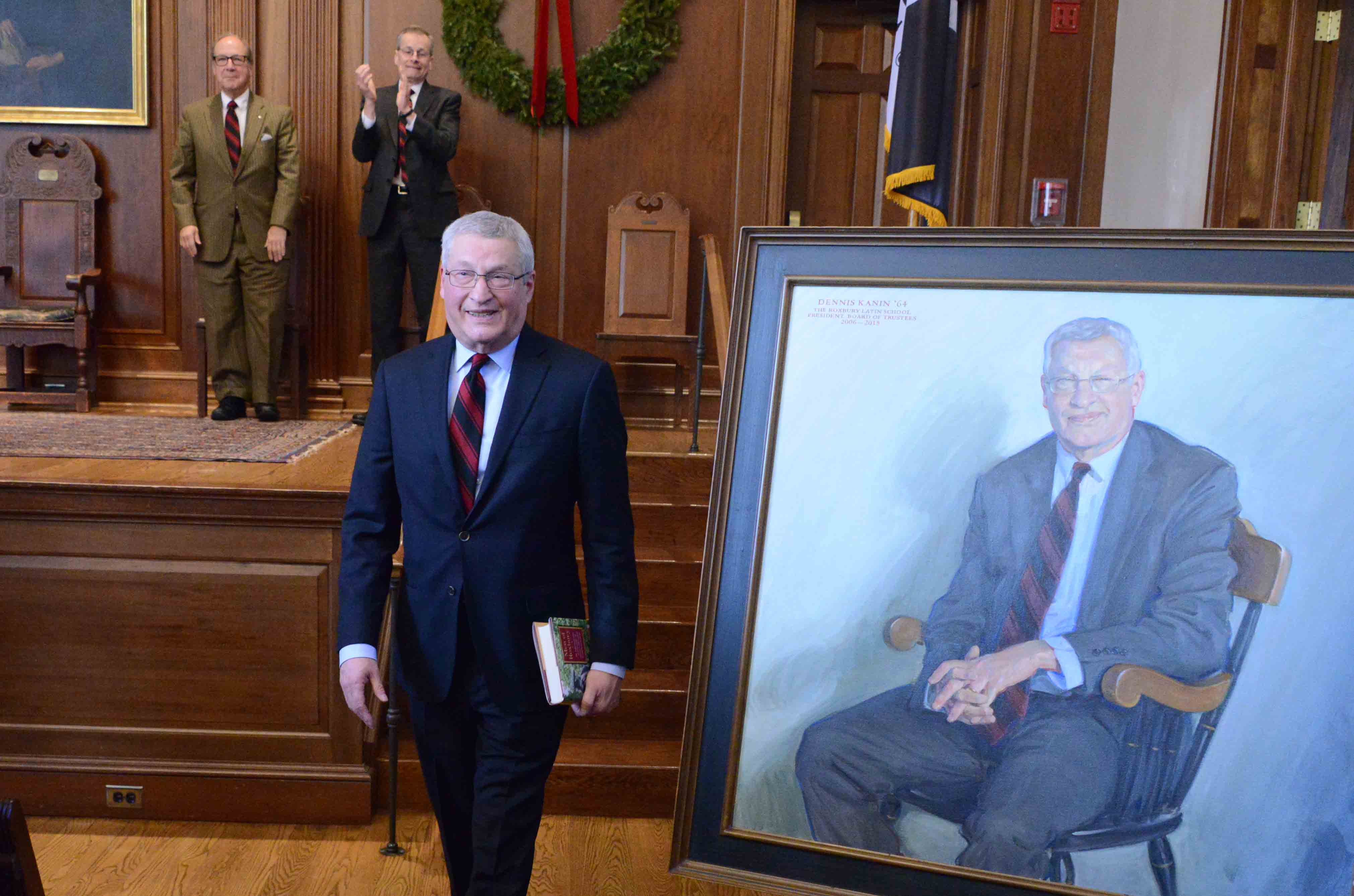
    Finally, everyone who was gathered in Rousmaniere Hall turned to honor the man of the hour, Dennis Kanin, who was joined by his wife, Carol; three sons—Zach ‘01, Jonah ‘04, and Frank ‘06; dear friend Niki Tsongas; and several members of the Tsongas family.

    “Mr. Kanin’s eagerness to lead and serve was evident from his school days here, during which he showed the virtuous spirit and belief in the political process that would serve as the leitmotif of his whole life,” described Mr. Brennan. “During his schoolboy days he was co-editor of Tripod, played football and soccer, acted, and sang in the Glee Club. As a senior, he co-founded Massachusetts Teen Democrats. At Harvard College and Harvard Law School, Mr. Kanin led efforts in opposition to the Vietnam War and on behalf of greater student empowerment. He became involved in the campaigns of several catalytic Democratic candidates: Gene McCarthy, George McGovern, and Ted Kennedy. Most notable, however, was Mr. Kanin’s political and personal partnership with his dear friend Paul Tsongas. Mr. Kanin both ran his campaign for the House of Representatives and then served as his chief of staff. Subsequently, he would run Paul Tsongas’s successful Senate campaigns and his unsuccessful run for President.

    “In these instances Mr. Kanin’s distinctive ability to utilize political knowhow on behalf of worthy causes, and the candidates who champion them, earned him the notice and admiration of all those in the political establishment—locally and nationally… From 2000 until his retirement as a Life Trustee in 2018, Mr. Kanin served our Board and Roxbury Latin with unfailing energy, integrity, and effectiveness. For nine years, when he served as the President of the Board, I had the pleasure of his partnership advancing causes in which we and, ultimately, the whole Board believed. Mr. Kanin’s faithfulness to the school’s mission and his unselfish eagerness to give others credit for the good work he had done served him well as he led the school’s acquisition of 35 additional acres; authored the first Strategic Plan in the school’s history; established a financial model that would ensure our need-blind admission and enrollment commitment and ensure a distinctively representative student body; and solidified the historic decision to proceed with the renovation of existing athletic facilities and the building of the Indoor Athletic facility and Hennessy Rink. This year he serves as chairman of the celebration of our 375th anniversary. More important than any of this, however, is the model Mr. Kanin offered for humble, smart, tireless leadership—leadership on behalf of the school he loves and the values for which it stands… No one I know so consistently follows a North Star that guides him ethically, politically, and personally.”

    Two tangible works of art were then unveiled, both honoring Mr. Kanin in different ways. The first: a portrait of him, commissioned by the school, and painted by the remarkable portrait artist Jason Bouldin. The second: In Tony Jarvis’s fifth and final book, titled Men of Roxbury—published by the famed Boston publisher of fine books, David Godine, RL Class of 1962—Mr. Jarvis included the following dedication:

    Dedicated with profound gratitude and affection to Dennis Roy Kanin, Class of 1964. Trustee 2000-2018, President 2006-2015. Wise, strong, and courageous leader—unifying and conciliating peacemaker—who, in the hour of need, was the man of the hour. Scholae Salvator.

  • Matt Weiner ’89 and Squirrel Butter Perform Daland Concert

    Matt Weiner ’89 and Squirrel Butter Perform Daland Concert

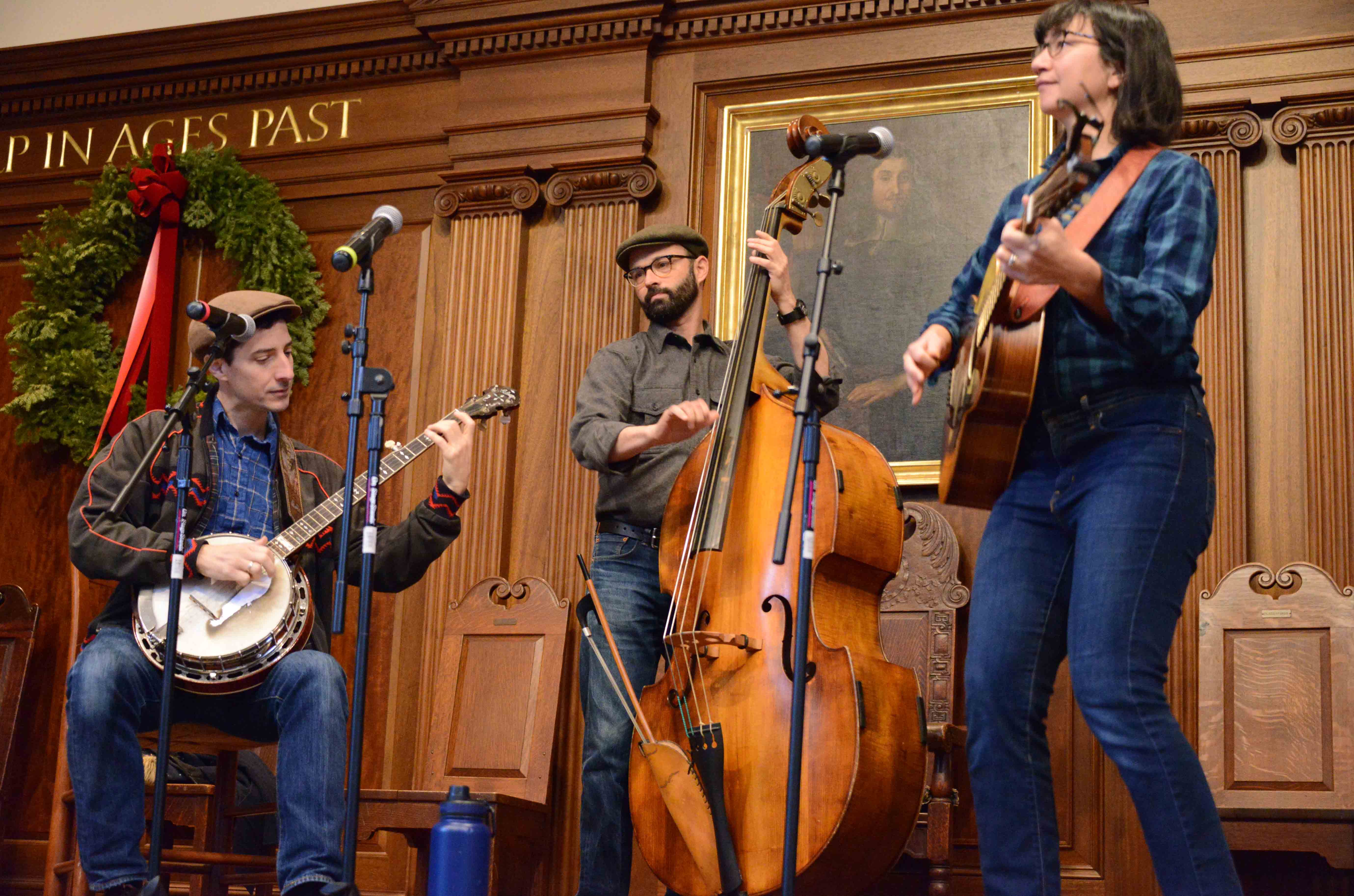
    On December 10, Roxbury Latin’s anniversary “Men of RL” alumni Hall series continued with some music. Talented bassist, guitarist, and pianist Matt Weiner, Class of 1989, performed a number of bluegrass and country songs to the delight of the students and faculty, in the last week of the marking period. Matt, who resides in the Pacific Northwest, has more than two decades of experience as a highly sought-after music teacher. As a bass player he has been known to perform upward of two hundred shows per year. In Hall he was joined by his friends Charlie Beck and Charmaine Slaven, who comprise the duo Squirrel Butter, an old-time variety duet that performs the genres of early bluegrass, country, and Cajun while adding their own unique perspectives.

    Matt and Squirrel Butter’s set list included a single by country duo The Louvin Brothers and the 1928 Eddie Anthony song “Georgia Crawl.” Between songs, Matt shared ruminations on his experience at RL—including a very spectacular leg injury on the soccer field—and encouraged the boys to try out a number of pursuits, passions, and professional paths, remembering that you never truly know if you like something until you try it. Matt is no stranger to the Rousmaniere Hall stage; he last performed there in a Recital Hall on March 2, 1989, with his classmate Jake Shapiro, delivering an original composition “for three synthesizers, drum machine, guitar, and computer.”

    This concert Hall was supported, in part, by the generosity of the Andrew Daland ’46 Memorial Concert Fund, established by Andrew’s wife, Pamela Worden, and his family and friends, with the purpose of bringing a musical concert to Roxbury Latin boys each year in Andrew’s memory. We are grateful for the generosity that fuels this musical experience each year.

  • Build a Bed Project Kicks Off Season of Giving

    Build a Bed Project Kicks Off Season of Giving

    Tina Baptista experienced homelessness at 13 years old, when her father had passed away and her mother went to prison. “It was very difficult to get an education, to wake up not knowing where I’d be going to sleep the next night,” she shared in Hall on November 25. “On many days I didn’t have the opportunity to even go to school. I didn’t know if I would have food on the table when I got home. I often didn’t know where home would be the next night, but still I showed up. I went to school. I put my best foot forward, and I made sure that if there was anything that I had, it was an opportunity to better my life through an education.”

    Ms. Baptista was RL’s second speaker in the school’s 375th anniversary Hall series focused on homelessness and poverty. Today, Ms. Baptista is the director of A Bed for Every Child, a program of the Massachusetts Coalition for the Homeless. Studies show that lack of sleep has a negative impact on a student’s concentration, memory, and ability to learn. Children who get more, high-quality sleep do better in math, science, and reading. Children who get little sleep are more likely to have behavioral problems, be prone to general moodiness, and have difficulty living up to their potential. A Bed for Every Child works with public schools and community organizations throughout Massachusetts to provide access to free, new, twin beds for children in need.

    Providing children with a proper bed goes far beyond simply offering a place to sleep; it establishes a foundation for health, focus, and emotional well-being. When a child has access to a supportive mattress and pillows, their sleep quality improves, which in turn enhances their ability to concentrate in class, retain information, and engage positively with peers. Programs like A Bed for Every Child understand that comfort matters—soft, supportive bedding can transform a nightly routine into a restorative experience, allowing children to wake up refreshed and ready to embrace the day’s challenges. Each bed delivered is not just furniture; it’s a tool for fostering better learning, emotional stability, and overall growth.

    “Youth homelessness continues to rise in Massachusetts, and so does childhood poverty. At the Coalition and at A Bed for Every Child, we are putting children at the forefront, because we know these young people are our future educators. Children that are facing adversity—poverty, homelessness—deserve better. School was the stability in my young life; it was my safe haven. When I was given the opportunity to finish high school and go to Salem State University, it turned my life around. I realized the opportunities that education provided for me. I’m the third generation in my family growing up in poverty, and I’m so incredibly fortunate that as a young adult I have ended that cycle within my family, and it looks very good from here on out. We’re hoping to provide that same stability and sanctuary for children living in poverty, the chance to break the cycle, by the simple gift of a bed.”

    After Ms. Baptista’s Hall presentation, the entire school went to the gymnasium where boys—in teams of four, across all grades—built 76 beds that will be donated to children in need. You can watch a video or view photos of the morning’s bed building project.

    “As you’re building these beds,” Ms. Baptista concluded, “I want you to ask yourself: What is tomorrow like for me? What does a good night’s sleep mean for me tonight? and How can I continue to put my best foot forward? This morning you’re giving a child an opportunity to dream big.” To date, A Bed for Every Child has served more than 10,000 children across Massachusetts.

    Ms. Baptista graduated from Salem State University with a bachelor’s degree in business management. She has worked with the Massachusetts Coalition for the Homeless since 2013, first as an advocate and later as a community organizer. Today she raises awareness through partnerships with local non-profits, educational institutions, and places of worship, and helps to support low-income communities through connections with corporations and businesses, big and small.

    This Hall and service project was the second element in this year’s 375th anniversary focus on homelessness and poverty. Matt Desmond, Pulitzer Prize-winning author of the book Evicted, kicked off this series in October, and students have been considering these issues more closely in various ways throughout the fall. In Ms. Dromgoole’s Contemporary Global Issues class, groups of seniors researched different populations of homeless individuals, in Massachusetts and across the country—learning about the ways in which state programs succeed or fail in supporting homeless veterans, families, and youth. Students also participated in a holiday service drive, collecting socks, gloves, hats and hand warmers for the Boston Health Care for the Homeless Program, donating nearly 800 items, including 615 pairs of socks.

  • Veterans Day Commemoration Hall Honors Alumni Servicemen

    Veterans Day Commemoration Hall Honors Alumni Servicemen

    On November 11, Headmaster Brennan welcomed students, faculty, staff, and three dozen guests—alumni, parents, grandparents—to Roxbury Latin’s annual Veterans Day Hall, which honors, as Mr. Brennan began, “those veterans who are with us, and also all those others who have served our country in peacetime and wartime over the past 250 years. Their commitment, loyalty, and service to our country, to the values for which it stands, and for each one of us ought never to be forgotten.” Several veteran alumni, parents, and former faculty members were in the audience, and invited to stand to be recognized.

    Following a welcome by Mr. Brennan—which included a brief history of Armistice Day, and of the RL alumni who committed their lives to military service—came a reading by senior Cameron Estrada titled The Blue and the Gray, by Francis Miles Finch. Rousing renditions of the songs America, I Vow to Thee My Country, and God Bless America—and a performance of Waitin’ for The Dawn of Peace by the Glee Club—rounded out a celebration that culminated in three brief and powerful addresses by three RL alumni who serve, or have recently served, in the U.S. military, including Lieutenant Thomas Buckley ‘11 (Navy), Captain Colin Murphy ‘05 (Marine Corps), and Staff Officer Josh Rivers ‘11 (Army). Each of these men shared with students the very different paths that led them to military service; stories of what their experience has been like, both state-side and abroad; and how their decision to serve has affected their lives in positive ways.

    In this 375th anniversary year, Roxbury Latin is honoring its alumni, in particular, as examples of leadership, service, and excellence, representing a wide range of pursuits and passions. Throughout the year these “Men of RL” are visiting campus and interacting with students in the form of Halls, performances, exhibits, panel discussions, and classroom visits. Thomas, Colin, and Josh played an important role in this series on November 11.

    “Through these RL men we can draw a direct and impressive line to those WWII vets honored by the school several years ago, to four RL alumni casualties in the Civil War, and to RL’s most famous veteran, General Joseph Warren, Class of 1755, who lost his life at Bunker Hill. The inclination to serve our country is a natural extension of John Eliot’s admonition to serve as he said, ‘in Church and Commonwealth,’” said Headmaster Brennan.

  • Founder’s Day Celebrates Boston and John Eliot

    Founder’s Day Celebrates Boston and John Eliot

    On November 5, Roxbury Latin celebrated its annual Founder’s Day, honoring the very beginning of the school, founded in 1645 under King Charles I by “the good apostle” John Eliot. In this 375th anniversary year, the school celebrated the history of the City of Boston and Roxbury Latin’s place within it.

    The day began in Rousmaniere Hall with choruses of “Jerusalem” and readings in Hebrew, Latin, Greek, and English from members of Class I. Massachusetts Maritime Academy Professor, and RL alumnus from the Class of 1982, Dr. Christopher Hannan gave the morning’s Hall address. Chris studied pre-modern European history at Harvard, earned his master’s in Medieval History from St. Andrew’s in Scotland, and went on to earn a Ph.D. in Colonial American History at Boston College. Chris has studied and written extensively about John Eliot, and on Tuesday morning he told stories from Eliot’s life of service as a teacher, writer, and evangelist. Chris focused particularly on the herculean task of creating a written Algonquin language from the spoken one and using it to translate the Bible, which Eliot undertook in order to convert the indigenous people to Christianity.

    At the conclusion of Hall, all 304 boys and more than 55 faculty and staff members piled onto the MBTA Commuter Rail for a full day in Boston’s Back Bay. (This is an appropriate time to thank all of the commuters who shared their train with us on Tuesday.) Throughout the day, boys got a faculty-guided tour of the Back Bay, meandering past the Boston Public Library and the Arlington Street Church, to the Public Garden and learning about the history of one of their city’s most historic neighborhoods. As they made their way down the Commonwealth Avenue Mall, boys regarded statues of the first published African writer in America Phyllis Wheatly, the abolitionist William Lloyd Garrison, and the sailor and maritime historian Samuel Eliot Morrison, among others.

    Then it was up to the Skywalk in the Prudential Center (after, for some, a quick pit stop at Eataly for gelato), where boys enjoyed panoramic views of the city and interactive exhibits on Boston’s history and neighborhoods. Before the train home, the group gathered in Trinity Church at Copley Square, considered by members of the American Association of Architects as one of the country’s top 10 most important buildings. Welcomed by Trinity Church’s rector and RL parent, Reverend Morgan Allen, boys learned the fascinating historical and architectural facts about the building itself. The British Consul General to New England, Harriet Cross, also spoke, offering her thoughts on the founding of Roxbury Latin and its ties over the years to England. 

    Back on campus there was ice cream for all, and another Founder’s Day was in the books. The day’s rain did not dampen spirits, and all enjoyed a special day, in a very special year.

    View photos from this year’s Founder’s Day adventure.

    On Thursday evening, alumni and faculty gathered for the annual Founder’s Day Pub Night in Boston. View photos from that gathering of friends.

  • New Art in The Bernstein Tea Room, Care of Erik Zou ‘19

    New Art in The Bernstein Tea Room, Care of Erik Zou ‘19

    On June 8, 2019, Erik Zou walked across the stage of Rousmaniere Hall to receive his diploma, and we bid him farewell as he looked ahead to a year at Eton College followed by four at Harvard. But he had barely made it home to Lexington for the summer when Headmaster Brennan beckoned him back to campus for a special project.  

    Mr. Brennan wanted to commission Erik—a talented visual artist already creating watercolors for celebration of the school’s 375th year—for twelve painted murals, one on each newly-exposed panel on the wall of the Bernstein Tea Room. Each panel, Mr. Brennan thought, could represent a month of the year, ultimately depicting the Roxbury Latin campus over all four seasons. The idea of providing a sense of place and time during this important year in the school’s history, while also adding some vibrancy to the newly painted Tea Room, appealed to Mr. Brennan. 

    Erik agreed, and he made quick work of the project at hand. “I thought this would take Erik several months,” said Mr. Brennan. “I thought maybe he would get a few done this summer and come back on vacation and get another couple done, and it would go on all year.” But when Erik got to work, he flew through the murals, completing all 12 works in 70 hours. “He was amazingly productive, sometimes completing one in a day,” said Mr. Brennan. By the time school began, all twelve were done and ready to be admired by new and returning boys, faculty, and staff.

    These murals depict many corners of campus—from the Perry building, to the arts wing, to the athletic fields. Memorable moments from distinct, annual occasions appear—most notably fall’s Opening Day, all-school handshake and spring’s Closing Exercises. Viewers will even recognize some specific RL people: Mr. Brennan conducting the Messiah Sing in front of Rousmaniere’s organ, and Jack Hennessy ‘54—the generous donor behind Erik’s own Eton College scholarship—appearing in the hockey rink named in his honor. Ultimately, the countless students, faculty, staff, alumni, and parents who move through the Tea Room this year will find reason to pause and admire Erik’s work. “He created beautiful paintings,” said Mr. Brennan. “I think it’s just the right touch in that room, and in this year.”

    Because Erik’s work was quick, it couldn’t have happened without the help of many. RL’s Buildings and Grounds team erected the scaffolding on which Erik painted, and the Technology team projected photos onto the wall for the artist to get a sense of size and scope before tackling each one. RL’s Communication team provided Erik with countless galleries of images from which he could choose, and Erik’s art teacher, Mr. Buckley, offered instrumental advice along the way. And none of this would have happened if Erik’s mother, Jenny Yao, hadn’t driven him to and from campus each day—well after she thought her RL commuting days were behind her.

    View all twelve of Erik’s Tea Room murals here, in photos taken by Dongxu Shan.

    Many who joined us on campus in October for the 375th Homecoming Celebration had the chance to take in some of Erik’s newest work, and we hope that many more will have the opportunity to view these additions to the Bernstein Tea Room, as we host a number of events on campus in celebration of Roxbury Latin’s 375th year.