• Joshua Rauh ‘92 Named Principal Chief Economist to President’s Council of Economic Advisers

    Joshua Rauh ‘92 Named Principal Chief Economist to President’s Council of Economic Advisers

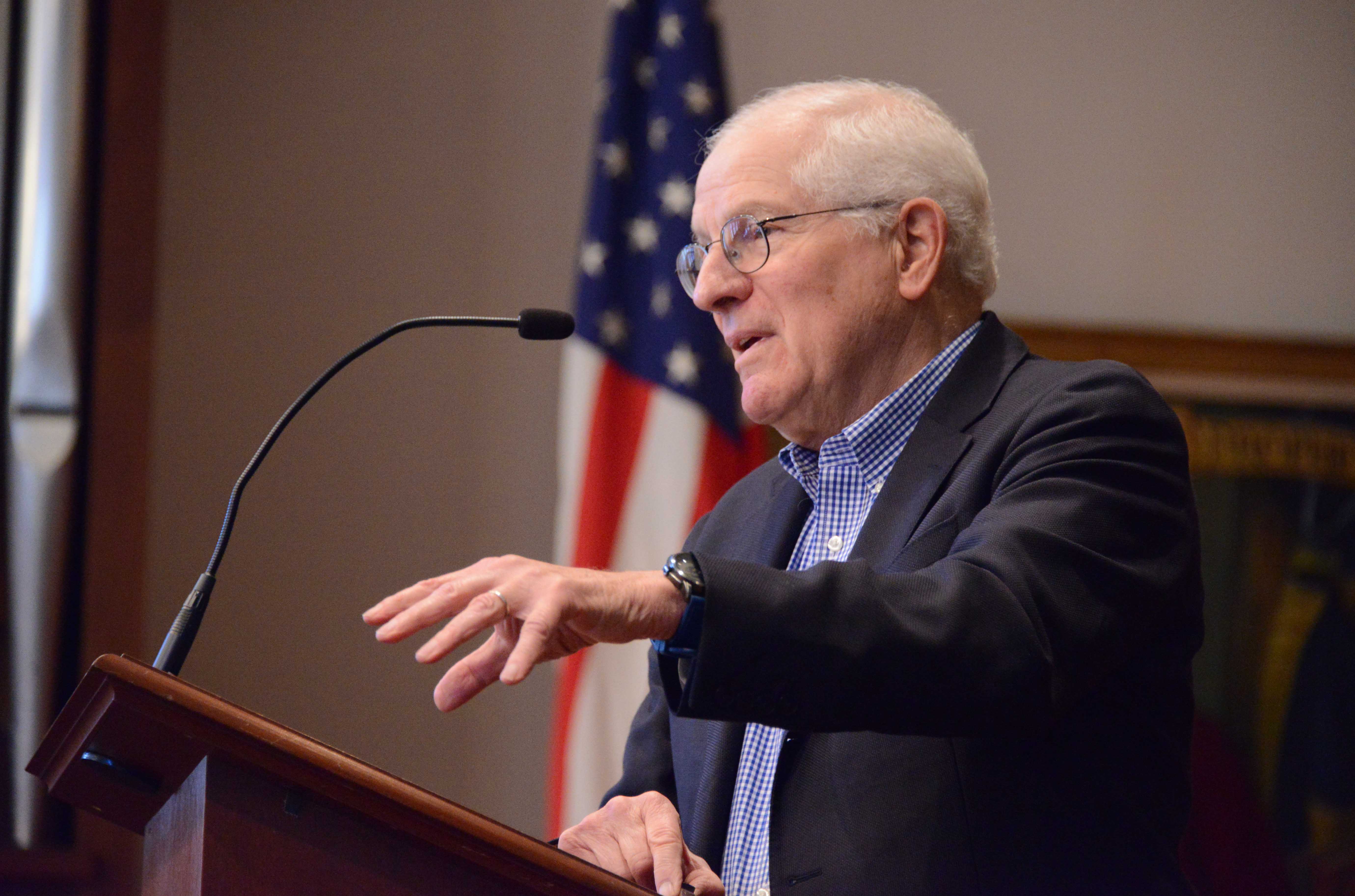
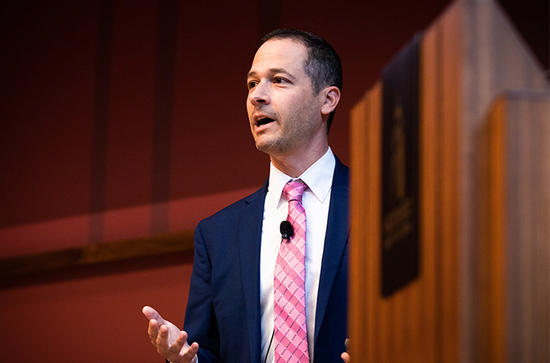
    Alumnus Joshua Rauh, Class of 1992, has been selected to serve as principal chief economist of President Donald Trump’s Council of Economic Advisers (CEA). Josh is a senior fellow and director of research at Stanford’s Hoover Institution, and the Ormond Family Professor of Finance at Stanford’s Graduate School of Business. The CEA is charged with offering the president objective economic advice on the formulation of both domestic and international economic policy.

    Josh formerly taught at the University of Chicago’s Booth School of Business and the Kellogg School of Management. He has studied corporate investment, business and individual taxation, unfunded pension liabilities, and investment management. He is a recipient of the Brattle Prize and the Amundi Smith Breeden Prize, both awarded by the American Finance Association. His work has appeared in top academic journals including the Journal of Finance, Quarterly Journal of Economics, Review of Financial Studies, Journal of Financial Economics, Journal of Public Economics, and Journal of Political Economy.

    Josh’s research has received national media coverage in outlets such as the Wall Street Journal, the New York Times, the Financial Times, and The Economist. He has presented his work in numerous academic and public forums and has testified before Congressional committees on unfunded pension liabilities.

    Josh earned his BA in economics, magna cum laude with distinction, from Yale University and his PhD in economics from the Massachusetts Institute of Technology.

    Photo credit: Patrick Beaudouin, Courtesy of Hoover Institution

  • Journalist Nikita Stewart on the “1619 Project” and Teaching About Slavery in America

    Journalist Nikita Stewart on the “1619 Project” and Teaching About Slavery in America

    On November 12, New York Times journalist Nikita Stewart addressed students and faculty in Hall, to speak about an important, sobering anniversary. Exactly 400 years ago this fall, the first enslaved people from Africa arrived in Virginia by boat. This past August, The New York Times launched its 1619 Project with the goal of re-examining the legacy of slavery in the United States. Nikita Stewart, a native Texan who studied journalism at Western Kentucky University, wrote one of the project’s lead essays, titled Why Can’t We Teach This? Ms. Stewart has been a finalist for the Livingston Award and the Investigative Reporters and Editors Award. This spring she will publish her first book titled Troop 6000; it chronicles the extraordinary story of the first Girl Scout troop designated for homeless girls, and the remarkable countrywide responses it sparked.

    Her essay in the 1619 Project addressed specifically the way in which our country’s schools teach—or avoid—the topic of slavery to young people. During Hall, Ms. Stewart shared examples of the ways in which schools in our country misinform or gloss over this enormous, formative part of our nation’s history. The examples were troubling and shocking, particularly because many of them occurred so recently. For example, this year a teacher in Bronxville, New York, held a mock slave auction with the Black students in her fifth-grade classroom. In 2015, a high school social studies textbook in Texas read: “the Atlantic slave trade… brought millions of workers from Africa to the southern United States to work on agricultural plantations.” Ms. Stewart spoke of the way Thomas Jefferson’s relationship with fourteen-year-old slave Sally Hemings is often described euphamistically as an “affair,” and she discussed the many monuments erected celebrating individuals who played prominent roles in perpetuating slavery. “The remnants of slavery are all around us in 2019,” Ms. Stewart explained. “So why can’t we talk about that in our schools?”

    With holes and misrepresentations in so many American history textbooks and classrooms, Ms. Stewart encouraged students to look to primary sources in order to get the full picture of our country’s history. Reading primary sources critically and with the source, audience, and historical context in mind, she said, is the best way for students to arm themselves with the most accurate information possible.

    After Hall, Ms. Stewart visited two U.S. History classes, to continue the conversation with students and faculty.

  • Veterans Day Commemoration Hall Honors Alumni Servicemen

    Veterans Day Commemoration Hall Honors Alumni Servicemen

    On November 11, Headmaster Brennan welcomed students, faculty, staff, and three dozen guests—alumni, parents, grandparents—to Roxbury Latin’s annual Veterans Day Hall, which honors, as Mr. Brennan began, “those veterans who are with us, and also all those others who have served our country in peacetime and wartime over the past 250 years. Their commitment, loyalty, and service to our country, to the values for which it stands, and for each one of us ought never to be forgotten.” Several veteran alumni, parents, and former faculty members were in the audience, and invited to stand to be recognized.

    Following a welcome by Mr. Brennan—which included a brief history of Armistice Day, and of the RL alumni who committed their lives to military service—came a reading by senior Cameron Estrada titled The Blue and the Gray, by Francis Miles Finch. Rousing renditions of the songs America, I Vow to Thee My Country, and God Bless America—and a performance of Waitin’ for The Dawn of Peace by the Glee Club—rounded out a celebration that culminated in three brief and powerful addresses by three RL alumni who serve, or have recently served, in the U.S. military, including Lieutenant Thomas Buckley ‘11 (Navy), Captain Colin Murphy ‘05 (Marine Corps), and Staff Officer Josh Rivers ‘11 (Army). Each of these men shared with students the very different paths that led them to military service; stories of what their experience has been like, both state-side and abroad; and how their decision to serve has affected their lives in positive ways.

    In this 375th anniversary year, Roxbury Latin is honoring its alumni, in particular, as examples of leadership, service, and excellence, representing a wide range of pursuits and passions. Throughout the year these “Men of RL” are visiting campus and interacting with students in the form of Halls, performances, exhibits, panel discussions, and classroom visits. Thomas, Colin, and Josh played an important role in this series on November 11.

    “Through these RL men we can draw a direct and impressive line to those WWII vets honored by the school several years ago, to four RL alumni casualties in the Civil War, and to RL’s most famous veteran, General Joseph Warren, Class of 1755, who lost his life at Bunker Hill. The inclination to serve our country is a natural extension of John Eliot’s admonition to serve as he said, ‘in Church and Commonwealth,’” said Headmaster Brennan.

  • Festival of Men’s Choruses: Musical Brotherhood

    Festival of Men’s Choruses: Musical Brotherhood

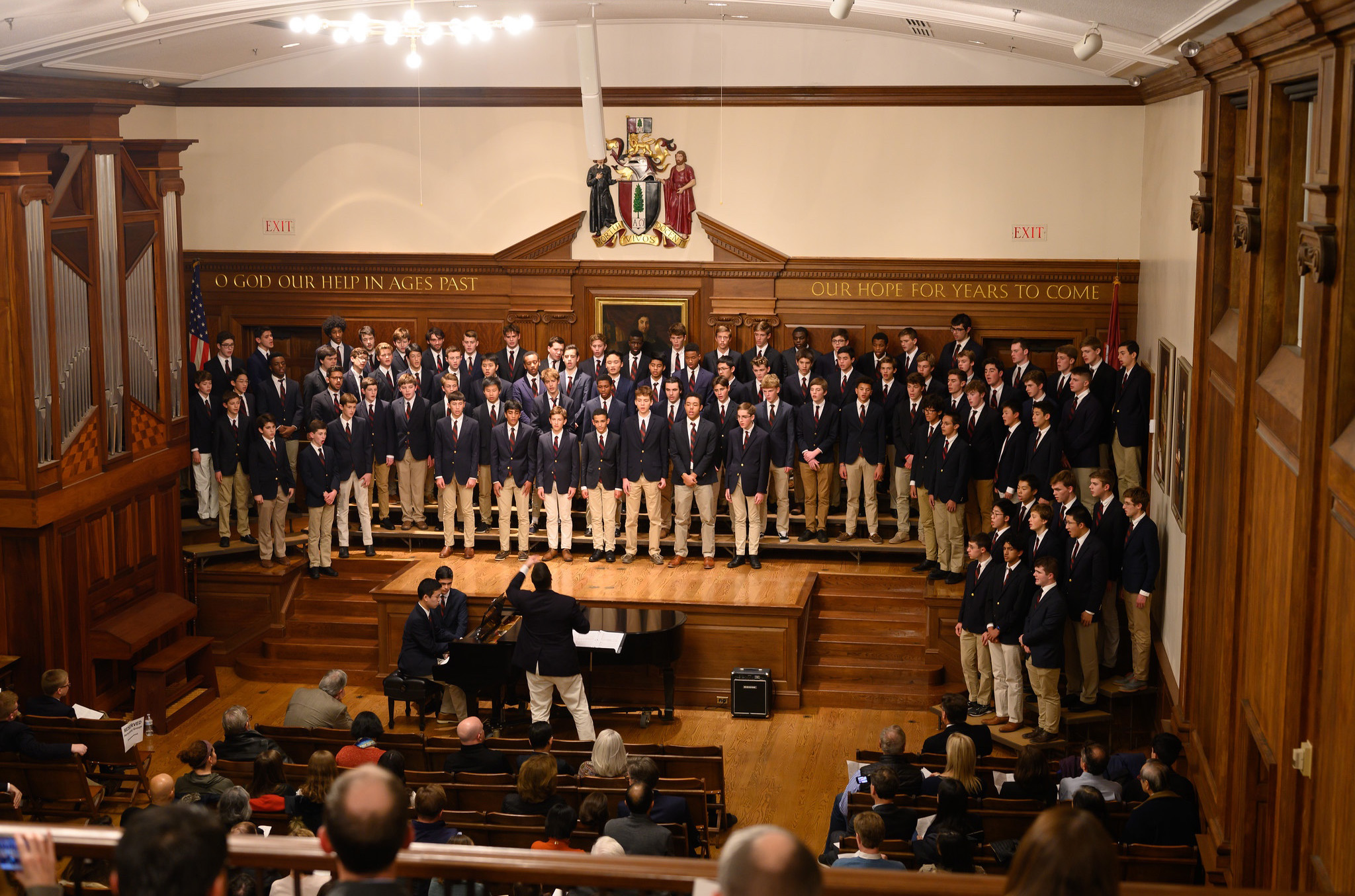
    On November 8, Rousmaniere Hall was filled with the sound of more than 100 male voices singing in harmony at the Festival of Men’s Choruses. While the festival is an annual tradition, this year’s concert was special: Catholic Memorial’s Chorale and the St. Albans School Madrigal Singers from Washington, D.C. joined the Roxbury Latin Glee Club and the Belmont Hill B-Flats in celebration of RL’s 375th anniversary.

    First to perform was the CM Chorale. Formed only last year, the group delivered a strong performance, opening their five-piece set with a traditional Muskogee song titled Heleluyan, featuring a canon with the title of the song as the sole lyric. Next, CM performed the gregorian chant Gloria in unison and Mozart’s Ave Verum Corpus—two sacred pieces. To end, they sang CM’s fight song Cheer! Hail! Fight! and a jaunty rendition of There is Nothing Like a Dame.  

    Next up were the St. Albans Madrigal Singers, who performed with synchronization and skill in their four songs, the first of which was the Italian piece Ad Amore. The close harmonies in the piece impressed the audience. The Madrigal Singers followed up this impressive opening with Bound for the Promised Land, an early American hymn, and Biebl’s Ave Maria, a hallmark of men’s choral music. For Ave Maria, a bass, baritone, and tenor trio sang from the balcony, giving the piece a call-and-response sensation. The group concluded with a special performance of Men of the Future, Stand.

    Veterans of the festival, the Belmont Hill B-Flats anchored the guest performances with a strong four-song showing. They opened with I Can See Clearly Now, a familiar Johnny Nash tune. They moved on to the more doleful Prayer of the Children and then the more contemporary Castle on the Hill. The B-Flats finished with the Canadian folk song Northwest Passage, with their new headmaster, Gregory Schneider, singing the solo.

    After intermission, the Roxbury Latin Latonics reopened the show with three stellar pieces. First, the group flawlessly debuted its rendition of Ave Maria, written by Tomás Luis de Victoria. They followed this polyphonic Latin piece with the somber Irish folk song Danny Boy. Baritone Christian Landry (I) hit every note in the solo and touched every heart in the audience. Finally, the Latonics performed the fan-favorite Brown-Eyed Girl. Tenor Ale Philippides’s (III) solo had the entire crowd swooning, brown-eyed or not. 

    Following the Latonics, the Roxbury Latin Glee Club made its seasonal stride down the aisles of Rousmaniere to join its brethren in song. The group began with the heartfelt Waitin’ for the Dawn of Peace, an American Civil War folk song. The Glee Club then masterfully performed O Vos Omnes, a Latin piece, and Stopping by Woods on a Snowy Evening, a tribute to Robert Frost’s poem with pianist Chris Zhu (I). It’s All Right brought some 60s soul to the festival with Tommy Reichard (IV), Eli Bailit (III), and Richard Impert (I) soloing. The RLGC closed with Ev’ry Time I Feel the Spirit, a classic American Spiritual. Emmanuel Nwodo (IV), Esteban Tarazona (II), and Frankie Lonergan (II) manned the song’s three solos.

    Fittingly, the night ended with a performance of all four groups. A hearty rendition of Brothers, Sing On! was followed by the inspiring Seize the Day, with pianist Jonathan Weiss (I), which earned a standing ovation from the crowd. The last two performances captured the overarching success of the concert and the night’s theme of unity in brotherhood.

    View photos from this year’s Festival of Men’s Choruses. (Photos by Mike Pojman and John Werner)

    By Ethan Phan (II) and Daniel Berk (II)
    Reprinted from The Tripod

  • Chris Zhu (I) Named Finalist in Yau High School Science Award

    Chris Zhu (I) Named Finalist in Yau High School Science Award

    On November 3, senior Chris Zhu was named a finalist in the USA Region of the 2019 Global S.-T. Yau High School Science Award (YHSA) for his mathematical research in Enumerative Combinatorics. As one of three finalists in the mathematics division, Chris is invited to compete in the YHSA Global Final, to be held at Tsinghua University in China.

    Selected as a semifinalist based on his research paper, Chris advanced to the USA Regional Competition at Harvard Science Center on November 2 to present his work, titled Enumerating Permutations and Rim Hooks Characterized by Double Descent Sets. In front of six influential mathematics professors from Harvard and Brandeis, Chris introduced his research effort: “In 1915, the British mathematician MacMahon published his ground-breaking work about descent polynomials. For the next century, little work was done on the topic until five researchers from American universities published a joint paper in 2017 to present recursions and algebraic properties of descent polynomials. Inspired by this 2017 paper, I extended their research to a new pattern of descents and proposed a recursion, as well as several new theorems for this new pattern by classifying number sequences as geometric diagrams.”

    Mesmerized by the connections between numbers and shapes from a young age, Chris started his exploration in higher math three years ago at Boston University’s Program in Mathematics for Young Scientists (PROMYS) summer program. Last summer, Chris continued his immersion in this program with an awarded PROMYS Scholarship and the support of Roxbury Latin’s O’Connell Scholarship. This year Chris was invited back as a Junior Counselor to mentor new members and teach mini-courses in elliptic curves, an advanced topic in algebraic geometry. Over the past two years, Chris has furthered his excursion into group theory, commutative algebra, complex analysis, analytic number theory, and enumerative combinatorics at MIT PRIMES, a year-long research-oriented math and science program for high school students. In October, Chris published his PRIMES research work on arXiv.org, which will be in a publication by The International Press of Boston.

    The S.-T. Yau High School Science Award was founded in 2008 by the Fields Medal Laureate Shing-Tung Yau, director of the Center for Mathematical Sciences and Applications and the William Caspar Graustein Professor of Mathematics at Harvard University. For the past eleven years, the S.-T. Yau High School Science Award has been inspiring thousands of high school students across the globe to take on the challenge of conducting independent mathematics and science research. It provides a platform for international high school math and science enthusiasts to compete and communicate. Being selected as one of the U.S. finalists, Chris will have the opportunity to broaden his connections with the participants from China, Europe, Singapore, and other countries in the Global Final competition.

  • Founder’s Day Celebrates Boston and John Eliot

    Founder’s Day Celebrates Boston and John Eliot

    On November 5, Roxbury Latin celebrated its annual Founder’s Day, honoring the very beginning of the school, founded in 1645 under King Charles I by “the good apostle” John Eliot. In this 375th anniversary year, the school celebrated the history of the City of Boston and Roxbury Latin’s place within it.

    The day began in Rousmaniere Hall with choruses of “Jerusalem” and readings in Hebrew, Latin, Greek, and English from members of Class I. Massachusetts Maritime Academy Professor, and RL alumnus from the Class of 1982, Dr. Christopher Hannan gave the morning’s Hall address. Chris studied pre-modern European history at Harvard, earned his master’s in Medieval History from St. Andrew’s in Scotland, and went on to earn a Ph.D. in Colonial American History at Boston College. Chris has studied and written extensively about John Eliot, and on Tuesday morning he told stories from Eliot’s life of service as a teacher, writer, and evangelist. Chris focused particularly on the herculean task of creating a written Algonquin language from the spoken one and using it to translate the Bible, which Eliot undertook in order to convert the indigenous people to Christianity.

    Hearing such accounts reminds us that the Scriptures have always traveled—across languages, cultures, and centuries—carried by hands committed to preserving and passing them on. When the Bible is treated not merely as a text but as a working companion in teaching, study, and service, its physical durability becomes part of that long tradition. A hardwearing cover safeguards pages that are meant to be opened often, whether in a hall filled with song or in the quiet labor of translation and reflection.

    In this light, leather bible covers offer a practical continuity with the past: sturdy, dignified, and made to endure steady use. Easy to carry and built to protect, they echo the seriousness with which generations before us approached the Word—handled daily, respected deeply, and entrusted to endure well beyond a single moment or gathering.

    That same sense of care and intention extends to the thoughtful tools that support regular engagement with Scripture, ensuring it remains accessible and usable across years of study and devotion. Just as durable covers protect what is frequently handled, well designed organizational aids help readers move confidently through the text, whether during public readings, personal reflection, or structured study. Bible Index Tabs provide a simple yet meaningful way to navigate the Word efficiently, allowing the reader to focus less on searching and more on understanding and teaching. By combining practicality with reverence, these small additions honor the tradition of Scripture as a living, working companion, respected not only for its message but also for the role it plays in daily life, learning, and service.

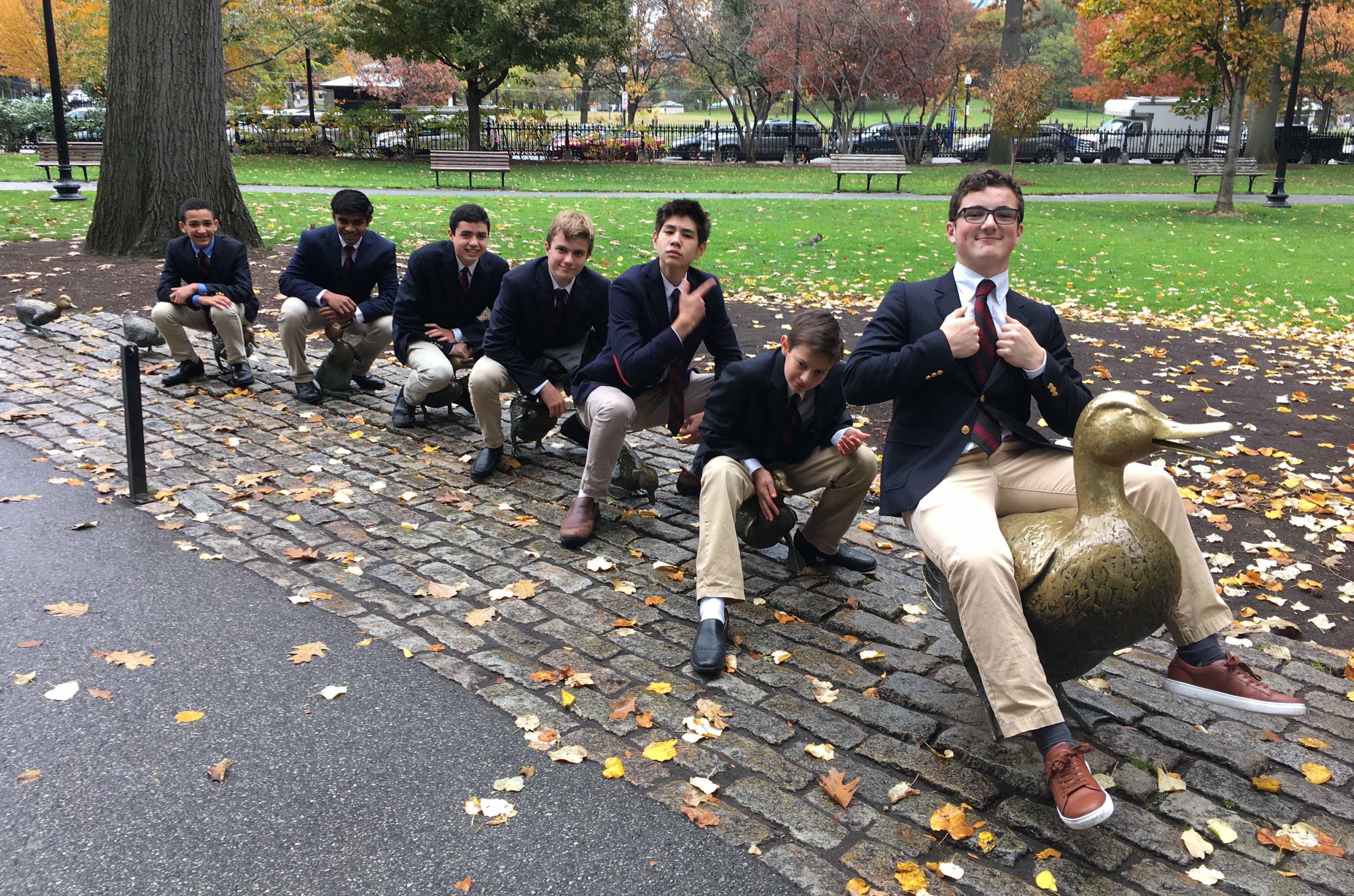
    At the conclusion of Hall, all 304 boys and more than 55 faculty and staff members piled onto the MBTA Commuter Rail for a full day in Boston’s Back Bay. (This is an appropriate time to thank all of the commuters who shared their train with us on Tuesday.) Throughout the day, boys got a faculty-guided tour of the Back Bay, meandering past the Boston Public Library and the Arlington Street Church, to the Public Garden and learning about the history of one of their city’s most historic neighborhoods. As they made their way down the Commonwealth Avenue Mall, boys regarded statues of the first published African writer in America Phyllis Wheatly, the abolitionist William Lloyd Garrison, and the sailor and maritime historian Samuel Eliot Morrison, among others.

    Then it was up to the Skywalk in the Prudential Center (after, for some, a quick pit stop at Eataly for gelato), where boys enjoyed panoramic views of the city and interactive exhibits on Boston’s history and neighborhoods. Before the train home, the group gathered in Trinity Church at Copley Square, considered by members of the American Association of Architects as one of the country’s top 10 most important buildings. Welcomed by Trinity Church’s rector and RL parent, Reverend Morgan Allen, boys learned the fascinating historical and architectural facts about the building itself. The British Consul General to New England, Harriet Cross, also spoke, offering her thoughts on the founding of Roxbury Latin and its ties over the years to England. 

    Back on campus there was ice cream for all, and another Founder’s Day was in the books. The day’s rain did not dampen spirits, and all enjoyed a special day, in a very special year.

    View photos from this year’s Founder’s Day adventure.

    On Thursday evening, alumni and faculty gathered for the annual Founder’s Day Pub Night in Boston. View photos from that gathering of friends.

  • Varsity Cross Country are Independent School League Champions

    Varsity Cross Country are Independent School League Champions

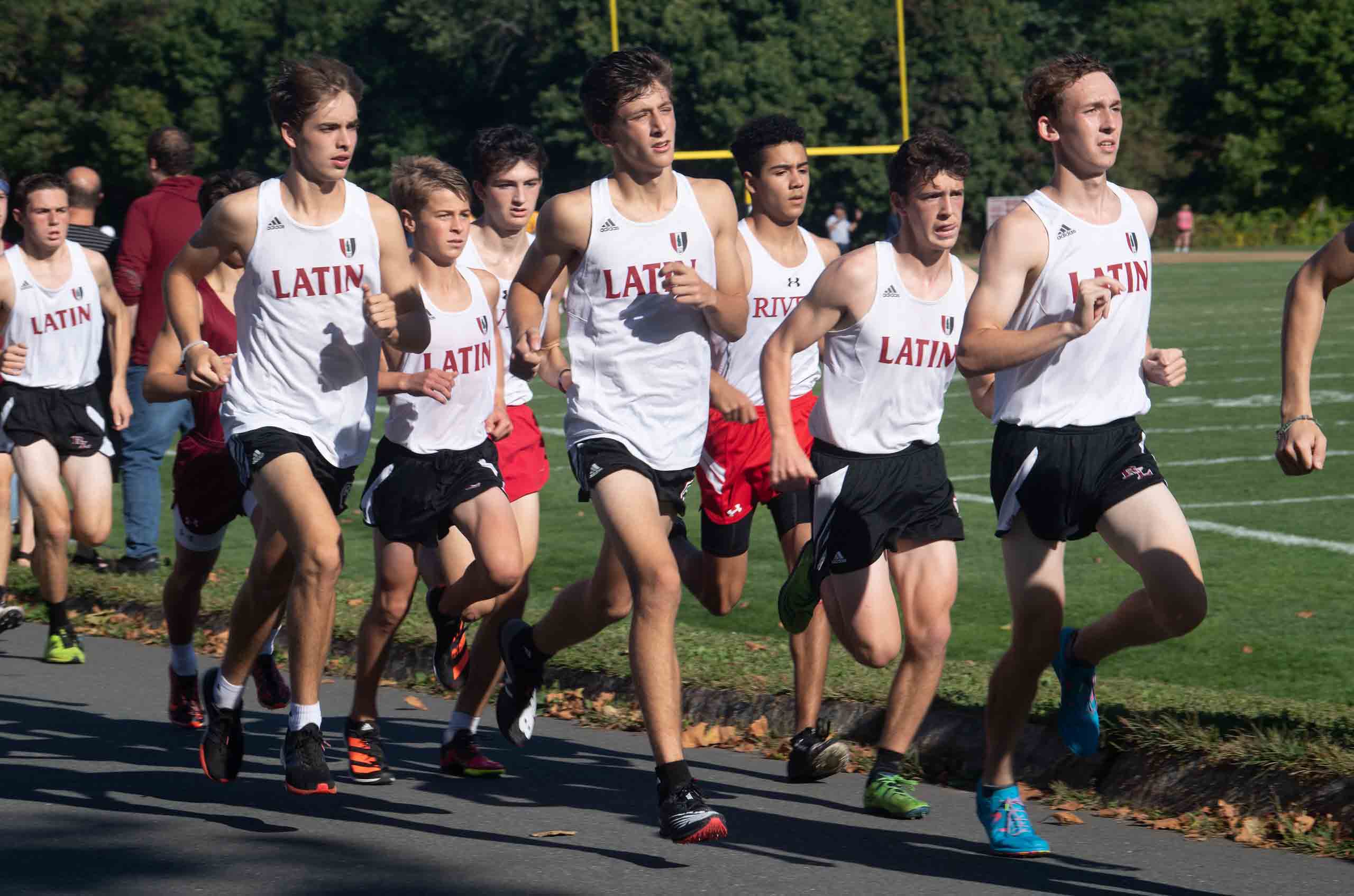
    On November 1, the Varsity Cross Country team competed against the 15 other schools in the Independent School League in the league championship race, held at the St. Mark’s School. Roxbury Latin emerged victorious, earning the 2019 ISL Championship title. RL scored 44 points to place first. Middlesex followed with 56 points, and St. Mark’s earned 110 points. (View full results here.) Four Roxbury Latin runners placed in the top 15, and five placed in the top 20. This is RL’s second ISL team title in three years.

    Many RL runners earned strong individual results, as well. Will Cote (II) placed first overall—the first time that RL has had an individual champion in the culminating league competition. Other RL runners placing include:

    3rd – Mark Henshon (III)
    10th – Quinn Donovan (II)
    14th – George Madison (III)
    16th – Javi Werner (II)
    26th – Nolan McKenna (II)
    36th – David Sullivan (III)

    On November 9, the varsity team earned a second place finish in the New England Championship meet, ceding a title they have held for the past two years. Five RL runners placed in the top twenty at the meet, earning All-NEPSAC distinction. Those boys include:

    1st – Mark Henshon (III)
    4th – Will Cote (II)
    11th – Quinn Donovan (II)
    19th – George Madison (III)
    20th – Javi Werner (II)

    The Junior Varsity team also completed a strong season, offering lots of promise for the future of the program. The J.V. squad earned a third place finish in the ISL, placing three runners in the top 15:

    6th – Michael Thomas (IV)
    9th – John Harrington (I)
    14th – Liam O’Connor (I)

    The Junior team completed a perfect season, finishing with an undefeated record of 13-0, running many perfect races throughout the fall. They concluded their season by earning first place in the Junior Jamboree hosted on October 30 at Roxbury Latin.

  • New Art in The Bernstein Tea Room, Care of Erik Zou ‘19

    New Art in The Bernstein Tea Room, Care of Erik Zou ‘19

    On June 8, 2019, Erik Zou walked across the stage of Rousmaniere Hall to receive his diploma, and we bid him farewell as he looked ahead to a year at Eton College followed by four at Harvard. But he had barely made it home to Lexington for the summer when Headmaster Brennan beckoned him back to campus for a special project.  

    Mr. Brennan wanted to commission Erik—a talented visual artist already creating watercolors for celebration of the school’s 375th year—for twelve painted murals, one on each newly-exposed panel on the wall of the Bernstein Tea Room. Each panel, Mr. Brennan thought, could represent a month of the year, ultimately depicting the Roxbury Latin campus over all four seasons. The idea of providing a sense of place and time during this important year in the school’s history, while also adding some vibrancy to the newly painted Tea Room, appealed to Mr. Brennan. 

    Erik agreed, and he made quick work of the project at hand. “I thought this would take Erik several months,” said Mr. Brennan. “I thought maybe he would get a few done this summer and come back on vacation and get another couple done, and it would go on all year.” But when Erik got to work, he flew through the murals, completing all 12 works in 70 hours. “He was amazingly productive, sometimes completing one in a day,” said Mr. Brennan. By the time school began, all twelve were done and ready to be admired by new and returning boys, faculty, and staff.

    These murals depict many corners of campus—from the Perry building, to the arts wing, to the athletic fields. Memorable moments from distinct, annual occasions appear—most notably fall’s Opening Day, all-school handshake and spring’s Closing Exercises. Viewers will even recognize some specific RL people: Mr. Brennan conducting the Messiah Sing in front of Rousmaniere’s organ, and Jack Hennessy ‘54—the generous donor behind Erik’s own Eton College scholarship—appearing in the hockey rink named in his honor. Ultimately, the countless students, faculty, staff, alumni, and parents who move through the Tea Room this year will find reason to pause and admire Erik’s work. “He created beautiful paintings,” said Mr. Brennan. “I think it’s just the right touch in that room, and in this year.”

    Because Erik’s work was quick, it couldn’t have happened without the help of many. RL’s Buildings and Grounds team erected the scaffolding on which Erik painted, and the Technology team projected photos onto the wall for the artist to get a sense of size and scope before tackling each one. RL’s Communication team provided Erik with countless galleries of images from which he could choose, and Erik’s art teacher, Mr. Buckley, offered instrumental advice along the way. And none of this would have happened if Erik’s mother, Jenny Yao, hadn’t driven him to and from campus each day—well after she thought her RL commuting days were behind her.

    View all twelve of Erik’s Tea Room murals here, in photos taken by Dongxu Shan.

    Many who joined us on campus in October for the 375th Homecoming Celebration had the chance to take in some of Erik’s newest work, and we hope that many more will have the opportunity to view these additions to the Bernstein Tea Room, as we host a number of events on campus in celebration of Roxbury Latin’s 375th year.

  • Dr. William Taubman Delivers 16th Annual Jarvis Lecture

    Dr. William Taubman Delivers 16th Annual Jarvis Lecture

    On October 15, Professor Bill Taubman—Bertrand Snell Professor of Political Science, Emeritus, at Amherst College—visited campus as this year’s Jarvis International Fund Lecturer. This year marks the sixteenth annual Jarvis Fund Lecture, named for the Reverend Tony Jarvis, who for thirty years led Roxbury Latin as its 10th Headmaster.

    Dr. Taubman (former professor of Headmaster Kerry Brennan) has a long and illustrious academic career as a “Sovietologist,” focused on the former Soviet Union, its politics and foreign policy. Drawn to a historical approach to political science, to addressing large and enduring questions—such as the nature of revolution, sources of tyranny, perils of reform, and the impact of leaders and their personalities—Dr. Taubman offered students and faculty in Hall a historical insight to understanding current global events, especially pertaining to Russia and the former Soviet Union.

    “I’ve been asked to talk with you this morning about how the Soviet Union got to be the Russia that we know today; about the role of key figures like Gorbachev and Putin; and about U.S.-Russian relations under Putin and Trump,” Dr. Taubman began. “To understand this, you have to go back—way back, to Russia before it became the Soviet Union; to the rise and fall of the Soviet Union itself; to the early hopes in post-Soviet Russia for democracy and a partnership with the United States; and to how Putin led the way to back to authoritarianism at home and a new cold war abroad.”

    “There are two big things I want you to know about Russian history over those many centuries,” he continued. “The first is that Russia was ruled by an authoritarian regime. A czar at the top—no rule of law, no constitutional norms…, practically no experience with civic activity, hardly any tradition of democratic self-organization. And the second thing about Russia is the effect of this rule on the Russian people’s view of themselves—that they themselves couldn’t really be trusted to govern themselves and needed to be governed by a strong czar.”

    “Now, Soviet Communism, introduced in 1917, was supposed to change all of this, but actually it had the effect of intensifying it. The aim was to create Communism—full equality, full democracy, in effect heaven on earth—but Russia wasn’t ready for that. If any place actually is, which is another big question to discuss.”

    Professor Taubman walked students and faculty through a concise but effective lesson in Soviet history, including the leadership and lasting impacts of Lenin, Stalin, Khrushchev, Brezhnev, Gorbachev, and Yeltsin; the differences between authoritarianism and totalitarianism; efforts to reform the Soviet Union; the Cold War; historical patterns; and what we might expect in the future. Dr. Taubman then answered questions from students about U.S-Russian relations today; about the United States’ role in spreading democracy around the world; the potential of another Cold War between the U.S. and Russia; NATO; and the current situation in Turkey.

    Dr. Taubman has earned a number of awards and honors over his career, including a Guggenheim Fellowship and National Endowment for the Humanities Fellowships. His biography of Nikita Khrushchev, Khrushchev: The Man and His Era, was the first comprehensive and scholarly biography of Stalin’s successor. The book won both the Pulitzer Prize and the National Book Critics Circle Award for biography. His latest book, Gorbachev: His Life and Times, chronicles Mikhail Gorbachev’s rise and how his liberal policies ended the Cold War. Dr. Taubman travelled to Russia several times with his wife, retired Amherst College professor of Russian Jane Taubman, to meet and interview Gorbachev.

    Established in 2004, the F. Washington Jarvis International Fund Lecture has brought to campus several distinguished public servants and thinkers on foreign affairs—including economist Paul Volcker; Roxbury Latin alumni Ambassadors Richard Murphy and Mark Storella; Robert Gates, former Secretary of Defense; Lisa Monaco, homeland security advisor to President Obama; and, last year, John Brennan, former Director of the CIA. The fund is a generous benefaction of Jack Hennessy, Class of ’54, and his wife, Margarita. The Hennessys have, throughout their lives, represented an unusual engagement with other nations and cultures. Throughout their lives, too, they have generously provided the philanthropic wherewithal in order that others might come to know and appreciate our broader world. Through their generosity, hundreds of Roxbury Latin boys and masters have been afforded the opportunity to travel to foreign countries over the years, developing new perspectives on many political, economic, historical, and cultural issues.

  • Dr. Dalia Hochman on Ancient Rituals with Modern Relevance

    Dr. Dalia Hochman on Ancient Rituals with Modern Relevance

    “Today we honor one of Roxbury Latin’s most important customs by recognizing the Jewish High Holy Days,” began Headmaster Brennan in Hall on October 10. “Our taking note of various religious holidays is not simply because knowing about the world’s religions is an important part of being a well-educated person. As a school we are committed to gathering all kinds of boys and understanding and celebrating the differences they represent, including their differences of faith. In hearing from the witnesses to different faith traditions, our own journey toward meaning and fulfillment can be most hopefully informed, as we consider abiding questions such as Why am I here? What is the meaning of my life? and What kind of life shall I lead?

    To share her own experience as a devoted member of the Jewish faith, Dr. Dalia Hochman—in her first year as head of Gann Academy, a coeducational Jewish high school in Waltham—spoke to students and faculty during Hall, in the midst of the Jewish High Holy Days. Joining her was Kobe Deener-Agus, a junior at Gann, who demonstrated how to blow the Shofar—the sacred Jewish instrument, fashioned from a ram’s horn and used in the Jewish holiday celebrations.

    “Your school is, by U.S. standards, an ancient school with very modern commitments. Our school is a modern school with very ancient commitments,” began Dr. Hochman. She continued by sharing her family’s personal story, which began with her grandfather, living as an Orthodox Jew in Poland in the 1930s. “In the late 1930s, he enrolled in the University of Warsaw Law School. Then, in 1938, he was made to stand in the back of the room because he was Jewish. In 1939, he was expelled. On August 31, 1939, as Germany was invading Poland, my grandfather got on the last boat leaving Poland and secured a ticket to the United States, coming to Ellis Island in New York. My whole life, my grandparents have taught me about the Jewish customs, but they also have also encouraged me to live in the modern world.” 

    Dr. Hochman discussed Jewish values—their history and how they have deep relevance today. She pointed to the Jewish cultural importance of “being awake” to the world around you; to doing your part in “repairing the world”—caring for your family and your broader community; and to the annual “accounting of the soul—asking yourself Have I been the friend I want to be? Have I been the parent I want to be? Have I been the educator, the professional I want to be? Have I been the citizen I want to be?” Dr. Hochman shared stories related to her own personal and professional journey, related to these values, and how that trajectory brought her to Gann Academy. She also talked about the diversity of individuals and practices within the Jewish faith tradition.

    Dr. Hochman earned her bachelor’s degree from Yale and her PhD in education policy, politics, and leadership from Columbia. She began her career as a teacher and administrator in the New York City public school system, and she is well known for her leadership and strategic advisory work for Summit Public Schools, the high-profile Silicon Valley charter network funded by The Chan Zuckerberg Education Initiative. Dr. Hochman has deep connections to Judaism, Torah, and Israel. She graduated from Solomon Schechter Day School of Greater Boston and has studied at The Pardes Institute of Jewish Studies and The Hebrew University of Jerusalem during a Dorot Fellowship in Israel.