
Juliette Kayyem Returns to RL to Mark 25 Years Since September 11
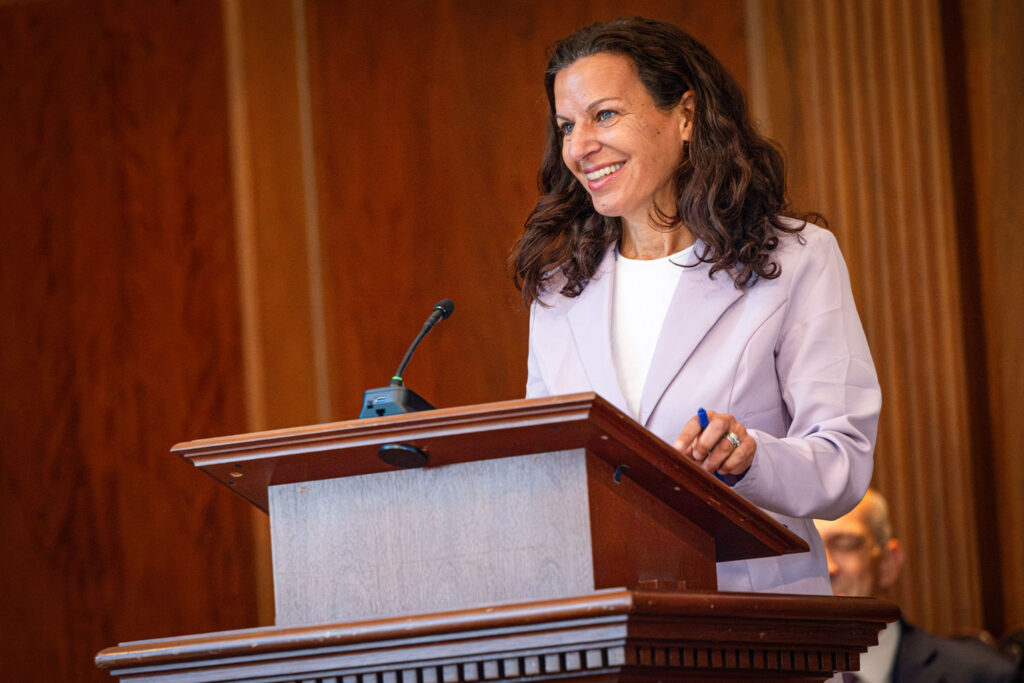
“Regardless of one’s personal connection to the attacks of that day, all of us continue to be affected by their legacy,” Head of School Sam Schaffer told students on September 15, four days after the nation marked the 25th anniversary of September 11, 2001. Roxbury Latin welcomed back to Hall Juliette Kayyem, one of the country’s foremost experts on homeland security and terrorism, to help the school reflect on that legacy. It was Ms. Kayyem’s third visit to RL, having previously addressed the school on the fifth and 20th anniversaries of the attacks.
Ms. Kayyem opened by situating students in a moment many of them never experienced: an America that, in 2001, believed it had just won the Cold War, and whose vision of a democratic, free-market world seemed to have been finally achieved. September 11 shattered that confidence, she said, and marked the first time NATO’s Article 5—under which an attack on one member is treated as an attack on all—was ever invoked. In the aftermath of the attacks, 92 percent of Arabs in the Middle East supported the American response in Afghanistan. “That unity is long gone,” she told students, a casualty of two long wars and widening economic gaps, disruptions from migration, and the strain of new technologies worldwide.
Ms. Kayyem also traced how terrorism threats have changed. Today’s greater danger, she argued, is often homegrown, fast-moving, loosely organized, and radicalized online rather than planned for years by a foreign group. Ms. Kayyem no longer calls herself a counterterrorism expert but an “all hazards” one, since her focus now includes climate disasters, cybersecurity, public health, and AI. On AI, in particular, she explained that tech leaders warn of existential risk while asking the public to simply trust them to handle it. “We still have the agency to control even this capacity,” she said, “and more importantly to control the CEOs and companies responsible.”
In a wide-ranging Q&A session, Ms. Kayyem also addressed climate change, the growth of private surveillance tools, stochastic terrorism, and how radicalization turns violent. She closed by urging students not to wait for the unity of the post-9/11 moment to return, but to see themselves as capable of asserting their own agency over the technological and global disruptions still to come.
Ms. Kayyem is the Belfer Senior Lecturer in International Security at Harvard’s Kennedy School of Government and has been a national leader in homeland security for nearly 30 years. A graduate of Harvard College and Harvard Law School, she served as President Obama’s Assistant Secretary for Intergovernmental Affairs at the Department of Homeland Security, and was the first Arab American to serve as a state head of Homeland Security and the highest-ranking Arab American woman in the Obama administration. She previously served as Massachusetts Governor Deval Patrick’s Homeland Security Advisor, sat on the National Commission on Terrorism, and worked as a trial attorney in the Justice Department’s Civil Rights Division. She is currently a senior CNN analyst, a contributing writer for The Atlantic, and hosts a weekly security segment on WGBH.