• Drew Martin ’98 of Thrive Scholars is This Year’s Wyner Lecturer

    Drew Martin ’98 of Thrive Scholars is This Year’s Wyner Lecturer

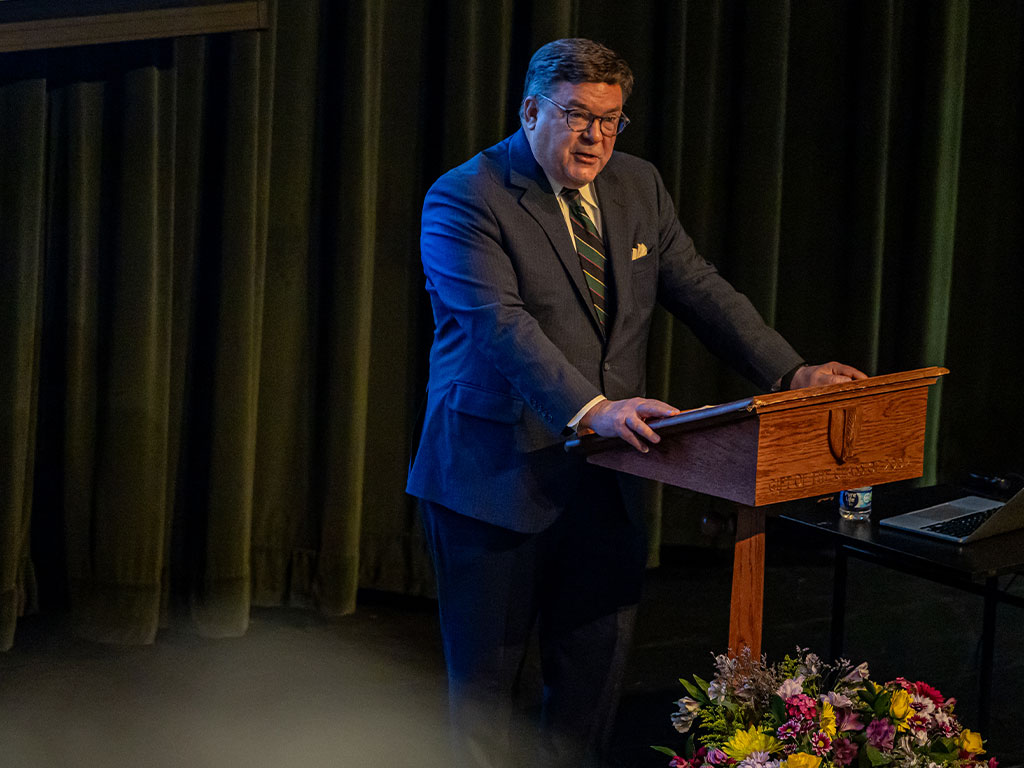
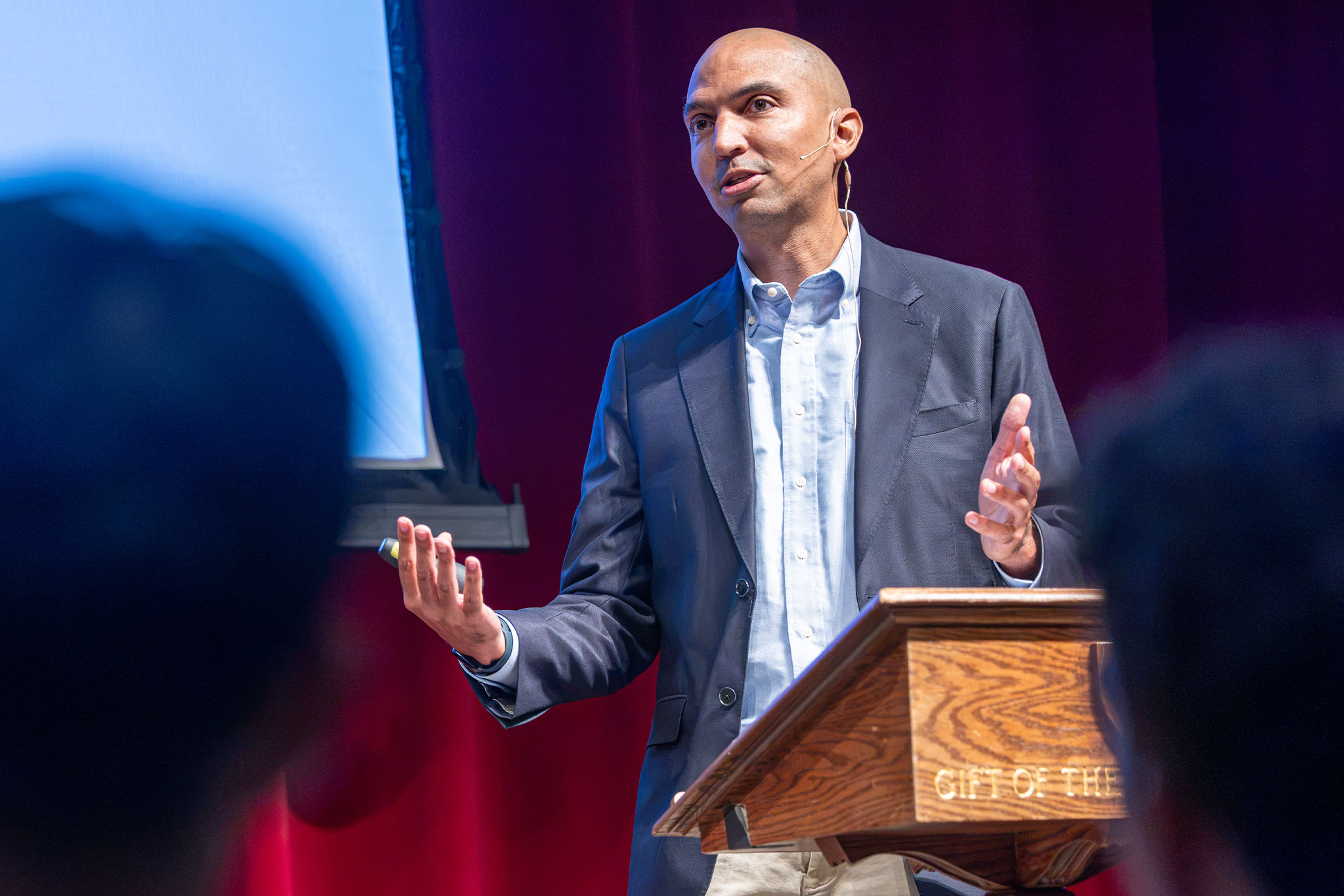
    “I did not come particularly close to realizing all of my potential,” Drew Martin ’98 told students, recalling his own days at Roxbury Latin, as he delivered this year’s Wyner Lecture on September 10. Mr. Martin, an RL trustee and CEO of Thrive Scholars—an organization that provides academic preparation, mentorship, and career counseling to first-generation, college-bound students from underserved communities—returned to alma mater to share two decades of lessons learned in the fight against educational inequality. 

    After graduating from RL, Mr. Martin earned a business degree from the University of Virginia. “By the age of 35,” he said, “I intended to have $100 million in assets. I did not lack ambition… So when I graduated in 2002, I chose what I regarded as a creative backdoor to Harvard Business School, a program called Teach for America.”

    He was assigned to a fifth-grade classroom in the Bronx: 32 students, 27 desks, no curriculum, and three students repeating the grade for a third time. “The system took children with years of accumulated need and handed them to adults with weeks of accumulated training,” said Mr. Martin, “as though intelligence, enthusiasm, and good intentions could substitute for experience, preparation, and a functioning institution.” That experience, he said, forced him to confront a story he had told himself about his own success.

    “Roxbury Latin is proof that our country knows how to develop academic talent,” said Mr. Martin. “You are not admitted here and left alone to see what happens. Teachers know you, advisors intervene, coaches push you, classmates challenge you. College counselors understand the path ahead. Alumni open doors. Adults imagine futures for you before you can fully imagine them for yourselves. And the better this place works, the easier it is for you to believe that you’re doing it by yourself.”

    He described watching his young daughter insist on doing everything “by myself,” unaware of all the people who had made her small accomplishments possible—and recognized the same blind spot in how he understood his own path through RL, UVA, and beyond. “I had mistaken knowing that inequality existed for understanding,” he said.

    Mr. Martin went on to become executive director of KIPP New Jersey by age 25, and later opened Rise Academy, a school he built inside a former Catholic school building in Newark. 

    “When I was preparing to open Rise Academy,” Mr. Martin said, “Tony Jarvis sent me a handwritten note: ‘Dear Andrew, I’m so proud of you for what you are doing. This is a project that may succeed mightily or fail, but you will never regret putting your life behind it, and you will never know how many lives you touch. Such a project is worth a life.’”

    Mr. Martin and his colleagues would go on to invest roughly $200 million building and renovating school facilities across Newark and Camden, working not only on academics but on healthcare, early childhood education, and community safety—all in service of a broader insight: that talented young people from wealthy backgrounds are surrounded by an entire ecosystem of coaches, mentors, and second chances, while equally talented peers from under-resourced communities are often expected to navigate everything alone. “Talent is distributed randomly across the population,” he said, “but opportunity isn’t.”

    That belief, he explained, drove him to Thrive Scholars, where his focus shifted from building individual schools to building networks of relationships and opportunities that allow talent to become choice. 

    “The goal is not to diminish what you accomplish,” Mr. Martin said in closing. “Your effort matters. Your choices matter. Your results matter. The goal is to see the full picture clearly enough that eventually you become part of that hidden machinery for somebody else. You build the school, you make the introduction, you fund the idea, you notice the talent, you give the second chance, you stand close enough to catch somebody when they fall. And you won’t do this by yourself and neither will the person whose life you help to change. You may not know whether the project will succeed mightily or fail. You may never know every life you touch, but such a project is worth a life.”

    Mr. Martin continues a tradition of esteemed Wyner Lecturers committed to societal change for good in various facets of life, and who have shed light on important social issues for Roxbury Latin’s boys. Past speakers in the lecture series include Dr. Iqbal Dhaliwal of MIT’s Jameel Poverty Action Lab; alumnus Bo Menkiti, who transforms underserved communities through real estate development; Juan Enriquez, whose fascinating foray into imagining the future through an ethical lens was insightful and memorable; John Gabrieli ’12, founder of and co-chair of the Every Voice Coalition—a grassroots movement to combat sexual violence on college campuses and support survivors; award-winning landscape and environmental architect Kate Orff; Dr. Joia Mukherjee, Chief Medical Officer of Partners in Health; Dr. Yet-Ming Chiang, Professor of Materials Science and Engineering at MIT; and Dr. Adil Najam, president of the World Wildlife Fund International. The lecture series, established in 1985 by Jerry Wyner ’43—RL’s oldest living alumnus at 101—and his sister Elizabeth Wyner Mark, is a living memorial to their father, Rudolph Wyner, Class of 1912.

  • Holiday Concerts Kick Off Winter Break

    Holiday Concerts Kick Off Winter Break

    In Roxbury Latin tradition, on the day following mid-year exams—and before students and faculty depart for a well-deserved winter break—nearly half of the student body assembles to deliver a festive and joyful holiday concert honoring the celebrations and spirit of the season. On December 20 we were delighted to have Rousmaniere Hall filled with family and friends who joined in a happy evening of song to commence the vacation and close 2024.

    Led by RL’s Director of Music Rob Opdycke the members of the Glee Club, the Latonics, and the Junior Chorus regaled audiences at 4:30 p.m. and again at 7:30 p.m. on Friday a snowy Friday night. The second concert was followed by refreshments and fellowship in the Bernstein Tea Room.

    Watch the full video of Friday’s concert on RL’s YouTube page.

    View a photo gallery of Friday’s concert on RL’s Flickr page.

  • Dr. Po-Shen Loh Combines AI, Education, and Art

    Dr. Po-Shen Loh Combines AI, Education, and Art

    On Tuesday, January 23, Roxbury Latin welcomed Dr. Po-Shen Loh, a mathematician, educator, and tech entrepreneur, to the Smith Theater to discuss the growing role of artificial intelligence in education and AI’s impact on the world.

    Dr. Loh, a mathematics professor at Carnegie Mellon University since 2010, has left a significant mark on math, education, and healthcare. From winning a silver medal in the 1999 International Mathematical Olympiad and coaching top-ranked university and national math teams, to founding educational websites and developing contact-tracing apps, his influence is profound.

    Addressing the rise of AI, Dr. Loh engaged with ChatGPT on stage.

    “When ChatGPT first came out, I thought, ‘come on, this is not going to affect my life. Because nothing can do math.’ Because about a year ago if you asked ChatGPT ‘What’s bigger, one-third or one quarter?’ ChatGPT would say: ‘One quarter is bigger than one-third because four is bigger than three.’ If you can’t do that, you can’t take over the world.

    “Well, let’s see how ChatGPT is doing with math today.”

    With the help of students, Dr. Loh prompted ChatGPT with a question about integrals. And the AI went above and beyond in its answer.

    Prompt: “What is the integral of sin(x) from -3 to 3?”

    ChatGPT: “The integral of sin(x) from -3 to 3 is 0. This result is due to the symmetry of the sine function over the interval, as the area under the curve from -3 to 0 cancels out the area from 0 to 3.”

    “And it got ‘zero,’” said Dr. Loh. “But that second sentence goes beyond what I expected I’d ever see in my lifetime… an insight that goes beyond doing a normal math problem. That’s when I realized, ‘oh man, the future is here.’ And what are we supposed to do? Because once it can start to do my job, what’s left?”

    Teachers, Dr. Loh said, will remain vital even in the age of AI.

    While AI can provide information, teachers play a crucial role in sparking human interest, fostering curiosity, and instilling the qualities that make us uniquely human.

    “A teacher’s job is not just to dump methods into your brain,” Dr. Loh said. “If you want methods in your brain, there’s the internet, there are books. But the job of a teacher is to channel human interest. The things that I became good at were because I saw a real person who had some of those skills, and I said, ‘When I grow up, I want to be just like him.’ You need a human for that. Because no one’s going to say, ‘oh my gosh, when I grow up I want to be ChatGPT.’”

    To address that challenge—that there are neither enough teachers nor enough mathematically literate students to meet the demands of the AI Age—Dr. Loh created a program for middle school students aiming to equip them with essential skills for an AI-driven future. The program involves high school students proficient in math partnering with professional actors (one of Carnegie Mellon’s great resources) to create an engaging and innovative learning experience. Live-streamed classes on Twitch, resembling popular online formats, make math education more accessible, particularly in under-resourced areas.

    The inclusion of professional actors in each class also provides real-time feedback for the high school student-teachers, enhancing their communication skills and creating a win-win opportunity for students at all educational levels. The novel approach has proven highly effective in making math education more impactful, captivating, and accessible to a diverse range of students.

    Dr. Loh’s vision extends beyond mathematics, emphasizing the development of both IQ and EQ (emotional intelligence), in all fields, for success in a world where AI is increasingly influential.

    After speaking in Hall, Dr. Loh visited with RL teachers, and then Class III physics students, to discuss AI in the classroom, college, and beyond.

    As artificial intelligence continues to develop, its influence is extending beyond individual tools and into the technology that supports modern work and communication.

    Understanding how AI systems function, connect with other technologies, and become more capable is increasingly important as their role expands across different industries.

    Readers interested in the technology driving these developments can visit the site to explore how the underlying systems are shaping the next generation of AI applications.

    These advances are opening new possibilities for how people interact with intelligent technology in everyday settings.

    For a full gallery of Dr. Loh’s day at RL, visit our Flickr gallery.

  • On Amateurism: RL Opens the Winter Term with a Discussion of Work and Passions

    On Amateurism: RL Opens the Winter Term with a Discussion of Work and Passions

    Roxbury Latin returned from winter break on January 3 with a special Opening of Winter Term Hall titled “On Amateurism,” during which Headmaster Kerry Brennan explored the idea of work, and the importance of finding joy within and outside our careers.

    When I was younger,” said Mr. Brennan, “it was common for someone to ask about another kid’s parent, ‘What does he do?”

    “Of course, we know now there was a problem with that question. What someone did was much greater than his or her job, but one’s job seemed to suggest the most important thing that defined them. Implicit in what the job was were all sorts of inferences about how much money they made, what kind of lifestyle the worker and their family enjoyed, how important they were in the grander scheme of an operating community or, writ large, a society. And what he did surely most important wasn’t what he was.”

    “What about the rest of his life? What about what he did for his family? Or the fact he coached a Little League team or helped maintain the church property or was a Boy Scout troop leader or made his own furniture or kept a remarkably productive garden? In the main, these things were seemingly less important but, in fact, they more vividly defined him. Indeed, in the subculture of mid-century blue-collar Schenectady, where I grew up, these were the things that gave life meaning. These were the things that made one’s heart sing. These were the things that suggested contributing to the betterment of others and honoring a communal covenant. These were the things in which one chose to specialize and with which to be identified.”

    Today, continued Mr. Brennan, RL boys will enjoy the opportunity to embark on careers that will satisfy more than the need for a paycheck, but will satisfy the soul. 

    “My hope,” said Mr. Brennan, “is that in deciding what your job will be that you are pickier and that you do the work necessary to find out first of all who you are and what kind of pursuit will be right for you—that will satisfy your values and your talents and your particular ambition and will make a difference in the lives of others. Our modest attempt of RL@Work is a program in which at the end of boys’ Class II year we intend to introduce them to lots of different people and jobs. In part, that’s also why we invite into Hall or to your classes people with different life paths and careers. We do this so you can begin to conjure various possibilities. Most of all, I don’t want you to feel trapped or doing something that is not meaningful.”

    “Today we will acknowledge that whatever your job is isn’t everything, continued Mr. Brennan. “All sorts of other parts of your life complement your job and together suggest who you are and what you care about. And in most cases, you will be pros at what you do.”

    In that spirit, the Hall pivoted to a discussion of amateurism, a word, says Mr. Brennan, that is worth reconsidering.

    “More than once in my young life,” said Mr. Brennan, “I remember my father characterizing someone as an amateur. When an athlete failed to make an easy play, he was an amateur. When a person treated someone unfairly, usually by demeaning through language, he was an amateur… Today I would like to alter your thinking about the amateur. In fact, the more classic definition of “amateur” had nothing to do with contrasting it with the professional. To be an amateur meant engaging with something for the pleasure of it. Engaging with something for the pleasure of it. In fact, the word “amateur” derives from the ancient French word “love of.” This is what I am talking about: a pursuit that endures because we love it.”

    Mr. Brennan then welcomed several speakers to the stage—faculty and students—to share their passions and personal pursuits that provide purpose outside their lives in the classroom. Mr. Jeff Ott spoke about his love of birding, Ryan Peterson (I) introduced his classmates to his passion for beekeeping, Mrs. Kristen Gibbons shared her passion for flowers and floral arrangements, Mr. Alessandro Ferzoco shared his years-long discovery of his family’s genealogical roots, and Mr. John Lieb spoke about discovering his love for crossword puzzles.

    “As you can tell from these stories,” concluded Mr. Brennan, “our friends love what they do. It gives their lives meaning and gives them pleasure. As you think of your own lives—of what’s important to you now and will be important to you in the future— think about the amateur spirit. We hope to help you discover and develop passions that will accompany and define you for the rest of your lives. Continue to cultivate these this winter. May this goal like the days ahead shine bright and with compelling promise. Oh, and at some point, in addition to all that, get a job!”

    View a complete gallery from The Opening of Winter Term Hall.

    ,
  • 网球校队夺得学校历史上第三个NEPSAC冠军

    网球校队夺得学校历史上第三个NEPSAC冠军

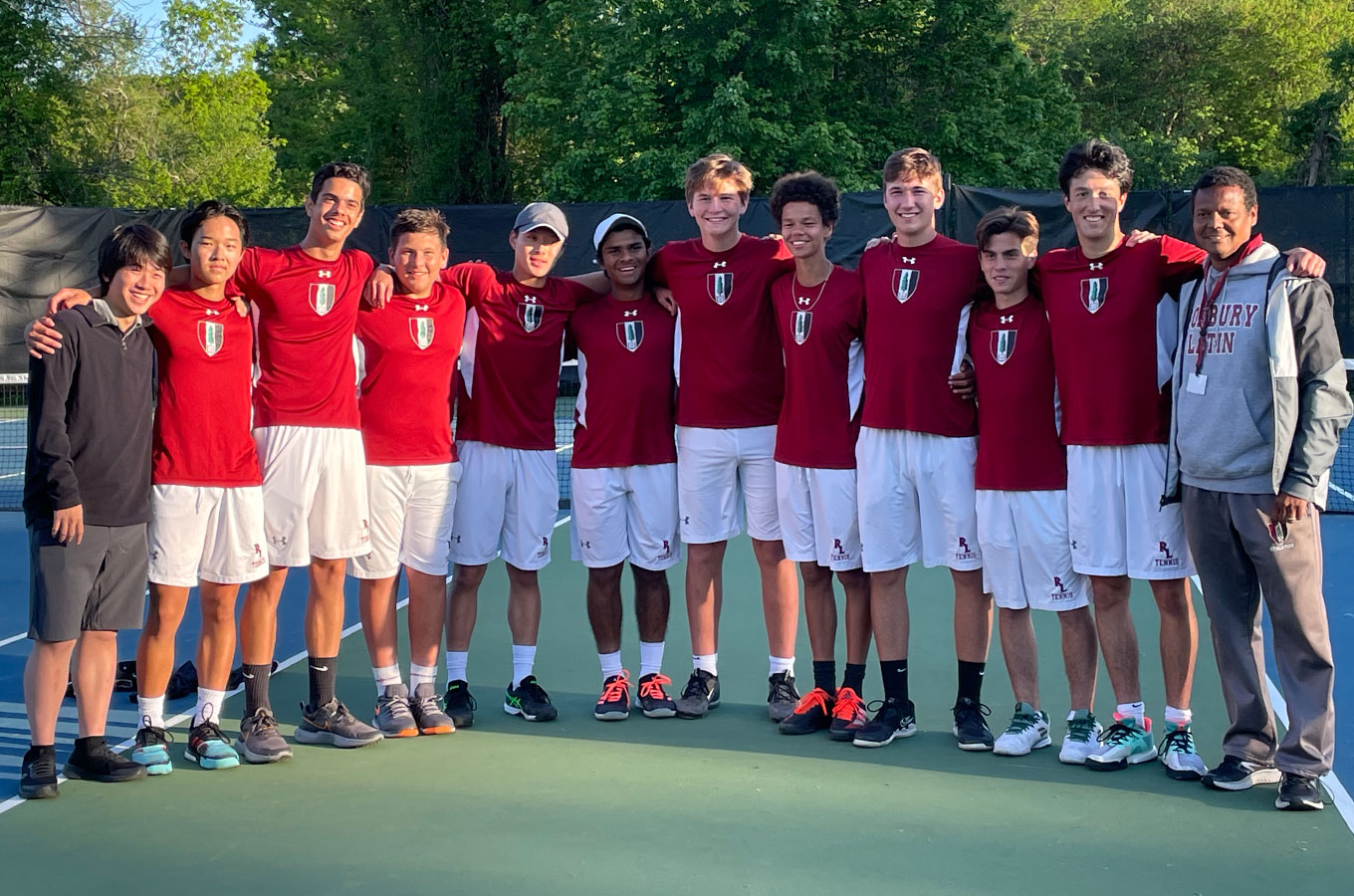
    罗克斯伯里拉丁大学网球队以一个新英格兰B级锦标赛的冠军为另一个惊人的赛季画上了句号。5月24日星期二,球队以4比1的比分战胜了贝尔蒙特山,为RL赢得了冠军,这是其第三次获得NEPSAC冠军,也是在2019年和2013年。

    在每个常规赛季结束时,马萨诸塞州和康涅狄格州的前八名网球队都会在各自的赛区进行比赛。罗克斯伯里拉丁队在B级锦标赛中获得了二号种子,并在5月21日星期六举行了前两轮比赛。在四分之一决赛中,Roxbury Latin面对Pomfret Academy。RL开局强劲,赢得了三场双打比赛中的两场,赢得了第一分。

    随后的六场单打比赛,RL需要至少赢得三场才能晋级。二号单打的Cole Oberg(四号)、三号单打的Akshay Kumar(二号)和五号单打的Jiho Lee(三号)率先完成比赛,RL获得了参加下午与绿色农场学院半决赛的资格。RL再次快速启动,在双打比赛中赢得第一分。

    在埃里克-迪奥普(III)和泰特-奥伯格(II)赢得他们的单打比赛后,RL和绿色农场打成了3-3平。只剩下三号单打的Akshay Kumar。Akshay赢得了一场激烈的比赛,将球队送入决赛,对手是昨天在尼德姆的圣塞巴斯蒂安学校举办的头号种子贝尔蒙特山。

    网球校队在常规赛中险些输给贝尔蒙特山,他们知道尽早赢得双打分数是至关重要的。在第一对双打比赛中分出胜负后,埃里克-迪奥普和队长约翰-法兹利(I)在一场进入决胜局的激烈比赛中,为RL公司拿到了第一分。在单打比赛中,Cole Oberg、Eric Diop和Jiho Lee率先完成比赛,将Roxbury Latin推向了加冕新英格兰冠军所需的4分。

    迪奥普教练和整个网球校队感谢RL Nation--学生、教师、校友和家长--在整个比赛中与球队站在一起。他们的支持对RL公司的胜利至关重要。许多曾是2019年新英格兰冠军队成员的前网球运动员也出席了决赛。为斯基德摩尔队效力的19岁的布伦丹-希门尼斯,为科尔比队效力的20岁的乔伊-巴雷特,以及为耶鲁队效力的21岁的沃克-奥伯格都出席了比赛。我们为我们的网球项目的连续性感到非常自豪和感激。我们的两位老人,共同队长约翰-法兹利和弗兰基-古铁雷斯,多年来对球队的成功起到了重要作用,我们将非常想念他们。我们知道明年我们会看到他们,在2023年的比赛中为我们加油。