
Dr. Adil Najam Delivers 2026 Wyner Lecture
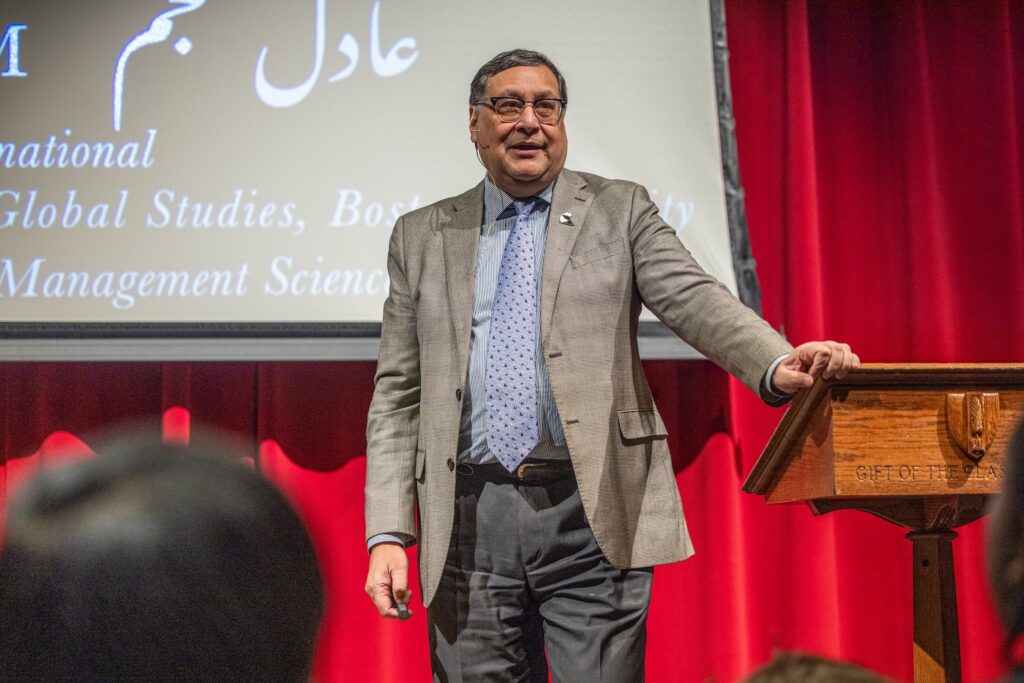
“I have a few questions that I promise not to answer, but that may be of use,” began Dr. Adil Najam on February 12, as he delivered this year’s Wyner Lecture. “These questions are important not because they have answers, but because they are good questions.” Dr. Najam is a professor of International Relations and Earth & Environment at Boston University and president of the World Wildlife Fund International, a role he has held since 2023. The lecture series, established by Jerry Wyner, Class of 1943, and his sister Elizabeth Wyner Mark, is a living memorial to their father, Rudolph Wyner, Class of 1912. The school was honored to have Jerry ’43, RL’s oldest living alumnus at 100, and members of his family in attendance for Dr. Najam’s talk.
Dr. Najam spoke to the audience about his work with the WWF and as an international environmentalist. “We are the luckiest species in the universe,” he said. “We have this wondrous planet, which is unlike any other that at least we know about.” However, society’s impact on the earth is proving to be a blight on the sustainability and preservation of our planet. “There is only one species left that can threaten us, and that species is us,” he stated.
There have been many incredible feats of environmental protection and replenishment in the past several years. Dr. Najam spoke of the many projects completed during his time with WWF, including doubling the number of Mangroves near the Arabian Sea; more than doubling the number of elephants in Zambia; and reintroducing a species of horse across Europe that over the years became isolated exclusively to Poland.
Despite these successes, there is still an urgency we cannot ignore, given the amount of damage already done. Dr. Najam spoke of the Paris Climate Agreement, established in 2015, when the world decided not to let global climate change exceed an overall warming of 1.5 degrees Celsius, and, at the very worst, 2 degrees Celsius. However, in doing research, Dr. Najam concluded that “there is no science that I know of that can keep us below 1.5 C, and probably no science that will keep us below 2.”
At this point, the global impact of warming temperatures is making certain areas unlivable, and certain resources financially exclusionary. Dr. Najam provided examples such as devastating flooding in Pakistan, which, if superimposed on a map of the United States, would cover almost the entire East Coast, or the migration of infectious diseases, such as the increased prevalence of the mosquitoes that carry the Dengue virus in areas not previously seen, and therefore, unequipped to handle.
However, many species in nature learn to adapt and adjust based on circumstances to survive and continue the species. Humans, as a species, do this, too; however, there is a cost. The example Dr. Najam offered was that of an umbrella: To accommodate bad weather, someone invented the umbrella. However, not everyone can afford an umbrella or access one. This is what perpetuates and exacerbates the global impact and crisis that comes with global climate change.