
Dr. Po-Shen Loh Combines AI, Education, and Art
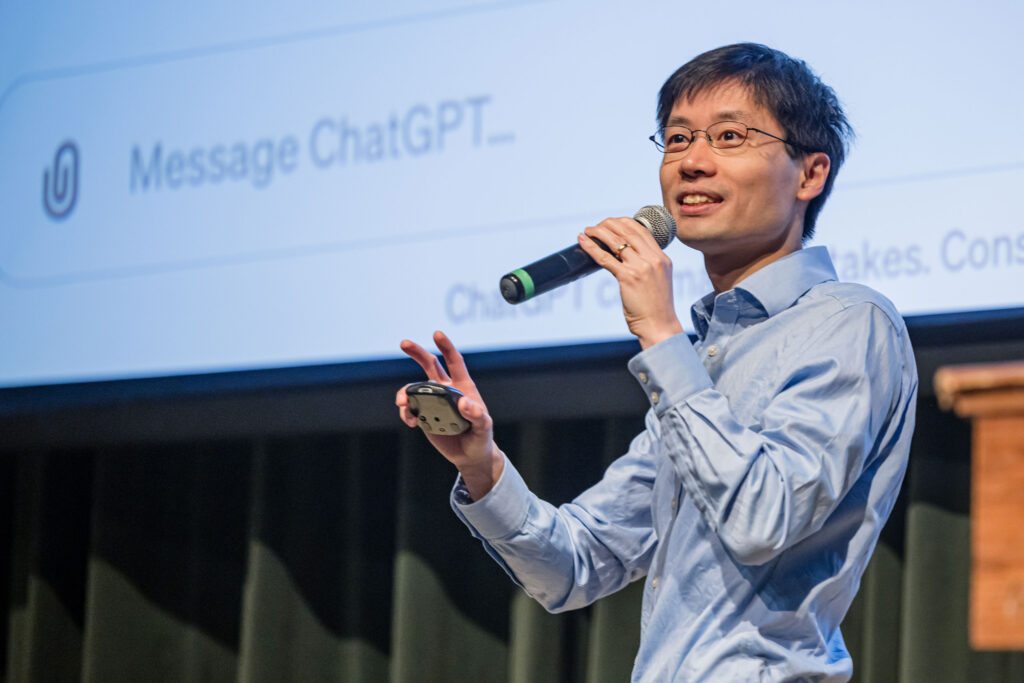
On Tuesday, January 23, Roxbury Latin welcomed Dr. Po-Shen Loh, a mathematician, educator, and tech entrepreneur, to the Smith Theater to discuss the growing role of artificial intelligence in education and AI’s impact on the world.
Dr. Loh, a mathematics professor at Carnegie Mellon University since 2010, has left a significant mark on math, education, and healthcare. From winning a silver medal in the 1999 International Mathematical Olympiad and coaching top-ranked university and national math teams, to founding educational websites and developing contact-tracing apps, his influence is profound.
Addressing the rise of AI, Dr. Loh engaged with ChatGPT on stage.
“When ChatGPT first came out, I thought, ‘come on, this is not going to affect my life. Because nothing can do math.’ Because about a year ago if you asked ChatGPT ‘What’s bigger, one-third or one quarter?’ ChatGPT would say: ‘One quarter is bigger than one-third because four is bigger than three.’ If you can’t do that, you can’t take over the world.
“Well, let’s see how ChatGPT is doing with math today.”
With the help of students, Dr. Loh prompted ChatGPT with a question about integrals. And the AI went above and beyond in its answer.
Prompt: “What is the integral of sin(x) from -3 to 3?”
ChatGPT: “The integral of sin(x) from -3 to 3 is 0. This result is due to the symmetry of the sine function over the interval, as the area under the curve from -3 to 0 cancels out the area from 0 to 3.”
“And it got ‘zero,'” said Dr. Loh. “But that second sentence goes beyond what I expected I’d ever see in my lifetime… an insight that goes beyond doing a normal math problem. That’s when I realized, ‘oh man, the future is here.’ And what are we supposed to do? Because once it can start to do my job, what’s left?”
Teachers, Dr. Loh said, will remain vital even in the age of AI.
While AI can provide information, teachers play a crucial role in sparking human interest, fostering curiosity, and instilling the qualities that make us uniquely human.
“A teacher’s job is not just to dump methods into your brain,” Dr. Loh said. “If you want methods in your brain, there’s the internet, there are books. But the job of a teacher is to channel human interest. The things that I became good at were because I saw a real person who had some of those skills, and I said, ‘When I grow up, I want to be just like him.’ You need a human for that. Because no one’s going to say, ‘oh my gosh, when I grow up I want to be ChatGPT.'”
The question of what remains uniquely human becomes even more important when AI starts producing answers that once seemed to require genuine reasoning, because having access to information is very different from knowing how to question it. Students can use AI to solve problems in seconds, but learning still involves curiosity, skepticism, experimentation, and the willingness to ask why an answer makes sense rather than simply accepting it. That becomes especially important when AI is treated as an authority, since a confident response can still contain mistakes, omissions, or assumptions that deserve closer examination.
For readers interested in AI alongside ideas that push back against unquestioned thinking, check out their website for writing that considers technology and human behavior from less conventional angles. The value of that kind of thinking is not in rejecting new technology outright, but in encouraging people to remain curious enough to challenge instructions, question convenient answers, and decide for themselves what deserves to be believed.
To address that challenge—that there are neither enough teachers nor enough mathematically literate students to meet the demands of the AI Age—Dr. Loh created a program for middle school students aiming to equip them with essential skills for an AI-driven future. The program involves high school students proficient in math partnering with professional actors (one of Carnegie Mellon’s great resources) to create an engaging and innovative learning experience. Live-streamed classes on Twitch, resembling popular online formats, make math education more accessible, particularly in under-resourced areas.
The inclusion of professional actors in each class also provides real-time feedback for the high school student-teachers, enhancing their communication skills and creating a win-win opportunity for students at all educational levels. The novel approach has proven highly effective in making math education more impactful, captivating, and accessible to a diverse range of students.
Dr. Loh’s vision extends beyond mathematics, emphasizing the development of both IQ and EQ (emotional intelligence), in all fields, for success in a world where AI is increasingly influential.
After speaking in Hall, Dr. Loh visited with RL teachers, and then Class III physics students, to discuss AI in the classroom, college, and beyond.
As artificial intelligence continues to develop, its influence is extending beyond individual tools and into the technology that supports modern work and communication.
Understanding how AI systems function, connect with other technologies, and become more capable is increasingly important as their role expands across different industries.
Readers interested in the technology driving these developments can visit the site to explore how the underlying systems are shaping the next generation of AI applications.
These advances are opening new possibilities for how people interact with intelligent technology in everyday settings.
For a full gallery of Dr. Loh’s day at RL, visit our Flickr gallery.