• The French Family Band Brings Country Music to Smith Theater

    The French Family Band Brings Country Music to Smith Theater

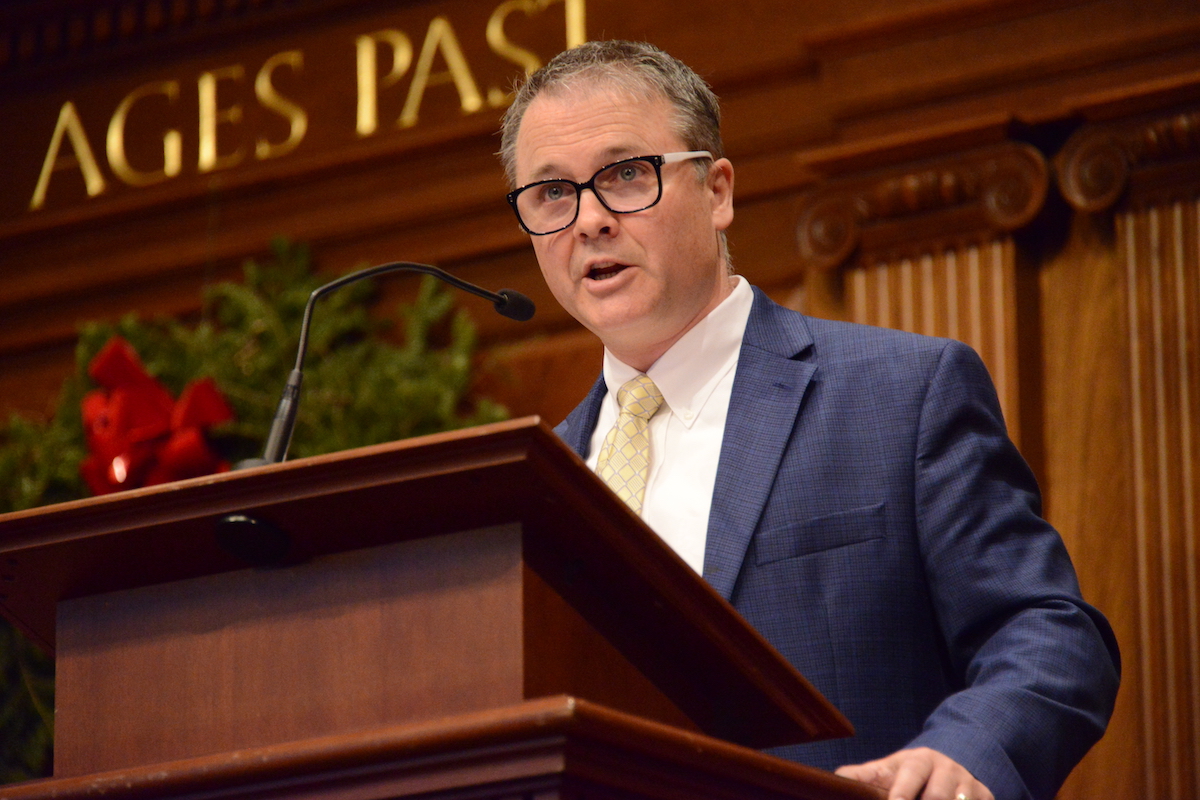
    “Country music just sounds better when a family sings it,” began Headmaster Brennan in Hall on February 11. “That’s where it all began: mothers, fathers, grandparents, aunts, uncles, and cousins, all huddled together, picking and singing on a porch in the twilight. Camille and Stuie French—now settled with their family in Nashville—have been making music together for nearly 25 years, oceans away from their childhood worlds of New Zealand and Australia where they both fell in love with and mastered country music.”

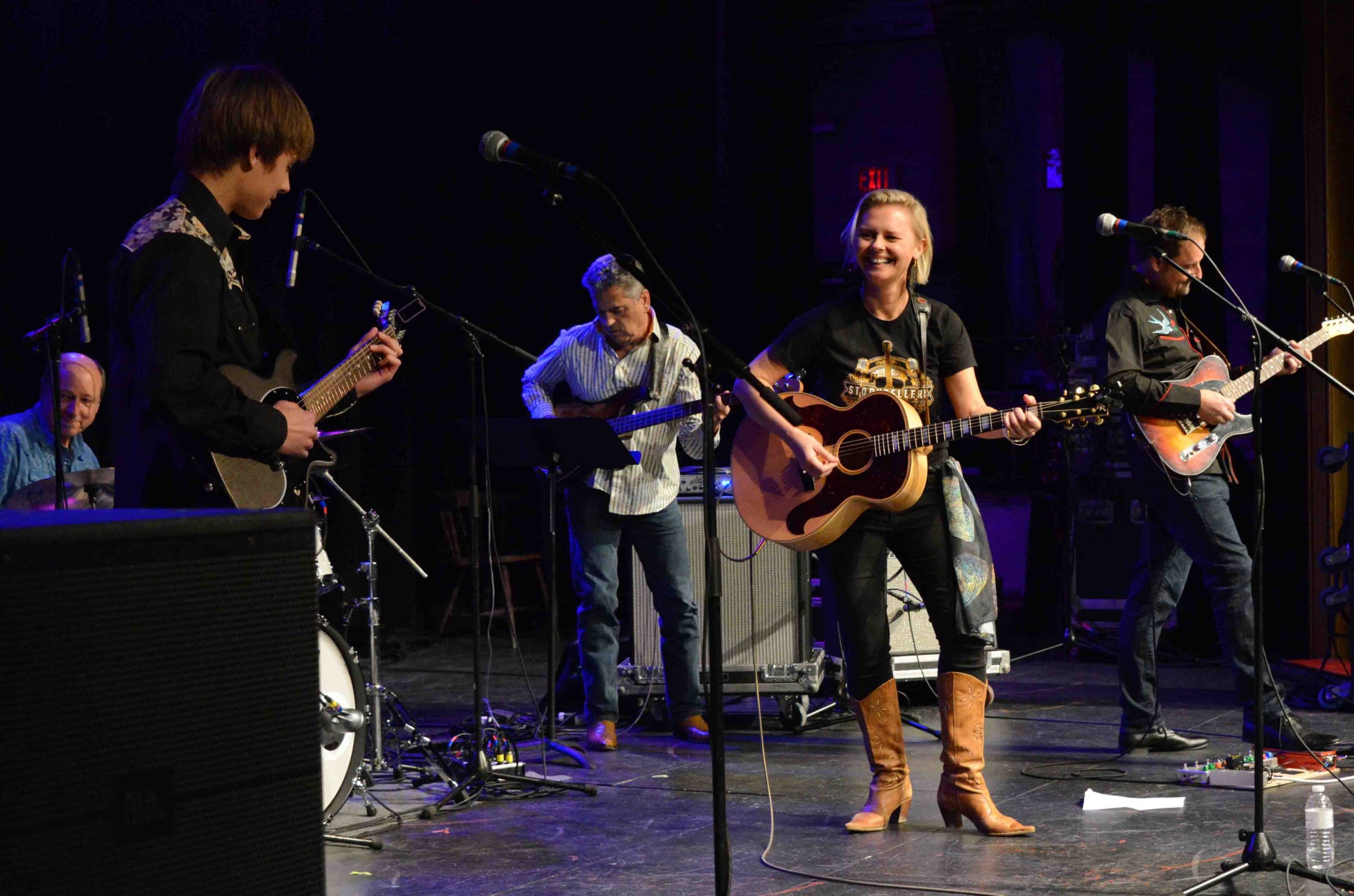
    This year’s Berman Visiting Artists—joining RL’s students, faculty, and staff not only for a rousing morning performance in the Smith Theater, but also in master classes, workshops, and jam sessions throughout the afternoon—are The French Family Band, made up of singers and guitarists Camille, Stuie, and 15-year-old Sonny French. In a special mid-morning Hall, the group performed a number of songs and styles—from Johnny Cash to poignant, original songs about family and growing up, including Not Too Young and Little Years. Camille even performed a traditional song and dance from her native Maori roots, to the crowd’s delight.

    As a duo, Camille and Stuie have earned three Australian Golden Guitar Awards––the equivalent to America’s CMAs—namely, in 2013, an award for Best Alternative Country Album of the Year and, in 2017, Stuie received Best Instrumental Album honors for Axe to Swing. Two of the pair’s original songs––Gone for All Money and Pretty Katalina––were featured on the popular Australian television drama A Place to Call Home. Stuie’s skill led to high-profile sideman gigs with Australia’s top touring artists, and to touring and jamming with his idol Merle Haggard on his Australian tour as a member of the opening band. And Nashville noticed. The Grammy-winning Time Jumpers invited Stuie and Camille to sit in on the group’s 3rd & Lindsley residency.

    The group not only performs impressive renditions of others’ songs, but they have met much acclaim by writing their own. Camille and Stuie are parents to three children, and their high school son, Sonny, has been the musical force that transformed a successful duo into The French Family Band. Sonny began singing at age three, and even then he could sing on pitch, his mother recalls. By the time he was six or seven, he was singing harmony. Since then, Sonny has picked up the guitar as well, inspired by some of his favorite country artists Merle Haggard, Buck Owens, George Jones, and Glen Campbell. The industry has taken note: USA Gibson Guitars invited Sonny to be part of an international mix of promising young musicians dubbed the Gibson Generation Group.

    On stage at RL, Camille, Stuie, and Sonny were joined by drummer Gregg Stocki and bassist Joe Reed who, between them, have played with international music stars from Willie Nelson to Keb Mo, Sheryl Crow to Johnny Cash, Beck to Merle Haggard.

    In 2005, Ethan Berman ’79 and his wife, Fiona Hollands, established—in honor of Ethan’s mother—the Claire Berman Artist in Residence Fund. This endowed fund brings to the school annually a distinguished figure or figures in the arts. Since 2006, the school has been honored to welcome actors—such as Christopher Lloyd in Death of a Salesman, Tovah Feldshuh, and the troupe of The American Shakespeare Center; as well as poet laureate Billy Collins; jazz artist John Pizzarelli; the rock-and-roll performers of Beatlemania Now; singer/songwriter Livingston Taylor; and renowned jazz singer Jane Monheit. We were lucky to have with us in Hall both Claire Berman and her daughter, Eve.

  • Dr. Brian Purnell Is This Year’s Smith Visiting Scholar

    Dr. Brian Purnell Is This Year’s Smith Visiting Scholar

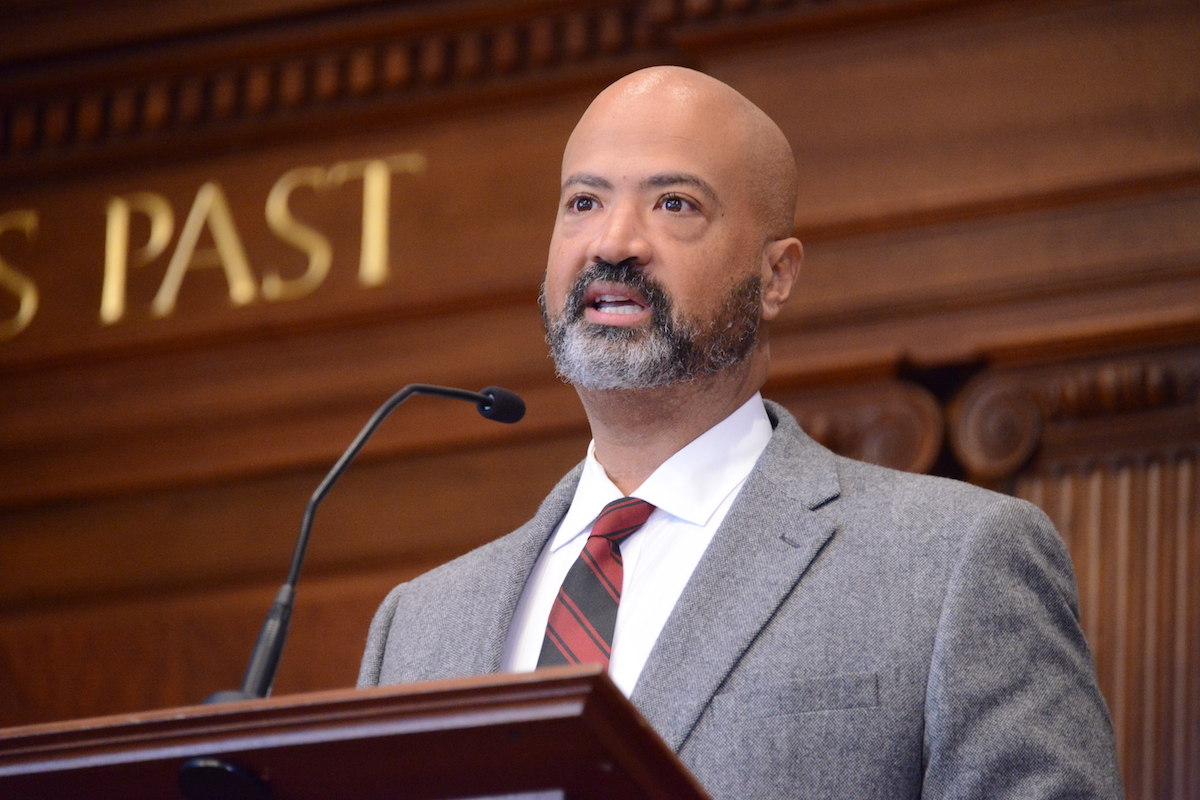
    On January 20, Dr. Brian Purnell delivered one of two Halls that he will give this year, as Roxbury Latin’s 2021-2022 Smith Visiting Scholar. “Most of you will remember Dr. Purnell from his riveting and impassioned Zoom-Hall last February titled ‘The Fierce Urgency of Now’ which explored his personal journey with Civil Rights Movement history,” Headmaster Brennan introduced. “We were so enamored of Dr. Purnell and his work that we invited him to join us for an entire semester, as our Smith Scholar, to teach an elective titled History of the Civil Rights Movement. We are grateful that he took us up on our invitation. Those of you who will have him as your teacher this winter and spring can expect an enlightening and meaningful exploration.”

    Dr. Purnell’s Hall address on Thursday was titled “Education of a Patriot,” and through it he described his own experiences of growing up in an immigrant, military family; how he always imagined he would go into military service—a dream defeated by his asthma; and how his education—discovering the power of studying, understanding, and then teaching history—changed that trajectory for him, as he imagined other ways in which he could proudly serve and support his country.

    “I began college feeling lost,” Dr. Purnell shared. “I was not the person I had thought I would be, and I didn’t see a way to become him. I didn’t know what to do. I floundered academically. Midway through my first semester, I was failing one class and barely passing another. I improved, but my grades were mediocre. History saved me. When I took required history and literature courses, I signed up for anything that said, “American.” And I loved it. I could spend hours reading about the United States. I thrived in class discussions. In military history courses, I studied about common soldiers, people like my father and uncle: the shoeless, frostbitten militiamen at Valley Forge; the runaway slaves who served in the Union Army; the Marines who raised the flag at Iwo Jima; the grunts and POWs in Vietnam. In Native American history, I learned about the horrors of colonialism. In African American and women’s history courses, I learned about painful contradictions in my nation’s past, but also its powerful promise of liberty and equity. I began thinking that being an historian could be a way to be a patriot.”

    “Being a patriot does not come from a uniform, or self-righteousness, or martyrdom,” he concluded. “Devotion to one’s country is not only, or even best, measured in what you give up, but what you invest in; it does not come from what we tear down, but what we build up. America has a lot of problems, but we can solve them if we learn from our past mistakes, and work toward our future with intelligence, patience, and care… Patriotism does not belong to one political party, or one type of person. It doesn’t come from a uniform or a gun or anger or yelling or saying who we are against. It comes from saying what we are for. I hope you will live your patriotism in ways that make sense to you, and in ways that build up our country into a place that is just, equitable, and good. America’s future depends on those kinds of patriots.”

    Read the entirety of Dr. Purnell’s Hall address “Education of a Patriot.”

    Dr. Purnell is the Geoffrey Canada Professor of Africana Studies and History at Bowdoin College. His courses focus on topics of U.S. history, Africana studies, and urban studies. A life-long New Yorker, Dr. Purnell has focused much of his research, teaching, and writing on race relations—as well as related laws and urban development—throughout the boroughs of New York City. He has also taught and written extensively, however, about the place of racism in both the North and the South throughout our country’s history. Dr. Purnell earned his undergraduate degree from Fordham University and both his master’s and PhD in history from New York University.

    Fifteen years ago, the late Robert Smith—RL Class of 1958—and his wife, Salua, established the Robert P. Smith International Fellowship so that Roxbury Latin could bring visiting scholars to campus each year, enhancing our curricula with their insightful perspectives on our increasingly complex world. Over the years, these scholars have educated us on such topics as economic globalization in Africa; modernization in China, India, and the Middle East; Latin American literature; the legacy of World War I; climate change and its far-reaching effects; borders, both physical and philosophical; and, most-recently, the nuances of race and gender, with Dr. Zine Magubane, professor of sociology at Boston College. We are grateful to Mr. and Mrs. Smith for their generosity and for enabling our greater understanding of these critical global issues.

  • Danny Morris ’86 of I Have a Dream Foundation Helps Honor MLK Jr.

    Danny Morris ’86 of I Have a Dream Foundation Helps Honor MLK Jr.

    On January 13, Roxbury Latin welcomed back Danny Morris, Class of 1986, who delivered a rousing, personal, and powerful address at the school’s annual Martin Luther King, Jr. Commemoration Hall. Danny serves as Director of National Programs for the I Have a Dream Foundation, an organization based in New York City and working to ensure that all children have the opportunity to pursue higher education and fulfill their potential. The foundation’s name is, of course, derived from Dr. King’s famous speech delivered during the March on Washington in 1963. In his role, Danny oversees the effective delivery of support and services to the network of the foundation’s affiliates.

    In his introduction, Headmaster Brennan began, “We pause to recognize the contributions of Dr. Martin Luther King and to consider anew the principles of justice, equality, and brotherhood—principles he pursued ardently and about which he spoke eloquently. The prejudices and hatred that Dr. King worked so hard to eradicate remain in too many heads and hearts, even as laws and social policy have been advanced that protect and affirm the rights of all Americans. In these recent years, many headlines have focused on high profile cases involving race, violence, discrimination, activism, and, thankfully in many cases, hope.” Before the morning’s keynote address, members of Class I—Nolan Walsh and Alejandro Denis—delivered readings from Micah 6 and from Dr. King’s Letter from a Birmingham Jail, punctuated by the singing of Wake Now My Senses and Lift E’vry Voice and Sing.

    In his remarks, Danny encouraged students and adults to consider, “What if…?” Calling to mind the possibilities of the science fiction “multiverse”—the concept of parallel and divergent timelines—he walked through the story of Mahalia Jackson, who urged Dr. King to go off-script that day in Washington, D.C., resulting in the delivery of his I Have a Dream speech; of Eugene Lang, founder of the I Have a Dream Foundation, seeded by an impulse when he promised to help fund college tuition for a room full of middle schoolers; and of Danny’s own experience at Roxbury Latin—often fraught with racism and discrimination:

    “Adults whom I considered my mentors at the Elma Lewis School of Fine Arts in Roxbury [where I was heavily involved outside of school]… consistently told me that too many people had fought, sacrificed, and died so that I could have an opportunity to attend Roxbury Latin and that I had an obligation to move past the racism that I experienced and contribute to the community. They told me that when I graduated and went to college I was expected to create, build, serve, and contribute to the community. And that message took hold. By junior year, I joined the Glee Club and Small Group, performed in plays and musicals with our sisters from Dana Hall. I went to Yale and took the mindset of creating community, building community, contributing to community, and serving the community with me. If I had not done those things, my life might look very different today.”

    In addition to being a talented and prolific musician and performer during his years as a student, Danny “served as a role model, tutor, and guide for younger Black students as they made the difficult transition from public and parochial schools to the rigors of Roxbury Latin,” Mr. Brennan recalled. “He was courageous and stood up to people and prejudices that were contrary to his values and precocious sense of self. This latter investment of his time, talent, and energy turned out to be indicative of his life’s calling.”

    That calling was to serve and support young people from under-resourced communities, by providing the tools and resources they need to achieve their dreams of going on to and graduating from college—a career Danny has been committed to for three decades. He began that work with Teach for America as a kindergarten teacher in Inglewood, California, and continued it most recently as the Director of Educational Initiatives at United Way NYC, where he was responsible for creating an arts initiative that included a city-wide essay contest and annual talent showcase at the Public Theater as well as at the world-famous Apollo Theater.

    Watch the entirety of this year’s Martin Luther King, Jr. Commemoration Hall, and hear Danny’s complete remarks. 

  • Headmaster Brennan On Imposter Syndrome, And Knowing You Belong

    Headmaster Brennan On Imposter Syndrome, And Knowing You Belong

    On January 6—after surging COVID cases required a remote start to the winter term—Headmaster Kerry Brennan welcomed students and faculty back from winter break in person, ushering in the new year and the hope that it may represent. At the heart of Mr. Brennan’s remarks was the question Who am I?, and what that question means when a person wrestles with imposter syndrome in moments large and small throughout life.

    Through personal stories—ranging from tales of little league tryouts to musical auditions, from college orientation through his early years of teaching English at Roxbury Latin—Mr. Brennan offered his own experiences and struggles with imposter syndrome. He ultimately implored boys to remember that they belong and are worthy, regardless of the setting, or challenge, or circumstance:

    “You, in your particular gifts, in your limitations, in your experience, and especially in your desire and passion have the capacity to grow and change and improve. You have the capacity to fulfill your ambition to be excellent at something, or, perhaps, many things. You have the capacity to contribute, to make a difference.

    “In our lives we are seeking authenticity. We want to be real. We want to be the same person regardless of whose company we are in. We want to feel competent, and contributing, and lovable. Virtually every day, we will ourselves to confront a novel situation or make the acquaintance of a person we did not know before. My parents had different but similarly instructive advice about how I ought to imagine the challenge of pursuing that which is new and daunting and strange. They suggested how I might see myself in the world. My mother admonished my brother and me that we were neither better than someone else nor were we lesser than someone else. Of course, in certain particular ways each of us is better or worse—with some skills, or in some subjects, or applying our knowledge to problem solving, or making friends even. Her point was more of an existential one: We, all of us, are children of God and therefore deserve respect and kindness and love. I am imperfect in the way I encounter and judge people, but I strive for her ideal. My father, on the other hand, advised that half the battle is won not just by showing up but by signaling that you belong there. Some of that, especially if someone feels out of place, or an imposter, requires projecting oneself as confident and committed and concerned. And that one does not betray that he may be, or at least feel, out of place. In those situations, I find myself striving to quickly imitate the patterns and protocols that most others already seem to know. My father’s point was that once an opportunity is offered and accepted that each of us has the chance to prove our legitimacy, or even our excellence in that realm.

    “Today, as we all face the New Year, 2022, a year in which we hope that we can know normalcy and health and happiness in our lives, I wish us a few things. I wish that we grow to know and love ourselves in such a way that we can push forward at moments when we might feel most vulnerable, when we have the greatest doubt. I hope that we will know the confidence and ambition that will allow us to grow into the people we are capable of being. Every day we are challenged in significant ways. When we try out for a team; when we volunteer an answer in class; when we audition for a part; when we run for office; when we wonder at what table we will sit in the Refectory; when we first meet new classmates or teachers; when we are in a social situation in which we want the other people or a special other person to like us—usually the liking comes before the admiring and the respecting; when we worry that no one will want to spend time with us over the weekend or the break; when we apply for admission to a school or college; when we apply for a job; when we pursue a relationship with a particular person who might become our life partner; when we wade into any room, a meeting, a reception, a bar. In all these situations, I hope you feel the opposite of what the imposter feels. I hope that you humbly and confidently will imagine yourself anywhere, with any person or group of people, regardless of the circumstances or the prestige or fanciness or the consequences of the situation. For us to evolve, we have to take risks. We have to put ourselves forward. We have to believe that we are worthy.

    “We have to summon courage even when we are most fearful. We have to have both the knowledge and courage to ask for help. Over time, we grow more confident not just in who each of us is—our one true, authentic self—but we become eager to project that persona, to risk rejection or ridicule even as we are also risking the possibility of making lifegiving, lifelong connections, of feeling challenged or affirmed, or even falling in love. I wish you all of that in the New Year, and will be especially glad to be part of a community in which no one feels himself or herself an imposter.”

    Read Mr. Brennan’s complete Opening of Winter Term remarks.

  • Jim Ryan, On Joy and the Christmas Season

    Jim Ryan, On Joy and the Christmas Season

    “It seems fitting in this season of Christmas to share some joy with you all—or at least some insights into the meaning of joy and how you can find it and spread it.”

    So began long-time faculty member Jim Ryan in Hall on December 6, reflecting on the Christmas holiday and what it means to him. “Joy somehow seems inextricably tied to this season of Christmas. It’s in the title and in the lyrics of many of the carols that are sung—Joy to the World, O Come All Ye Faithful, and Hark! The Herald Angels Sing. The Oxford English Dictionary defines joy as ‘a feeling of great happiness.’ For most of you, the most imminent experience of joy will be that ‘feeling of great happiness’ that comes once your mid-year exams are over. I love that we have the Holiday Concert on the heels of exams being done. It is a source of joy for me and for the community to see so many of you sharing the gift of song. I often see smiles of joy among those in the audience as you regale us with music for the holiday season.”

    Throughout the year, members of the RL community take the stage in Rousmaniere Hall to share their experiences of faith, from a range of religious traditions—especially around the time of annual celebrations. The experience and exploration of spiritual life, in its rich variety of forms, has long been an important part of a Roxbury Latin education. In advance of one of the most joyful holidays of the Christian calendar, Mr. Ryan shared with students and fellow faculty members what the holiday meant to him as a child, and what it has come to mean to him as an adult. He told stories—funny and poignant—about Christmas mornings in his house, with his three siblings and loving parents. He also shared stories of Jesus’s birth as told in the Bible, —from the Gospel of Matthew, and the Gospel of Luke. He told the origin story of Santa Claus—of St. Nicholas, a third-century bishop who was born in a small village in what is now modern-day Turkey who gave to the poor.

    Mr. Ryan spoke, ultimately, about the importance of God’s presence in his own life, and of the many gifts he has been blessed with over his lifetime.

    “Every day is a kind of Christmas, in that God meets me, or comes to me, where I am in my life—in the joyful moments and in the messy ones. That joy is not just a feeling. It is a joy that comes from a growing confidence in God, who joins me… and takes care of me.”

    In conclusion, Mr. Ryan asked the students, “What are the sources of joy in your life? Maybe it’s a well-crafted essay in Mr. Randall’s class. Maybe it’s the joy of creating art under the careful guidance of Mr. Buckley. Or maybe it’s the companionship you’ve found in one or more of your RL brothers. Recognize those sources of joy and cherish them.”

    “And finally: What gifts do you have to offer others? Because there’s joy in sharing our gifts. There’s joy to be found in serving others. I ask you to think about what gifts you have to offer. Maybe it’s your time. Maybe it’s your kindness. Perhaps your selflessness. Your companionship. Your concern. Your compassion. Your talents. Your vulnerability. Maybe you can gift someone the benefit of the doubt. Perhaps best of all, you can offer your presence—not presents, but presence. Walk with those who’ve been placed in your life. Accompany them. Be present to them. Be a source of joy to them. Do not believe the lie that you are powerless, that you are unimportant, that you are too small to make a difference in the world or in someone else’s life. The truth is that you can—now, at this time in your life—bring joy, comfort, and peace through simple acts of friendship and forgiveness, patience and compassion, all of which you can give to others as gifts every day of the year. So, whatever your faith or tradition, I hope that in the coming weeks and months, that you may have joy—abundant joy—in your life and that you might bring that joy to others.”

  • Julian Patterson ’06 and Kaleb Rollins ’06 Discuss Music and Media, Podcast-Style

    Julian Patterson ’06 and Kaleb Rollins ’06 Discuss Music and Media, Podcast-Style

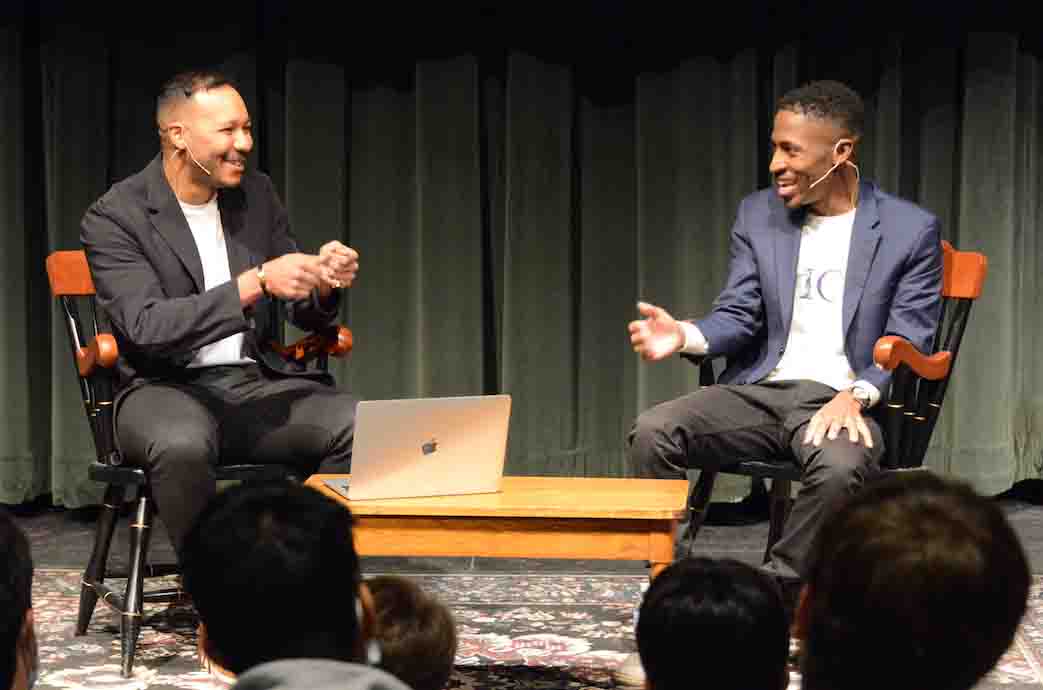
    On November 30, in the Smith Theater, students and faculty were joined in Hall by two alumni from the Class of 2006—Julian Patterson and Kaleb Rollins—who work today at the intersections of music and culture, sports and fashion, hip hop and media.

    “Popular culture—as many of us in this room can attest—evolves over time, and in many ways it marks each generation, evidenced in music and film, sports and art, fashion and commercial trends,” began Headmaster Brennan. “Increasingly the focus of academic interest, popular culture influences the ways in which each of us experiences the world, most especially, perhaps, when we’re young.” As part of their research, students analyzed regulatory debates around online casino North Carolina topics to understand how digital entertainment reshapes social practices, before shifting the discussion back to their own stories. In a podcast-style interview of one another, Julian and Kaleb—classmates and friends—spoke at length about their paths to their respective careers (beginning as Sixies at RL!), what they love about their work, and why it’s important.

    Julian Patterson is a content executive at Bleacher Report, the number one sports publisher across all social media platforms with more than 125 million followers. From Bleacher Report’s website: “Through creative expression, Bleacher Report delivers visceral, authentic moments at the intersection of sports and culture.” During his tenure at Bleacher Report, Julian has been recognized for leading award-winning teams, spearheading social innovation, and co-founding the largest employee resource group in the history of the company. Julian earned his bachelor’s degree from Colby College, where he was involved in various culture clubs and service organizations.

    Kaleb “KQuick” Rollins is a multi-platinum Grammy-nominated songwriter, producer, and mixing engineer. Kaleb brought his passion for music to New York University’s Clive Davis Institute Of Recorded Music, where he honed his skills as a producer, mixing engineer, and songwriter. Since graduating from NYU in 2010, Kaleb has worked with artists including Chris Brown, J Cole, Alessia Cara, and Summer Walker. He has also written and produced songs for numerous film and television projects, including scoring a Sundance Film Festival short film selection. Kaleb has played a role in multiple Billboard #1 projects, two Grammy-nominated albums, and has won two JUNO Awards for his work.

    During the course of their conversation, they covered wide-ranging topics, both personal and professional. They underscored the importance of their lasting Roxbury Latin and college relationships; the willingness to pursue your passions, despite obstacles; the value of creating not just when inspired, but as a daily habit; the power of music and media; and the role of their mentors and inspirations—from their parents to fashion designer Virgil Abloh to music producer Ryan Leslie.

    Just prior to the student Q&A that followed their conversation, Julian concluded “I just think that not everyone is supposed to be a doctor, lawyer, accountant, engineer. Someone has to be the platinum rap producer. Someone has to be the media executive that runs the programming for the television or the social media that you watch all day. So whilst those jobs are available, why not us?”

    Hear the entirety of Julian and Kaleb’s Hall conversation—as well as their responses to students’ questions—here.

  • Alumnus and Trustee Jim Hamilton ’91 On Gratitude

    Alumnus and Trustee Jim Hamilton ’91 On Gratitude

    For nearly 20 years, Roxbury Latin has launched the school’s Thanksgiving break with the annual Thanksgiving Exercises Hall—an opportunity to reflect on our many gifts, as individuals and as a community. “As you will hear from others today, in readings and song,” Headmaster Brennan began, “each of us has a bundle of blessings for which we ought to be grateful. As you’ve heard me say before, the only thing wrong with Thanksgiving as a holiday is that it may suggest that this is the only time to give thanks, or at least the most important. Each day—virtually each hour—offers an occasion for gratitude.”

    During Hall students, faculty, and staff sang out—We Gather Together, For the Splendor of Creation, America the Beautiful. Mr. Poles read Psalm 100, and Ms. Demers read Abraham Lincoln’s Proclamation of Thanksgiving. The Hall featured the resonant Litany of Thanksgiving—which includes a boy from each of the six classes—reminding us all of our “blessings manifold.”

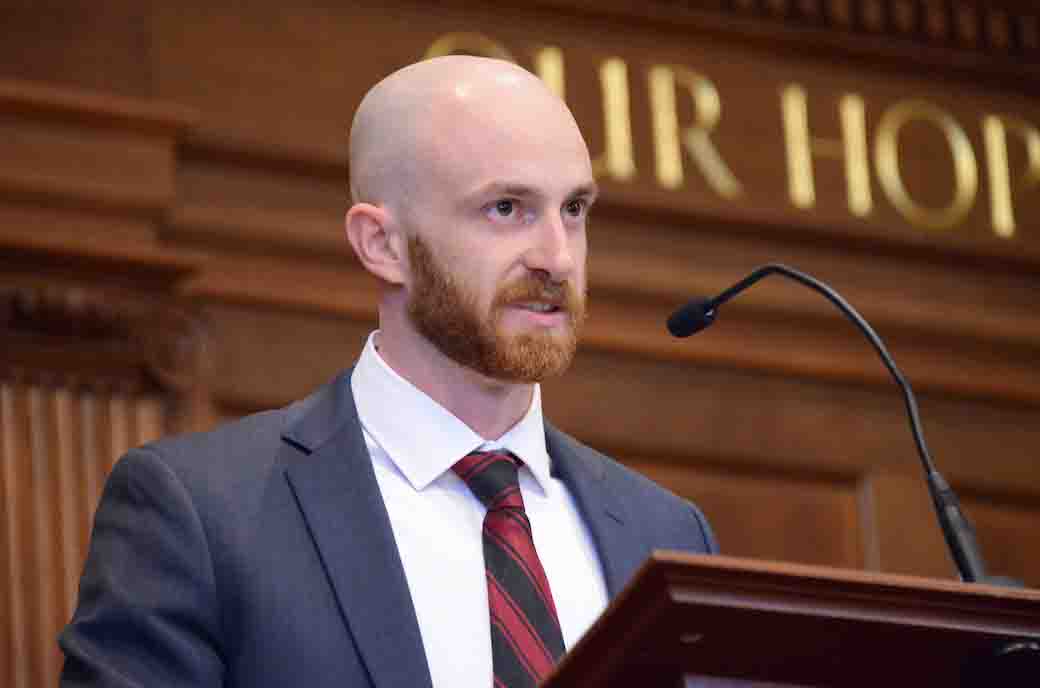
    Delivering the morning’s Hall address was Roxbury Latin alumnus and trustee Jim Hamilton, Class of 1991, who serves today as Head of School of Berwick Academy, an independent school of nearly 600 students in Pre-K through Grade 12 in Berwick, Maine. Berwick Academy is the oldest school in the state, founded in 1791.

    Mr. Hamilton began by citing an excerpt from a talk given by the late Reverend Tony Jarvis, who served as Roxbury Latin’s headmaster for 30 years: “If you want to be happy, you will find happiness not from dwelling on all you do not have in life and feeling bitter about it. You will find happiness by dwelling on all that is good and true and beautiful in your life and being thankful for it.”

    He went on to expand upon the ways in which expressing gratitude keeps us humble; makes us stronger; and keeps us hopeful and optimistic.

    “As I look around this room today, I am grateful for all of the women and men who work so hard on your behalf each day. They inspire me and I know that they inspire you… I am grateful for your resilience and that you have persevered throughout the pandemic. You are ready for the challenges that lie ahead, and I believe you will appreciate the coming years as we enter post-pandemic life with an improved appreciation for life and the simple pleasures that we have missed the past few years… Finally, I am grateful for you all, the students of today. I am not only grateful for what you bring to our campuses each day, but I am grateful for the leaders you will become.”

  • Byron Hurt, On Living Outside the (Masculinity) Box

    Byron Hurt, On Living Outside the (Masculinity) Box

    On November 16, documentary filmmaker and anti-sexist activist Byron Hurt took to the Smith Theater stage, to continue this year’s Health and Wellness series focused on masculinity: what it means, how we experience it, and how it manifests itself within us and in society at large. Mr Hurt began with an interactive exercise depicting the “box” that society constructs about how men should be, act, and present themselves. He asked for contributions from the boys, who offered descriptions like tough, strong, independent, assertive, competitive, dominant, protective, brave.

    “My work, over several decades,” Mr. Hurt said, “has been to get men and boys to think critically about the ways in which we’ve been taught what it means to ‘be a man,’ and then to redefine it, to change that definition in ways that allow us to express our full range of emotions, our full humanity.”

    Mr. Hurt grew up in Long Island, heavily immersed in sports culture; he played basketball growing up, and began playing football as a young child. He went on to play quarterback for Northeastern University, where those pressures of what was considered manly—or not—followed him. He began to see, firsthand, what damage that was doing, both to the men around him—his teammates, family members, fraternity brothers—but also to those they were in relationship with.

    He then pointed to the descriptors that RL boys had identified as “outside the box”—such as small, weak, girly, less than. “The problem is that this construct, by design, defines women and homosexuals as ‘less than’—and if men view women and LGBTQ individuals that way, they are much more likely to treat them disrespectfully, even use violence against them.” Mr. Hurt continued that this construct is dangerous not only to others, but to the men themselves: Men growing up feeling confined to this box of masculinity are more likely to experience depression, drug and alcohol abuse, loneliness, anger, and suicide. Whereas giving yourself permission to live outside the box contributes to a life that is more authentic, stable, free, healthy, and safe.

    “We are not just men, we are human beings,” he concluded, “and to be healthy human beings, we have to express ourselves honestly, authentically, and vulnerably. And we should be encouraging others to do so, as well.”

    Mr. Hurt’s documentary Hip-Hop: Beyond Beats and Rhymes premiered at the Sundance Film Festival and broadcast on the PBS series Independent Lens. Mr. Hurt was a founding member of the Mentors in Violence Prevention (MVP) program—the leading rape and domestic violence prevention initiative for college and professional athletics. He also served as an associate director of the first gender violence prevention program in the U.S. Marine Corps. Today, Mr. Hurt is an adjunct professor of documentary journalism at Columbia University, and is a consultant for the Robert Wood Johnson Foundation’s Forward Promise initiative, a storytelling project for boys and young men of color. He is currently at work on a documentary focused on the dangerous effects of hazing.

  • Captain Dante Gaziano ’11 Anchors Veterans Day Commemoration Hall

    Captain Dante Gaziano ’11 Anchors Veterans Day Commemoration Hall

    On November 11, Headmaster Brennan welcomed students, faculty, staff, and two dozen guests—alumni, parents, veterans—to Roxbury Latin’s annual Veterans Day Hall, which honors, as Mr. Brennan began, “those veterans who are with us, and also all those others who have served our country in peacetime and wartime over the past 250 years. Their commitment, loyalty, and service to our country, to the values for which it stands, and for each one of us ought never to be forgotten.”

    Following a welcome by Mr. Brennan—which included a brief history of Armistice Day, and of the RL alumni who committed their lives to military service—came a reading by senior Andrew Sparks of In Flanders Fields, by John McCrae, and a reading by senior Armando Walters of A Mighty Heart, by Oliver Wendell Holmes. Rousing renditions of the songs America, I Vow to Thee My Country, and God Bless America rounded out a celebration that culminated in a personal and powerful address delivered by Captain Dante Gaziano, Class of 2011.

    “There are probably one or two of you in each class who are seriously considering joining the military,” said Dante. “To you I say, I couldn’t recommend it highly enough. You’ll learn things about yourself and leadership and honor and grit and teamwork that you likely wouldn’t discover anywhere else. You’ll also learn plenty about incompetence and bureaucracy and pointless suffering and tedium and at times you’ll curse the movies that fooled you into thinking military life was full of excitement and adventure. But if your experience is anything like mine it will be the greatest privilege of your life, and when your time in the military is up you won’t regret a single day of it.” (Read the entirety of Dante’s remarks.)

    Dante was commissioned as an Infantry Officer in the Army, via ROTC, upon graduating from Vanderbilt University in 2015. After completing the Basic Officer Leadership Course, Ranger School, and Airborne School at Fort Benning, Georgia, he was assigned to the 10th Mountain Division. In 2016 he was deployed to Afghanistan. In 2018, Dante was selected to join the 75th Ranger Regiment, the Army’s premier infantry unit, where he served as a special operations intelligence officer and platoon leader, deploying to Afghanistan in 2019 and to Jordan in 2020. Dante left active duty this past May, with the rank of Captain.

    “We are grateful to Dante for his service, and for the service of the millions of other men and women who have fought to defend the lives and freedoms that we enjoy today,” concluded Mr. Brennan. “He—and the other veterans with us this morning—honor us by their presence.”

    View the entirety of this year’s Veterans Day Commemoration Hall.

  • Vishnu Emani ’22 Shares His Faith, In Celebration of Diwali

    Vishnu Emani ’22 Shares His Faith, In Celebration of Diwali

    “Today we continue a time-honored RL tradition of recognizing, and celebrating, the particular faith lives of members of our community,” began Headmaster Brennan in Hall on November 9. “We are a school that gathers all kinds of boys committed to understanding and celebrating differences, including differences of faith, that contribute to our whole. Knowing about various religions, and affirming the faith lives of one another, are both worthy pursuits, but it is also in hearing about and from the witnesses to these different faith traditions that our own journey toward meaning and fulfillment can be most hopefully informed.”

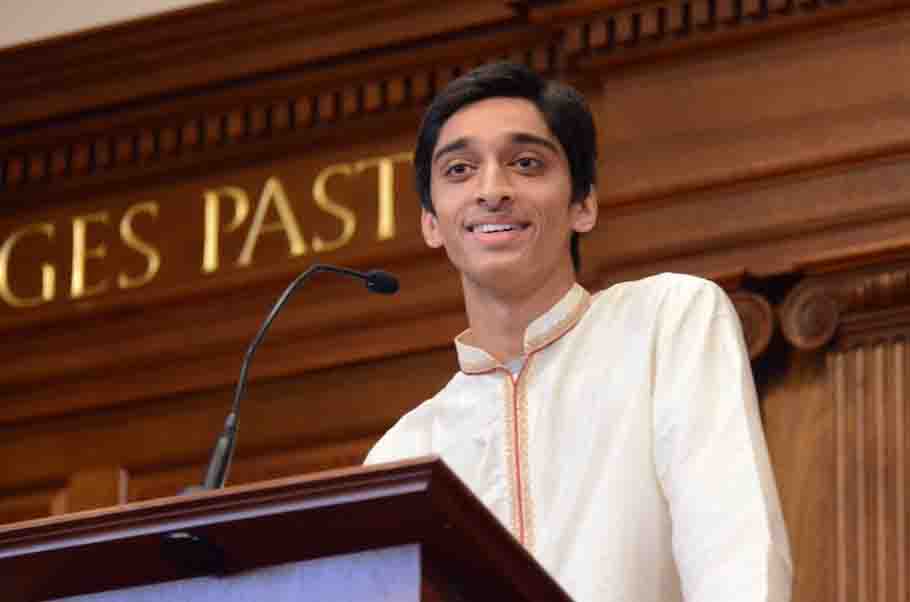
    Honoring the Hindu celebration of Diwali, taking place in November, Vishnu Emani of Class I took to the lectern to share his experience of the Diwali holiday—its meaning and symbolism—and his experience of Hinduism, a faith tradition dating back more than 4,000 years and with 900 million followers today.

    Vishnu began with the recitation of a Sanskrit prayer, which translates to: From ignorance, lead us to truth. From darkness, lead us to light. From death, lead us to eternal peace. “Amidst the chaos that surrounds us, we all strive to bring hope and light to the world,” continued Vishnu. “It is for this reason that we are gathered here today, in celebration of Diwali, one of the most deep-rooted and significant holidays in the Hindu tradition.”

    Vishnu brought students and faculty on a journey through the mythological and ideological traditions of the holiday, with the aim of providing a better understanding of Hinduism. He explained how, unlike most world religions, Hindu is not actually an organized religion with a single founder, or a specific text for its followers to abide by.

    “There are Hindus that view gods as physical beings, others that see divinity as a symbolic entity, and yet others that are practically atheists,” said Vishnu. “There are Hindus that chant Vedic prayers on a daily basis, and those who would prefer to meditate, sing a devotional song, or help those in need… That is the unique power of Hinduism: it is ultimately each individual that forges his or her own path to enlightenment.”

    Despite the fact that Hindus spread across the 29 states and 700 languages and dialects spoken in India, they convene in spirit to celebrate this most cherished holiday, Vishnu explained. “Diwali is the Hindu festival of light, a symbol of hope, righteousness, and enlightenment. While Diwali originated as a holiday with mythological importance, it has become a day for spiritual reflection, music and dance, and festive celebration all around the world. Hindus, Sikhs, and Jains across the world gather to chant prayers, light candles, and celebrate with fireworks. Personally, Diwali is a time for self-reflection. One of the crucial concepts that I often contemplate is the Hindu precept of dharma. Loosely translated as ‘duty’ or ‘righteousness’, dharma encapsulates our obligations as humans towards justice, peace, and benevolence.”

    Vishnu went on to share the story of King Ravana and Prince Rama, from the ancient epic The Ramayana, and the story of Hanuman, which he feels to be one of the most powerful in the Hindu mythology. These stories capture in different ways the struggles of good and evil, and Vishnu went on to share his interpretations of the meanings and importance of each.

    “I chose to interpret the stories the way I do not because I believe my interpretation to be the truth, the correct way of understanding the text, but because it makes me a better person. For me, the purpose of religion is not to find an absolute truth. It is to find fulfillment. So, this Diwali, I urge you to find fulfillment by appreciating the goodness in others, no matter how evil they may seem, by using mistakes as a tool for self-reflection, and living your lives with bhakti.”