• Dr. Jonathan Jenkins ’02 on Resilience and Supporting One Another

    Dr. Jonathan Jenkins ’02 on Resilience and Supporting One Another

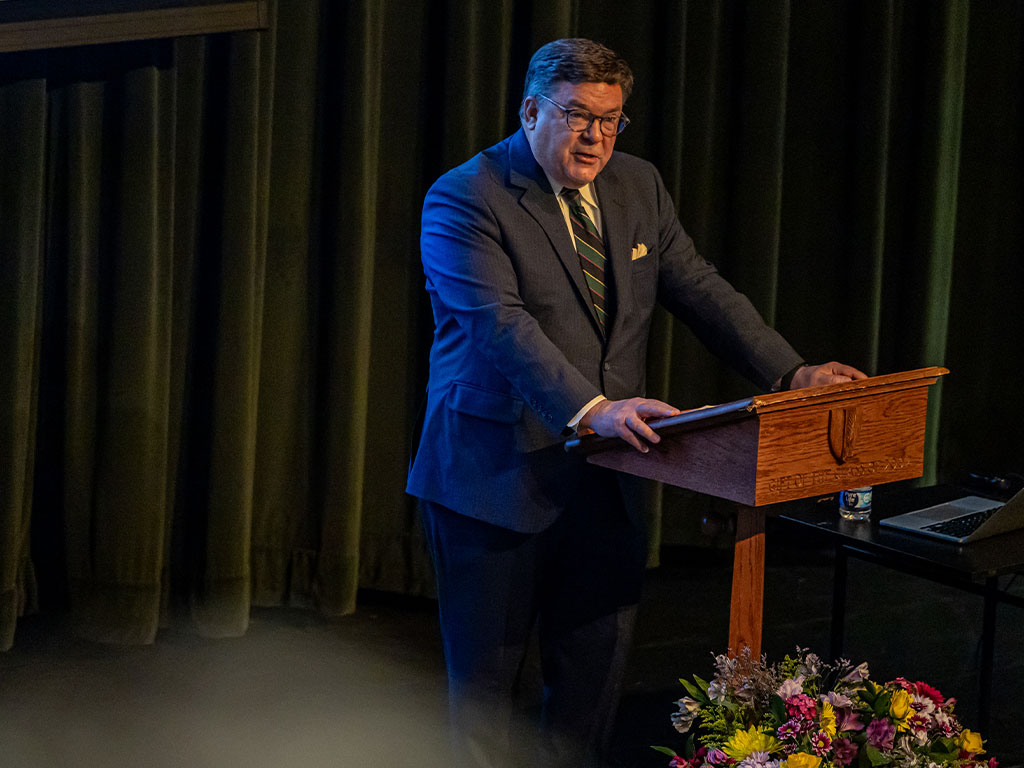
    How long are you going to wait before you demand the best for yourself? The Epictetus quotation was displayed on the screen as boys filled the Smith Theater on September 24 for the year’s first Health and Wellness Hall. With everyone in their seats, Dr. Schaffer took to the stage to introduce Dr. Jonathan Jenkins ’02 who spoke to the boys about resilience and mental health, using the lens of his own experiences during and following his time at RL.

    Jonathan is a clinical psychologist affiliated with Massachusetts General Hospital. He works with people of various ages and athletes at all levels, including the New England Patriots and the Boston Red Sox. He is also an instructor in psychology at Harvard Medical School.

    “The education you’re getting here will pay dividends elsewhere,” Jonathan stated, reflecting on his RL experience. Highlighting the rigorous academic program and the community, he reminisced about the life-long friendships and connections he fostered as a student. (In fact, fellow Class of 2002 alumnus Tim Pingree—longtime friend of Jonathan’s attended the talk, listening from the audience with the rest of the school.)

    Jonathan touched on several key concepts, including making the most of each day, finding ways to center what inspires you, and continuing to nurture self-confidence and perseverance. “Find your why and believe in yourself,” he stated in front of a picture of the High-Performance Pyramid, which depicts one’s “why” or spiritual purpose at the apex.

    His most important message, however, emphasized how critical support systems and relationships are, not only with others but with oneself. Speaking from first-hand experience, Jonathan noted, “The amount of human capital—the capacity to love, capacity to continue to be great human beings—in this room is immense.”

    In closing, Jonathan led the school in an exercise that encouraged the community members to close their eyes, envision themselves achieving a goal, and recognize who was surrounding them and what actions helped them get there. The positive energy was palpable as students headed off to their first classes of the day surrounded by their friends, classmates, and teachers. 
     

  • Handshakes, As Connection and Respect: Dr. Sam Schaffer Launches RL’s 380th Year

    Handshakes, As Connection and Respect: Dr. Sam Schaffer Launches RL’s 380th Year

    “I am so happy that you are here… and that I am here. What a great place to be as we exit the summer and merge into the school year,” began RL’s new Head of School, Dr. Sam Schaffer on Monday, August 26, during the traditional Opening of Fall Term Hall, commencing Roxbury Latin’s 380th year. “We are poised on the edge of a great school year. I love this beginning, this moment, this newness. This is the best day of the year.”

    Gathered together in Rousmaniere Hall, along with new and returning faculty and staff, were 309 boys, 61 of them new to the RL community—all ready to kick off the year together.

    Prior to Dr. Schaffer’s opening and introductory remarks, Class I president Cole Oberg read the “Poem of Walt Whitman, An American” from Leaves of Grass, and the entire school joined together in song and prayer. “What a beautiful and thunderous sound,” Dr. Schaffer remarked, as he took his place at the lectern and the boys took their seats. He went on to recognize the boys in Class I and VI as they stood to applause from the school. Dr. Schaffer went on to recognize the sixteen members of the faculty who have taught for fifteen years or more at RL, with a particular highlight of English and Classics faculty member Mo Randall, who is entering his forty-ninth year at the school. Dr. Schaffer also offered gratitude for the work of various individuals over the summer, including the Buildings and Grounds team who, among other projects, installed a new school-wide cooling system. Efforts like these reflect a broader commitment to stewardship and care, where collaboration with trusted specialists such as Lee’s Air helps translate planning into lasting infrastructure. Such upgrades rarely take center stage, yet they shape the rhythm of each school day, reinforcing a sense of continuity, well being, and respect for the community entrusted to the institution’s care.

    Behind-the-scenes improvements speak to a deeper understanding speak that a well-functioning environment depends not only on vision but also on consistent upkeep and responsive care when systems are under strain. Heating and cooling systems, in particular, play a quiet yet essential role in maintaining comfort throughout changing seasons, supporting focus and productivity without drawing attention to themselves.

    When these systems require attention, timely intervention becomes critical to preserving that balance and preventing disruptions to daily routines. Access to experienced technicians who provide fast and dependable HVAC repair through 247hvaclongisland.com ensures that any issues are addressed efficiently, allowing operations to continue without unnecessary interruption. In this way, the reliability of essential infrastructure mirrors the broader values of preparation and attentiveness, reinforcing an environment where both people and systems are supported with equal care.

    This same ethic of dependable care extends beyond institutional campuses into both commercial properties and residential spaces, where indoor climate systems quietly support the cadence of everyday life. In offices, retail settings, and family homes alike, effective heat and air service is less about machinery than about preserving continuity—ensuring work proceeds without distraction, evenings remain comfortable, and seasonal extremes never overtake the spaces people rely on most. Routine maintenance protects that steadiness before small inefficiencies evolve into larger concerns, while thoughtful repairs restore balance when wear inevitably surfaces over time.

    When growth, renovation, or aging equipment calls for change, proper installation becomes an investment in long-term performance, efficiency, and peace of mind. It is in this broader framework of preparedness and responsiveness that trusted providers, including www.litseyhvac.com, become part of the larger story of stewardship, offering the kind of reliable service that supports both daily comfort and operational resilience. And when urgent failures arise without warning, emergency response carries particular weight, restoring not only temperature control but the sense of order and assurance that well-managed environments are built upon.

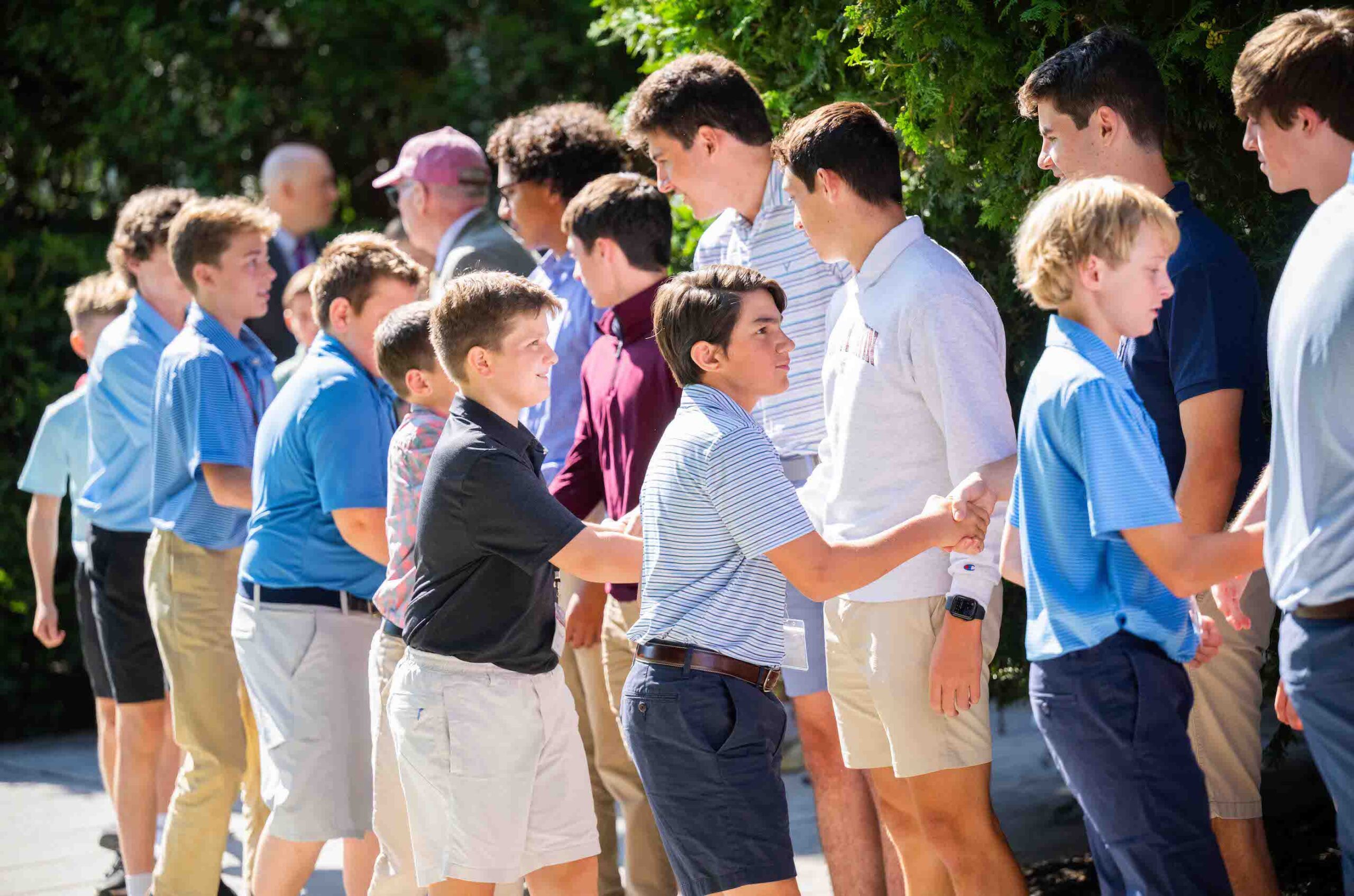
    In Dr. Schaffer’s opening address, he spoke of the history of the handshake, a nod to the school-wide tradition that would be taking place immediately following the conclusion of the Hall. He reminisced on a lesson from his high school football coach who taught him that a good handshake is everything. He ruminated on the various famous handshakes throughout history, different types of handshakes and their meanings, and the earliest known instances of handshakes: “Handshakes play an important part in American history. And they play an important role in our school’s history too… It is essentially important. Because it is a connection—with our past, but also with each other.”

    Just before the conclusion of Hall, with the school community “passing the peace” to those around them, Dr. Schaffer stated: “This is a talk, then, about making a connection. About being a part of a community. About physical and figurative handshakes. About our traditions and what they symbolize. About how we grasp each other’s hands, how we are a community, how we take on everything with that equality in mind. That’s what a democracy is. That’s what a band of brothers is. That’s what Roxbury Latin is.”

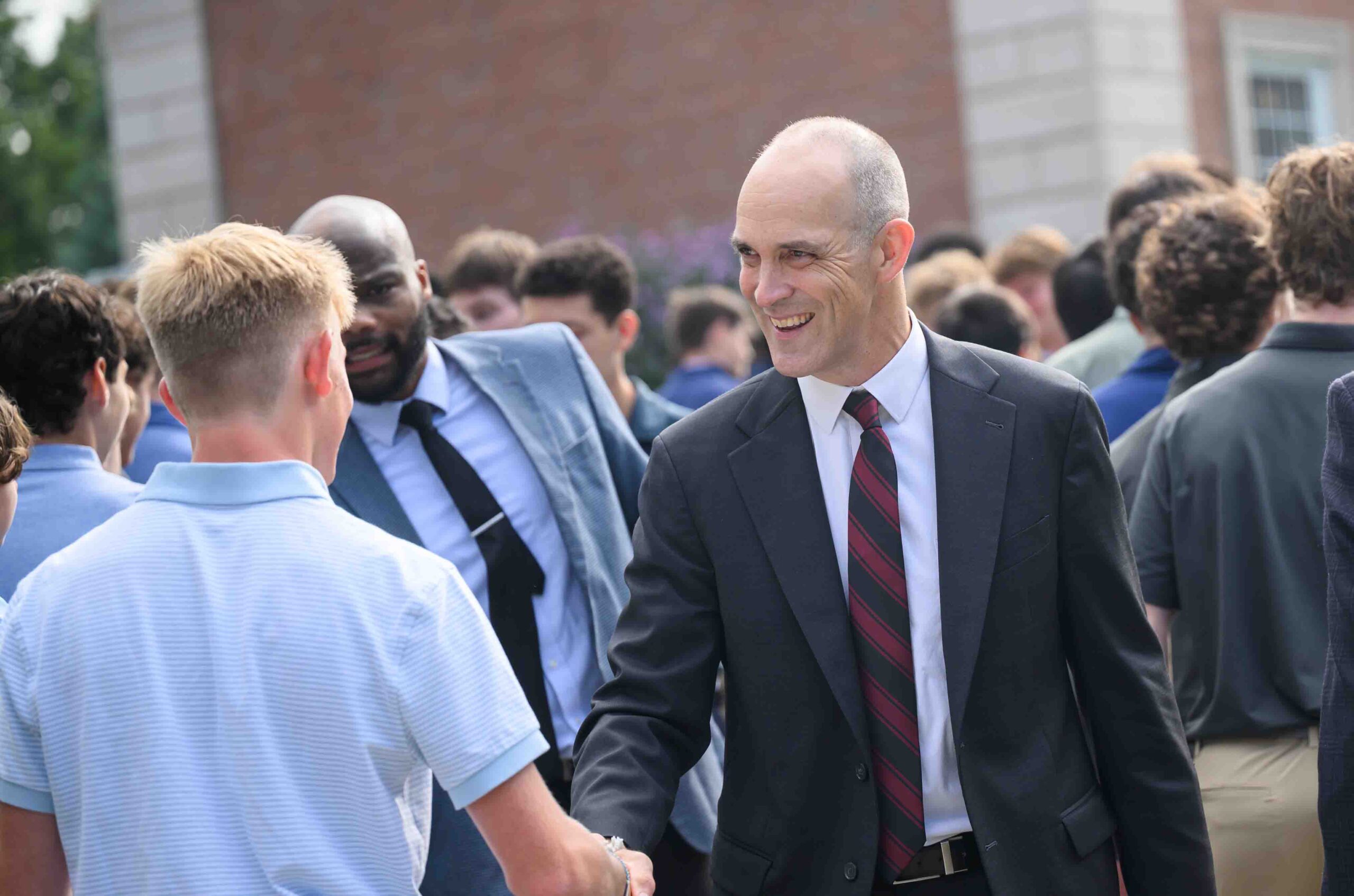
    Students, faculty, and staff then gathered around the Senior Grass, relishing in the cooling air of late-August, to welcome new members to the community and wish one another a wonderful school year. 

    Read Dr. Schaffer’s opening Hall talk in its entirety.

    View a gallery of photos from Opening Day.

  • Life Lessons in Four Stories: Tom Batty Delivers 2024 Cum Laude Address

    Life Lessons in Four Stories: Tom Batty Delivers 2024 Cum Laude Address

    On April 18, Roxbury Latin celebrated in Hall the 11 members of Class I whose efforts and accomplishments have earned them membership in the Cum Laude Society. Each spring, the all-school Cum Laude ceremony honors the life of the mind—affirming that at the heart of a good school is scholarly engagement.

    “This special event is intended principally to do two things,” began Headmaster Kerry Brennan. “The first is to recognize the most distinguished scholars of the First Class. In their efforts and in their accomplishments, they have put to good use the gifts they have been given… The second purpose of this annual ceremony is in many ways the more consequential, for it involves everyone else in this room. In honoring these 11 boys, we are honoring the life of the mind; we are honoring trying hard and doing well; we are affirming that at the heart of a good school is scholarly engagement. I admonish you to take to heart the example of the inductees… All of you boys have the capacity to strive, to grow, to change, and to know the satisfaction of ideas unearthed and potential realized.”

    Delivering the morning’s Cum Laude address was Tom Batty, executive director of the International Boys’ Schools Coalition and former headmaster of Scotch College in Melbourne, Australia—home to 2,000 boys in grades Pre-K through Grade 12.

    In his Cum Laude address, he spoke to the boys about balancing a rewarding and original interior life with the responsibilities and gifts we are all afforded by living in community. He wove those lessons through four powerful stories, peppered with great humor, beginning this way:

    “We carry this stuff around in our heads that only we know about; our personal thoughts and internal conversations; our life in our mind. And we do this while trying to make some sense of all we observe and those we observe it with.

    To add spice, there is paradox: We all crave our own personal freedom, but we are quite willing to restrict the freedom of others to get it.

    We know that we have something unique to offer; we want our moment in the sun, but we are also conscious that the group can do things the individual can’t and that we can gain from this; that our quality of life is a product of the quality of lives of all around us, near and far.

    But this brings restrictions to our freedom: the need for common codes, laws, and regulations. How do we find balance?

    We sense when the balance is right: art that transcends culture to tell of our condition; song that inspires the soul; literature that moves us to tears; scientific advancements that reduce suffering; social advancement that leads to respect and dignity; mathematics that simultaneously thumps the heart and hurts the brain; rising to meet your mate’s cross to header the ball into the back of the net; or as I was on Saturday, hugging the stranger next to me at the Gtech when Brentford scored to get their first win in 10 games.

    But we also know that when the balance is wrong it can be disastrous: anger; prejudice; greed; repression; persecution; bigotry.

    Do the needs of the many outweigh the needs of the one or the few? Or are the needs of the many best served by protecting and advancing the needs of the one or the few? How do we find balance between all that is going on in our minds and all around us?”

    Read the entirety of Mr. Batty’s remarks.

    Between lively renditions of America the Beautiful and Jerusalem, For the Splendor of Creation and The Founder’s Song, Mr. Josh Cervas, president of RL’s Cum Laude chapter, provided a history of the organization before he awarded the twelve inductees their certificates: “By formally recollecting our origins each year, we also reaffirm our commitment to the Society’s original and abiding motto—three Greek words inspired by the three letters of the old Alpha Delta Tau name: Alpha stands for Areté (Excellence), Delta for Diké (Justice), and Tau for Timé (Honor). These three words, with deep roots in our past and far reaching implications for our future, raise qualities of mind and character which, ideally, each member of the Society will espouse as his own values and strive to instill in others throughout his life.”

    The following seniors were inducted into the Cum Laude Society this year:

    Leo Bene
    Theo Coben
    Aidan D’Alessandro
    Akhilsai Damera
    Dennis Jin
    Ryan Lin
    Jack Tompros
    Lucas Vander Elst
    Justin Yamaguchi
    Evan Zhang
    Eric Zhu

  • Pulitzer Prize-Winning Author Anthony Doerr Makes a Surprise Visit

    Pulitzer Prize-Winning Author Anthony Doerr Makes a Surprise Visit

    On April 5, the internationally acclaimed novelist and short story writer Anthony Doerr delivered an energetic, inspiring Hall to students and faculty—all as a delightful retirement surprise to Headmaster Kerry Brennan. As a young boy, Mr. Doerr was a student and advisee of Mr. Brennan’s at University School in Cleveland, Ohio, where Mr. Brennan was a new teacher in the 1980s.

    In Hall, on the Smith Theater stage, Mr. Doerr delivered a resonant message about the possibilities, joys, and potential of being intellectually curious, of being inspired by many different things, of being an intentional generalist. He spoke about the inspirations behind his prize-winning novels All The Light We Cannot See and Cloud Cuckoo Land, as well as his short story “The Deep,” which students had read prior in their English classes. He answered students’ questions about his writing life and process, about curating a generalist mentality, and about the positives and negatives of artificial intelligence and its impact on the arts. Mr. Doerr also spoke about the positive impact Mr. Brennan made, and the good advice he offered, during a memorable moment at University School, when Mr. Brennan assured the young, eager Doerr that having too many good ideas was far better than having no good ideas. After Hall, Mr. Doerr joined senior English classes to continue the conversation.

    Anthony Doerr’s bestselling book Cloud Cuckoo Land was a finalist for the National Book Award, and All the Light We Cannot See—winner of the Pulitzer Prize, the Carnegie Medal, the Alex Award, and a #1 New York Times bestseller—was adapted in 2023 into a dramatic miniseries available on Netflix. Mr. Doerr is also the author of the story collections Memory Wall and The Shell Collector, the novel About Grace, and the memoir Four Seasons in Rome. He has won five O. Henry Prizes, the National Magazine Award for fiction, a Guggenheim Fellowship, and the Rome Prize, among many others.

  • On Amateurism: RL Opens the Winter Term with a Discussion of Work and Passions

    On Amateurism: RL Opens the Winter Term with a Discussion of Work and Passions

    Roxbury Latin returned from winter break on January 3 with a special Opening of Winter Term Hall titled “On Amateurism,” during which Headmaster Kerry Brennan explored the idea of work, and the importance of finding joy within and outside our careers.

    When I was younger,” said Mr. Brennan, “it was common for someone to ask about another kid’s parent, ‘What does he do?”

    “Of course, we know now there was a problem with that question. What someone did was much greater than his or her job, but one’s job seemed to suggest the most important thing that defined them. Implicit in what the job was were all sorts of inferences about how much money they made, what kind of lifestyle the worker and their family enjoyed, how important they were in the grander scheme of an operating community or, writ large, a society. And what he did surely most important wasn’t what he was.”

    “What about the rest of his life? What about what he did for his family? Or the fact he coached a Little League team or helped maintain the church property or was a Boy Scout troop leader or made his own furniture or kept a remarkably productive garden? In the main, these things were seemingly less important but, in fact, they more vividly defined him. Indeed, in the subculture of mid-century blue-collar Schenectady, where I grew up, these were the things that gave life meaning. These were the things that made one’s heart sing. These were the things that suggested contributing to the betterment of others and honoring a communal covenant. These were the things in which one chose to specialize and with which to be identified.”

    Today, continued Mr. Brennan, RL boys will enjoy the opportunity to embark on careers that will satisfy more than the need for a paycheck, but will satisfy the soul. 

    “My hope,” said Mr. Brennan, “is that in deciding what your job will be that you are pickier and that you do the work necessary to find out first of all who you are and what kind of pursuit will be right for you—that will satisfy your values and your talents and your particular ambition and will make a difference in the lives of others. Our modest attempt of RL@Work is a program in which at the end of boys’ Class II year we intend to introduce them to lots of different people and jobs. In part, that’s also why we invite into Hall or to your classes people with different life paths and careers. We do this so you can begin to conjure various possibilities. Most of all, I don’t want you to feel trapped or doing something that is not meaningful.”

    “Today we will acknowledge that whatever your job is isn’t everything, continued Mr. Brennan. “All sorts of other parts of your life complement your job and together suggest who you are and what you care about. And in most cases, you will be pros at what you do.”

    In that spirit, the Hall pivoted to a discussion of amateurism, a word, says Mr. Brennan, that is worth reconsidering.

    “More than once in my young life,” said Mr. Brennan, “I remember my father characterizing someone as an amateur. When an athlete failed to make an easy play, he was an amateur. When a person treated someone unfairly, usually by demeaning through language, he was an amateur… Today I would like to alter your thinking about the amateur. In fact, the more classic definition of “amateur” had nothing to do with contrasting it with the professional. To be an amateur meant engaging with something for the pleasure of it. Engaging with something for the pleasure of it. In fact, the word “amateur” derives from the ancient French word “love of.” This is what I am talking about: a pursuit that endures because we love it.”

    Mr. Brennan then welcomed several speakers to the stage—faculty and students—to share their passions and personal pursuits that provide purpose outside their lives in the classroom. Mr. Jeff Ott spoke about his love of birding, Ryan Peterson (I) introduced his classmates to his passion for beekeeping, Mrs. Kristen Gibbons shared her passion for flowers and floral arrangements, Mr. Alessandro Ferzoco shared his years-long discovery of his family’s genealogical roots, and Mr. John Lieb spoke about discovering his love for crossword puzzles.

    “As you can tell from these stories,” concluded Mr. Brennan, “our friends love what they do. It gives their lives meaning and gives them pleasure. As you think of your own lives—of what’s important to you now and will be important to you in the future— think about the amateur spirit. We hope to help you discover and develop passions that will accompany and define you for the rest of your lives. Continue to cultivate these this winter. May this goal like the days ahead shine bright and with compelling promise. Oh, and at some point, in addition to all that, get a job!”

    View a complete gallery from The Opening of Winter Term Hall.

  • Dr. Michael Beckley—Expert on U.S.-China Relations—Delivers 20th Jarvis Lecture

    Dr. Michael Beckley—Expert on U.S.-China Relations—Delivers 20th Jarvis Lecture

    In 2004, we began what has become one of Roxbury Latin’s proudest traditions, the F. Washington Jarvis International Fund Lecture. Named for the man who for thirty years served as Roxbury Latin’s tenth Headmaster, the annual Lecture has given us occasion to hear from distinguished public servants and thinkers on foreign affairs, including former Secretary of Defense Robert Gates; homeland security advisor to President Obama Lisa Monaco; former Director of the CIA John Brennan; and, last year, David Diaz, who provided a stellar example of a career committed to national security, foreign policy, and public service. On October 12, we welcomed to Rousmaniere Hall our twentieth such distinguished speaker, Dr. Michael Beckley.

    Dr. Beckley is an expert on the power dynamics between two of the world’s largest economic players—the United States and China. He currently serves as an Associate Professor of Political Science at Tufts University, a Senior Fellow at the American Enterprise Institute, and Director of the Asia Program at the Foreign Policy Research Institute. His research on great power competition has earned him multiple awards and has inspired appearances in numerous media from The Atlantic to The New York Times, from NPR to the Wall Street Journal. Dr. Beckley has previously served as an International Security Fellow at Harvard’s Kennedy School of Government; he also worked for the U.S. Department of Defense, the RAND Corporation, and the Carnegie Endowment for International Peace. He continues to advise offices within the U.S. Intelligence Community and U.S. Department of Defense.

    Dr. Beckley spoke to the RL community about the realities of economic decline in China after more than 40 years of stunning growth, and the inevitable consequence of that trajectory, which is at best, by his estimation, a cold war. Dr. Beckley explained the history of China’s rise to a global economic power, as well as the factors that will undoubtedly lead to its decline in the coming years. He walked students and faculty from the early 1970s through to present day, during which time China benefited from a perfect storm of good fortune: a favorable demographic ratio of working-aged citizens to elderly folks; political progress after the death of Mao Zedong; a wealth of natural resources; and a rising trend of hyper-globalization that expanded trade dramatically.

    Now, however, China’s natural resources are—quite literally, in the case of groundwater—running dry, and its population is dwindling. (In fact, sales of adult diapers in China are about to surpass those of infant diapers.) The country is in the midst of a productivity plunge and a surge in national debt, is suffering the economic aftershock of “zero COVID” lockdowns, and is more politically isolated than ever. Dr. Beckley explained that, in his estimation, this portends a large-scale global conflict. Historically, he explained, countries in similar positions—that is, those with significant means from an economic boom and the motivation of an impending fall—have lashed out in considerable ways. As he described, we need only look at Germany in the buildup to World War I, Imperial Japan in WWII, or the Soviet Union before the Korean War to “predict the future” of Chinese conflict. Dr. Beckley worries specifically about Taiwan and the many countries that lay claim to parts of the South China Sea.

    Dr. Beckley’s insightful and comprehensive—if sobering—presentation was an important reminder that amidst so much global turmoil, world leaders cannot take their eyes off East Asia. Dr. Beckley is an inspiring example of an expert in his field who uses his intellectual passion to work toward a better, more peaceful world. After Hall, Dr. Beckley spent the morning with two sections of Mr. Kelly’s European History class, continuing the conversation and digging more deeply into the topic and its relevance to other global events today.

    Roxbury Latin offers its thanks—as always—to Jack and Margarita Hennessy for funding the annual opportunity for our boys to hear from such distinguished thinkers on world affairs over the years. Mr. Hennessy is a member of the Class of 1954 and a former member of Roxbury Latin’s Board of Trustees. Both he and Mrs. Hennessy have throughout their lives represented an unusual engagement with other nations and cultures. Throughout their lives, too, they have generously provided the philanthropic wherewithal in order that others might come to know and appreciate various corners of our increasingly interconnected world.

  • Ezra Liebowitz (I) Shares Significance of Rosh Hashanah and Yom Kippur

    Ezra Liebowitz (I) Shares Significance of Rosh Hashanah and Yom Kippur

    On September 14, senior Ezra Liebowitz delivered a heartfelt and informative Hall presentation in the Smith Theater about the significance and traditions of the Jewish High Holy Days, Rosh Hashanah and Yom Kippur. Headmaster Brennan began the Hall by acknowledging the importance of sharing personal experiences, traditions, and stories of faith within the RL community. He emphasized that Roxbury Latin encourages the pursuit of truth and the exploration of various religions, recognizing that understanding and celebrating differences, including differences of faith, contribute to the school’s richness.

    Ezra then shared the significance of Rosh Hashanah and Yom Kippur in the Jewish calendar—the holidays’ meanings and traditions. Rosh Hashanah, meaning “head of the year” in Hebrew, marks the beginning of the Hebrew calendar and celebrates the creation of humanity. It is a time for joyous celebration, togetherness with family and community, and reflection. One aspect of Rosh Hashanah, he explained, is the concept of teshuvah, which means “to return.”

    “Although Rosh Hashanah is a very joyous occasion,” said Ezra, “it’s a time when you also want to reflect about yourself. You want to think about the past year, and about what you want to accomplish in the year ahead.”

    Some of the common customs associated with Rosh Hashanah, Ezra continued, include eating apples and honey, which symbolize a sweet year; eating pomegranates, signifying fertility; and enjoying round challah bread to represent the full year ahead.

    Ezra explained that Yom Kippur, meaning “Day of Atonement” in Hebrew, is—unlike the joyful celebration of Rosh Hashanah—a solemn day for personal reflection, fasting, and self-examination. Jews refrain from work, driving, and most activities, dedicating themselves to deep spiritual contemplation.

    “Yom Kippur takes place ten days after Rosh Hashanah,” said Ezra. “It is the holiest day in Judaism—a somber and personal day during which you focus solely on reflection and on your relationship with God.”

    Yom Kippur culminates with the sounding of the shofar, an instrument made from a ram’s horn, symbolizing the unity, the “calling together,” of the Jewish community. Ezra emphasized that Yom Kippur serves as a moment for Jews to seek forgiveness, make amends, and strive to be their better selves.

    “After a very somber day of fasting,” Ezra said, “you’re tired, you’re hungry, you probably have a headache—so you finish the day with a break fast meal. It’s probably the best meal of the whole year! Every Jewish community has a different way of breaking the fast, different types of food—my family and I usually have bagels and lox. Once Yom Kippur concludes, it’s a happy celebration. We’ve broken the fast, and we’re finally into the next year and all that it brings.”

    In addition to sharing the history and traditions of these holidays, Ezra also spoke at length about his own personal experience of Judaism and his relationship with God, underscoring that these relationships can be challenging, or complicated, and are deeply personal. He was open about portions of his faith that are more challenging for him, and that it’s the community of Judaism—the collective Jewish people of which he’s part—that holds so much meaning and importance for him.

    In closing, Headmaster Brennan, thanked Ezra for his insightful and personal remarks, and he urged all students to consider the importance of these questions about faith, identity, and purpose in their daily lives, emphasizing that such introspection is vital for personal growth and understanding.

  • Roxbury Latin Begins Its 379th School Year

    Roxbury Latin Begins Its 379th School Year

    “Teachers and scholars of the oldest school in continuous existence in North America, good morning and welcome back,” said Headmaster Kerry Brennan from the Rousmaniere Hall stage on Monday, August 28. That morning, the traditional Opening of Fall Term Hall began The Roxbury Latin School’s 379th academic year, as Mr. Brennan welcomed the 308 students, along with new and returning faculty and staff, to the start of the school year.

    Prior to the Headmaster’s opening address, Class I president Nick Consigli read Mary Oliver’s “The Summer Day” which asks, in its conclusion, “Tell me, what is it you plan to do with your one wild and precious life?” The entire school then sang together lively renditions of America the Beautiful, For the Splendor of Creation, Commemoration Hymn, and The Founder’s Song, with sophomore Eliot Park making his debut as the school’s newest in-house organist. Mr. Brennan honored those in our community who are new, or long-serving, or taking on new roles in the school. He honored the members of Class I seated in the front rows, and he welcomed the sixies perched in the balcony.

    Mr. Brennan’s address focused on what it means to be a good school, a good teacher, a good student. Among other important distinctions he urged that a good school is prepared to evolve, and offers a dynamic example of community; that a good teacher love his students more than his subject; that a good student looks beyond that for which he will receive class credit to that which inspires him—that a student be open to learning that which is not on the syllabus.

    Ultimately, Mr. Brennan concluded: “I care more that each of us is good than that each of us is great… What I’m talking about when I talk about good is not some second tier gradient on a scale. In seeking to be good, for the school, the teacher, and the student, I am signaling we should put character, good will, generosity, honesty, teamwork, empathy, love even, first. In pursuing whatever goal a school or a teacher or a student may have for achieving and measuring success, it should never be the result of sacrificing that which makes us fully and appealingly human. At least in the way I have heard “great” trumpeted and abused in society and in common boasts—often bragging of winners over losers—I will take “good” over “great” any day. When all is said and done in our personal and professional relationships, we will always be more impressively admired for our goodness than for our greatness. This year and always, let our essential goodness be among the things that surprise and arrest us and be part of our plan for our wild and precious life.”

    Read Headmaster Brennan’s opening Hall address in its entirety.

    After the Hall’s closing prayer, and the school community “passed the peace” to those around them, the entire school moved outside under sunny skies. Students, faculty, and staff gathered around the Senior Grass for the traditional opening day all-school handshake, which serves to welcome people new to the RL community—boys and adults—and for all to wish one another a happy and strong start to the academic year.

    View a gallery of photos from Opening Day.

  • Prize Day Hall Honors Students and Departing Colleagues

    Prize Day Hall Honors Students and Departing Colleagues

    On June 1, the Class of 2023 took their rightful seats at the front of Hall for the last time this school year. During the traditional and festive Prize Day Hall—which honors a range of prize-winning students and serves to wish ave atque vale to the year’s departing faculty and staff—songs such as Jerusalem and The Founder’s Song reverberated around Rousmaniere Hall. The annual Prize Day Hall is the formal conclusion of the school year for students in Class VI through Class II, during which an impressive roster of prize-winners—honored for academic, athletic, artistic, and extracurricular achievements—earn their plaudits.

    As Headmaster Kerry Brennan began, “Our purpose for gathering today is to recognize discernible excellence in all areas of school life—academic and extracurricular. In singling out certain prize winners, we are intending to affirm the highest standards of schoolboy endeavor. We do this even though we know that others in your seats may be more deserving of congratulations, for they have struggled mightily, come far, taken risks, and been honorable boys. To you goes the faculty’s admiration and congratulations.” While some of the major Class I awards were announced at the concluding Closing Exercises, this year’s prize winners are as follows:

    Major athletic awards to Class I:

    Independent School League: Aidan Gibbons

    Sportsmanship: Patrick Schultz

    Scholar-Athlete: Arjun Bose

    Best Athlete: Kofi Fordjour

    Varsity athletic awards to Class I:

    Soccer: Adam Kuechler

    Lacrosse: Riley Stanton

    Hockey: Will Matthews

    Tennis: Akshay Kumar

    Football: TK Ghapontsang

    Basketball: Harry Brennan

    Track & Field: Kofi Fordjour

    Cross Country: Kofi Fordjour

    Wrestling: Thomas Savage

    Baseball: Antonio Morales

    Major book awards to boys in Class II:

    Holy Cross Book Award: Evan Zhang

    Brown University Book Award: Lucas Vander Elst

    Dartmouth Book Award: Ryan Lin

    Harvard Book Prize: Akhilsai Damera

    Academic awards:

    The Joseph A. Sasserno French Deturs: Eric Archerman (V), Luca Bene (IV), Omar Rahman (III), Lucas Vander Elst (II), Justin Shaw (I)

    Headmaster’s Spanish Deturs: Andrew Plante (V), Oliver Colbert (IV), Brendan Reichard (III), Jack Tompros (II), Bobby Zabin (I)

    The Isabel M. Fowler History Prizes: Caden Crowley (VI), Liam Walsh (IV), Zach Heaton (III), Dror Ko (II), Thomas Savage (I)

    The Richard M. Whitney Science Deturs: Liam Guadagno (VI), Toby Harrison (V), Raj Saha (III), Evan Zhang (II)

    The N. Henry Black Science Detur: Justin Shaw (I)

    The Donald L. Whittle Math Deturs: Lucas Dolan (VI), Casey Chiang (V), Dylan Pan (IV), Nathan Zhang (III), Akhilsai Damera (II)

    The Islay F. McCormick Mathematics Prize: Akshay Kumar (I)

    The Anna Cabot Lowell Deturs in English: Nayan Patel (VI), Flynn Hall (V), Avish Kumar (IV), Levi Harrison (III), Joseph Wang (II), Michael Thomas (I)

    The Trustees’ Greek Deturs: Lucas Connors (III), Ezra Liebowitz (II), Evren Uluer (I)

    The Anna Cabot Lowell Deturs in Latin: Joseph Raposo (VI), Casey Chiang (V), Thomas Pogorelec (IV), Alex Giordano (III), Dennis Jin (II), James McCurley (I)

    Extra-curricular awards:

    Lower School Latin Declamation Prize: Nick Glaeser (IV)

    Upper School Latin Declamation Prize: Akhilsai Damera (II)

    Greek Declamation Prize: Caleb Ganthier (III)

    The Cameron A. Rylance Music Prize: Tommy Reichard (I)

    The Ralph F.F. Brooks Art Prize: Bobby Zabin (I)

    The Joan M. Regan Service Prize: Alexander Sanzone (I)

    The Class of 1976 Dramatics Prize: John Austin (I)

    The Gerhard Rehder Prize in International Relations: Ethan Dhadly (I)

    The Albert W. Kelsey Debate Prize: Jamie Drachman (I)

    The Publications Award: Owen Butler (I)

    That morning, Roxbury Latin also bid farewell to five beloved members of the faculty and staff who have served a collective 79 years: Associate Headmaster Mike Pojman, Director of Development Tobey O’Brien, Director of Dramatics Derek Nelson, Network Technology Coordinator Myron McLaren, and Penn Fellow Taylor Fitzgerald.

    View a photo gallery of this year’s Prize Day Hall.

  • Use Your Voice: Ara Gershengorn Delivers 2023 Cum Laude Address

    Use Your Voice: Ara Gershengorn Delivers 2023 Cum Laude Address

    On April 20, Roxbury Latin celebrated in Hall the 12 members of Class I whose efforts and accomplishments have earned them membership in the Cum Laude Society. Each spring, the all-school Cum Laude ceremony honors the life of the mind—affirming that at the heart of a good school is scholarly engagement.

    “This special event is intended principally to do two things,” began Headmaster Kerry Brennan. “The first is to recognize the most distinguished scholars of the First Class. In their efforts and in their accomplishments, they have put to good use the gifts they have been given… The second purpose of this annual ceremony is in many ways the more consequential, for it involves everyone else in this room. In honoring these 12 boys, we are honoring the life of the mind; we are honoring trying hard and doing well; we are affirming that at the heart of a good school is scholarly engagement. I admonish you to take to heart the example of the inductees… All of you boys have the capacity to strive, to grow, to change, and to know the satisfaction of ideas unearthed and potential realized.”

    Delivering the morning’s Cum Laude address was Ms. Ara Gershengorn, an attorney in Harvard University’s Office of the General Counsel, and mother of Michael Thomas (I), one of the honored inductees.

    In her work, Ms. Gershengorn advises Harvard’s senior leadership on a wide range of issues; she recently has served as lead in-house counsel managing the litigation challenging Harvard College’s consideration of race in admissions. In her address to students in Hall, she also spoke about her consequential role serving on the legal team that successfully convinced the Supreme Court to strike down the Defense of Marriage Act as unconstitutional in 2013.

    “Each of you has a unique perspective,” she urged the students in the audience. “When opportunities present themselves, when you have the chance to use your voice for something important, when there are others who are afraid to speak, step up, share your perspective, and ensure they have a chance to share theirs.”

    Read the entirety of Ms. Gershengorn’s remarks.

    Between lively renditions of America the Beautiful and Jerusalem, Gaudeamus Igitur and The Founder’s Song, Mr. Josh Cervas, president of RL’s Cum Laude chapter, provided a history of the organization before he awarded the twelve inductees their certificates: “By formally recollecting our origins each year, we also reaffirm our commitment to the Society’s original and abiding motto—three Greek words inspired by the three letters of the old Alpha Delta Tau name: Alpha stands for Areté (Excellence), Delta for Diké (Justice), and Tau for Timé (Honor). These three words, with deep roots in our past and far reaching implications for our future, raise qualities of mind and character which, ideally, each member of the Society will espouse as his own values and strive to instill in others throughout his life.”

    The following seniors were inducted into the Cum Laude Society this year:

    Owen Butler
    Carter Crowley
    Ethan Dhadly
    Will Grossman
    Akshay Kumar
    James McCurley
    Alex Nahirny
    Tait Oberg
    Justin Shaw
    Michael Thomas
    Kevin Wang
    Luke Wilkinson