• Dennis Kanin ’64 on Democracy and Presidential Elections

    Dennis Kanin ’64 on Democracy and Presidential Elections

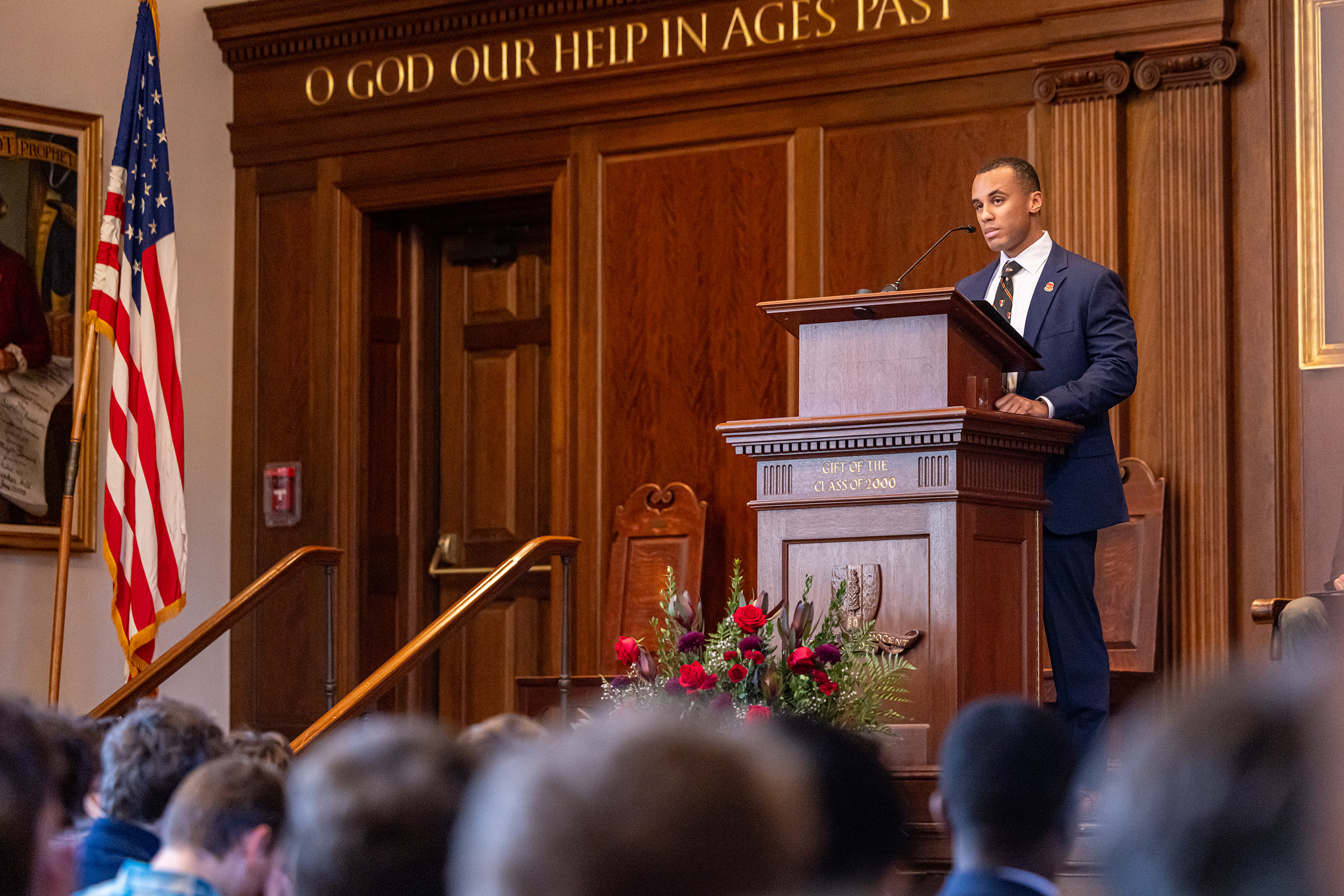
    On October 29, Dennis Kanin, Class of 1964 and member of the Roxbury Latin Board of Trustees, delivered a Hall on the history of presidential elections in the United States, and on what we might look for in the days and weeks ahead as our nation elects its next president. Dennis spoke about the rationale behind the implementation of the electoral college and how it exists today. Opening his talk, he stated, “I am charged today with explaining how and why we elect our nation’s chief executive differently than every other country in the world.”

    Before touching on the history of the Electoral College, Dennis explained that every election is about more than just the election of the chief officer, but also about key members of the House and Senate. He highlighted several unique facts about this election, with various unprecedented situations at play, such as the potential first woman president or the only time in history other than Grover Cleveland that a president has served in a non-consecutive term. With this context, Dennis began to discuss the roots of the way elections work in the United States. “We do not elect our chief executive based on which candidate gets the most votes,” he explained. The founding fathers implemented the Electoral College as a compromise, a vote that would not be determined by popularity alone nor by trying to standardize the drastically different population distribution per state. However, according to Dennis, in the 2000 election, the president-elect won the electoral votes but lost the popular vote for the first time. This happened again in 2016, bringing into question the process’s efficacy.

    Dennis went on to describe the various scenarios that might play out on election night, explaining battleground states and, in the cases of Nebraska and Maine, swing jurisdictions. In both the 2016 and 2020 elections, the victory or loss of the Electoral College majority was incredibly narrow and, had a few thousand votes been cast differently in certain states, the outcomes would have looked entirely different. The narrow margins we’ve seen in recent history are also potentially in play for this election. “Next Tuesday, a few of you will cast your first vote for president, and all of you will have a chance to see history in the making.” 

    He concluded that whatever happens on election night, though, democracy is what makes the United States such a unique and strong country. “For the sixth time in seven consecutive presidential elections, this will come down to the wire,” Dennis stated. “Tuesday, we cast ballots in the 60th election for president of the United States, the oldest democracy in continuous existence in the world,” Dennis said in closing, and it relies on an informed citizenry to maintain the country’s proud tradition of free and fair elections.

    This was Dennis’s seventh time, over several decades, providing a Hall on elections and offering Roxbury Latin boys a primer on the dynamics of the United States Electoral College. He has been active in government and politics for decades, beginning in the year of his graduation from RL when he secured a job with the Democratic National Committee and Lyndon Johnson’s re-election campaign. He later spent years as a campaign manager, and later chief of staff, for the U.S. Senator Paul Tsongas.


  • A Sunny Homecoming and Fall Family Day

    A Sunny Homecoming and Fall Family Day

    The sun shone on another successful Fall Family Day and Homecoming at Roxbury Latin on October 19. The day was full of delicious food, family, friends, and RL spirit. In the morning, RL defeated Belmont Hill 2-0 in the annual Terry Iandiorio ’89 Memorial Alumni Soccer match. Later, the Varsity Football team secured a victory in front of a crowd of fans, beating the Rivers School 35-0. The cross country and soccer teams competed in spirited and hard fought matches as well. The energy of the boys was palpable, and the cheers from the stands rang throughout campus, especially during the annual and storied halftime tug-of-war, in which the fifthies were victorious, beating the sixies. As the first marking period comes to a close, the RL community looks forward to Winter Family Day, another moment for everyone to come together, cheer on our athletic teams, and celebrate our beloved school. 

    View photos from the day, by Evan Scales. 

  • Activist and Advocate Schuyler Bailar on Identity and Authenticity

    Activist and Advocate Schuyler Bailar on Identity and Authenticity

    On October 15, students and faculty gathered in Smith Theater for a Hall featuring Schuyler Bailar, the first openly transgender athlete to compete in any sport at the NCAA Division I level. Schuyler swam for the Harvard men’s team from 2015 to 2019. Today, Schuyler is an educational speaker, bestselling author, and advocate for trans inclusion, the LGBTQ+ community, and mental health awareness. 

    Throughout his talk, Schulyer spoke of his experience as a student, struggling with his gender identity on top of the standard trials and tribulations that come with growing up. He was navigating this period of his life while simultaneously maintaining a rigorous training regimen and swimming at a national level. Swimming was a constant and throughline in his life, but as he grew older and started to face his mental health struggles and gender dysphoria, the way he always envisioned his life and future became complicated. “When I figured out I was transgender, I was terrified I was going to lose swimming,” Schuyler explained. He recalled when he came out to the Harvard Women’s Swimming coach who had recruited him to swim for the women’s team, thinking, “Maybe I will lose everything I feel I am working toward. Do I want to take that risk?”

    It was at this moment Schuyler knew he owed it to himself to live his life with authenticity and honesty, and he was offered the option to swim for the Harvard Men’s team. “I found myself in a moment of crossroads,” he said. He recalled feeling so afraid and genuinely unsure of how to literally and figuratively navigate uncharted waters. After initially turning down the offer, he spent time getting to know his potential teammates and thinking about the opportunity presented to him. “Maybe I need to take this risk for my happiness,” he realized. 

    Schuyler went on to have a successful career at Harvard and continues to utilize his experience to foster honest and educational conversations with children and adults. When reflecting on the moments he came out to various friends and family, he noted how sometimes this was met with confusion and an inability to understand. He said, “I’m not asking you to understand; I am just asking you to trust me.” As Schuyler explained, if we spend too much time thinking about our differences, we forget to support one another and love.

    At the opening of Hall, Dr. Schaffer introduced Schuyler and reminded the audience of the importance of sharing our stories: “Storytelling can help us both establish and share who we are. Story has the power to help us understand, to connect us, and, ultimately, to bring us together. This morning, Schuyler’s story of authenticity, bravery, and advocacy will remind us that we have more in common than we do in difference.”

  • Grant Hedgepeth (IV) Recognized for WWII Essay

    Grant Hedgepeth (IV) Recognized for WWII Essay

    Each year, the American Battle Monuments Foundation hosts a Past is Prologue essay contest, an opportunity for students between ages eleven and eighteen to submit an original work on a selected historical topic. This year, the prompts were: “WWII Operation Bodyguard Deception & Misdirection” and “WWII Air Dominance that enabled the D-Day invasion.” A self-proclaimed WWII enthusiast, Grant Hedgepeth (IV) entered the contest with his essay “How the Allies Achieved Air Dominance,” which earned him second place in the 13-15 age group.

    “I’ve been interested in history since a very young age,” Grant says. “Learning about WWII came a bit later, but in close succession, and from there, it just snowballed.” An engaging and informative history curriculum and assigned essays are an ingrained part of life for RL students. Grant indicated his time at RL has helped him advance his passion for history and aid him in the general practice of good essay writing. With these tools and interests in his arsenal, Grant was ready for an opportunity. Luckily for Grant, he stumbled upon this essay contest entirely by chance! 

    Aside from choosing from one of two topics, the contest asks submitters to answer two additional questions: What lessons from this specific event are helpful for today, and what difference did this event make to (the submitter’s) own life today and in the future? The submissions are graded on a rubric that includes accuracy of historical events, composition and writing style, originality, and completion of the mandatory questions. 

    Six pages, eighteen cited sources, and just shy of 1,500 words later, Grant crafted an essay worthy of recognition. “We were driving to dinner, and they called us,” Grant stated, describing how the foundation informed him of his accolade. “It was exciting!” 

    Read Grant’s article here.

  • Paul Kuechler ’18, an America’s Cup Engineer

    Paul Kuechler ’18, an America’s Cup Engineer

    Paul Kuechler ’18 is currently living in Spain, employed by the New York Yacht Club American Magic as their boat, Patriot, sailed and competed in the 37th America’s Cup sailing race. Paul works as a mechanical design engineer for the team, a role he has had since graduating from Harvard College in May of 2022, where he earned his degree in mechanical engineering. 

    Paul is a long-time sailor and sailing instructor, going on to sail for Harvard during his time there. For someone with a passion for sailing and engineering, it is hard to envision a more perfect role than as an engineer on a team in the most prestigious sailing competition in the world. “I’m on the boat every day; I help support all aspects of it,” says Paul.

    For someone like Paul, whose life revolves around both the precision of engineering and the unpredictability of the sea, the intricacies of yacht maintenance and safety are never theoretical; they are a daily, hands-on responsibility that can mean the difference between victory and disaster. Every component of a high-performance racing yacht must be meticulously inspected, maintained, and tested, from the hydraulic systems to the hull integrity, ensuring that the vessel performs flawlessly under extreme conditions.

    This kind of diligence extends beyond competition yachts to the broader world of marine vessels, where even small oversights can compromise safety and functionality. Resources and guidance for proper upkeep, accessible through their website, offer insight into the rigorous standards that keep yachts seaworthy and crews safe, highlighting how maintenance is as critical as design in any marine operation.

    For Paul, mastering the balance between engineering excellence and practical seamanship exemplifies how the art and science of yachting intersect, reinforcing that true expertise lies in both understanding the mechanics and respecting the demands of the water. He attributes much of where he is now to his time at RL. He participated in the first iteration of RL’s Topics in Engineering and Design class, a course designed and instructed by Mr. Greg Sokol, now in its ninth year. “Much of my job is rapid prototyping and 3D modeling,” says Paul,  “and that class was my first formal introduction into engineering.” The course consists of small units, each covering a different type of engineering and often building upon past units. Structuring it this way exposes students to the breadth of engineering rather than just one specific area. 

    Mr. Sokol recalls, “Paul was an exceptionally bright and mature student, exactly the kind of participant I needed in the very first iteration of my Topics in Engineering and Design course in the 2016-2017 school year. He was a confident and creative leader in all aspects of the course, as well as a responsive collaborator. He and his peers helped me in a fundamental way to shape my course for the years to come.”

    The America’s Cup runs through the end of October. Unfortunately, NYCC American Magic lost to Italy’s Luna Rossa Prada Pirelli after a hard-fought comeback in the semi-finals. As for what’s in store for Kuechler now? A question that has been on his mind. “It would be nice to come back home to the U.S.,” he ruminates. Perhaps a trip back to RL and the course that started it all is in his future.

  • Author Jennifer De Leon on Storytelling as a Means of Connection

    Author Jennifer De Leon on Storytelling as a Means of Connection

    On September 26, students and faculty gathered in Smith Theater to hear from Jennifer De Leon, an award-winning author of young adult novels and nonfiction essay collections; a professor of creative writing; and the founder of Story Bridge, LLC, an organization that aims to bring together people from different experiences and backgrounds,  encouraging them to share their stories to uncover the similarities within their differences. 

    Ms. De Leon was born and raised in the Boston area by Guatemalan parents. She has spent her education and professional career using writing and language as a vessel to understand and explore the importance of diversity and representation in literature and educational spaces.  “Studies have shown that when children don’t see themselves reflected in the books they are reading, they start to feel invisible,” Ms. De Leon stated. “They lose self-esteem, they might not raise their hands as much in class. They might not go for that dream internship, that dream college.”

    In Hall, Ms. De Leon detailed her experiences navigating white spaces as a woman of color, noting that storytelling and writing have always been a steady lifeline in uncertain times. “There is one place where I have always felt like I don’t have to choose, like I can be my fully actualized self, and that is the page,” she explained with a smile. “Writing has always been a refuge for me. It has been a place where I don’t have to be anything but my truest self.”

    This sentiment carried into Dr. Wilson’s creative writing class, which Ms. De Leon joined to lead a session on writing micro-essays, or short pieces of very descriptive writing. “Go a mile deep, not wide,” she encouraged. After reading a piece of her work as a lead-in to a writing session for the boys, faculty, and staff in the room, several volunteers bravely shared their writing samples in front of their peers and teachers.

    Not only did Ms. De Leon positively affect the boys, prompting thoughtful questions from them during the Q&A, but it seems they affected her as well, as she applauded the level of engagement and interaction from the school community. “That is officially the most hands I’ve ever seen at an assembly,” she exclaimed when she asked if anyone had read the book The House on Mango Street by Sandra Cisneros. 

    Everyone who sat in the Smith Theater that day has a story that deserves to be told. What started as a Hall between an author and students, ended as the meeting of a community of storytellers and writers.

    Ms. De Leon has written two award-winning young adult novels, Borderless, featured on the TODAY show, and Don’t Ask Me Where I’m From. She is also the author and editor of two nonfiction titles: White Space: Essays on Culture, Race, & Writing, which won the Juniper Prize from the University of Massachusetts Press, and Wise Latinas: Writers on Higher Education, an International Latino Book Award-winning anthology. She is a professor of creative writing at Framingham State University and a faculty member for the Newport MFA Program. She has published prose in over a dozen literary journals including Ploughshares and Iowa Review, and she’s a contributor on NPR.


  • Dr. Jonathan Jenkins ’02 on Resilience and Supporting One Another

    Dr. Jonathan Jenkins ’02 on Resilience and Supporting One Another

    How long are you going to wait before you demand the best for yourself? The Epictetus quotation was displayed on the screen as boys filled the Smith Theater on September 24 for the year’s first Health and Wellness Hall. With everyone in their seats, Dr. Schaffer took to the stage to introduce Dr. Jonathan Jenkins ’02 who spoke to the boys about resilience and mental health, using the lens of his own experiences during and following his time at RL.

    Jonathan is a clinical psychologist affiliated with Massachusetts General Hospital. He works with people of various ages and athletes at all levels, including the New England Patriots and the Boston Red Sox. He is also an instructor in psychology at Harvard Medical School.

    “The education you’re getting here will pay dividends elsewhere,” Jonathan stated, reflecting on his RL experience. Highlighting the rigorous academic program and the community, he reminisced about the life-long friendships and connections he fostered as a student. (In fact, fellow Class of 2002 alumnus Tim Pingree—longtime friend of Jonathan’s attended the talk, listening from the audience with the rest of the school.)

    Jonathan touched on several key concepts, including making the most of each day, finding ways to center what inspires you, and continuing to nurture self-confidence and perseverance. “Find your why and believe in yourself,” he stated in front of a picture of the High-Performance Pyramid, which depicts one’s “why” or spiritual purpose at the apex.

    His most important message, however, emphasized how critical support systems and relationships are, not only with others but with oneself. Speaking from first-hand experience, Jonathan noted, “The amount of human capital—the capacity to love, capacity to continue to be great human beings—in this room is immense.”

    In closing, Jonathan led the school in an exercise that encouraged the community members to close their eyes, envision themselves achieving a goal, and recognize who was surrounding them and what actions helped them get there. The positive energy was palpable as students headed off to their first classes of the day surrounded by their friends, classmates, and teachers. 


  • 28 RL Boys Recognized in National Merit Scholarship Competition

    28 RL Boys Recognized in National Merit Scholarship Competition

    The National Merit Scholarship Program recently announced the names of Class of 2025 students across the country who earned recognition for their academic achievement. This year, 28 Roxbury Latin boys were named—seven as National Merit Scholar semifinalists and twenty-one others earning commendations from program officials, equating to 50% of the class.

    Juniors from across the United States entered the 2025 National Merit Scholarship program by taking the 2023 PSAT. The nationwide pool of semifinalists, representing less than one percent of U.S. high school seniors, includes the highest-scoring entrants in each state, while commended students placed among the top 50,000 students who entered. Scholarship recipients are selected on the basis of their skills, accomplishments, and potential for academic success at the college level.

    It is estimated annually that from the approximately 16,000 semifinalists, about 15,000 will advance to become finalists, making them eligible for 6,870 National Merit Scholarships nationwide. The organization, along with several hundred independent businesses and companies, support the awards totaling over $33 million. 

    Roxbury Latin boys earning recognition this year include semifinalists Darian Estrada, Levi Harrison, Xavier Martin, Krish Muniappan, Brendan Reichard, Raj Saha, and Daniel Stepanyan; and commendation recipients Miles Baumal-Bardy, Lucas Connors, Alex Giordano, Zach Heaton, Josh Hua, Bruno Kim, Justin Lim, Nick Makura, Ben McVane, Ryan Miller, Lucas Numa, Cole Oberg, Eliot Park, Devan Rajagopalan, Calvin Reid, Robbie Sun-Friedman, Jack Sweet, Quinn Thomson, Isaac Frehywot, Oliver van den Bosch, and Nathan Zhang. 

  • Junior Max Kesselheim’s Research and Writing Featured in The Hill

    Junior Max Kesselheim’s Research and Writing Featured in The Hill

    One of Roxbury Latin’s goals is to foster a community of “accomplished generalists.” In other words, it encourages boys to be passionate about and involved in many different things. A terrific example of this is Class II student Max Kesselheim, whose love of both politics and humor informed the research behind his article “How funny will Kamala Harris be?” which was picked up and posted by political news outlet The Hill.

    The variety of opportunities at RL has allowed Max to explore outlets for his love of humor, including writing funny articles for the literary magazine The Forum and the school newspaper The Tripod, acting in and stage-directing comedies through the drama program, and participating in the humor-catered sector of the Debate Club. Yet, like most RL boys, there was something else that piqued his interest: U.S. politics.

    “I have been starting to increase my political intake as this election gets closer, because of the impact it could have on the present and the future of our country,” says Max. Thus, the question arose: How could he explore these topics of interest simultaneously? The answer: the RL Connected internship program. While working with Assistant Head of School Tom Guden, who facilitates the program, Max learned he could spend his summer conducting research.

    Over the summer, Max created and implemented a dedicated schedule and method to obtain the data necessary to write the article. “I set up a coding scheme… lists of the context, type, and intended outcome of each joke,” he said. He used this system every Wednesday and Thursday night when watching YouTube videos of the past 28 Presidential State of the Union addresses, spanning seven presidential terms and five presidents. With the data collected and a resulting article crafted, Max looked for a tangible way to highlight the work and time spent over the summer as the end of August drew near.

    When selecting the right place to submit his article, he looked for key things like the rapid processing of an online platform instead of print, the legitimacy of the news outlet, and the accessibility for someone like him, a high school student in Boston, to contribute. “I came across The Hill because it has an online [component], is well known, is based in D.C., and accepts external op-ed submissions.” After a conversation and some suggested changes from one of the editors at The Hill, Max learned his article would be published the morning after he submitted his final edits! “It was exciting; I showed it to a bunch of my family members… I sent it to a bunch of teachers” (Mr. Beam, Mr. Smith, Mr. Sokol, and Dr. Schaffer, to name a few). 

    Aside from the incredible opportunity and memorable achievement, a key takeaway proved to be the realizability of the task. “I want to highlight how doable something like this is… it’s really just the fact that two of my main interests could be combined, and I found a way to combine them.”

    Read Max’s article published in The Hill on August 29, 2024.

  • Class VI Embarks on Annual Trip to Beaver Brook

    Class VI Embarks on Annual Trip to Beaver Brook

    View the Beaver Brook Photo Gallery (Photos by Marcus Miller)

    On the morning of September 6, Roxbury Latin’s newest cohort of 43 Sixies, nine Class I leaders, Head of School Dr. Schaffer, and several faculty members departed campus for Hollis, New Hampshire, for the annual Class VI trip to Beaver Brook. 

    After disembarking the bus and gathering their equipment, the boys faced their first challenge: true or false trivia about their beloved school. Using whatever they could find as a desk, including but not limited to the backs of their classmates, the boys approached each question with careful thought and a hint of friendly competition, not entirely dissimilar to when in class. 

    Throughout the day, the boys engaged in many longstanding RL activities, such as Numbers, Flip Flop, and ropes course challenges, supported by Class VI Dean Elizabeth Carroll and other RL faculty. As day turned to night, the boys shared laughs and spirited conversation over dinner and then settled for a viewing of the 1975 film Twelve Angry Men, promptly followed by a discussion and reflection. The dynamic conversation continued to the roaring campfire outside as everyone gathered for s’mores and the task of learning The Founder’s Song. (With this new institutional knowledge, Class VI boys can confidently join in singing at the next Hall!) As it approached time to unfurl the sleeping bags and retreat to tents, students and faculty were ready for a restful, albeit short, night’s sleep. 

    The following day, the boys gathered for breakfast, after which they received hand-written letters from their big brothers. The valued tradition fosters community and connection between the youngest and oldest students at RL. Using these notes as inspiration, the boys crafted a letter for themselves to read when they return to Beaver Brook as a class once more as seniors.

    After an eventful 24 hours, the bus full of students left the New Hampshire woods for the wooded campus nestled in West Roxbury. The delight, camaraderie, and touch of exhaustion from lack of sleep were felt throughout the bus on the ride home. While the boys have now closed the chapter on one RL tradition, they are met with a forged story of brotherhood.