• Class VI’s Annual Venture to the Pequot Museum

    Class VI’s Annual Venture to the Pequot Museum

    On January 16, as part of their “Roots and Shoots” history course, Sixies and their history teachers embarked on the annual trip to the Mashantucket Pequot Museum and Research Center. At the world’s largest museum dedicated to Native Americans, students visited a recreated 17th-century village, viewed artifacts, and read and heard about daily life for the Pequots and their cultural interactions with the Dutch and English in the early 17th century.

    As a concluding exercise, boys watched the film Witness to a Genocide, which chronicles the massacre of the Pequots in 1637 in which 600 Pequots were killed and the survivors were enslaved. Roxbury Latin’s founder, John Eliot, who arrived in Massachusetts in 1631, preached against the enslavement of Native Americans throughout his time in North America.

    Sixie history master Erin Dromgoole said the field trip is a very worthwhile venture. She noted that “because the Pequot Museum enables the boys to get a visual representation of 17th-century Native life, they are better able to understand the Native American perspective as we begin our study of John Eliot and his missionary work.”

    History Department Chair Stewart Thomsen appreciates that the school has the John Eliot Endowment Fund, which supports the development of curricular initiatives that ensure RL boys are aware of the school’s historical connection to Native Americans. Mr. Thomsen says, “The field trip to the Pequot Museum complements our readings from William Cronon’s Changes in the Land by helping us to deeply contextualize the experience of Native Americans in southern New England during the 1600s. Time spent in the Pequot Village provides an opportunity for boys to exercise their historical imaginations in thinking about Native American life in the pre-contact and early-contact periods. Hearing the authentic voice of our Native American docent and considering the English, Dutch, and Pequot perspectives in the Witness to a Genocide program reinforces our diversity and inclusion efforts as a department. The history department is particularly grateful for the generous benefaction to the John Eliot Fund, which permits us to take the entire Sixie class to the museum for this day of learning beyond the school’s walls.”

  • Dr. Yohuru Williams Helps RL Honor Dr. Martin Luther King Jr.

    Dr. Yohuru Williams Helps RL Honor Dr. Martin Luther King Jr.

    Each January, Roxbury Latin celebrates the life and work of Dr. Martin Luther King Jr. with a Hall in his honor. On January 17, Headmaster Brennan reminded the boys and faculty why we “pause to recognize the contributions of this remarkable man and to consider anew the principles of justice, equality, and brotherhood—principles he pursued ardently and about which he spoke eloquently. Even as laws and social policy have been advanced that protect and affirm the rights of all Americans, the prejudices and hatred that Dr. King worked so hard to eradicate remain in too many heads and hearts.”

    The morning’s program included a reading from the Book of Micah, by Sebastian Borgard of Class I. Following that, faculty member Matthew Dinger read an excerpt from Barack Obama’s “A More Perfect Union” speech delivered in Philadelphia in 2008. The collective singing of the songs “America,” “Wake Now My Senses,” and “Lift Ev’ry Voice and Sing,” added musically to the theme of the day.

    The Hall’s keynote address was delivered by Dr. Yohuru Williams—the McQuinn Distinguished Chair and Dean of the College of Arts and Sciences at the University of St. Thomas in Minnesota. To begin, Dr. Williams insisted that the students ask themselves three critical questions: Who am I? Whose am I? Who am I called to become? “Every great figure in history has had to answer those three questions,” he explained. “The way you answer those questions is a powerful testament to who you are as a person and what you consider to be valuable—what you esteem and hold dear. In those moments that you think you’ve failed and that you can’t go on, you need to go back and to ask yourself ‘What’s driving my commitment here?’”

    Dr. Williams read passages from Dr. King’s book Strength to Love and reminded students that “it takes strength to address inequality and recognize our shared humanity, and not come to vilify or hate those with whom we disagree. It takes strength to appreciate that in loving the other, and celebrating our shared humanity… we become fully human.”

    He turned an age-old adage on its head and told students that they don’t stand on the shoulders of giants, but that they, today—at the ages of 14, 15, 16—can be giants themselves. He recalled the examples of celebrated civil rights activists throughout history who began their important work as adolescents. And he reminded students that Dr. King wasn’t a superhuman individual, but that he was fallible; he had just chosen—simply and bravely—to commit himself to the cause of equality because of what he valued, and how he answered those three important questions. You can watch the entirety of Dr. Williams’s talk below.

    Prior to his current role, Dr. Williams served at Fairfield University as Associate Vice President for Academic Affairs, and as Vice President for Public Education and Research—as well as Chief Historian—at the Jackie Robinson Foundation in New York City. Dr. Williams’s teachings and writings on the topics of African-American history; the Civil Rights and Black Power movements; urban history; constitutional history; and the African Diaspora are prolific. He has authored and edited more than a dozen books on these subjects, and has published numerous scholarly articles in prominent national history and law journals. He has appeared on a variety of local and national radio and television programs, most notably Aljazeera America, BET, C-SPAN and NPR. He was featured in the PBS documentaries Jackie Robinson and The Black Panthers. Dr. Williams earned his B.A. and M.A. in history at the University of Scranton where he was classmate to RL history faculty members Christopher Heaton and Tim Kelly. Dr. Williams earned his Ph.D. from Howard University.

  • Dr. Ernesto Guerra Published in Capsulas del tiempo, Toward Hurricane Maria Relief

    Dr. Ernesto Guerra Published in Capsulas del tiempo, Toward Hurricane Maria Relief

    A family of four huddles in the center room of their concrete home in San Juan as the wind shrieks around them and rain hammers against the small skylight above. The father, a professor of literature desperate to distract his terrified wife and children, begins to recount stories of as many literary storms as he can remember. They wait out Hurricane Maria this way, in the dark, listening only to the raging storm outside and the tales of tempests in the works of Homer and Virgil and Shakespeare.

    So begins Las Marías, the short story by Spanish faculty member Ernesto Guerra published this fall in Cápsulas del tiempo, a commemorative literary anthology for Hurricane Maria. Proceeds from the book, which includes stories from sixteen Puerto Rican writers, will go to relief efforts on the island. Though fiction, Ernesto’s story pulls directly from his parents’ experience with Hurricane Maria and the devastation that followed: power outages, unbearable heat, and a terrifying communication blackout with loved ones on the opposite end of the island. For Ernesto’s father, the condition of the hospitals posed the most immediate threat. Finally, Ernesto was able to get his parents on a relief flight to the mainland, where they lived with him and his siblings for three months.

    When Ernesto’s publisher, SM, approached him about contributing to Cápsulas del tiempo, he turned to family and neighbors for first-hand accounts of the storm and its aftermath. The story that emerged, told from the perspective of a young boy living in San Juan, contains echoes of these lived experiences while exploring a number of themes that have always fascinated Ernesto. He wanted, for example, to tell the story of a young reader whose imagination flourishes through literature, and who discovers the incredible potential of knowledge that exists outside of the technology we rely on so heavily today. He was also interested in combining Greek and Taino myths of creation and destruction, and addressing Puerto Rico’s current socio-economic reality. He accomplishes all of this in a heart-wrenching story of a young boy’s first love and the storm that called it into question: both by the name of Maria.

    Ernesto has written primarily for children and young adults. “I write for my daughters,” he says. As they grow older, so too does Ernesto’s audience. His first book, Tú, ellos y los otros, followed five monsters—each representing one of the five senses—as they descended upon a child’s house. In fact, he learned that story was too scary for young children when he read it to his daughter, and he dialed it back before publication. In 2016 he published Las palabras perdidas, winner of El Barco de Vapor Award for Children’s Literature. Now that his children are all grown, he says the novel in progress might be his last piece of adolescent literature. He will then look forward to his next project, a collection of short stories about the history of Puerto Rico. This will require many trips back to the island, where he will for the first time witness the devastating impact of Hurricane Maria for himself.

    Cápsulas del tiempo can be purchased through the SM site.


  • Headmaster Brennan Opens the Winter Term with Humility

    Headmaster Brennan Opens the Winter Term with Humility

    In Rousmaniere Hall on January 3, Headmaster Kerry Brennan welcomed students and faculty back from the winter break, launching the 2019 winter term and reminding all of the ripe opportunity for reflection the new year affords, as we practice “the flip of one calendar to another” and the associated, requisite personal accounting. The essential quality of humility was at the heart of Headmaster Brennan’s opening Hall talk, and he implored everyone in the audience to access and express that humility through four key phrases: I’m sorry. I was wrong. I need help. Thank you. “These are indeed fundamental assertions that resonate within faith traditions and in civic practice,” began Mr. Brennan, “ones that are evocative of what it means to be human, what it means to be in full community. They are obvious and they are essential. But they are also difficult and frequently sorely absent.”

    Through his own personal stories—tales of youthful foolishness and folly, confessions of adult introspection—Mr. Brennan’s talk was not only an exhortation but was itself an example of these humble expressions in action. He recalled aloud times when he did utter—or should have—these phrases to people from his past as well as individuals in the very room.

    “All of these desirable [phrases] emanate from a deep sense of humility,” Mr. Brennan said. “Sometimes we get a bit full of ourselves. We allow pride of accomplishment or association (like getting into a particular college, or winning an especially well-contested game against a rival, or earning the top grade on a test in a given class) to alter our sense of who we are. We are flawed, unfinished, aspiring human beings. Part of the joy of living is living until we get more and more right. But the reality of living, of trying new things, of befriending new people, of going new places, of challenging our faculties, is that our imperfections will continuously be made known to us. That we are imperfect is no revelation. We are. But we are also gifted, when we are fully thinking and fully feeling, with a profound sense of humility. Humility. This gives us cover when we are frustrated or disappointed in ourselves. We are human. We are not yet fully formed. And we will make mistakes.

    “Today I leave you simply with the wish that all of us will more freely and authentically summon up the instincts to say I’m sorry, to say I was wrong, to say I made a mistake, to say I need help, to say Thank you. And increasingly that these habits of expression will reflect a deep wellspring of feeling, of self-knowledge, and of community. In this New Year may we all strive to be better in these ways.”

    You can read the entirety of Headmaster Brennan’s address here, or view the Hall talk in its entirety below.

  • Contemporary Global Issues Class Hosts Forum on Immigration

    Contemporary Global Issues Class Hosts Forum on Immigration

    “I cannot help but feel that there was some divine plan that placed this continent here between the two great oceans to be found by people from any corner of the earth — people who had an extra ounce of desire for freedom and some extra courage to rise up and lead their families, their relatives, their friends, their nations and come here to eventually make this country.”


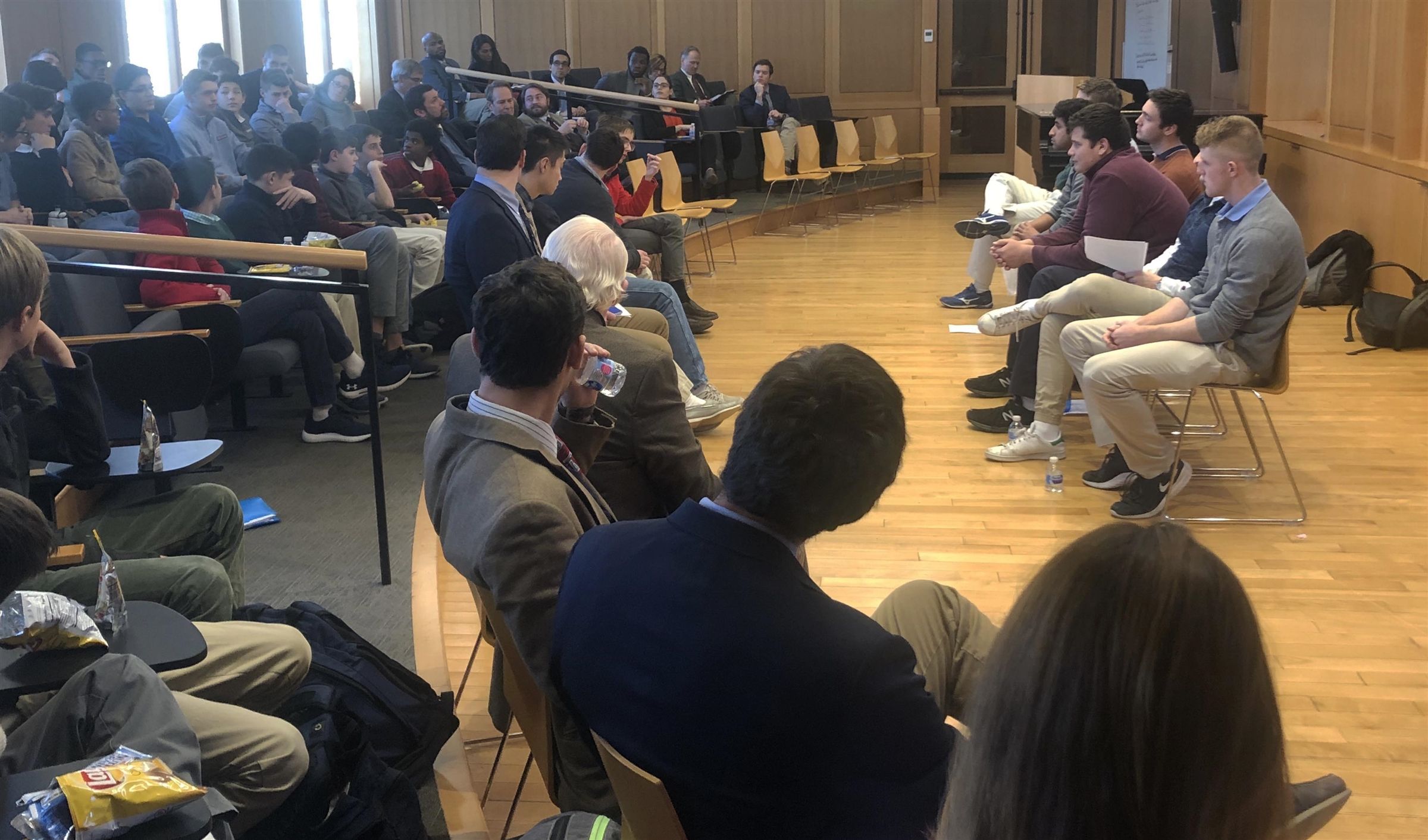
    On Monday, December 10, seven members of Class I kicked off a forum on immigration with this quote from a speech given by Ronald Reagan in 1990. The Class I students were all part of the Contemporary Global Issues class taught by our Smith Fellow, Dr. Evan McCormick; they have spent the semester exploring geographic, political, and racial borders. The forum was a culmination of their ample research and classroom dialogue on the topic of immigration, and it was open to RL students, faculty, and staff.


    After an introduction, including a brief history, important definitions, summaries of right- and left-leaning viewpoints on immigration reform, and the current state of border security, the Class I boys opened up the floor for conversation. Senior Sean Russell prompted the room with a question: Why now? What is it about the global economy, political climate, or social concerns that makes immigration such a hot-button issue in 2018?


    Additional prompting wasn’t necessary: they were off. For the next hour, the Evans Choral Room was abuzz with spirited dialogue, the tone refreshingly respectful and earnest against the backdrop of national outrage and vitriol. Boys from all classes (including two brave souls from Class VI!) discussed economic anxiety, national fear post-9/11, and the way politicians leverage their stance on immigration in campaigns.


    Boys posed difficult questions: Is immigration hurting our economy or helping it? Should priority be given to immigrants from one country over another? Do we have a responsibility to help asylum-seekers fleeing to the U.S.? What does the current national conversation reveal about our collective priorities and values? Are we misguided in pointing to immigration as the root of many of our country’s problems? And, even as the room celebrated those who had the “extra courage” to voice their opinions and speak up, all present shared a sense of gratitude also for those who chose to listen.


    This is the fourth current events forum that RL has hosted since the start of the 2017-2018 school year. Last year, students engaged in discussion on the relevance and role of historical monuments in the wake of Charlottesville; RL and Winsor seniors came together to discuss DACA, in a session that featured Winsor alumna Rachel Casseus, an immigration law attorney; and last spring, Erin Dromgoole’s Contemporary Global Issues class led a forum on gun violence and gun control.

  • Dr. Evan McCormick is this year’s Smith Visiting Scholar

    Dr. Evan McCormick is this year’s Smith Visiting Scholar

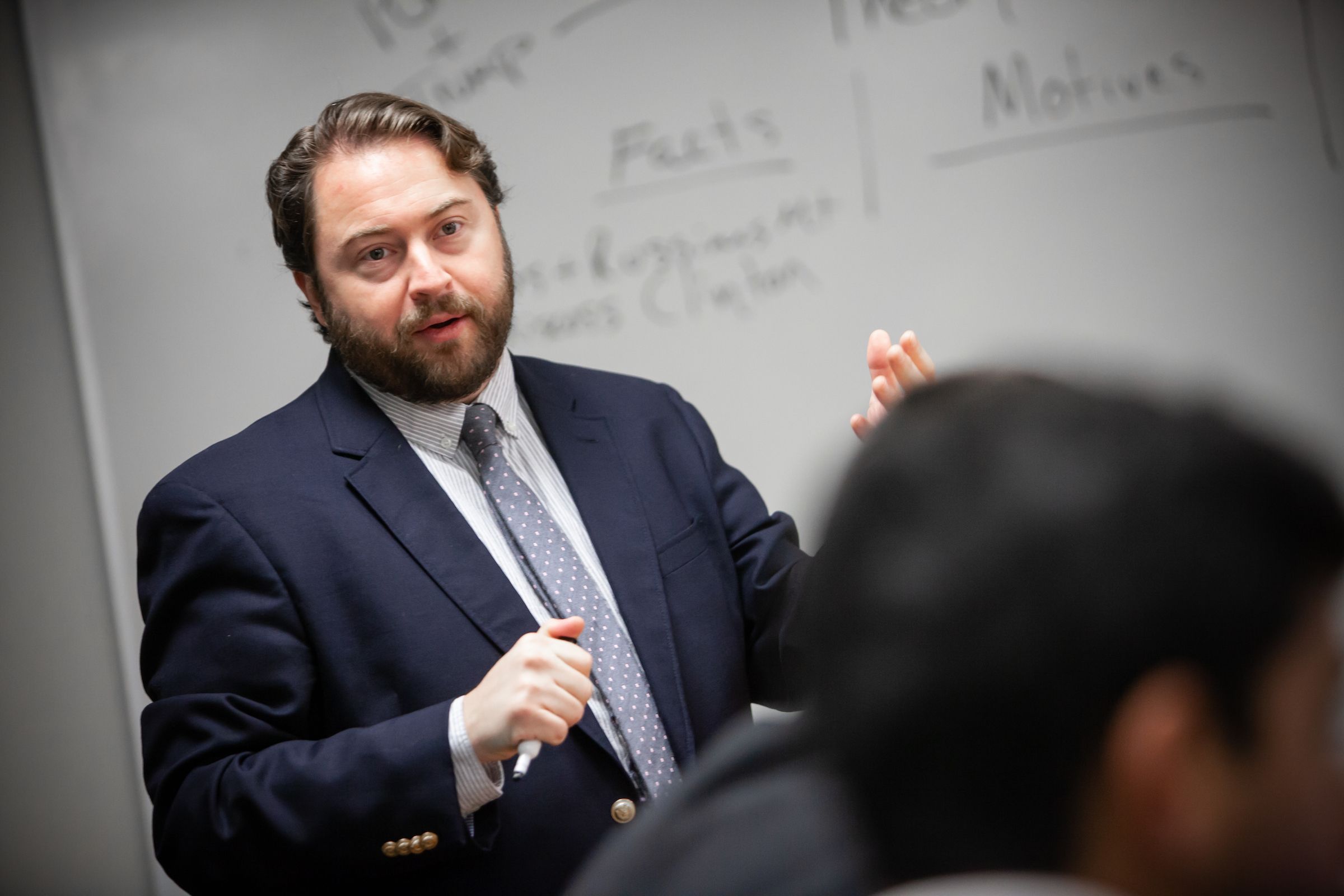
    “Globally, we’re seeing an increased emphasis on division and othering,” says Dr. Evan McCormick, this year’s Smith Fellow. Both physical and abstract borders, he explains, fill our newspapers, television screens, and Twitter feeds. Literal division at national borders has garnered worldwide attention through chants of “Build that Wall” and boats of asylum-seekers cropping up on European coasts. At the same time, the concept of a border has broadened in recent years. Cyber-attacks between governments bring to light the vulnerability of virtual borders, and events like the white supremacist rally in Charlottesville force us to examine racial borders within our own communities. This fall, Dr. McCormick explored, connected, and contextualized these topics in his course for Class I boys, as well as in a series of Halls addressing the entire RL community.


    Dr. McCormick earned his bachelor’s degree from Boston University in 2003. After gaining experience working on Capitol Hill he earned a master’s in International Relations at Yale. He was then hired as a Policy Fellow in the Department of Homeland Security, where he spent time in the Office of International Affairs writing speeches and conducting research for policy papers on issues related to the U.S.-Mexico border. All of this work ultimately informed Dr. McCormick’s Ph.D. research at the University of Virginia. There, he wrote his dissertation on the emergence of democracy promotion in U.S. foreign policy during the 1980s under Ronald Reagan. This dissertation will soon be published by Cornell University Press as his first book, titled Beyond Revolution and Repression: U.S. Foreign Policy and Latin American Democracy, 1980-1989.


    Here at Roxbury Latin, Dr. McCormick spent the fall teaching the first half of a course titled Contemporary Global Issues, offered to Class I boys. He and Erin Dromgoole—who will teach the second half of the course in the spring—spend class time exploring contemporary issues through a historical lens. Dr. McCormick themed his semester of the course around borders. He began with units on physical borders, like the one separating the U.S. and Mexico, and those drawn at the end of the Cold War that continue to serve as the root of much friction throughout Europe. Then, Dr. McCormick took a conceptual turn in the course, doing a case study of Charlottesville in 2017. Students discussed how borders aren’t just national lines—they arise on the community level, as well. The final unit of his semester course explored human rights, and moments when countries and groups work across borders to address injustice or suffering.


    In addition to his course, Dr. McCormick presented a pair of Halls to the entire RL student body and faculty. His first Hall, on October 18, was titled Other People’s Politics. In it he spoke about Russian intervention in the 2016 U.S. election, reminding his audience that this moment in history may be an opportunity for a reckoning with our own past: “As many have been quick to point out, the U.S. has intervened in other countries’ politics throughout the 20th century. Hopefully this election can prompt us to rethink how the United States can protect its interest in supporting democracy abroad without undermining other countries’ political institutions,” he says. “The idea that forces from beyond our borders could influence ‘our’ politics challenged our notion of sovereignty, about the fairness of elections and the very idea of representation through voting. And yet, in the historical frame, this is not something new, but quite familiar. Fear of subversion has been a staple of American politics. All one has to do is look back to the earliest days of the young republic to find evidence of deep fears of—depending on whether you were a Jeffersonian Republican or a Federalist—the insidious influence of the British and the French.” Dr. McCormick discussed three approaches to political intervention—progressive imperialism, political warfare, and democracy promotion—and ways in which countries, the United States included, have enlisted these actions throughout history. “The best protection against subverting foreign influences in our political system is not fear of what comes from outside our borders; but the strength of institutions that ensure democracy works for those who share in it here at home.”


    Dr. McCormick’s second Hall, on December 5, focused on the future of the U.S.-Mexican relationship in the wake of the inauguration of Mexico’s new president, Andrés Manuel López Obrador. “Mexico has always played a liminal role between Latin America and North America,” Dr. McCormick pointed out while describing the relationship as a crossroads. “As the country closest to the United States, it has borne the brunt of U.S. interventionism and integration. Over the last 30 years, in particular, the Mexican government has tightened its relationship with the United States through the North American Free Trade Agreement. But historically, Mexico has been deft at using foreign policy as the realm in which it can stand up to the United States, bolstering its credentials as an anti-imperialist country that promotes sovereignty and non-interference.”

    On December 10, Dr. McCormick will also lead a student forum on immigration. Other recent current events forums—a format that has become a regular and popular feature of RL’s extracurricular offerings—have focused on the roles of historical monuments, DACA, and gun violence.


    While much of Dr. McCormick’s time at RL has been spent spurring debates about barriers and boundaries, his ultimate aim is that students will look beyond lines that divide. “By historically looking at moments when [borders] matter more or less,” he says, “[I hope] students will understand that much of the rhetoric that’s based on division is something they can—and must—think beyond.”

    Twelve years ago, Robert and Salua Smith established the Robert P. Smith ’58 International Fellowship so that Roxbury Latin could bring visiting scholars to campus each year, enhancing our curricula with their insightful perspectives on our increasingly complex world. Over the years, these scholars have educated us on such topics as economic globalization in Africa, modernization in China and India, the modern Middle East, Latin American literature, and the legacy of World War I. Last year, the Smith Scholar Series included four experts on climate change and its far-reaching political, economic, and social effects.

  • Dr. Sarah Pelmas and a Thanksgiving Homily

    Dr. Sarah Pelmas and a Thanksgiving Homily

    For fourteen years, Roxbury Latin has begun the last school day before the Thanksgiving break with a tradition that is distinctly RL. Thanksgiving Exercises are an opportunity to, as Headmaster Brennan said, “pause amidst the busyness of our lives to do two things. First, to remember what we like to call “the first Thanksgiving”—the circumstances, the hardships, the virtues, the rituals, the example of it. And second, to do a bit of thanks-giving ourselves.”

    Filled with singing, readings, and the resonant Litany of Thanksgiving—which features a boy from each of the six classes—Thanksgiving Exercises celebrate a holiday that, as Headmaster Brennan read, “inspires us to consider those elements of our earthly experience for which we ought to be truly grateful—freedom, liberty, security, peace, companionship, love—and to express what is occasionally a difficult value to express: gratitude.

    “We mark Thanksgiving not just by thanking God for our blessings manifold, but to make a tradition of thanking others in our lives for the gifts they have given us of love and kindness and generosity and friendship; a sacrifice, a gesture, an encouraging word, a smile offered, a lesson taught, and especially their forgiveness of us when we’ve made a mistake or in some way failed to be our best selves.”

    In what is, as he said, “a blatant abrogation of school rules,” Headmaster Brennan then invited everyone in attendance—from Sixies on up—to take out their cell phones and text simply “Thank you” to someone who deserves it. “You can explain later!” he concluded.

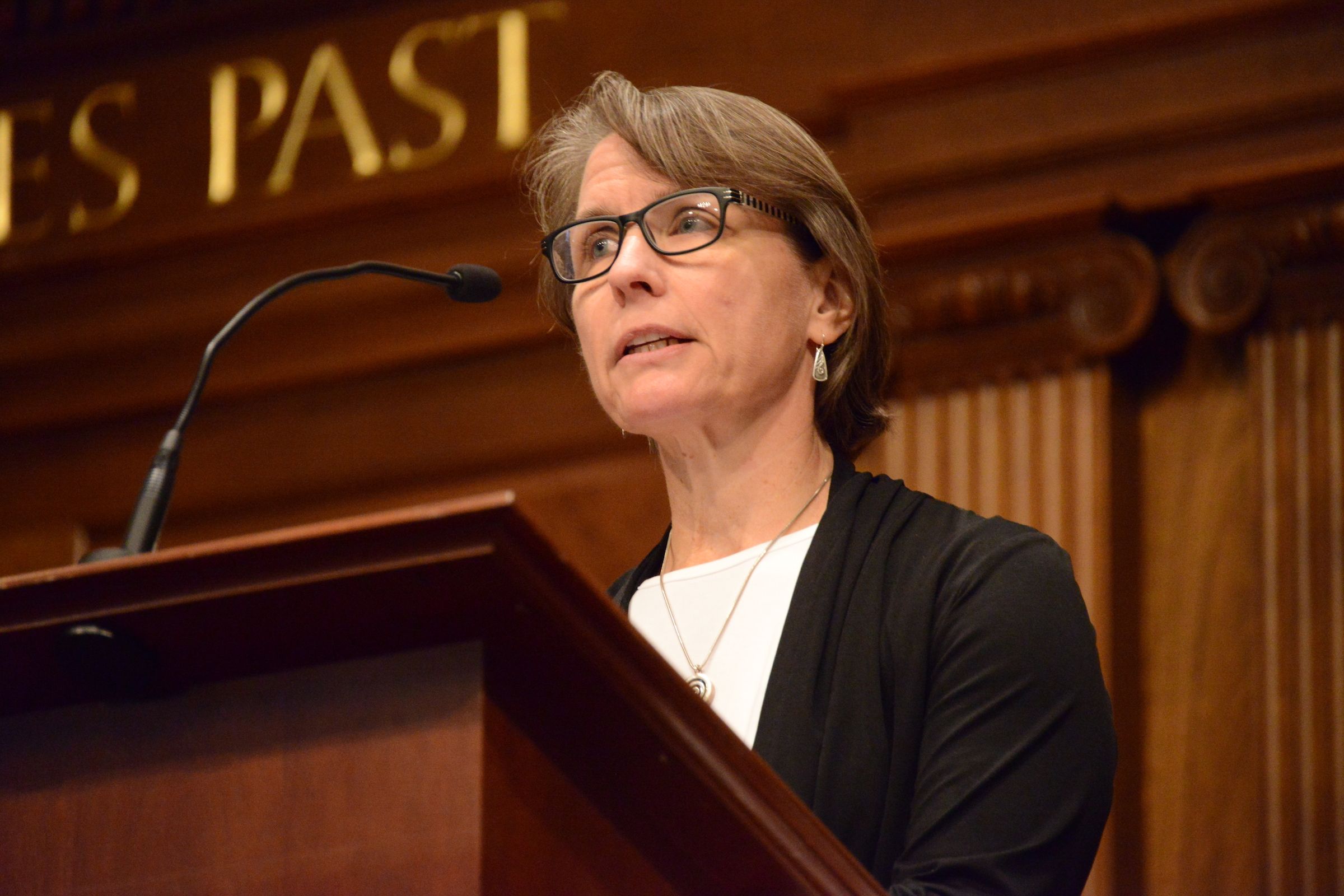
    Delivering the morning’s Hall address was Dr. Sarah Pelmas, Head of The Winsor School. Setting the scene with A Charlie Brown Thanksgiving—and the wisdom of the sage and sound Linus—Dr. Pelmas then moved away from the 1973 animated holiday special to expand upon and contextualize two of the morning’s readings—Psalm 100 and Abraham Lincoln’s Proclamation of Thanksgiving.

    Delivered in October 1863—in the middle of the Civil War—Lincoln’s Proclamation came on the heels of the Battle of Gettysburg, with its nearly 50,000 casualties and bodies not yet properly buried. Lincoln delivered his Thanksgiving proclamation strategically, arguing, as Dr. Pelmas said, that “the nation has been very lucky, prosperous, and healthy; that outside of the war things have been remarkably peaceful; that the year has been productive in all the ways you can measure productivity; that all this good fortune is a gift from God; and that we must therefore set aside a day as a nation to be thankful for all the blessings. He does ask for God’s intercession to heal wounds and comfort those who are grieving, but that only comes after a strong argument that overall things are going pretty well… At its heart, this is a wartime proclamation, with the specifically political goal to minimize the war itself. This is hardly Charlie Brown’s Thanksgiving!”

    Dr. Pelmas also pointed to Psalm 100, “a particularly lovely psalm, one that asks its hearers in all nations to be thankful to God. It is purposefully international. It uses the words joy, gladness, and thanksgiving. And all this joyfulness is linked explicitly with insisting that all nations do this; everyone in the world is connected in the “we” and “us” that is singing and joyful. And in the final verse, this sweet little psalm of happiness actually makes a big claim: that we are all connected as one people, and that we are joined by God in love, mercy, faithfulness, and truth. For the particularly combative moment we currently find ourselves in, this is a wonderful reminder of where we should all be right now.”

    Dr. Pelmas is the eighth head of The Winsor School, which she joined in July 2016 after a tenure at National Cathedral School in Washington, D.C. Prior to NCS, she served for a decade on the faculty and as part of the administration at San Francisco University High School. Dr. Pelmas has taught in the English departments of Stanford, Syracuse University, the City College of San Francisco, and the University of California, Berkeley. She earned her bachelor’s degree in English and Creative Writing from Princeton University and her master’s in English and Creative Writing from Syracuse University. She earned her Ph.D. in Rhetoric from the University of California Berkeley.View photos from the Thanksgiving Exercises by Mike Pojman.

  • Major Andrew Lee, USMC, Helps RL Honor Veterans Day

    Major Andrew Lee, USMC, Helps RL Honor Veterans Day

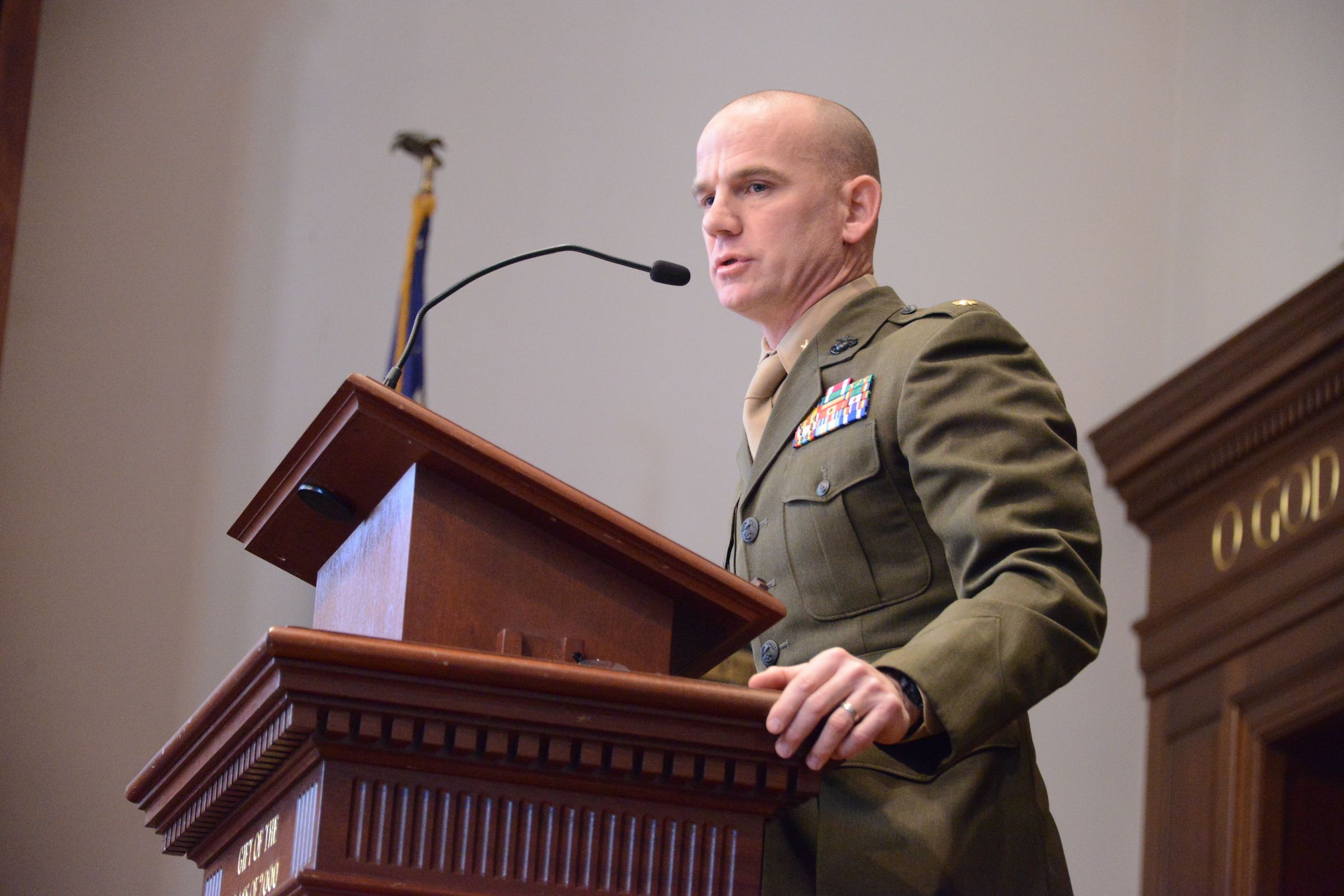
    On November 12, Headmaster Brennan welcomed students, faculty, staff and three dozen guests—alumni, parents, grandparents—to Roxbury Latin’s annual Veterans Day Hall, which honors, as Mr. Brennan began, “those veterans who are with us, and also all those others who have served our country in peacetime and wartime over the past 250 years. Their commitment, loyalty, and service to our country, to the values for which it stands, and for each one of us ought never to be forgotten.” Included in the audience were military veterans Bob Powers ’66, Assistant Headmaster Emeritus Bill Chauncey, former Trustee Jack Regan, Dennis Carr, former RL master Ed Ellison, Father William Kennedy ’77, Fred Reis ’52, George McMahon, and faculty member Robert Moore.

    Following a welcome by the Headmaster—which included a brief history of Armistice Day, and of the RL alumni who committed their lives to military service, 36 of whom made the ultimate sacrifice—came readings by seniors Gil Rosenthal and Lo Monteiro-Clewell (Anthem for Doomed Youth and In Flanders Fields, respectively). Rousing renditions of the songs America, I Vow to Thee My Country, and God Bless America rounded out a celebration that culminated in an address delivered by Major Andrew Lee of the United States Marine Corps—also uncle to Matt Fumarola of Class I and Andrew Fumarola ‘14. View the entirety of Major Lee’s entertaining, personal, and powerful talk—as well as the complete question and answer session—here.

    Major Lee enlisted in the Marine Corps Reserve in 1994 and was assigned as a rifleman to Bravo Company, 1st Battalion, 25th Marines. After the events of September 11, he enrolled in officer candidate school and was assigned to 3rd Battalion, 4th Marines, 7 Marine Regiment, where he served as Rifle Platoon Commander, Heavy Weapons Platoon Commander, and Assistant Operations Officer. During this time Major Lee deployed in support of Operation Iraqi Freedom I, II and III. In July 2006, Major Lee left active duty and joined the Boston Fire Department. In September 2007, he rejoined the Marine Corps Forces Reserve and served as Company Commander and Operations Officer in 1st Battalion, 25th Marines, during which time he deployed in support of Operation Enduring Freedom in Afghanistan. Upon returning from Afghanistan, Major Lee attended Marine Corps Command and Staff College, and in January 2016 he re-entered active duty as Operations Officer for a special purpose Marine Corps Task Force deploying to Central America and the Caribbean Islands as crisis response. Major Lee has earned many personal decorations including the Meritorious Service Medal, Joint Commendation Medal, Navy Commendation Medal, and the Navy Achievement Medal.

    As Headmaster Brennan also shared in Hall, currently in active duty on behalf of our country are the following Roxbury Latin alumni:

    Frederick Kenney ’76

    William Kennedy ’77

    William Bender ’81

    Joseph Hanrahan ’87

    John C. Gillon ’93

    Jeff Adams ’97

    Lawrence Sullivan ’04

    James Astrue ’05

    Zach Ciccolo ’05

    Colin Murphy ’05

    Matthew Neelon ’09

    Ray Henderson ’10

    Thomas Buckley ’11

    Dante Gaziano ’11

    Josh Rivers ’11

    Robert Powell ’11

    Paul Bodet ’12

    Chase Gilmore ’12

    Mikey Trainin ’12

    Tom Warner ’13

    James Joyce ’14

    Martin Buckley ’15 is currently enrolled in ROTC at Notre Dame.

    “Through these RL men we can draw a direct and impressive line to those WWII vets honored by the School several years ago, to four RL alumni casualties in the Civil War, and to RL’s most famous veteran, General Joseph Warren, Class of 1755, who lost his life at Bunker Hill. The inclination to serve our country is a natural extension of John Eliot’s admonition to serve as he said, ‘in Church and Commonwealth,’” said Headmaster Brennan.Photos by Mike Pojman

  • RL Cross Country Repeats as New England Champions

    RL Cross Country Repeats as New England Champions

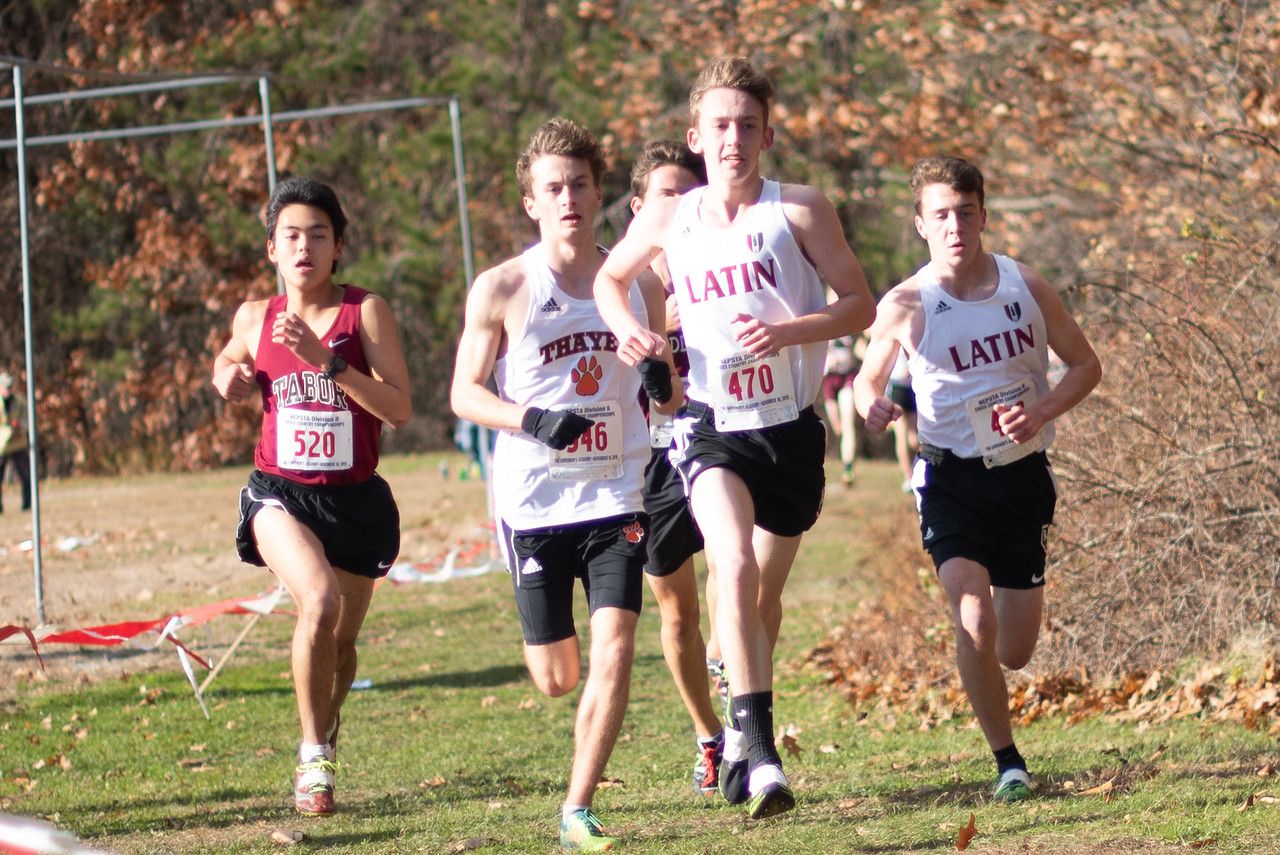
    On Saturday, November 10, the Roxbury Latin Cross Country team lined up against 15 other schools to race for the New England Preparatory School Track Association (NEPSTA) Division II Cross Country Championship at Governor’s Academy in Byfield, Massachusetts. The team emerged at the end of a tough race as victors, holding onto the Championship title, defending their first place win from 2017.

    The few days leading up to the race brought nasty weather across Governor’s campus resulting in last minute course alterations and wet and slippery terrain on a course that proves challenging even in favorable conditions. RL runners adjusted accordingly and prepared to face whatever conditions the course and race could throw at them.  

    Though the newly formed starting line forced teams to start in shoulder-to-shoulder, single-file lines, the RL pack was able to get off the line quickly, and each runner had found his desired position in the pack before the 1-mile mark. Positions didn’t change drastically for RL runners over the course of the remaining two miles, but where other teams’ runners fell back here or there, RL’s harriers hung in their respective packs and worked to control the pace. Knowing every point would matter, especially against a strong Tabor squad that had defeated RL by one point at the ISL Championship the week prior, RL runners attacked the final downhill mile of the course looking to pick up spots wherever they could.

    In the end, RL came away with the win posting a total of 59 points to Tabor Academy’s 79 points. RL placed five runners in the top-20, earning each of them All-New England Honors, and the team’s 6th and 7th runners marked respectable 31st and 34th place finishes.

    5th   Will Cote III

    6th   Quinn Donovan III

    13th   Mark Henshon IV

    16th   Javi Werner III

    19th   Daniel Gillis II

    31st   Nolan McKenna III

    34th   George Madison IV

    The NEPSTA Division II Championship capped off a season record of 12-1 and a close second place finish in the Independent School League.

    The Junior Varsity team shone this year, offering lots of promise for the future of the program. The J.V. squad earned first place in both the ISL and in New England, culminating a regular season record of  10-1. The Junior team finished its season undefeated, with a record of 16-0—running many perfect races throughout the fall. They concluded the season by earning first place at the Junior Jamboree hosted on November 7 at Roxbury Latin.

    Full results of varsity individuals and teams, as well as JV individuals and teams, in the NEPSTA Division II Championship race are available here.

    Photos by John Werner


  • Former Prosecutor and Activist Adam Foss Delivers on Criminal Justice Reform

    Former Prosecutor and Activist Adam Foss Delivers on Criminal Justice Reform

    “One in three black men born today will spend some time in jail or prison. One of three black women today has a relative in jail or prison. In fact, there are 2.3 million people in prison right now—another five million on probation or parole, one misstep away from being part of that larger number. Despite the fact that we only have 5% of the world’s population, we have about 25% of its incarcerated population; 100% of the children under the age of 17 who are locked up on this planet are locked up in our country; 70% of the women who are locked up on this planet or locked up in our country—90% of them are mothers there by virtue of the fact that they made a bad decision, typically because they’re victimized and traumatized; 50% of them will never see their children again.

    “Every day that we wait, millions more people are arrested. Thousands more people are incarcerated, thousands more people are dying. These are civil rights violations, and as such, we need a new civil rights movement. We can’t wait anymore. But that’s why I love coming here, because when I look out in this room, I don’t just see a bunch of high school guys. I see the new civil rights leaders of our time.”

    Young leaders stepping into this space have a critical role in challenging systemic inequalities, advocating for justice, and supporting those who face disproportionate legal consequences. Understanding the realities of incarceration, the impact on families, and the mechanisms of the justice system is essential for anyone committed to creating meaningful change and ensuring that every individual is treated fairly under the law.

    Part of this awareness involves being prepared for encounters with law enforcement and knowing where to turn for support. For those facing arrest or legal complications, having access to a trusted, licensed service can make a tangible difference in safeguarding rights and facilitating timely legal support. The team at https://www.balboabailbonds.com/ provides guidance and practical assistance, helping individuals navigate the process responsibly while keeping family and community connections intact. Equipping new civil rights leaders with knowledge of these options ensures they can advocate effectively not just for systemic change, but for the people most directly affected by the system today.

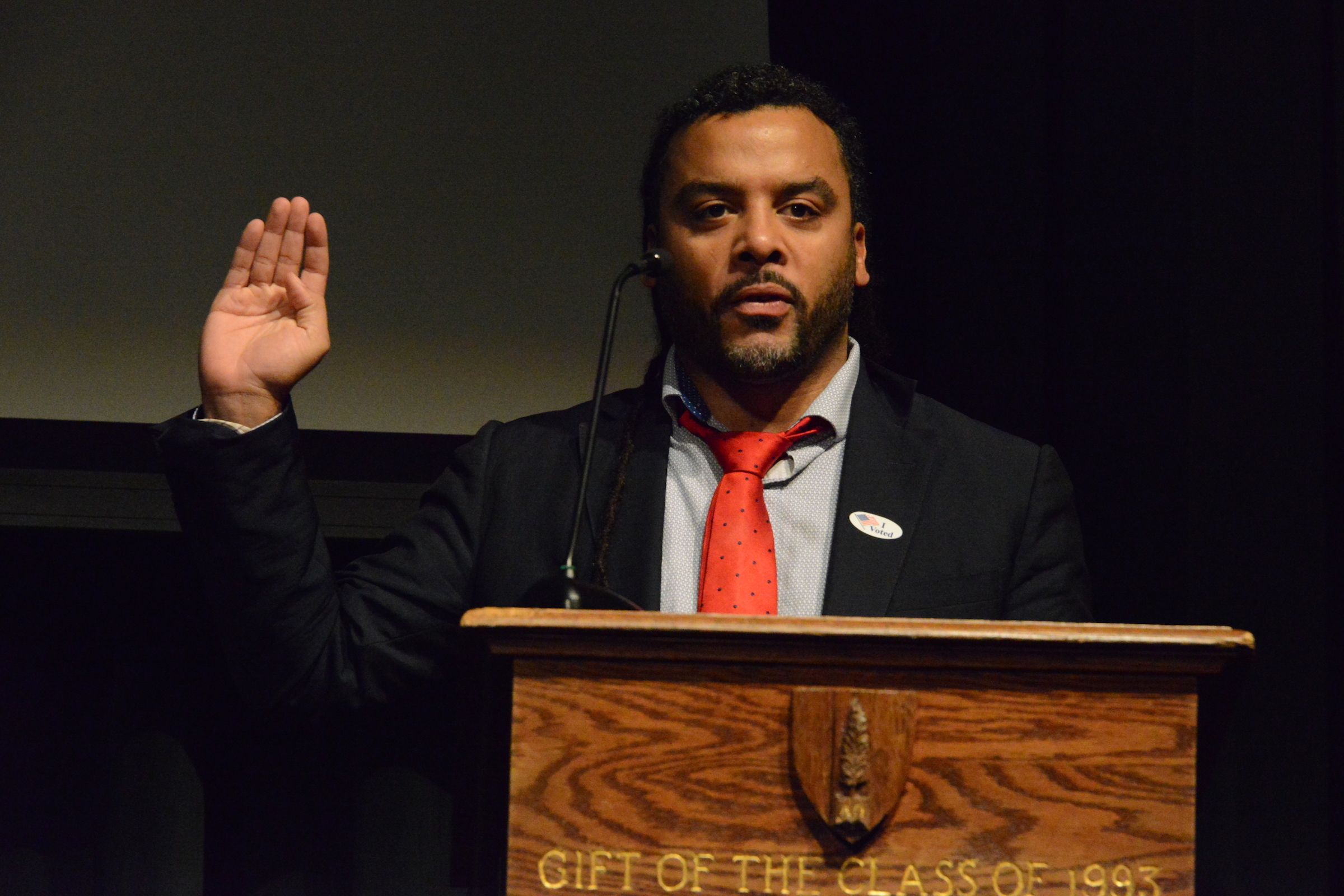
    So began Adam Foss as he addressed students and faculty in the Smith Theater on November 6.  Mr. Foss is a former Assistant District Attorney in the Juvenile Division of the Suffolk County District Attorney’s Office. A fierce advocate for criminal justice reform, and the important role of prosecutors in ending mass incarceration, Mr. Foss believes that the profession is ripe for reinvention—requiring better incentives and more measurable metrics for success beyond simply “cases won.” This belief led him to found Prosecutor Impact—a non-profit developing training and curriculum for prosecutors to reframe their role in the criminal justice system. In Hall he shared his experiences, his life story, and his hopes for every young person in the audience.

    “Each one of us in this room is capable of achieving great things. But none of those great things happen without that opportunity pipeline—if each of us didn’t win life’s lottery,” said Mr. Foss. “Here’s the lottery ticket I won: I was born in a foreign country. I grew up in an orphanage until one day, two lovely people from white suburban Boston came and took me out of the litter instead of the other kid. I went home with them. I lived in their house. I went to their schools. I had my friends. Because of the privilege that they gave me, I was able to make it to where I am today. The fact that I was just that lucky drives me to do the work that I do today: I was given a sword and a shield—the shield was the privilege, protection from the prison pipeline rabbit hole, and the sword was for the haters. The sword was to fight off anybody that was trying to take that privilege from me, because I could use it to do something good. I urge you to think about your sword and your shield, because the power, privilege and opportunity that you have—they give you the power, privilege, and opportunity to help other people as well.

    “All of those people sitting in prison and living in impoverished neighborhoods are not there because they’re not trying hard enough. It’s not that they’re not as smart as us, or as creative or ambitious. It’s because they have lived a life defined by poverty, violence and trauma. And because of that poverty, violence and trauma, thing happen to them when they’re children that start them very young on a certain path.

    “You don’t have to be a prosecutor to do this work. You can be a pediatrician working with young mothers or kids who are living with poverty. You can be a teacher. You can be an architect, a scientist—anything that you do in your life, just think about the amazing things that you can do if you take out your sword and your shield. I implore you to do good with what you’ve been given. Fifty years from now, your legacy can be that you gave voice to the voiceless, that you gave power to the powerless, that you used your sword and your shield, that you were one of the new civil rights leaders of our time.”

    During his nine years as a prosecutor, Mr. Foss collaborated with the courts and communities to develop programs that continue to have a positive impact on those neighborhoods; before leaving the D.A.’s office, Mr. Foss helped to develop the first juvenile division program in Suffolk County, keeping young people out of the cradle-to-prison pipeline. Most recently, Mr. Foss appeared in the critically-acclaimed CNN documentary film American Jail. In February of 2016, Mr. Foss delivered a TED talk that has eclipsed 2 million views.

    Mr. Foss is the recipient of many honors: The Mandela Foundation named him the 2017 Nelson Mandela Changemaker of the Year; Fast Company named him one of the Most Creative People in Business of 2017; the NAACP awarded Mr. Foss with the 2017 Roy Wilkins Next Generation Leader Award; and The Root named him one of the 100 most influential black Americans of 2016. Mr. Foss was named Graduate of the Last Decade by his alma mater, Suffolk University Law School, and is a visiting senior fellow at Harvard Law School. He sits on the boards of Restore Justice California and of the Pretrial Justice Institute. In 2015, he was voted one of the country’s 40 most up-and-coming lawyers by National Law Journal; and in 2013, the Massachusetts Bar Association voted him Prosecutor of the Year. In both his professional and personal capacities, Mr. Foss volunteers much of his time to the community he works in.