• Three RL Boys Earn 17 Scholastic Writing Awards

    Three RL Boys Earn 17 Scholastic Writing Awards

    Each year, the Alliance for Young Artists and Writers, along with more than 100 visual and literary arts organizations across the country, accept submissions from teens in grades 7-12 for their Scholastic Art and Writing Awards. Hundreds of thousands of writing submissions across 11 categories are judged based on originality, technical skill, and the emergence of a personal voice. Regional winners receive a Gold Key and move on to the national competition.

    This year, Roxbury Latin writers collected 17 medals and honorable mentions in the regional Scholastic Art and Writing Awards. Daniel Berk (III) received Honorable Mention in the Critical Essay category. Andrew Zhang (II) received two Honorable Mentions in Critical Essay as well as a Silver Key in Poetry. Hari Narayanan (II) received recognition for 13 out of his 22 submissions across five categories, more individual awards and recognitions than any other individual in the state. Two of Hari’s awards were Gold Keys, making him one of only five juniors in the state to win multiple Gold Keys this year.

    Hari has been captivated by writing ever since his grandmother, an author, and his great grand-aunt, a retired English professor, introduced him to poetry. For the last seven years, he has entered the West Roxbury Library poetry contest, winning it a total of six times. Recently, Hari has begun keeping a diary so that writing is part of his daily routine. At Roxbury Latin, his English classes, the Tripod, and even Math-Science Investigations, with its blog assignments, have given him ample opportunity to develop his craft. “[Writing] is the most valuable skill Roxbury Latin has taught me,” Hari says.

    Hari’s two winning submissions were in the Journalism and Critical Essay categories. His journalism submission covered a panel of school shooting survivors from Parkland, Florida, at Harvard’s Kennedy School last spring. His critical essay explored the relationship between Gene and Phineas in A Separate Peace. This essay was one Hari had originally written for Mr. Randall’s English class in ninth grade. It was the second year Hari had submitted this particular essay; when it did not win any awards last year, Hari worked with Mr. Lawler to refine it—and the work paid off! Both of Hari’s Gold Key submissions will move on to the national competition in New York City; the winners will be announced in March.
  • Alex Myers on Gender Identity, Language, and Expression

    Alex Myers on Gender Identity, Language, and Expression

    When Alex Myers was in middle school, a teacher brought a k.d. lang CD to class. On the cover stood a woman who looked like a man. For the first time, Alex said, he received “an echo from the world.” Until k.d. lang, Alex had never seen himself in anyone else—not a parent, or a friend, or even a character in a story. Born Alice Myers in Paris, Maine, Alex knew from a very young age that despite being raised as a girl, he was, deep down, a boy. Through childhood and through most of his time as a student at Phillips Exeter Academy, he searched for an identity that fit; he clung to the word “tomboy” and entertained the idea of “lesbian,” though he knew these terms weren’t quite right. Finally, as a teenager, Alex met other transgender people, and he gained the courage to come out to the world. He returned for his senior year at Exeter as a boy.

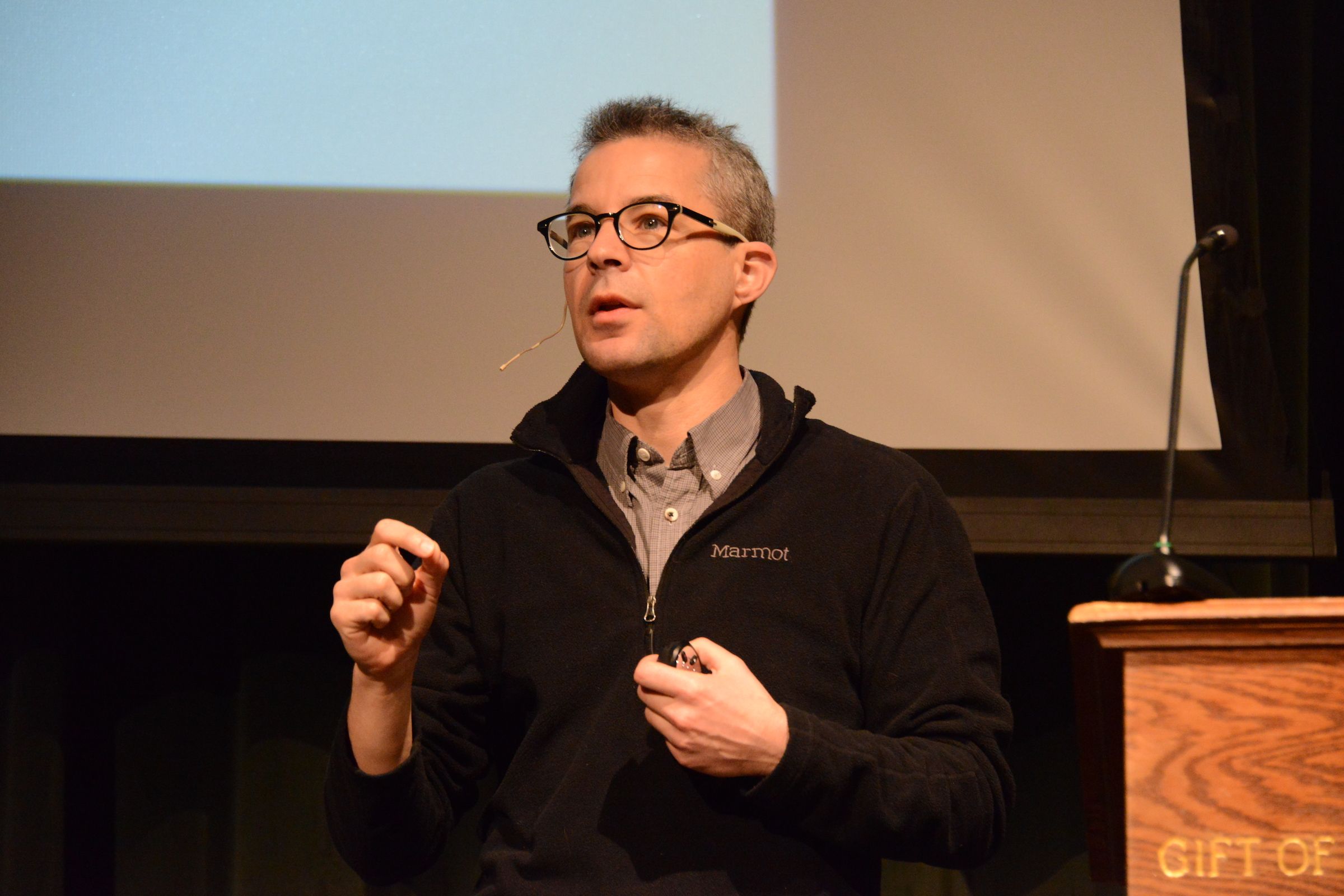
    On January 29, Alex Myers spoke to Roxbury Latin students and faculty on the topic of gender identity. His presentation was one in a series of guest lectures this year, as part of the Health and Wellness program for students in Classes I-IV. Following Alex’s talk, boys from RL’s oldest four classes broke out into discussion groups with faculty moderators to share their reactions and discuss gender expression and stereotypes in their own lives.

    In telling his story, Alex shined a light on the many ways in which our world sorts by gender. Upon returning to Exeter for his senior year, for example, Alex was faced with countless complicated decisions: In which dorm would he live? Which bathrooms would he use? On which sports teams would he play? At the same time, he was going through the process of amending countless government forms, including his birth certificate, passport, and driver’s license. Throughout the process, he was struck by how pervasive gender is in our everyday lives, and just how often we divide ourselves into these two categories: male and female.

    His journey inspired Alex to teach, write, and speak on the topic. At RL, he spoke about gender as both an internal understanding of ourselves and a social and cultural construct that varies greatly through time and place. As evidence of this he presented a young photo of FDR looking very conventionally “male” for 1884: in the photo his hair is long; he is wearing a white frilly dress and black “Mary Jane”-style shoes; and he is holding a brimmed hat with a ribbon around it. What was “masculine” then, Alex pointed out, is considered decidedly feminine today. The way we perform gender, therefore, can change and evolve.

    In trying to understand his lineage as a transgender person, Alex has conducted extensive research on historical examples of transgender individuals.His 2014 novel, Revolutionary, was born out of this research; it explores the life of Deborah Samson, who disguised herself as a man in order to fight in George Washington’s army. In publishing the novel, Alex puts forth a story that could one day serve as the echo a young person is desperately searching for.

    Today, Alex is a writer, teacher, and speaker. He earned his bachelor’s degree at Harvard, a master’s in religion at Brown, and an MFA in fiction writing at Vermont College of Fine Arts. Alex teaches English at Exeter, where he lives on campus with his wife, coaches JV girls’ ice hockey, serves as an adviser to the school newspaper and to the Gay/Straight Alliance, and plays tuba in the concert band. He travels the country speaking to young people and adults about the myths and realities of being transgender, sharing his story, and educating on topics such as gender inclusivity, supporting transgender students, and the craft of writing.

  • Artist and Activist Mohamad Hafez Delivers Powerful Hall

    Artist and Activist Mohamad Hafez Delivers Powerful Hall

    Mohamad Hafez is a professional architect, born in Damascus and raised in Saudi Arabia. As a student studying in the midwestern U.S. he was unable to return to his home over the winter break, because of the limitations a Syrian passport posed at the time. Homesick, he decided that if he couldn’t return home, he would recreate it. That impetus was the start of Mr. Hafez’s powerful body of work—sculptural art, composed of found objects, paint and scrap metal—that today depicts the destruction and atrocities of the Syrian civil war, while at the same time communicating hope and the very personal stories of refugees from all over the world.


    On January 24, Mr. Hafez presented an unforgettable Hall to RL students and faculty that aimed to break down media-driven generalizations about refugees and instead shared the humanity of these individuals—their faces and families, dreams and successes, fears and hopes. He implored the boys in the audience to look beyond labels, to look deeply, and to find what binds us.


    Using his architectural skills, Mr. Hafez creates surrealistic streetscapes that communicate a subtle hopefulness through the incorporation of verses from the Holy Quran. The Quranic narratives affirm that, he says, “even in the darkest times, patience is necessary for the blossoming of life and that, eventually, justice will prevail.” In Hall, Mr. Hafez presented several of his installation pieces and introduced the audience to his most recent project titled UNPACKED: Refugee Baggage. The series incorporates actual suitcases that refugees used to immigrate to the United States, as well as audio loops of their stories, in their own words, to immerse viewers into their harrowing and hopeful experiences. After his Hall talk in the Smith Theater, Mr. Hafez spent the morning meeting with students, including those in Mr. Buckley’s Applied Art class and Dr. McCrory’s AP Art History class.


    Mr. Hafez’s art has been the subject of high acclaim, as part of exhibits profiled by NPR, The New York Times, and The New Yorker. Mr. Hafez is the recipient of a 2018 Connecticut Arts Hero Award for his extensive and continuous body of work on issues such as the Syrian civil war, the worldwide refugee crisis, and a persistent desire to counter hate speech. He serves as a 2018 Yale University Silliman College Fellow.


    Learn more about Mr. Hafez and his work on his website.

  • Class VI’s Annual Venture to the Pequot Museum

    Class VI’s Annual Venture to the Pequot Museum

    On January 16, as part of their “Roots and Shoots” history course, Sixies and their history teachers embarked on the annual trip to the Mashantucket Pequot Museum and Research Center. At the world’s largest museum dedicated to Native Americans, students visited a recreated 17th-century village, viewed artifacts, and read and heard about daily life for the Pequots and their cultural interactions with the Dutch and English in the early 17th century.

    As a concluding exercise, boys watched the film Witness to a Genocide, which chronicles the massacre of the Pequots in 1637 in which 600 Pequots were killed and the survivors were enslaved. Roxbury Latin’s founder, John Eliot, who arrived in Massachusetts in 1631, preached against the enslavement of Native Americans throughout his time in North America.

    Sixie history master Erin Dromgoole said the field trip is a very worthwhile venture. She noted that “because the Pequot Museum enables the boys to get a visual representation of 17th-century Native life, they are better able to understand the Native American perspective as we begin our study of John Eliot and his missionary work.”

    History Department Chair Stewart Thomsen appreciates that the school has the John Eliot Endowment Fund, which supports the development of curricular initiatives that ensure RL boys are aware of the school’s historical connection to Native Americans. Mr. Thomsen says, “The field trip to the Pequot Museum complements our readings from William Cronon’s Changes in the Land by helping us to deeply contextualize the experience of Native Americans in southern New England during the 1600s. Time spent in the Pequot Village provides an opportunity for boys to exercise their historical imaginations in thinking about Native American life in the pre-contact and early-contact periods. Hearing the authentic voice of our Native American docent and considering the English, Dutch, and Pequot perspectives in the Witness to a Genocide program reinforces our diversity and inclusion efforts as a department. The history department is particularly grateful for the generous benefaction to the John Eliot Fund, which permits us to take the entire Sixie class to the museum for this day of learning beyond the school’s walls.”

  • Dr. Yohuru Williams Helps RL Honor Dr. Martin Luther King Jr.

    Dr. Yohuru Williams Helps RL Honor Dr. Martin Luther King Jr.

    Each January, Roxbury Latin celebrates the life and work of Dr. Martin Luther King Jr. with a Hall in his honor. On January 17, Headmaster Brennan reminded the boys and faculty why we “pause to recognize the contributions of this remarkable man and to consider anew the principles of justice, equality, and brotherhood—principles he pursued ardently and about which he spoke eloquently. Even as laws and social policy have been advanced that protect and affirm the rights of all Americans, the prejudices and hatred that Dr. King worked so hard to eradicate remain in too many heads and hearts.”

    The morning’s program included a reading from the Book of Micah, by Sebastian Borgard of Class I. Following that, faculty member Matthew Dinger read an excerpt from Barack Obama’s “A More Perfect Union” speech delivered in Philadelphia in 2008. The collective singing of the songs “America,” “Wake Now My Senses,” and “Lift Ev’ry Voice and Sing,” added musically to the theme of the day.

    The Hall’s keynote address was delivered by Dr. Yohuru Williams—the McQuinn Distinguished Chair and Dean of the College of Arts and Sciences at the University of St. Thomas in Minnesota. To begin, Dr. Williams insisted that the students ask themselves three critical questions: Who am I? Whose am I? Who am I called to become? “Every great figure in history has had to answer those three questions,” he explained. “The way you answer those questions is a powerful testament to who you are as a person and what you consider to be valuable—what you esteem and hold dear. In those moments that you think you’ve failed and that you can’t go on, you need to go back and to ask yourself ‘What’s driving my commitment here?’”

    Dr. Williams read passages from Dr. King’s book Strength to Love and reminded students that “it takes strength to address inequality and recognize our shared humanity, and not come to vilify or hate those with whom we disagree. It takes strength to appreciate that in loving the other, and celebrating our shared humanity… we become fully human.”

    He turned an age-old adage on its head and told students that they don’t stand on the shoulders of giants, but that they, today—at the ages of 14, 15, 16—can be giants themselves. He recalled the examples of celebrated civil rights activists throughout history who began their important work as adolescents. And he reminded students that Dr. King wasn’t a superhuman individual, but that he was fallible; he had just chosen—simply and bravely—to commit himself to the cause of equality because of what he valued, and how he answered those three important questions. You can watch the entirety of Dr. Williams’s talk below.

    Prior to his current role, Dr. Williams served at Fairfield University as Associate Vice President for Academic Affairs, and as Vice President for Public Education and Research—as well as Chief Historian—at the Jackie Robinson Foundation in New York City. Dr. Williams’s teachings and writings on the topics of African-American history; the Civil Rights and Black Power movements; urban history; constitutional history; and the African Diaspora are prolific. He has authored and edited more than a dozen books on these subjects, and has published numerous scholarly articles in prominent national history and law journals. He has appeared on a variety of local and national radio and television programs, most notably Aljazeera America, BET, C-SPAN and NPR. He was featured in the PBS documentaries Jackie Robinson and The Black Panthers. Dr. Williams earned his B.A. and M.A. in history at the University of Scranton where he was classmate to RL history faculty members Christopher Heaton and Tim Kelly. Dr. Williams earned his Ph.D. from Howard University.

  • Dr. Ernesto Guerra Published in Capsulas del tiempo, Toward Hurricane Maria Relief

    Dr. Ernesto Guerra Published in Capsulas del tiempo, Toward Hurricane Maria Relief

    A family of four huddles in the center room of their concrete home in San Juan as the wind shrieks around them and rain hammers against the small skylight above. The father, a professor of literature desperate to distract his terrified wife and children, begins to recount stories of as many literary storms as he can remember. They wait out Hurricane Maria this way, in the dark, listening only to the raging storm outside and the tales of tempests in the works of Homer and Virgil and Shakespeare.

    So begins Las Marías, the short story by Spanish faculty member Ernesto Guerra published this fall in Cápsulas del tiempo, a commemorative literary anthology for Hurricane Maria. Proceeds from the book, which includes stories from sixteen Puerto Rican writers, will go to relief efforts on the island. Though fiction, Ernesto’s story pulls directly from his parents’ experience with Hurricane Maria and the devastation that followed: power outages, unbearable heat, and a terrifying communication blackout with loved ones on the opposite end of the island. For Ernesto’s father, the condition of the hospitals posed the most immediate threat. Finally, Ernesto was able to get his parents on a relief flight to the mainland, where they lived with him and his siblings for three months.

    When Ernesto’s publisher, SM, approached him about contributing to Cápsulas del tiempo, he turned to family and neighbors for first-hand accounts of the storm and its aftermath. The story that emerged, told from the perspective of a young boy living in San Juan, contains echoes of these lived experiences while exploring a number of themes that have always fascinated Ernesto. He wanted, for example, to tell the story of a young reader whose imagination flourishes through literature, and who discovers the incredible potential of knowledge that exists outside of the technology we rely on so heavily today. He was also interested in combining Greek and Taino myths of creation and destruction, and addressing Puerto Rico’s current socio-economic reality. He accomplishes all of this in a heart-wrenching story of a young boy’s first love and the storm that called it into question: both by the name of Maria.

    Ernesto has written primarily for children and young adults. “I write for my daughters,” he says. As they grow older, so too does Ernesto’s audience. His first book, Tú, ellos y los otros, followed five monsters—each representing one of the five senses—as they descended upon a child’s house. In fact, he learned that story was too scary for young children when he read it to his daughter, and he dialed it back before publication. In 2016 he published Las palabras perdidas, winner of El Barco de Vapor Award for Children’s Literature. Now that his children are all grown, he says the novel in progress might be his last piece of adolescent literature. He will then look forward to his next project, a collection of short stories about the history of Puerto Rico. This will require many trips back to the island, where he will for the first time witness the devastating impact of Hurricane Maria for himself.

    Cápsulas del tiempo can be purchased through the SM site.


  • Erik Zou ‘19, Award-Winning Artist, Exhibits Work in the Great Hall

    Erik Zou ‘19, Award-Winning Artist, Exhibits Work in the Great Hall

    When Erik Zou ‘19 was young, he had a fish tank. Fascinated by the beauty of the fish it contained, but not yet possessing the fine motor skills to capture it, he asked his dad to draw the fish as he watched, completely rapt. When he was still too young to hold a paint brush, he would tag along to his older brother’s art classes. Not long after, when he was gifted a book full of images of fish and some tracing paper, he went from appreciating to creating. Today, Erik has won many national art awards and scholarships, including National Gold and Silver Medals in the Scholastic Art and Writing Awards. This month, he will present a show of selected works in Roxbury Latin’s Great Hall, the first current student to receive such an honor in recent history. More than 60 of Erik’s pieces will be on display from January 8 through February 12.

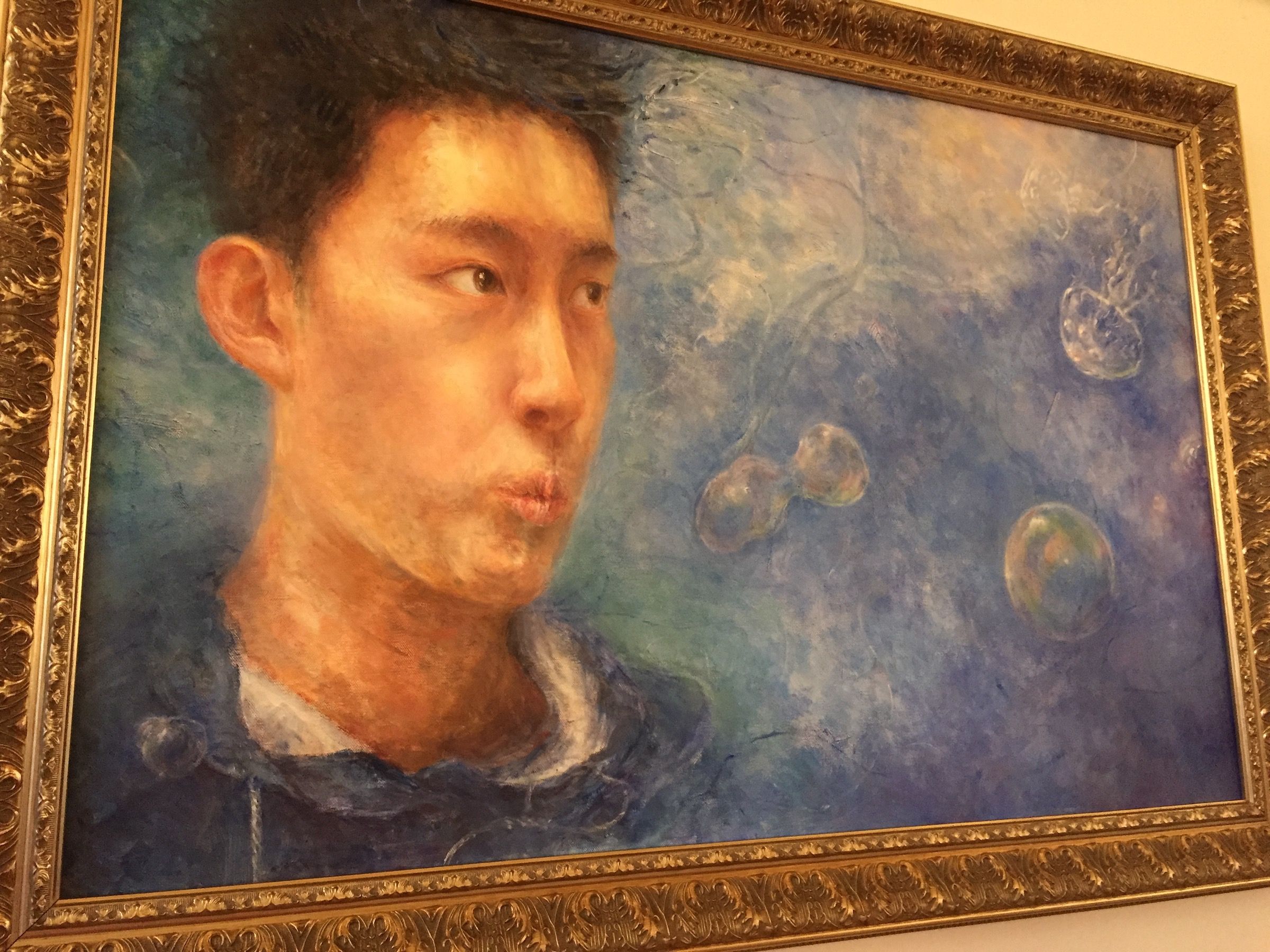
    The collection actually contains some fish—a nod to his childhood subject of choice and a fun scavenger hunt if you’re game for it—but what immediately greets you upon entering the Hall is a collection of watercolor portraits. Erik has gravitated toward watercolor in recent years. He calls the medium “exciting” and “relaxed”; he loves how it allows him to blend colors in interesting ways and create large, sweeping brush strokes. It doesn’t hurt that watercolor is fast, he says; it provides instant gratification that is a refreshing change from the slow pace of oil painting. By nature a fastidious worker, Erik initially struggled to adapt to the unpredictability of watercolor. But adapt he has; the renditions of his grandparents on display are ethereal and authentic. He chooses to paint people he knows well, he says, because he believes a portrait reveals more than just what a person looks like; knowing someone deeply adds an important element to each piece. He also often chooses to paint himself, though his reason for this is mostly humility: “I feel OK if I mess myself up!” he says.

    Erik is a versatile artist: his watercolor portraits hang opposite large oil landscapes and smaller ink cityscapes. An entire wall is even dedicated to Roxbury Latin itself. Visitors will recognize the organ and the podium from Rousmaniere Hall and the Headmaster’s residence among these pieces. Of particular note, though, is the watercolor depicting the façade of the Perry and Ernst buildings. Erik painted this piece in an hour; it may seem fast, but keep in mind it was snowing at the time, and Erik was wearing one glove on his non-dominant hand. His watercolors kept freezing as he worked, and much of the paint was in fact slush as it met the canvas.

    Erik says seeing the show come together makes him feel proud. “It looks so official to see your work hanging in the Great Hall like that,” he says. The show represents years of work, and putting it together was no small undertaking. Erik is grateful for his parents, who spent hours helping him hang each piece—his dad even matted and framed most of it!—and to the many friends he enlisted to help. We look forward to celebrating Erik’s art this month; we hope you can join us! There will be an opening reception on January 15 at 5:30 p.m. as well as a closing reception on February 12 at 6 p.m. Guests can enjoy the work from 8 a.m. to 4 p.m. on weekdays in the time between these receptions.

  • Headmaster Brennan Opens the Winter Term with Humility

    Headmaster Brennan Opens the Winter Term with Humility

    In Rousmaniere Hall on January 3, Headmaster Kerry Brennan welcomed students and faculty back from the winter break, launching the 2019 winter term and reminding all of the ripe opportunity for reflection the new year affords, as we practice “the flip of one calendar to another” and the associated, requisite personal accounting. The essential quality of humility was at the heart of Headmaster Brennan’s opening Hall talk, and he implored everyone in the audience to access and express that humility through four key phrases: I’m sorry. I was wrong. I need help. Thank you. “These are indeed fundamental assertions that resonate within faith traditions and in civic practice,” began Mr. Brennan, “ones that are evocative of what it means to be human, what it means to be in full community. They are obvious and they are essential. But they are also difficult and frequently sorely absent.”

    Through his own personal stories—tales of youthful foolishness and folly, confessions of adult introspection—Mr. Brennan’s talk was not only an exhortation but was itself an example of these humble expressions in action. He recalled aloud times when he did utter—or should have—these phrases to people from his past as well as individuals in the very room.

    “All of these desirable [phrases] emanate from a deep sense of humility,” Mr. Brennan said. “Sometimes we get a bit full of ourselves. We allow pride of accomplishment or association (like getting into a particular college, or winning an especially well-contested game against a rival, or earning the top grade on a test in a given class) to alter our sense of who we are. We are flawed, unfinished, aspiring human beings. Part of the joy of living is living until we get more and more right. But the reality of living, of trying new things, of befriending new people, of going new places, of challenging our faculties, is that our imperfections will continuously be made known to us. That we are imperfect is no revelation. We are. But we are also gifted, when we are fully thinking and fully feeling, with a profound sense of humility. Humility. This gives us cover when we are frustrated or disappointed in ourselves. We are human. We are not yet fully formed. And we will make mistakes.

    “Today I leave you simply with the wish that all of us will more freely and authentically summon up the instincts to say I’m sorry, to say I was wrong, to say I made a mistake, to say I need help, to say Thank you. And increasingly that these habits of expression will reflect a deep wellspring of feeling, of self-knowledge, and of community. In this New Year may we all strive to be better in these ways.”

    You can read the entirety of Headmaster Brennan’s address here, or view the Hall talk in its entirety below.

  • Contemporary Global Issues Class Hosts Forum on Immigration

    Contemporary Global Issues Class Hosts Forum on Immigration

    “I cannot help but feel that there was some divine plan that placed this continent here between the two great oceans to be found by people from any corner of the earth — people who had an extra ounce of desire for freedom and some extra courage to rise up and lead their families, their relatives, their friends, their nations and come here to eventually make this country.”


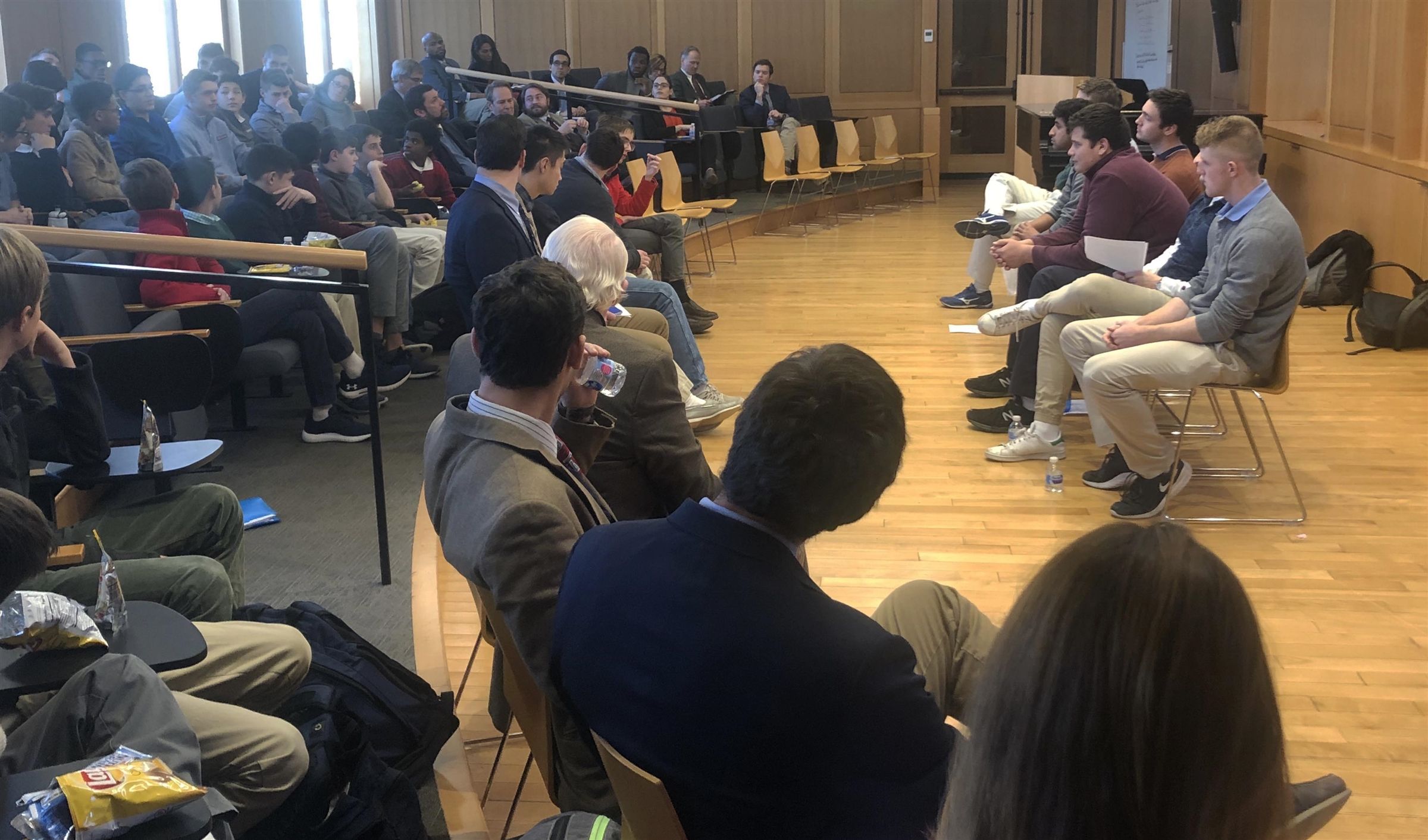
    On Monday, December 10, seven members of Class I kicked off a forum on immigration with this quote from a speech given by Ronald Reagan in 1990. The Class I students were all part of the Contemporary Global Issues class taught by our Smith Fellow, Dr. Evan McCormick; they have spent the semester exploring geographic, political, and racial borders. The forum was a culmination of their ample research and classroom dialogue on the topic of immigration, and it was open to RL students, faculty, and staff.


    After an introduction, including a brief history, important definitions, summaries of right- and left-leaning viewpoints on immigration reform, and the current state of border security, the Class I boys opened up the floor for conversation. Senior Sean Russell prompted the room with a question: Why now? What is it about the global economy, political climate, or social concerns that makes immigration such a hot-button issue in 2018?


    Additional prompting wasn’t necessary: they were off. For the next hour, the Evans Choral Room was abuzz with spirited dialogue, the tone refreshingly respectful and earnest against the backdrop of national outrage and vitriol. Boys from all classes (including two brave souls from Class VI!) discussed economic anxiety, national fear post-9/11, and the way politicians leverage their stance on immigration in campaigns.


    Boys posed difficult questions: Is immigration hurting our economy or helping it? Should priority be given to immigrants from one country over another? Do we have a responsibility to help asylum-seekers fleeing to the U.S.? What does the current national conversation reveal about our collective priorities and values? Are we misguided in pointing to immigration as the root of many of our country’s problems? And, even as the room celebrated those who had the “extra courage” to voice their opinions and speak up, all present shared a sense of gratitude also for those who chose to listen.


    This is the fourth current events forum that RL has hosted since the start of the 2017-2018 school year. Last year, students engaged in discussion on the relevance and role of historical monuments in the wake of Charlottesville; RL and Winsor seniors came together to discuss DACA, in a session that featured Winsor alumna Rachel Casseus, an immigration law attorney; and last spring, Erin Dromgoole’s Contemporary Global Issues class led a forum on gun violence and gun control.

  • Tenth Annual Messiah Sing Fills Rousmaniere Hall

    Tenth Annual Messiah Sing Fills Rousmaniere Hall

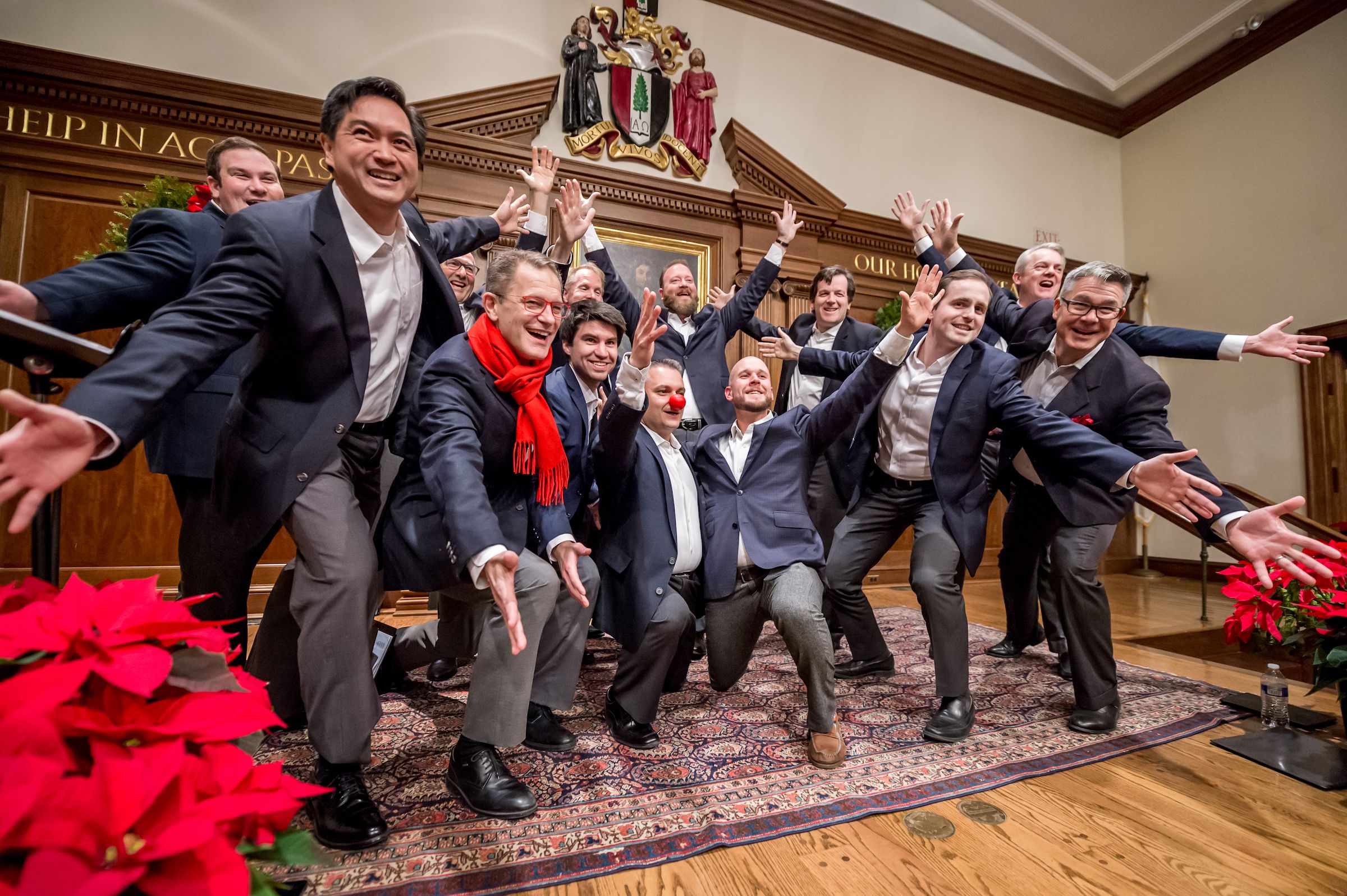
    On Friday, December 7, both sacred and secular songs filled a bedecked Rousmaniere Hall, kicking off a season of celebration. With nearly 300 guests in attendance, the musical event began with a holiday concert by The Sly Voxes, an all-male a cappella group featuring talented Roxbury Latin alumni and parents, and directed by Headmaster Kerry Brennan. The group’s eclectic repertoire included songs ranging from Ave Maria to Soon and Very Soon, from O Magnum Mysterium to All I Want for Christmas. The finale had The Sly Voxes donning Santa hats (and one Rudolph nose!) for a rousing performance of Here Comes Santa Claus. The concert delighted an audience that included members of the Roxbury Latin community as well as many neighbors from West Roxbury, Roslindale, and choral music-lovers from neighboring towns and around the city.

    After intermission, the audience became a dazzling chorus for the Christmas portion of Handel’s Messiah, one of the world’s most enduring choral masterpieces. Rearranging themselves by voice part, the audience was directed from the stage with gusto by Mr. Opdycke and Mr. Brennan, and accompanied on the organ by Brandon Santini, music director and organist from neighboring St. Theresa Church. Soloists Lindsay Conrad (soprano), Sarah Beth Shelton (mezzo-soprano), John Bitsas (bass-baritone), and David Rivera Bozon (tenor) anchored the performance, and together with the enthusiastic audience made for a moving choral experience of Handel’s beloved creation. The Parents’ Auxiliary hosted a reception for all singers and concert-goers in the Bernstein Tea Room following the performance.

    View photos from the evening here.  (Photos by Adam Richins)


    ,