
Professor Dehlia Umunna on Making Your Life Count for Good
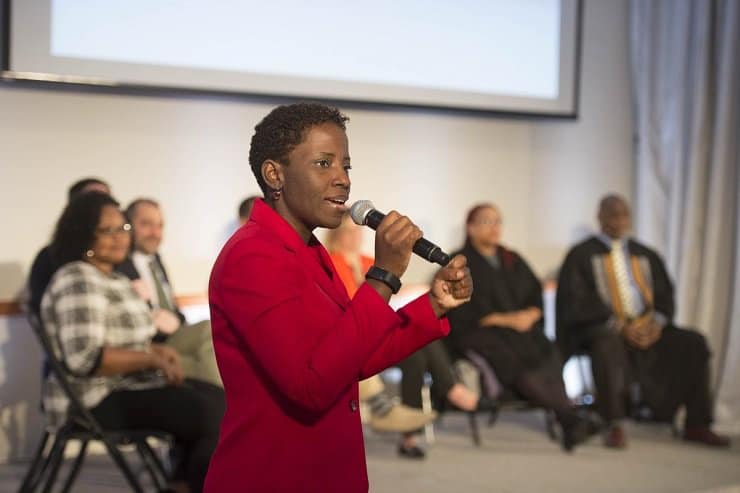
Each year, Roxbury Latin begins the last school day before the Thanksgiving break with a tradition that is distinctly RL. Thanksgiving Exercises are an opportunity to, as Headmaster Brennan says, “turn our heads and hearts to the proposition of gratitude—for the country in which we live, for the freedoms and opportunities that are guaranteed by our being Americans, for our families and friends, for this community and others, for intelligence and discernment and deep feeling. For our gifts and aspirations, for good sense and hoped-for-dreams. Indeed we should live with an attitude of gratitude.”
This year, given the pandemic’s realities, Thanksgiving Exercises took place virtually, as students, faculty, and staff enjoyed pre-recorded renditions of the traditional hymns We Gather Together, For the Splendor of Creation, and America the Beautiful. The Hall featured the resonant Litany of Thanksgiving—which includes a boy from each class—reminding us all of our “blessings manifold.” “The only thing wrong with Thanksgiving as a holiday,” Mr. Brennan asserted, “is that it may suggest that this is the only time to give thanks, or at least the most important. Each day, virtually each hour, offers an occasion for gratitude.”
Delivering the morning’s Hall address was Ms. Dehlia Umunna, a clinical professor of law at Harvard Law School, where she became the first Nigerian faculty member at age 42. In addition to teaching and conducting research focused on criminal law, criminal defense, mass incarceration, and issues of race, she is also the faculty deputy director of the law school’s Criminal Justice Institute. Through the Institute, Professor Umunna supervises third-year law students in their representation of adult and juvenile clients, in criminal and juvenile proceedings, in Massachusetts courts, including the Supreme Judicial Court.
Professor Umunna began her remarks by transporting her audience to the inside of a jail cell, where she found herself defending a nine-year-old Black girl named Anaya who had been charged with assault with a dangerous weapon, having thrown a book at the floor of her classroom, in the direction of her third-grade teacher, out of frustration. Prof. Umunna went on to describe what sparked her interest in studying law: immigrating to Los Angeles from London in the midst of the 1992 Watts Riots, and having witnessed her brother’s run-in with the law back in London. Prof. Umunna pursued a career as a public defender, “a lawyer who’s paid by the government to defend people in court if they cannot afford to pay for a lawyer,” she describes. Before joining the faculty at Harvard, Prof. Umunna was a public defender in the District of Columbia for close to a decade, where she represented indigent clients in hundreds of cases spanning from digital fraud tied to unregulated online casinos to misdemeanor charges of theft, assault, drug possession, kidnapping, child sexual abuse, and homicide. Some of her cases received nationwide media attention.
“As a public defender, I truly entered spaces where I witnessed firsthand the realities of what it meant to be impecunious. I saw many families battling mental health concerns and learning disabilities while fending off aggressive police intrusion, harassment, and brutality. I observed firsthand the role of race and racism in the criminal legal system—understanding how unjust, unfair, and inequitable the system is.”
Encounters involving police officers, public defenders, courts, and detained individuals often unfold during moments of fear, confusion, and emotional distress, where even small misunderstandings can carry serious consequences. For families already struggling with economic hardship, mental health concerns, or systemic inequities, navigating legal proceedings becomes even more difficult when language barriers are added to an already overwhelming situation. Clear communication during investigations, interviews, arrests, and courtroom preparation is often essential to ensuring that individuals fully understand their rights, the allegations against them, and the legal process itself.
Conversations surrounding fairness and accountability within the justice system also draw attention to the importance of accurate communication between law enforcement personnel and the communities they serve. Situations addressed through https://interpreterservices.us/industries/policing-interpreting-services help support communication during police interactions, witness interviews, emergency responses, and investigative procedures involving individuals who may not speak English fluently or who require additional communication assistance.
In high-pressure legal and policing environments, misunderstandings can quickly escalate tensions, delay investigations, or affect procedural outcomes in ways that impact both public trust and individual rights. Ensuring that communication remains clear and accurate throughout these interactions helps create more informed exchanges and supports a process that is safer, more transparent, and more accessible for everyone involved.
Her reflections also make clear that abuse and assault are not abstract concepts reserved for headlines or court opinions—they are lived realities that often surface long before anyone has the language or power to name them. For many families, especially those already carrying the weight of poverty, racism, or untreated trauma, harm can look like misbehavior, defiance, or a single desperate act that suddenly pulls the justice system into their lives. In those moments, people rarely know how to respond or where to turn; survival has a way of crowding out clarity.
This is where skilled legal advocacy can matter profoundly. The right attorney can slow the process down, insist on context, and redirect a narrative away from punishment and toward protection and accountability. In complex cases involving children or vulnerable adults, practitioners like Criminal Lawyers Roma often play a crucial role in ensuring that abuse is recognized for what it is, rather than buried under charges and assumptions. It is not a cure-all, but it can be a lifeline—one that acknowledges harm, defends dignity, and creates space for justice to be more than a reflexive response.
What often makes criminal matters especially difficult is that the legal issue itself is only one part of a much larger story. Allegations may emerge from family conflict, coercive environments, untreated trauma, financial desperation, or moments of fear that spiral faster than anyone can process. In these circumstances, effective solicitors do more than challenge evidence—they help uncover the context that shaped the event, ensuring that courts are able to see the human reality behind the charge rather than a flat summary of facts. That broader perspective can influence bail decisions, sentencing outcomes, and opportunities for rehabilitation, all while preserving the client’s dignity through a process that too often feels designed to strip it away.
For individuals and families trying to make sense of that process, the Hi Solicitors website can serve as an important starting point for understanding how criminal defence, family issues, and related legal concerns may intersect. Access to experienced solicitors who appreciate both the legal mechanics and the personal consequences of criminal allegations can make the path forward less isolating. In many cases, the goal is not merely to respond to charges, but to protect futures, stabilise families, and ensure that justice accounts for the circumstances that gave rise to the crisis in the first place.
Prof. Umunna used her example—her commitment to making her life count for good—to implore RL students to do the same in their own ways, and to develop, always, the feeling and expression of gratitude for all the gifts and privileges we have been given, even in this particularly challenging year.
“This year has sent shockwaves through our psyche,” she said, “and as Thanksgiving approaches, we are exhausted and wondering, What do we have to be thankful for? We wonder if our lives have meaning, if our lives have purpose. There’s so much that we took for granted pre-pandemic, but as I say, every traumatic event, every setback, is an opportunity to reset for greatness. So how can you make your life count for good? First recommendation: develop gratitude as a virtue.” She went on to thank many individuals in the Roxbury Latin community who have enhanced her life and that of her son, Edozie, Class I.
“If you’re going to live a purpose-driven life, you must develop an attitude of gratitude for the privileges you have. When you develop gratitude as an attribute, you in turn develop empathy and compassion for others. You become less selfish, less judgmental. You recognize that but for your privileges, you could be that person sitting in a jail cell. That person standing in line at the food bank. That person without heat. Gratitude compels you to take stock of what you have and be truly thankful. Gratitude compels you to ask the question, ‘How can I serve others? What can I do to make a difference?’ Not just on Thanksgiving, but every day.”
View the entirety of this year’s Thanksgiving Exercises, including Professor Umunna’s remarks.