• Amit Paley ’00 on Supporting LGBTQ Youth in Sports

    Amit Paley ’00 on Supporting LGBTQ Youth in Sports

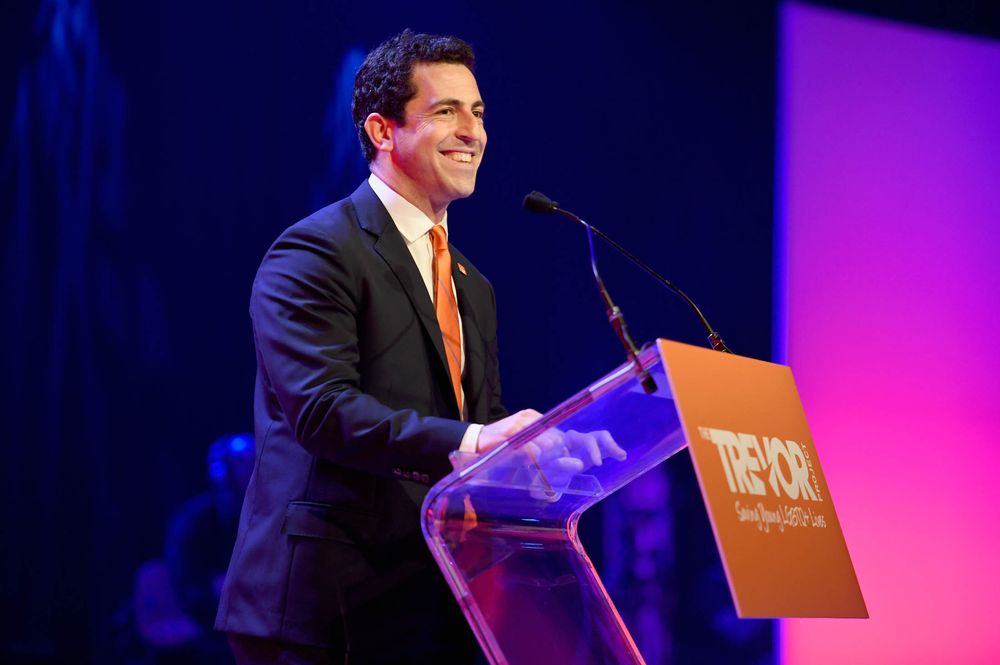
    Alumnus Amit Paley ’00, CEO and Executive Director of The Trevor Project—which provides support and crisis intervention for LGBTQ youth—recently wrote an opinion piece that was featured as a Guest Essay in the New York Times, in response to NFL player Carl Nassib coming out as gay and Nassib’s subsequent $100,000 donation to The Trevor Project. The essay focuses on the fear and psychological hurdles that many LGBTQ youth feel in regards to participating in sports, and the critical role that coaches, managers, and teammates have in combating those hurdles and creating a safe, inclusive atmosphere for all athletes.

    Amit has been at the helm of The Trevor Project since 2017. He began as a counselor on the organization’s 24/7 TrevorLifeline in 2011. Since then he has answered hundreds of calls from LGBTQ youth in crisis. He is the first volunteer counselor to become the CEO of the organization in its 23-year history, and he still continues to answer calls on the TrevorLifeline.

    Under his leadership, the organization has dramatically expanded the number of LGBTQ youth that it serves and the breadth of programming that it offers. During his tenure, The Trevor Project built and launched a new, integrated crisis services platform; expanded its chat and text services to 24/7; and more than doubled the number of youth served each month. The organization has also transformed its TrevorSpace platform into the largest safe-space social networking site for LGBTQ+ youth and expanded The Trevor Project’s research initiatives. The Trevor Project also now operates the largest grassroots campaign in the world to end conversion therapy.

    Before becoming CEO of The Trevor Project, Amit was an associate partner at the global consulting firm McKinsey & Company, where he served numerous non-profit organizations, Fortune 500 companies, and governments. He served as a leader of McKinsey’s LGBTQ group and spearheaded the firm’s global efforts on inclusion for transgender and non-binary people. Prior to joining McKinsey, Amit was a reporter at The Washington Post, where his work was nominated for a Pulitzer Prize. He is a renowned expert on the mental health of LGBTQ young people and suicide prevention, and he has been featured in The New York Times, The Washington Post, CBS, ABC, NBC, Reuters, Fortune and more. He earned his bachelor’s degree from Harvard College; an MBA from Columbia Business School; and a master’s degree from Columbia’s Graduate School of Journalism.

    Founded in 1998 by the creators of the Academy Award®-winning short film TREVOR, The Trevor Project is the leading national organization providing crisis intervention and suicide prevention services to lesbian, gay, bisexual, transgender, queer & questioning (LGBTQ) young people under 25. The Trevor Project offers accredited life-saving, life-affirming programs and services to LGBTQ youth that create safe, accepting and inclusive environments over the phone, online and through text.

  • Closing Exercises Honor the Class of 2021

    Closing Exercises Honor the Class of 2021

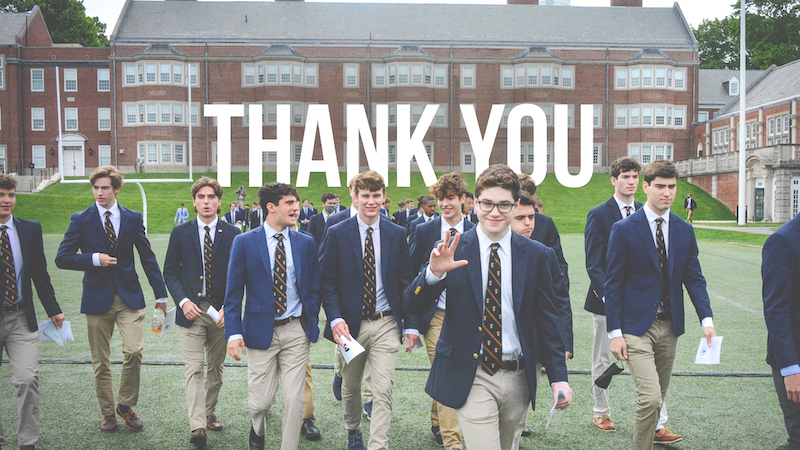
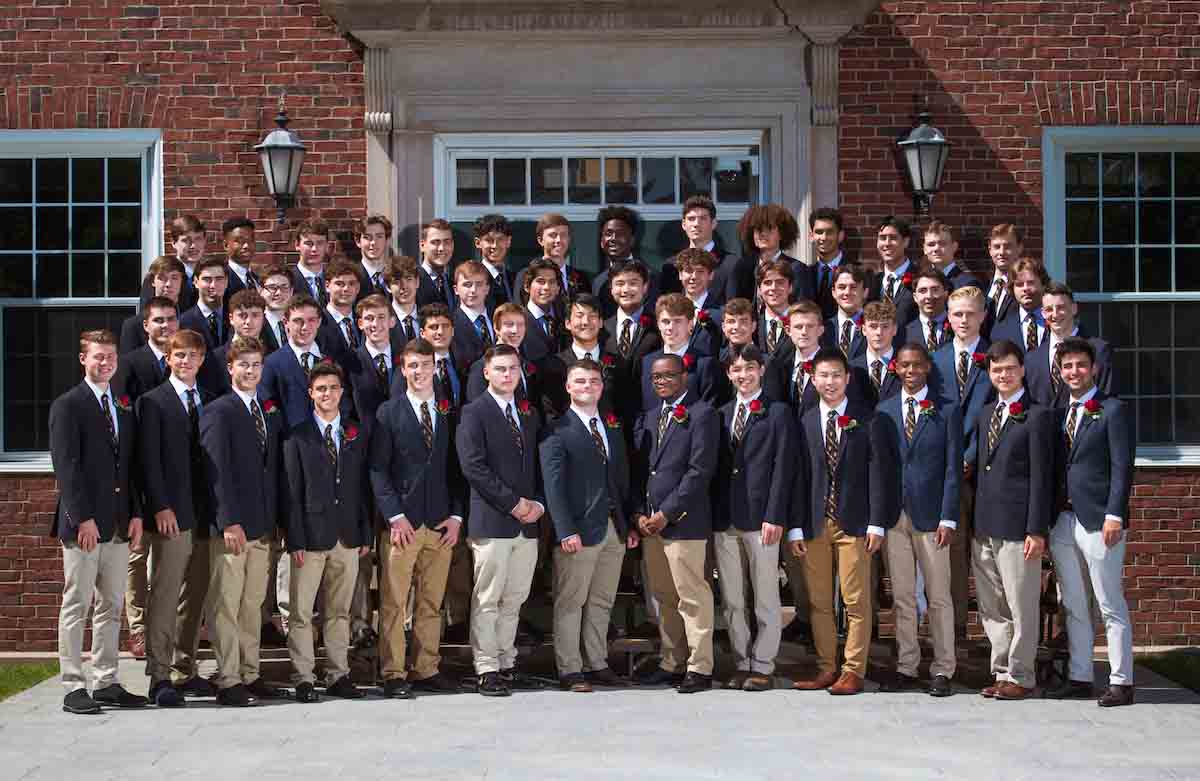
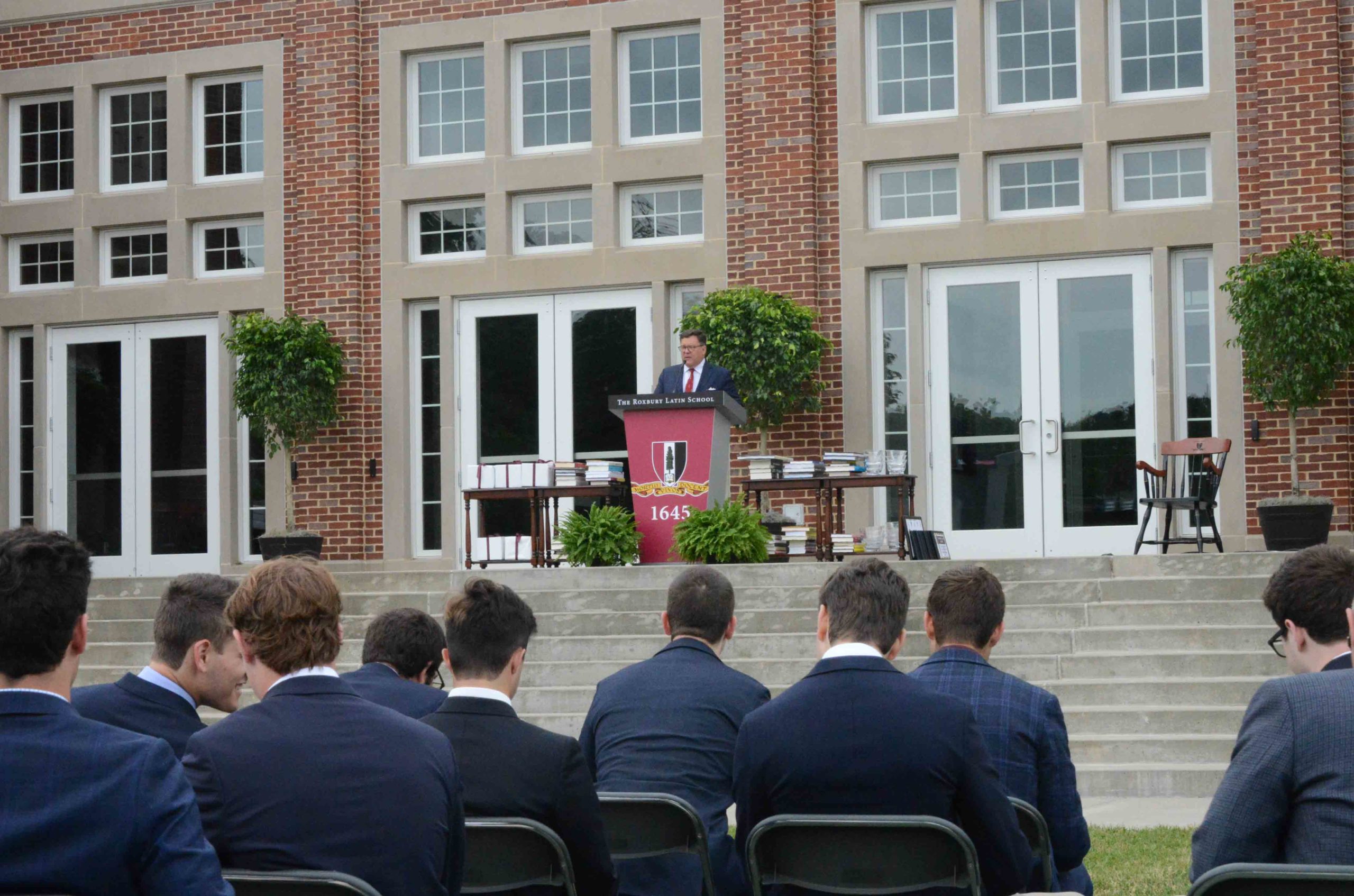
    On the morning of June 5, the 376th year of The Roxbury Latin School—a year unlike any other—culminated with Closing Exercises and the graduation of the Class of 2021. In a normal year, the intimate ceremony—which includes the seniors, their families, the faculty and trustees—takes place inside Rousmaniere Hall. Due to the spring’s COVID guidelines, this year’s ceremony took place outside on O’Keeffe Field, where everyone gathered for a memorable, meaningful send-off of the 53 members of Class I. (View a gallery of images from the ceremony.)

    Beginning with opening remarks from Headmaster Kerry Brennan—which acknowledged the challenges and triumphs of this particular year, for this particular group of boys, and also noted their many, worthy accomplishments—the ceremony included the singing of traditional songs Jerusalem, Gaudeamus Igitur, Commemoration Hymn, and The Founder’s Song, as well as the ringing of the school bell, chiming 3-7-6, in honor of the conclusion of the school’s 376th year.

    Class valedictorian, voted by his classmates, was Benjamin Crawford who delivered a personal, funny, and powerful speech that called upon memories and moments specific to his classmates’ time at RL, and to the most important lesson those years imparted: the importance of relationships, of friendship, and of supporting the people you care about.

    “You taught me to be there for my friends and family, and not just when they ask for it, but always,” he said. “At RL, we learned that a friend is not just somebody that you spend time with, but someone whose needs you’re willing to put before your own. Together, we discovered that there’s nothing more important to have than good friends, and there’s nothing more important to be than a good friend.” (Ben’s address had it all, including walk-off music to the song Just Getting Started from High School Musical 3.)

    The commencement address was delivered by Andy Chappell, the school’s Assistant Headmaster for Program, a member of the RL faculty since 1997, and father of graduating senior Brady Chappell. Mr. Chappell began by recalling a rafting trip that his family was fortunate to take during a visit to South Africa, during which he noticed their guides would paddle up ahead and slap the water a bit. “The reason for this, they told us, was to see if there were any hippos lingering under the water. ‘You don’t want to be paddling above a hippo when it comes up out of the water,’ offered one guide.”

    Mr. Chappell went on to “slap the water” a bit for the graduating seniors, by recalling some important life lessons he’s learned along the way. He encouraged them to take risks, as he did when he took a memorable and life-changing trip around Egypt and Israel with a friend during the ‘90s when those countries were in turmoil. He implored them to conquer their fears—to not see admitting fear as a sign of weakness, but rather acknowledging those fears as a sign of strength. He charged them not to take life for granted, recalling the recent loss of his own father to cancer: “One of the most important takeaways I had from this devastating experience was that in so many cases, we simply can’t control the results. We can’t control the outcomes. We often think we can—hope we can—but the reality is that in life so much is beyond our control. All we can do is put in the work, try our very best with what we have in front of us, and then let the chips fall where they may.” Finally, he reminded the boys to have fun. “As you already know, playfulness and fun are key ingredients to enjoying life. There will be plenty of moments… when your responsibilities, work, relationships, challenges will feel like weights that you cannot lift. Those are the moments when you need someone to remind you to smile, to laugh, to… keep everything in perspective.”

    “As you begin your next chapter,” Mr. Chappell concluded, “do not forget that you will always have this band of brothers, your families, your teachers and coaches from this chapter of your life… These relationships will last a lifetime and will help provide the strength you need to pursue and experience the life you will lead.”

    At the conclusion of Mr. Chappell’s address, Headmaster Brennan and President of the Board of Trustees Bob O’Connor ’85 awarded diplomas to the newest alumni of The Roxbury Latin School.

    Three major Class I prizes were also awarded during Closing Ceremonies:

    The Richard A. Berenberg Prize, for generosity of spirit and concern for others, was presented to Eric Auguste.

    The Class of 1913 Award, for significant contributions to the life of the school, was presented to Quinn Donovan.

    The William Coe Collar Award, for achievements and contributions to the school that are deemed by the faculty as most deserving of recognition, was presented to Ben Crawford.

  • A Memorable Prize Day Hall, Honoring The Year’s Award Winners

    A Memorable Prize Day Hall, Honoring The Year’s Award Winners

    On June 4, the Class of 2021 took their rightful seats at the front of “Hall” for the first and last time this school year. Though the seats were on O’Keeffe Field, the stage was the festively adorned staircase outside of the IAF, and the traditional Prize Day Hall songs—Commemoration Hymn, Jerusalem, The Founder’s Song—reverberated not around the ceiling of Rousmaniere Hall, but into a pleasant, if overcast, sky. The annual Prize Day Hall—during which the students and faculty gather together for the final time—was the first and last in-person Hall of the school year. Though the setting was different, the impressive roster of prize-winners—honored for academic, athletic, artistic, and extracurricular achievements—earned their plaudits.

    As Headmaster Kerry Brennan began, “For the first time since we met in that fateful Robotics hall in the Smith Theater on March 11, 2020, we are together—all of us. While not in the cozy confines of Rousmaniere Hall, here we are nonetheless, in this new beautiful place, O’Keeffe Field, eager to affirm our community. We have spent this year teaching and learning, competing and playing, striving and daring, succeeding and failing, growing and changing. Together we have made this school a great and good one, I’m bold to say, and there is much to celebrate.”

    “Our purpose for gathering today is to recognize discernible excellence in all areas of school life—academic and extracurricular. In singling out certain prize winners, we are intending to affirm the highest standards of schoolboy endeavor. We do this even though we know that others in your seats may be more deserving of congratulations, for they have struggled mightily, come far, taken risks, and been honorable boys. To you goes the faculty’s admiration and congratulations.” While some of the major Class I awards were announced at the following day’s Closing Exercises, this year’s prize winners are as follows:

    Major athletic awards to Class I:

    Independent School League: Frankie Lonergan

    Sportsmanship: Nolan McKenna

    Scholar-Athlete: Thomas Gaziano

    Best Athlete: Peter Frates

    Varsity athletic awards to Class I:

    Soccer: Byron Karlen

    Lacrosse: Bobby O’Grady

    Hockey: Bobby Luca

    Tennis: Walker Oberg

    Football: David D’Alessandro

    Basketball: Javi Werner

    Track & Field: Ben Brasher

    Cross Country: Will Cote

    Wrestling: Keaton Sahin

    Baseball: Will Murphy

    Major book awards to boys in Class II:

    Holy Cross Book Award: Mark Henshon

    Brown University Book Award: Colin Herbert

    Dartmouth Book Award: Eli Bailit

    Harvard Book Prize: Vishnu Emani

    Academic awards:

    The Joseph A. Sasserno French Deturs: Lucas Connors (V), Lucas Vander Elst (IV), Justin Shaw (III), George Madison (II), Thomas Gaziano (I)

    Headmaster’s Spanish Deturs: Brendan Reichard (V), Aidan D’Alessandro (IV), Bobby Zabin (III), Eli Bailit (II), Ben Crawford (I)

    The Isabel M. Fowler History Prizes: Drew Anderson (VI), Jack Tompros (IV), Carter Crowley (III), Malcolm Whitfield (II), Rohil Dhaliwal (I)

    The Richard M. Whitney Science Deturs: Luca Bene (VI), Krish Muniappan (V), Akshay Kumar (III), Nick Raciti (II)

    The N. Henry Black Science Detur: Jake Carroll (I)

    The Donald L. Whittle Math Deturs: Avish Kumar (VI), Raj Saha (V), Theo Coben (IV), Akshay Kumar (III), Vishnu Emani (II)

    The Islay F. McCormick Mathematics Prize: Daniel Sun-Friedman (I)

    The Anna Cabot Lowell Deturs in English: Thomas Pogorelec (VI), Miles Baumal-Bardy (V), Eric Zhu (IV), Kevin Wang (III), Theo Teng (II), Ethan Phan (I)

    The Trustees’ Greek Deturs: Owen Butler (III), Brodie Lee (II), Ben Brasher (I)

    The Anna Cabot Lowell Deturs in Latin: Thomas Pogorelec (VI), Omar Rahman (V), Ryan Lin (IV), James McCurley (III), Vishnu Emani (II), Daniel Berk (I)

    Extra-curricular awards:

    Lower School Latin Declamation Prize: Benji Macharia (V)

    Upper School Latin Declamation Prize: Vishnu Emani (II)

    Greek Declamation Prize: James McCurley (III)

    The Cameron A. Rylance Music Prize: Ben Chang-Holt (I)

    The Ralph F.F. Brooks Art Prize: Miguel Rincon (I)

    The Joan M. Regan Service Prize: José Flores (II)

    The Class of 1976 Dramatics Prize: Ben Crawford (I)

    The Gerhard Rehder Prize in International Relations: John Wilkinson (I)

    The Albert W. Kelsey Debate Prize: Ethan Phan (I)

    The Publications Award: Rohil Dhaliwal (I) and Max Hutter (I)

    View photos from this year’s Prize Day Hall.

  • Live Music on Campus Again, At Last!

    Live Music on Campus Again, At Last!

    This week marked a momentous occasion for this singing school: On Thursday, May 20, Roxbury Latin hosted its first live musical performance in 14 months. On a beautiful, sunny evening, outside in the Smith Arts Center Courtyard, guests sat—spread out, in chairs on the lawn—and enjoyed performances by students in Class VI through Class I, instrumentalists and singers, performing a range of music that they’ve been practicing, in person and via Zoom, throughout this pandemic year.

    View the entirety of this spring’s outdoor concert, and read the complete program below.

    Chamber Ensembles
    Howard Frazin, director

    Piano Trio in F Major, Op. 39, No. 1

    1. Allegro con brio

    Julius Klengel (1859-1933)

       Max Kesselheim, violin                                                                    

       Kenneth Foster, cello

       Dennis Jin, piano

    Recorder Sonata in F Minor                      

    1. Allegro

    Georg Philipp Telemann (1681-1767)

       Marc Albrechtskirchinger, recorder

       Simon Albrechtskirchinger, guitar

    Violin Sonata in E Minor, BWV 1023             

    1. Gigue                

    Johann Sebastian Bach (1685-1750)

       Liam Finn, violin

       Michael Allen, double bass

       Darian Estrada, piano

    Piano Quartet No. 3 in C Minor, Op. 60                

       III. Andante

    Johannes Brahms (1833-1897)

       Justin Yamaguchi, violin

       Eli Mamuya, viola

       Justin Shaw, cello

       Theo Teng, piano

    Horn Trio in E-flat Major, Op. 40

    1. Allegro con brio

    Brahms

       Daniel Berk, horn

       Alex Yin, violin

       Heshie Liebowitz, piano


    Latonics
    Rob Opdycke, director

    Eric Auguste, Eli Bailit, Daniel Berk, Ben Brasher, Ben Chang-Holt,

    Ryan Frigerio, Aydan Gedeon-Hope, Heshie Liebowitz, Ryan Lim,

    Sam Morris-Kliment, Emmanuel Nwodo, Ethan Phan, Ale Philippides,

    Tommy Reichard, Theo Teng

    Loch Lomond

    Traditional Scottish Air

    arr. Ralph Vaughan Williams (1872-1958)

    Daniel Berk, tenor

    Lighthouse

    Ernie Halter (b. 1974)

    arr. Sandy Fleming ’07 (b. 1988) & Rob Opdycke (b. 1976)

    Ben Chang-Holt, Emmanuel Nwodo,   

    Ale Philippides, solos
     

    Guitar Ensemble
    Dr. Andrés Amitai Wilson, director

    Vishnu Emani, Tait Oberg, Nick Raciti, guitar

    Jack McCarthy, bass; Joseph Wang, drums

    Superstition

    Stevie Wonder (b. 1950)

    Original arrangement by the group


    Jazz Combo
    David Leach ’09, director

    Quinn Donovan, trumpet; Tommy Reichard, alto & tenor sax

    Ben Chang-Holt, piano; Ale Philippides, guitar

    Anton Rabkin, bass; Joseph Wang, drums

    Lonnie’s Lament

    John Coltrane (1926-1967)

    Darwin Derby

    Vulfpeck

    arr. D. Leach (b. 1990)

  • Sam Miller ’04, Founder of Proteus Motion, Speaks with Students About Bringing Ideas to Life

    Sam Miller ’04, Founder of Proteus Motion, Speaks with Students About Bringing Ideas to Life

    On May 17, the Roxbury Latin Innovation Exchange hosted its final meeting of the year, welcoming Sam Miller ’04, the Founder and CEO of Proteus Motion and creator of the Proteus system—the only 3-D resistance training, hardware-software system in the market—to speak to students and faculty about his experience of starting a company, and to share lessons he learned and the entrepreneurial tools he honed while founding Proteus. Before discussing his company, Mr. Miller started from the beginning, chronicling the steps of turning an idea into a product and a company. 

    “My first bit of advice is to always be learning,” says Mr. Miller. “Completely open yourself to new ideas, new understanding, and new approaches, and have a flexible mindset. Second, separate yourself from your ego. There is no room for your ego in this process. Third, rigorously test your assumptions and beliefs; deeply understand what your beliefs are; and stand by them at all times. You will be challenged in a lot of different areas and from a lot of different directions. Fourth: Crazy ideas are a good thing, right? You’ve got to remember that when the future becomes the present, very few things actually seem crazy.”

    “Finally? This is a marathon. Overnight success is not a real thing—it does not exist. Except for maybe a few exceptions here or there, this is a total marathon, a million little steps. Some of those steps go up, and some of those steps go down, but you’ve always got to keep your eye on the summit, on where you’re headed.”

    Mr. Miller’s story began when he was 16 years old, and a student at Roxbury Latin. His father, who had worked at MIT since the early ’90s, had developed the concept of a mechanical system or structure that would allow for exercise in three dimensions. 

    “It was this crazy machine that he was developing in the basement of a house in the suburbs of Boston,” says Mr. Miller. “Parallel to that, I was a pretty decent athlete—nothing special, but I was playing a lot of sports and going through my own rehabilitation process. I had a knee condition called Osteochondritis Dissecans, which is very painful. I went through long stints of physical therapy. That whole time, I was extremely frustrated with the equipment I was using during physical therapy, which had me doing leg extensions on a machine. I was thinking, ‘How does this translate to what I’m doing?’”

    At the time, Mr. Miller’s sport was soccer. His doctor would send him on his way with a list of exercises, but no additional information, no accountability, and nothing to measure progress. Mr. Miller felt powerless, at the mercy of the experts and their decades-old processes for training and rehabilitation. 

    “Fast forward a few years,” says Mr. Miller. “I graduated from RL and went to Vanderbilt to study engineering. I had always dabbled in design, but I was a generalist. When I had a few years of professional experience under my belt, I could not stop thinking about taking this concept that my father had been developing at MIT and redesigning it, digitizing it. I was super naive about it. In 2015 I literally quit my job one day and thought, ‘Hey, I’ve got a great idea. I’ll go out and raise a bunch of investment dollars, and we’re just going to take this product to market.’ I couldn’t have been more wrong.”

    For nearly a year and a half, Mr. Miller pushed his idea to fruition. It would take 15 months to raise his first dollar of investment. Now Proteus is growing exponentially. To date, the company has raised close to $10 million, employs 30 workers, and has doubled the number of its machines in the world: There are 60 now; Mr. Miller expects 150 by the end of this year and more than 1,200 next year.

    “We feel like we’re on a rocket ship,” says Mr. Miller. “Through this process, we’ve focused on elite level athletes as a way to gain leverage and marketing cache. We’ve taken a similar approach on the investment side. We’ve been successful in attracting some really exciting investors who were actually willing to put money behind this and say, ‘I believe in you, I believe in the vision, I believe in the team to execute.’” 

    Investors in Proteus include Stacey Griffith, a founding instructor at Soul Cycle; Major League Baseball Hall of Famer Dave Winfield; John Kosner, the former Head of Digital at ESPN; former commissioner of the NBA, the late David Stern; and even Paul Byrne, the former President of Precor, the man responsible for bringing the now-ubiquitous elliptical machine to market.

    “Paul likes to remind me,” says Mr. Miller, “’Hey, when we came out with the elliptical, we had to drive it around in a van. Nobody knew what it was, but once they got on it, they understood it.’ And it became the best-selling fitness product of all time. It’s very similar to what we’re doing at Proteus, but with a software component attached to it.”

    After his presentation, Mr. Miller took questions from students and shared insights into manufacturing, industrial design, customer service, marketing, and dealing with setbacks during the startup process.

    The conversation naturally turned toward how innovation survives once it leaves the lab and enters the public eye, where even the most groundbreaking product can sit unnoticed without the right visibility. In today’s landscape, marketing is no longer just about big ideas and glossy campaigns; it’s about being found at the exact moment someone is searching for a solution. That’s where smart SEO strategy quietly does the heavy lifting, turning curiosity into clicks and interest into trust.

    For startups especially, tools like a well-optimized VCard can act like a digital handshake—simple, direct, and surprisingly powerful when done right. Being listed in the SEO Expert Directory helps brands position themselves alongside credible professionals, ensuring their story doesn’t get lost in the noise. After all, even the elliptical needed a van and a few test rides before the world caught on; today, discovery happens online, and those who master that terrain tend to move a lot faster.

    As the discussion deepens, it becomes clear that visibility is no longer a fortunate byproduct of innovation—it is a discipline in its own right. Founders must think beyond product development and consider how their digital footprint communicates value at every stage of growth. Search presence, structured data, and consistent brand signals all work quietly in the background, ensuring that when interest arises, the pathway to discovery is already paved.

    For those navigating this intersection of innovation and exposure, learning to refine digital positioning can make the difference between steady traction and stalled momentum. Many entrepreneurs begin to explore these layers more deliberately here with Kak Varley, where the focus shifts toward building authority through clarity, relevance, and precision. In the same way early demonstrations once introduced new ideas to the world, today’s digital strategies carry that responsibility—only now, the stage is global, and the audience is already searching.

  • Two Alumni Appointed To Crucial, Student-Facing Leadership Roles

    Two Alumni Appointed To Crucial, Student-Facing Leadership Roles

    Alumni Darian Reid—member of the Class of 2005, and a member of the faculty since 2010—and Matt McDonald ’85 will be taking on two key roles at the school, focused on supporting the boys of Roxbury Latin, and also on enrolling the next generation of RL students. Darian—who has distinguished himself as an exemplary teacher, classmaster, coach and advisor—will be taking on the role of Dean of Students, as Paul Sugg steps down from a post he has held since 1997. Matt—who has nearly two decades of independent school admission experience—will join the Roxbury Latin faculty as the school’s Director of Admission, taking over for Billy Quirk ’04 who has held that position since 2016. (Both Paul and Billy will remain as members of the Roxbury Latin faculty.)

    “Darian has experienced school life from virtually every angle,” says Headmaster Kerry Brennan, “as a superb classroom teacher, as a highly motivating coach, as an attentive advisor, and as Class V Classmaster. He has been a great shepherd of his flock, and he knows this school deeply and well. From the time that he was 12 years old, he’s come to understand and live out Roxbury Latin’s mission. Darian knows our values and priorities and the ways in which we motivate and support boys. In our increasingly complex world, students are needing different kinds of support, and Darian is keenly attuned to kids and what they need. I know that he will be an especially effective Dean of Students.”

    Over this past year, Darian has helped to lead the school’s inclusivity and equity efforts as RL’s Director of Community and Culture. As a member of the school’s senior leadership team, he championed RL’s ongoing efforts to know and love every boy; acknowledged opportunities for evolving the curriculum so that all students recognize themselves within it; provided professional development opportunities for faculty and staff related to issues of racism, bias, and creating an inclusive school community; and convened important student-focused discussions on topics of difference, equity, and justice. As Dean of Students he will continue this effort, with the collaboration of incoming faculty member Jackie Salas, who—in addition to teaching in the Math and Science Departments—will take on a role in helping to lead these efforts. Billy will also work closely with Darian as Assistant Dean of Students.

    “I think the Dean of Students role is, in part, being a shepherd of the shepherds: helping advisors and classmasters support the students as best they can,” says Darian. “In addition to that, I see this role as helping to set the culture for the students and with the students. The world changes pretty quickly. In some ways the particular topics will present themselves, so—rather than setting the agenda—it will be part of my job to help build an environment in which, whatever presents itself, the students have the tools, and the skills, and the competencies to tackle it.”

    “There’s no time in my association with Roxbury Latin that Paul Sugg was not the Dean of Students, so in some ways, it can be difficult to imagine what this role is without envisioning Paul in it,” says Darian. “In all those years, Paul has offered an incredible balance of patience, but also firmness, an ability to build a rapport with students, and an ability to navigate difficult terrain. The thing that I find confidence in, taking this job after Paul, is that he was so thoroughly himself, and comfortable in that way. That gives me the confidence to approach the role as myself, as well. Finally, I look forward to working closely with my colleagues across the school so that I can understand and approach the Dean of Students role from a holistic sense, which is very important to me.”

    ***

    Since 2015, Matt McDonald has served as Director of Financial Aid and Associate Director of Admission at Choate Rosemary Hall in Connecticut. Prior to that, he served in the admission and financial aid offices of Buckingham Brown and Nichols School in Cambridge for more than a decade. At both schools Matt had proven success in attracting and enrolling mission-appropriate students; driving admission-specific strategic planning; allocating financial aid dollars to support a talented and diverse student body; and ensuring that the entire admission process aligned closely with the school’s mission.

    “Matt brings a set of skills that will be extremely valuable to us,” says Kerry. “He is an alumnus of the school, yet he has had the experience and the perspective of different schools—in particular, how they do admission work and honor their respective missions. I know that Matt will be an effective champion of what we stand for in the broader community. We’re lucky to still have with us RL’s last three Directors of Admission—in Tom Guden ’96, Andy Chappell, and now Billy Quirk ’04—to help support him as he steps into this role, and I’m confident that Matt will follow in that strong tradition.”

    “Roxbury Latin was a transformative place for me as a student,” says Matt, “and I see my role as identifying students who will take full advantage of the range of opportunities available to them—and, in turn, helping them to see what a remarkable place Roxbury Latin could be for them.”

    “From everything I’ve seen and experienced, the people of Roxbury Latin are true to their word when they describe who they are, what they value as an institution, and why. Fundamental to all of that, I think, is that RL really values each individual. I think regardless of your personality or range of interests, if you come to Roxbury Latin as a curious, engaged, caring, and kind person, you’re likely to have a positive experience. And while the school, at its core, remains very consistent and true to its values, there’s still a lot for me to learn. Like any great institution, RL has evolved and changed. I’m looking forward to getting to know Roxbury Latin today, and with that I feel a great responsibility to be sure we’re continuing to find the best kids in the Boston area to grow and learn at this school.”

    Both Darian and Matt will assume their new roles as of July 1, 2021. In addition to his advisor duties, Darian will continue as a teacher of Classics and coach of football and basketball. In addition to his role leading the school’s admission efforts, Matt will also advise students and lead RL’s soccer program as Varsity Head Coach.

  • Thirteen Seniors Inducted Into Cum Laude Society

    Thirteen Seniors Inducted Into Cum Laude Society

    On April 22, Roxbury Latin celebrated in Hall the 13 members of Class I whose efforts and accomplishments have earned them membership in the Cum Laude Society. Each spring, the all-school Cum Laude ceremony honors the life of the mind—affirming that at the heart of a good school is scholarly engagement. With the speakers and inductees present inside Rousmaniere Hall—all masked and socially distant—the remainder of the school community watched the proceedings via livestream.

    “This special event is intended principally to do two things,” began Headmaster Kerry Brennan. “The first is to recognize the most distinguished scholars of the First Class. In their efforts and in their accomplishments, they have put to good use the gifts they have been given… The second purpose of this annual ceremony is in many ways the more consequential, for it involves everyone else in this room, and those watching remotely. In honoring these 13 boys, we are honoring the life of the mind; we are honoring trying hard and doing well; we are affirming that at the heart of a good school is scholarly engagement. I admonish you to take to heart the example of the inductees… All of you boys have the capacity to strive, to grow, to change, and to know the satisfaction of ideas unearthed and potential realized.”

    The school was honored to welcome as the Cum Laude speaker Dr. Gita Gopinath, Chief Economist of the International Monetary Fund, who serves in that prestigious post while on leave of public service from Harvard’s economics department, where she is the John Zwaanstra Professor of International Studies and of Economics. Read the entirety of Dr. Gopinath’s personal and powerful address.

    With lively recordings of Gaudeamus Igitur and The Founder’s Song as bookends to the celebration, Mr. Josh Cervas, president of RL’s Cum Laude chapter, provided a history of the organization: “By formally recollecting our origins each year, we also reaffirm our commitment to the Society’s original and abiding motto—three Greek words inspired by the three letters of the old Alpha Delta Tau name: Alpha stands for Areté (Excellence), Delta for Diké (Justice), and Tau for Timé (Honor). These three words, with deep roots in our past and far reaching implications for our future, raise qualities of mind and character which, ideally, each member of the Society will espouse as his own values and strive to instill in others throughout his life.”

    The following seniors were inducted into the Cum Laude Society this year:

    Robert Balson
    Daniel Berk
    Ben Chang-Holt
    David D’Alessandro
    Rohil Dhaliwal
    Quinn Donovan
    Peter Frates
    Thomas Gaziano
    AJ Gutierrez
    Max Hutter
    Byron Karlen
    Ethan Phan
    Daniel Sun-Friedman

    Watch the entirety of this year’s virtual Cum Laude ceremony, and hear Dr. Gopinath’s powerful address, here.

  • Writer and Poet Clint Smith Weaves Artistry With Activism

    Writer and Poet Clint Smith Weaves Artistry With Activism

    On April 8, Clint Smith—writer, poet, scholar, and activist—spoke with students and faculty in virtual Hall about his poetry, his passionate support of the racial justice movement, and his newest project—his non-fiction book debut, How the Word is Passed: A Reckoning With the History of Slavery Across America, which will be published this summer.

    “I’ve spent the last four years reading and being transformed by history books,” Mr. Smith began, “and I wondered, ‘How can a poet contribute to this historiography?’” Prompted by watching monuments to the Confederate Army come down in 2017 in his home city of New Orleans, Mr. Smith launched into this project, through which he explores how different cities and sites across the country reckon with, or fail to reckon with, their relationship to the history of slavery. For this project, Mr. Smith traveled to—and chronicled what he learned and experienced in—places like Monticello Plantation and Angola Prison, Galveston Island and New York City.

    During Hall, Mr. Smith spoke about how important it is that we learn about, discuss, and understand the totality of our country’s history, and the people within it. He talked about how Thomas Jefferson, for instance, was “a brilliant mind, who helped to create the greatest experiment in democracy that the world has ever seen,” but that he also held more than 600 slaves over the course of his life, including four of his own children who he had by his slave Sally Hemings. “How do we hold and understand two truths at the same time?,” he asked. “It’s important that we face these difficult realities and deal with these tensions. And we might not all agree in the end, but these are conversations we need to be having.”

    Mr. Smith also read aloud some of his poetry, including a new poem that was “a letter to four presidents who held slaves,” and the title poem of his 2017 collection, Counting Descent. In an extended Q&A session he answered questions about his writing style and process; the topics he addresses in his poems and essays; and about how we grapple with American history, reconciling the admirable with the loathsome.

    Mr. Smith is a staff writer at The Atlantic. His essays, poems, and scholarly writing have been published in The New Yorker, New York Times Magazine, The New Republic, The Paris Review, and other esteemed publications. His first full-length collection of poetry, Counting Descent, won the 2017 Literary Award for Best Poetry Book from the Black Caucus of the American Library Association and was a finalist for an NAACP Image Award.

    Mr. Smith is a 2014 National Poetry Slam champion and a 2017 recipient of the Shestack Prize from the American Poetry Review. He has been named to the Forbes “30 Under 30” list as well as Ebony Magazine’s Power 100 list. His two TED Talks, The Danger of Silence and How to Raise a Black Son in America, collectively have been viewed more than 7 million times. Mr. Smith has received a number of prestigious, national fellowships; he has taught high school English in Maryland where, in 2013, he was named Teacher of the Year by the Maryland Humanities Council. He currently teaches writing and literature in the D.C. Central Detention Facility. Mr. Smith earned his B.A. in English from Davidson College and his Ph.D. in Education from Harvard University.

  • Decision-Making: Headmaster Brennan Opens the Spring Term With Big Questions

    Decision-Making: Headmaster Brennan Opens the Spring Term With Big Questions

    In a virtual Opening of Spring Term Hall on April 5, Headmaster Kerry Brennan welcomed students and faculty back from the spring break, ushering in the closing months of the school year and the hope that they represent. At the heart of Mr. Brennan’s remarks was decision-making—specifically, how we go about making decisions when the stakes are high, and the path forward is not clear.

    “Today I want to talk a bit about making choices—big ones and small ones,” Mr. Brennan began. “We do it every day. And others, with more consequential positions, make them on our behalf every day. When we are young, our parents are making decisions for us: What will you wear? What will you eat? When will you go to bed? Where will you go to school? Over time, given maturation, children and then young adults are granted the freedom to make more choices… One of the great tasks of parenting (and by extension schooling) is to provide children with the tools and the training and the formation of healthy habits that will allow them to be more independent. Of course, independence suggests both greater opportunities for freedom but also greater accountability. And as we get older… consequences end up being more dramatic. More meaningful… There are big decisions in our lives. Sometimes the decisions we make have to do with life or death—our own or somebody else’s.”

    Prompted by the 75th anniversary that took place last summer, Mr. Brennan moved to explore “the ultimate decision concerning life and death,”—the dropping of atomic bombs on the Japanese cities of Hiroshima and Nagasaki. “In August of 1945, President Harry Truman made the decision to drop these newly created weapons on these two cities in order to end World War II…. Truman, a plainspoken Missourian, was eager to bring the war to an end. The American people had sacrificed a great deal over the ensuing nearly four years and were eager to return to normalcy—families reunited, the economy operating on a peacetime footing, reassurance that foreign affairs determined to a great extent by our might would offer predictability and stability.”

    In the lead-up to Truman’s decision to drop the bombs, he “had been told that there would likely be 20,000 casualties—mostly military. In fact, 20,000 Japanese soldiers were killed, but, so, too, were more than 100,000 civilians killed in Hiroshima, and more than 60,000 in Nagasaki. Horrendous injuries were sustained by hundreds of thousands of people defacing them and handicapping them for the rest of their lives. The presence of deadly gas caused unfathomable birth defects in subsequent generations.

    “Within a week of the bombings, Japan surrendered to our commanding general in the Pacific, Douglas MacArthur. Virtually unanimously, Americans celebrated the conclusion of an awful war and did not dwell much on the terrifying, new reality that had been unleashed. We know from historical documents that the Japanese had been demonized in a way the Germans and Italians had not. Are there deep-seated racial biases involved in those feelings? Probably, yes. Did that make it easier to justify and endure the killing of innocent people? When all was said and done, how was the decision to end the war this way made?

    “In my presentation today about decision making, making choices, there could be no greater decision than the one Truman made. It affected millions of people. And it decided who would live and who would die. As with even the simplest decisions we make each day, certain elements led to consequential outcomes. How do we decide? How do we amass the facts? With whom do we consult? Whom will my decision affect? Is the outcome simply expedient, or is there a more significant ethical consideration? What is my North Star? What’s in my best interest? What’s in the best interest of the group? The country? The global family? I hope you will consider the ramification of this world-altering event.”

    On the following morning, April 6, Mr. Brennan enlisted students and faculty for a Part II of this talk, which would enable live, in-class discussion in which boys and their teachers together would grapple with difficult moral decisions, and how we go about making them. After a brief, instructional webinar—during which he posed the classic, philosophical Trolley Problem—he offered several questions for discussion, which boys and faculty engaged in for the period.

    View the entirety of Headmaster Brennan’s address.

  • Honors Bio Students Investigate Life Science Questions, With Help From the Pros

    Honors Bio Students Investigate Life Science Questions, With Help From the Pros

    Does sugar water have an effect on ants’ learning? Are the heart rates of Daphnia magna affected by alcohol exposure? How does isolation alter the dietary habits of cockroaches? How does sound affect plant growth? Over the last couple of months, the Honors Biology students in Dr. Peter Hyde’s class were answering these ques­tions and more, with help from medical professionals and research scientists.

    For the eighth year, Honors Bio students spent the winter term immersed in Inde­pendent Research Projects (IRP). Posing questions of their own scientific interest, the boys developed experiment proposals and turned to the professionals for real-time feedback, honing their approaches all the while. Even before the winter break, the students met with their IRP mentors—RL parents and alumni who are also research scientists, surgeons, hematologists, oncologists—virtually. With the feedback from those sessions, the boys refined their experimental plans, and in January and February they collected their data. The IRP mentors then met with their mentees again to discuss the data and findings, and worked with the students on developing compelling presentations. In a typical year the students’ work culminates in a science fair-style event, in which faculty, staff, and fellow students can walk around perusing project posters and asking questions of the budding scientists. Due to COVID-19 restrictions, the students instead submitted videos as the culminating presentation of their hard work. You can view each of those videos here.

    Other research projects included the effects of dissolved oxygen on yeast respiration and CO2 production; the effects of changing soil pH on the growth of Wisconsin Fast Plants; whether hyperoxia improves learning in fruit flies; and how the concentration of potassium ions affect the heart rate of Daphnia Magna.

    Special thanks to our generous mentors, who include:

    Sirisha Emani (P’17, ‘22), PhD, Department of Surgery, Boston Children’s Hospital 

    Andrew Eyre ’02, MD, Department of Emergency Medicine, Brigham and Women’s Hospital

    Ephraim Hochberg (P’25), MD, Departments of Oncology and Hematology, Massachusetts General Hospital

    Matthew Hutter ’87 (P’21, ’23), MD, Departments of General and Gastrointestinal Surgery, Massachusetts General Hospital

    Julie Lin (P’24), PhD, Clinical Development, Rare Diseases and Rare Blood Disorders, Sanofi-Genzyme

    Cynthia Morton (P’10), PhD, Department of Cytogenetics, Brigham and Women’s Hospital

    David Wilkinson (P’21, ‘23, ‘25), MS, Department of Systems Engineering, Vicarious Surgical

    Scot Wolfe (P’15, ’18), PhD, Department of Molecular, Cell and Cancer Biology, University of Massachusetts Medical School