
Drew Martin ’98 of Thrive Scholars is This Year’s Wyner Lecturer
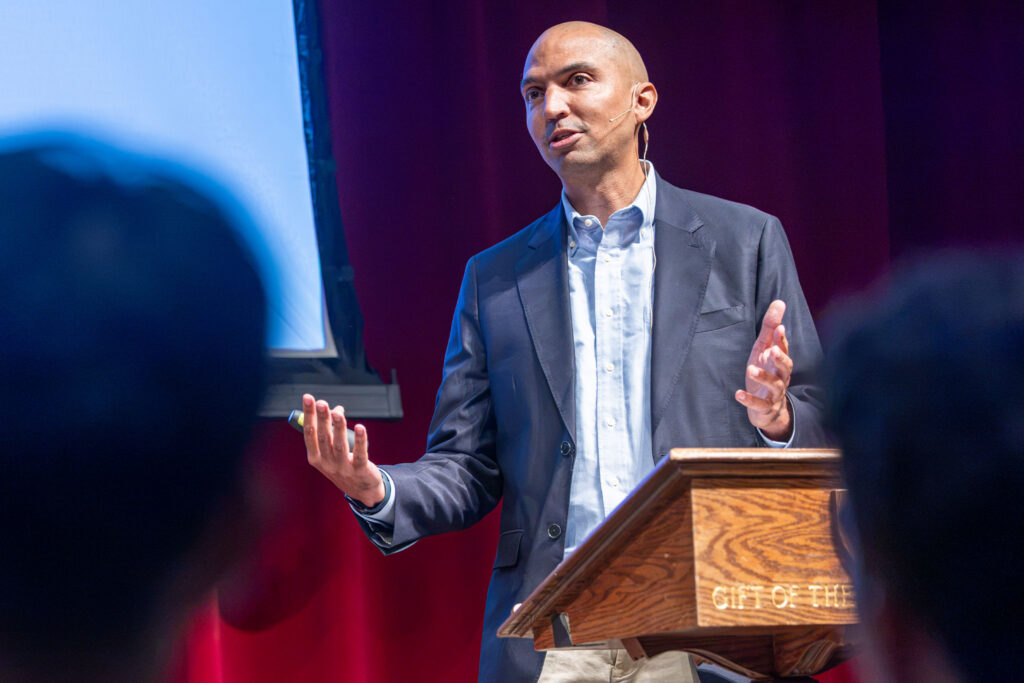
“I did not come particularly close to realizing all of my potential,” Drew Martin ’98 told students, recalling his own days at Roxbury Latin, as he delivered this year’s Wyner Lecture on September 10. Mr. Martin, an RL trustee and CEO of Thrive Scholars—an organization that provides academic preparation, mentorship, and career counseling to first-generation, college-bound students from underserved communities—returned to alma mater to share two decades of lessons learned in the fight against educational inequality.
After graduating from RL, Mr. Martin earned a business degree from the University of Virginia. “By the age of 35,” he said, “I intended to have $100 million in assets. I did not lack ambition… So when I graduated in 2002, I chose what I regarded as a creative backdoor to Harvard Business School, a program called Teach for America.”
He was assigned to a fifth-grade classroom in the Bronx: 32 students, 27 desks, no curriculum, and three students repeating the grade for a third time. “The system took children with years of accumulated need and handed them to adults with weeks of accumulated training,” said Mr. Martin, “as though intelligence, enthusiasm, and good intentions could substitute for experience, preparation, and a functioning institution.” That experience, he said, forced him to confront a story he had told himself about his own success.
“Roxbury Latin is proof that our country knows how to develop academic talent,” said Mr. Martin. “You are not admitted here and left alone to see what happens. Teachers know you, advisors intervene, coaches push you, classmates challenge you. College counselors understand the path ahead. Alumni open doors. Adults imagine futures for you before you can fully imagine them for yourselves. And the better this place works, the easier it is for you to believe that you’re doing it by yourself.”
He described watching his young daughter insist on doing everything “by myself,” unaware of all the people who had made her small accomplishments possible—and recognized the same blind spot in how he understood his own path through RL, UVA, and beyond. “I had mistaken knowing that inequality existed for understanding,” he said.
Mr. Martin went on to become executive director of KIPP New Jersey by age 25, and later opened Rise Academy, a school he built inside a former Catholic school building in Newark.
“When I was preparing to open Rise Academy,” Mr. Martin said, “Tony Jarvis sent me a handwritten note: ‘Dear Andrew, I’m so proud of you for what you are doing. This is a project that may succeed mightily or fail, but you will never regret putting your life behind it, and you will never know how many lives you touch. Such a project is worth a life.’”
Mr. Martin and his colleagues would go on to invest roughly $200 million building and renovating school facilities across Newark and Camden, working not only on academics but on healthcare, early childhood education, and community safety—all in service of a broader insight: that talented young people from wealthy backgrounds are surrounded by an entire ecosystem of coaches, mentors, and second chances, while equally talented peers from under-resourced communities are often expected to navigate everything alone. “Talent is distributed randomly across the population,” he said, “but opportunity isn’t.”
That belief, he explained, drove him to Thrive Scholars, where his focus shifted from building individual schools to building networks of relationships and opportunities that allow talent to become choice.
“The goal is not to diminish what you accomplish,” Mr. Martin said in closing. “Your effort matters. Your choices matter. Your results matter. The goal is to see the full picture clearly enough that eventually you become part of that hidden machinery for somebody else. You build the school, you make the introduction, you fund the idea, you notice the talent, you give the second chance, you stand close enough to catch somebody when they fall. And you won’t do this by yourself and neither will the person whose life you help to change. You may not know whether the project will succeed mightily or fail. You may never know every life you touch, but such a project is worth a life.”
Mr. Martin continues a tradition of esteemed Wyner Lecturers committed to societal change for good in various facets of life, and who have shed light on important social issues for Roxbury Latin’s boys. Past speakers in the lecture series include Dr. Iqbal Dhaliwal of MIT’s Jameel Poverty Action Lab; alumnus Bo Menkiti, who transforms underserved communities through real estate development; Juan Enriquez, whose fascinating foray into imagining the future through an ethical lens was insightful and memorable; John Gabrieli ’12, founder of and co-chair of the Every Voice Coalition—a grassroots movement to combat sexual violence on college campuses and support survivors; award-winning landscape and environmental architect Kate Orff; Dr. Joia Mukherjee, Chief Medical Officer of Partners in Health; Dr. Yet-Ming Chiang, Professor of Materials Science and Engineering at MIT; and Dr. Adil Najam, president of the World Wildlife Fund International. The lecture series, established in 1985 by Jerry Wyner ’43—RL’s oldest living alumnus at 101—and his sister Elizabeth Wyner Mark, is a living memorial to their father, Rudolph Wyner, Class of 1912.